
There will be an intensive fruit crop nutrition short course in Connecticut March 17-18 that may be of interest to many. Please see the attached flyer for details.
UCONN Fruit Crop Nutrition Short Course
Grapevine pruning information and videos at Michigan State Extension
MSUE recently posted some very helpful pruning videos for vineyards on their website, which also includes a lot of other great management information. This cold day is a good one to stay inside and catch a lesson that you can apply in the vineyard once things warm up.
http://grapes.msu.edu/viticulture
New England Grape Production Survey
New England Grape Growers:
The USDA National Agricultural Statistics Service will be completing its first annual survey of grape production in New England. This data is critical for developing a clear understanding of the scope and scale of grape production in the region. Results are used by many service provider and industry organizations to develop support for the industry, and your support is much needed. All information is confidential and critically important to collect.
To date, decisions on support for technical personnel, marketing, and grant programs is based on best guesses for the size of the industry, and this effort will ensure that such data is collected on a consistent basis. No matter of the size of your vineyard, please help us to develop this information by participating.
Thank you,
Terry
grape survey letter.docx
2015 Jan grape press release.docx
GRAPEPROCESSING Q 2014.doc
Grape Prod Disp Q 2014.doc
2015 Catamount Farm Summer Courses
The University of Vermont will offer a suite of complementary farm-based summer courses in summer 2015 designed to provide students with applied skills in an educational setting. Course registration begins February 11.
Catamount Farm Summer Experience
http://www.uvm.edu/~summer/catamount-farm/
Learn to Farm and Earn College Credit at the University of Vermont
Dig deep with your education this summer and immerse yourself in the vibrant learning environment of Catamount Education Farm at the University of Vermont. Use your hands and head in these farm-based courses that are simultaneously experiential, innovative and rigorous. Start with the Sustainable Farm Practicum and add up to three more classes for a summer of learning that could earn you a semester’s worth of credit.
Catamount Farm Summer Experience
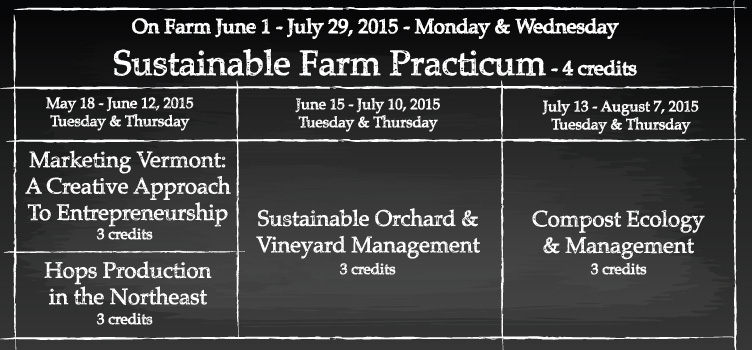
PSS 209 Sustainable Farm Practicum
Instructors: Susie Walsh Daloz and Terry Bradshaw
Dates: May 18-August 5, 2015 (On-line coursework is from May 18-27 and August 3 – 5; On-farm practicum is MW from June 1-July 29)
Time: 9:30am-3pm (MW)
Location: The Catamount Educational Farm at the UVM Horticultural Research Center
Course Description: In this hands-on, experiential course, students will learn principles and practices of sustainable, diversified vegetable production at the Catamount Educational Farm (part of the UVM Horticultural Research Center). Topics to be covered over this twelve-week course include: vegetable crop families, soil management, composting, organic weed, pest and disease control, propagation and planting, crop planning, irrigation and marketing techniques.

The class format will consist of a combination of lectures, hands-on fieldwork, and visits to local vegetable farms. Concepts and skills taught will immediately be applied through participation in Catamount Educational Farm’s five acre vegetable operation that supplies produce to the community through a CSA, a farm stand and multiple wholesale accounts. Students will also have the opportunity to work with participants in the UVM Farmer Training Program. The Sustainable Farm Practicum is open to UVM undergraduates as well as to students from other colleges and universities who are interested in an on-farm for-credit training experience. This course also fulfills credits for the UVM Food Systems minor.
“Awesome summer course, hands on experience is unparalleled especially in agriculture, learned a lot of valuable information.” – 2014 Sustainable Farm Practicum student
PSS 196 Hops Production in the Northeast

Instructor: Lily Calderwood
Dates: TR, May 18 – June 12, 2015
Time: 9:00am-3:00pm
Location: The Catamount Educational Farm at the UVM Horticultural Research Center
Course Description: This course will cover the nuts and bolts of sustainable hop production. The goal of the course is to give participants all the knowledge they need to start a hop yard of their own. Topics will include agronomic and infrastructure challenges, our mistakes, and current practices. Field prep, planting, stringing, training, pest management, harvest, and storage will be covered in addition to the topics listed below. We will take field visits to three hop yards in Vermont.
CDAE 195 Marketing Vermont: A Creative Approach to Entrepreneurship

Instructor: Kate Finley Woodruff
Dates: TR, May 18 – June 12, 2015
Time: 9:00am-3:00pm
Location: TBD
Course Description: This course will address various aspects related to marketing products, services, and experiences that are branded “Vermont”. The course will incorporate policy issues as it relates to marketing Vermont (such as GMO, raw milk, Made in Vermont, regulation and enforcement), determine WHO is doing the marketing (including for-profit entrepreneurs, state agencies, regional organizations, even UVM!), discuss WHY we use the Vermont name (what value it might have to consumers, and various consumers from visitors to vegetarians), WHERE the Vermont name is used (packaging to trucking to billboards, etc.)and the WHO and HOW of marketing Vermont products (including the opportunity to visit food manufacturers, artists, wood product producers, etc.). This course provides a comprehensive look at Vermont as a brand, and what value the name represents for farmers, value-added producers, the tourism industry, consumers, and more.
PSS 195 Sustainable Orchard and Vineyard Management
Instructor: Terry Bradshaw
Dates: TR, June 15 – July 10, 2015
Time: 9:00am-3:00pm
Location: The Catamount Educational Farm at the UVM Horticultural Research Center
Course Description: Students will learn principles and practices of commercial orchard and vineyard crop production, including: site selection and preparation; cold hardiness development; varietal selection; tree and vine training and trellising systems; nutrient, water and pest management; harvest and postharvest considerations. Special emphasis will be placed on environmental and economic sustainability of fruit production systems.
“Super knowledgeable, and super on top of his game. Terry’s class is one of a kind and an invaluable resource for anybody interested in apples or grapes! It really is an incredible class and the real world application is off the charts.” – 2014 Sustainable Orchard & Vineyard Management student
PSS 154 Compost Ecology & Management
Instructor: Lynn Fang
Dates: TR, July 13 – August 7, 2015
Time: 9:00am-3:00pm
Location: The Catamount Educational Farm at the UVM Horticultural Research Center
Course Description: This course explores ecological, physical and chemical principles behind composting, the practical management of the composting process, and benefits of using compost in plant and soil ecosystems. Prerequisite: Three credits in basic biological or ecological science or Instructor permission.
February 10th Northern Grapes Webinar Registration is Open
The Northern Grapes Project Webinar Series
“Comparing and Contrasting Vertical Shoot Positioning and Top Wire Cordon Training Systems”
Tuesday, February 10th, 2015
12:00 Noon Eastern (11:00 am Central)
7:00 pm Eastern (6:00 pm Central)
Join Bob Utter of Flying Otter Vineyard and Winery, John Thull of the University of Minnesota, and Tim Martinson of Cornell University as they discuss the pros and cons of Vertical Shoot Positioning (VSP) and Top Wire Cordon (TWC) training systems. Bob will discuss TWC, including the advantages (including reduced labor, frost protection, and varmint predation), disadvantages, and how to convert from VSP to TWC. John will cover how the narrow canopies created on VSP trellises allow for great sunlight interception and lower disease pressure, and the control that VSP gives the grower in the way of canopy management and what mechanized practices can be implemented. Tim will talk about the training system trials in New York on Marquette and Frontenac, and the differences observed between them, including yield and fruit composition.
If you have received this email from someone other than Chrislyn Particka, you need to register via the link below:
https://cornell.qualtrics.com/jfe/form/SV_dm33v6vhzkhrNY1
Registering for one Northern Grapes Webinar will place you on the mailing list, and you will receive announcements and connection instruction for all further Northern Grapes Webinars.
Registration will close at 8 am (Eastern) on Friday, February 6th.
Registration is NOT required if you received this email directly from Chrislyn Particka, as it means that you are a member of the Northern Grapes Webinar mailing list.
All members of the Northern Grapes Webinar mailing list will receive an email the Monday before the webinar containing the web address (URL) for both webinar sessions as well as connection instructions.
Feel free to email Chrislyn Particka (cap297@cornell.edu) with any questions, if you want to check your registration status, or if you’d like to be removed from the Northern Grapes Webinar mailing list.
Further Northern Grapes Project information is available on-line at
http://northerngrapesproject.org/
The Northern Grapes Project is funded by the USDA’s Specialty Crops Research Initiative Program of the National Institute for Food and Agriculture, Project #2011-51181-30850 and through the New York State Specialty Crops Block Program.
Reminder: registration for February 12 Grower Meeting
Less than four weeks away:
Please see the attached agenda and registration form for the 119th Annual Vermont Tree Fruit Growers Association & UVM Apple Program Annual Meeting. This year, the meeting will be hosted by Citizen Cider at their new facility at 316 Pine Street in Burlington, VT. Agenda highlights include:
- Discussions on thinning and plant growth regulator use in orchards by Dr. Duane Greene, University of Massachusetts
- Managing fire blight and apple scab in modern orchards with Dr. Kerik Cox, Cornell University
- A panel discussion on labor issues in Vermont orchards
- Cider and cheese pairing suggestions by food consultant and sensory scientist Dr. Montserrat Almena-Aliste
- An optional post-meeting tour of Citizen Cider’s production facilities
Reduced-rate early registration deadline is February 1, 2015. The meeting is open to anyone, but VTFGA members receive a $10 discount on registration, as well as other benefits. Annual membership renewal, base operations, and research support dues may be made when signing up for registration.
Online registration, including credit card payment, is available here:
https://www.eventbrite.com/e/119th-annual-vermont-tree-fruit-growers-association-uvm-apple-program-annual-meeting-tickets-14960511292
For mail in registrations, print the attached form and mail with payment by check to the address listed (also available at: http://www.uvm.edu/~fruit/treefruit/meetings/VTFGA2015MembershipAndRegistrationForm.pdf).
Please feel free to contact me with any questions.
Terry
VTFGA2015MembershipAndRegistrationForm.pdf
BrochureVTFGA119th2015.pdf
January 2015 Northern Grapes Project News You Can Use: Winery Customer Satisfaction
PDF version available at:
http://northerngrapesproject.org/wp-content/uploads/2015/01/January-2014-News-You-Can-Use-Customer-Satisfaction.pdf

News You Can Use
Winery Customer Satisfaction

Customers enjoy wine tasting at Tassel Ridge Winery in Leighton, IA. Tassel Ridge was a cooperator in the tasting room customer satisfaction survey.
Customer satisfaction is especially important for the cold climate wineries; as an emerging industry, it relies on visitors (regional customers and tourists) for an important share of total sales. By ensuring that customers have a satisfactory experience, the winery can create customer loyalty and positive press as clients recommend the establishment to their friends, colleagues and family. In the winery business, customer satisfaction is primarily determined by the tasting room experience, as tasting room visitors are not solely interested in the wine.
The study, led by Miguel Gomez at Cornell University, was conducted in six wineries in New York and Iowa, which collected surveys from tasting room customers from June through November 2012.
The purpose of this study was twofold:
1) Determine which factors drive customer satisfaction among local wineries in the emerging wine regions of New York and Iowa.
2) Identify the linkages between customer satisfaction and sales performance within these wineries.
The team found that a focus on customer service was the most effective strategy to increase customer satisfaction scores, and that “highly satisfied” visitors purchased an additional bottle of wine and spent $10 more per visit, compared to “satisfied” visitors.
Links:
The Tasting Room Experience and Winery Customer Satisfaction:
April 9, 2013 webinar by Gregg McConnell and Miguel Gomez. Miguel’s portion of the webinar, “Customer Satisfaction Drives Tasting Room Sales,” starts right around the 30 minute mark. Gregg’s portion of the webinar, “Towards Startup Winery Profitability: When do I start Making Money?” also has a lot of great information, although it is not directly related to customer satisfaction.
The Northern Grapes Project is funded by the USDA’s Specialty Crops Research Initiative Program of the National Institute for Food and Agriculture, Project #2011-51181-30850
Chrislyn A. Particka, PhD
Extension Support Specialist
Cornell University
Department of Horticultural Sciences
630 W. North Street
Geneva, NY 14456
cap297
315-787-2449 (desk)
315-787-2216 (fax)
Trunk disease problems on ‘Crimson Topaz’
Dr. Dave Rosenberger recently posted on his tree fruit pathology about observations of trunk cankers on ‘Crimson Topaz’ trees. You can view his comments at: http://blogs.cornell.edu/plantpathhvl/2015/01/05/trunk-disease-problems-on-crimson-topaz/.
TB
January 13th Northern Grapes Project Webinar Registration
The Northern Grapes Project Webinar Series
“Emerging Cold Hardy Wine Grape Cultivars”

Mark Hart Tom Plocher
Tuesday, January 13th, 2015
12:00 Noon Eastern (11:00 am Central)
7:00 pm Eastern (6:00 pm Central)
Tom Plocher and Mark Hart, both veteran private breeders of cold-hardy grapes, are teaming up to bring you this webinar on grape varieties to consider in cold climate regions. Recently named varieties from the University of Minnesota have had a huge impact on the viability of commercial viticulture for northern grapes, but there alternatives form Elmer Swenson and other private breeders that can broaden the spectrum of wine types and growing regions for this industry. Tom and Mark will present a little background on the process used by grape breeders, followed by a review of the viticultural practices and enological potential of a number of new and lesser known grape varieties.
If you have received this email from someone other than Chrislyn Particka, you need to register via the link below:
https://jfe.qualtrics.com/form/SV_6s1Gf5EVfhR7QC9
Registering for one Northern Grapes Webinar will place you on the mailing list, and you will receive announcements and connection instruction for all further Northern Grapes Webinars.
Registration will close at 8 am (Eastern) on Friday, January 9th.
Registration is NOT required if you received this email directly from Chrislyn Particka, as it means that you are a member of the Northern Grapes Webinar mailing list.
All members of the Northern Grapes Webinar mailing list will receive an email the Monday before the webinar containing the web address (URL) for both webinar sessions as well as connection instructions.
Feel free to email Chrislyn Particka (cap297) with any questions, if you want to check your registration status, or if you’d like to be removed from the Northern Grapes Webinar mailing list.
Further Northern Grapes Project information is available on-line at
The Northern Grapes Project is funded by the USDA’s Specialty Crops Research Initiative Program of the National Institute for Food and Agriculture, Project #2011-51181-30850 and through the New York State Specialty Crops Block Program.
Feb 12: VT Tree Fruit Grower/UVM Apple Program Annual Meeting
Please see the attached agenda and registration form for the 119th Annual Vermont Tree Fruit Growers Association & UVM Apple Program Annual Meeting to be held on February 12, 2015. This year, the meeting will be hosted by Citizen Cider at their new facility at 316 Pine Street in Burlington, VT. Agenda highlights include:
- Discussions on thinning and plant growth regulator use in orchards by Dr. Duane Greene, University of Massachusetts
- Managing fire blight and apple scab in modern orchards with Dr. Kerik Cox, Cornell University
- A panel discussion on labor issues in Vermont orchards
- Cider and cheese pairing suggestions by food consultant and sensory scientist Dr. Montserrat Almena-Aliste
- An optional post-meeting tour of Citizen Cider’s production facilities
Reduced-rate early registration deadline is February 1, 2015. The meeting is open to anyone, but VTFGA members receive a $10 discount on registration, as well as other benefits. Annual membership renewal, base operations, and research support dues may be made when signing up for registration.
Online registration, including credit card payment, is available here:
https://www.eventbrite.com/e/119th-annual-vermont-tree-fruit-growers-association-uvm-apple-program-annual-meeting-tickets-14960511292
For mail in registrations, print the attached form and mail with payment by check to the address listed (also available at: http://www.uvm.edu/~fruit/treefruit/meetings/VTFGA2015MembershipAndRegistrationForm.pdf).
Please feel free to contact me with any questions.
Terry
VTFGA2015MembershipAndRegistrationForm.pdf
BrochureVTFGA119th2015.pdf