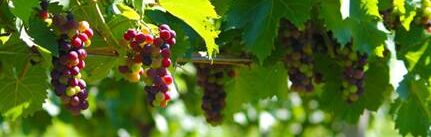
Immediate prebloom in grapes

Grape bloom is looming in many Vermont vineyards, and this is a critical time for disease and vine management. As we mention in our initial IPM strategy for winegrapes, all of the major diseases save for late-season fruit rots are sensitive to management right now. That means that fungicide applications should be made, using a material or materials with broad range of coverage against powdery mildew (PM), downy mildew (DM), black rot (BR), anthracnose (Ant), and that last bit of phomopsis (Ph) for the season. Generally, this means a combination of materials, including a protectant (mancozeb, most effective against Ph, BR, PM, or captan (Ph, DM)) plus a systemic or more narrow-spectrum material. Those may include Vivando / Quintec (PM only); a DMI material like myclobutanil or tebuconazole ((BR, PM); or a strobilurin (BR, PM, also excellent against botrytis so save until later in the season in July if you have issues with that disease). I’ll mention other materials with excellent efficacy against DM and botrytis later when those diseases are of greater relative concern.

For organic growers, be sure to maintain your copper and/or sulfur sprays, watch for phytotoxicity, and remove diseased leaves and clusters as soon as you see them. The good thing is that it has been relatively dry this season, so disease pressure should be manageable. That said, in this vulnerable period, spray coverage should be applied prior to expected wetting events.

Insect activity is usually pretty quiet at this time of the season. Keep an eye out for bloom on wild grapes, as that sets the clock for the degree day model used to time management of grape berry moth (GBM). We typically add BT (Dipel, Javelin, etc.) or another material specifically active against lepidopteran pests soon after bloom at the earliest, so there’s time before we consider managing for this pest. GBM isn’t always a problem in every Vermont vineyard, we’ll talk about scouting for that pest in an upcoming bulletin. While we’re on the subject of insects, I haven’t seen much / any grape tumid gallmaker (GTGM) at the Hort Farm vineyard this year, but it has been a somewhat unlikely yet injurious pest in local vineyards in the past couple of years. I do not want to get into recommending treatment for minor pests of likely little economic importance, but if yours is one of the handful of vineyards which as suffered from extensive damage in recent years, consider using Movento or Assail if you see the first stages of galling by overwintering midges as they are hatching out now. There are only a very few vineyards where I’m even suggesting treatment for this- if you don’t remember this pest and its’ damage, then don’t worry about it on your farm. For more information on GTGM check the link above or my previous bit on them here.

Horticulture: There are two good times to collect petiole samples to assess vine nutrient status, bloom and veraison. Generally, you should stick with whichever timing you have been using so that you may compare to past tests. Dr. Joe Fiola at University of Maryland has a good fact sheet on petiole sampling. We recommend the Cornell Nutrient Analysis Laboratory for petiole sampling, as they have extensive experience in providing nutrient recommendations for grapes. Should nutrient applications be needed, this is a good time to apply boron, magnesium, and nitrogen as they are needed during this period of rapid shoot and fruit growth.

Other activities that I don’t need to tell you about: shoot thinning can continue, but shoots aren’t lignified at the base enough to comb them, they’ll just break off. Keep the vineyard mowed to improve airflow, but a golf course mowing regime isn’t necessary unless that’s your aesthetic choice. Keep the in-row weeds down however you can, but most herbicides should be put away for now because of likelihood of vine damage.

Terence Bradshaw
University of Vermont
Sent via Mobile

VT Apple IPM: Thinning time

Apple scab ascospore maturity models for essentially every weather station in the state indicates that we are at the end of the primary scab infection season. That means spores that could cause apple scab have matured and either has or likely will release after the next good wetting event. However, growers should maintain protective fungicide coverage on all trees for the next 1 to 2 weeks and should inspect their orchard carefully to ensure that infections have not occurred before backing off from coverage for the season. This is a good time to use group 7 or 11 fungicides to also provide protection against powdery mildew and apple rusts.

The warm weather we are expecting this week could cause fire blight infections in susceptible varieties with lingering blossoms such as newly planted trees. Consider protection if your orchard is in that situation. This is also a good time to maintain a program of 3-4 sprays of prohexdione-calcium (e.g., Kudos, Apogee) at 6 oz per acre or 2-3 oz per acre with Actigard at 2 oz per acre to stiffen up cell walls in developing shoots to reduce shoot blight susceptibility.

Plum curculio is active in orchards. If full block insecticide coverage was applied at petal fall, only border row sprays may be warranted until you have reached 308 degree days base 50F after petal fall, after which the insect is no longer actively laying eggs and causing fruit damage.

Codling moth are slow to take flight around the region. Growers should check pheromone baited traps daily and set the biofix for the management model as the first date of trap capture. The NEWA model will calculate accumulated degree days (base 50F) after sustained flight to predict egg hatch, most insecticides should be applied 100-200 DD later to be most effective. We don’t expect that to occur until next week, anyway.

The big management activity for this week should focus on thinning applications. The warm weather we are expecting today through Friday coupled with low wind conditions mean that thinners will be particularly active this week. In most orchards that I have seen in the state that were not affected by the April 20 freeze, I am recommending an aggressive thinning strategy this year to prevent a large crop of small fruit and subsequent biennual conditions next year and the years following. The weather conditions in the next few days are especially conducive to using the 6-BA thinning materials, which are especially useful on small fruited cultivars such as Empire, Macoun, and Gala. Larger fruited cultivars may benefit from NAA applications. Either of those would be enhanced with the inclusion of 1 pint of carbaryl per 100 gallons. This is the most important window for you to manage this year’s crop, so take advantage of it.

Terence Bradshaw (he/him)

Associate Professor, Specialty Crops

Chair, Dept of Agriculture, Landscape, and Environment
(formerly Plant and Soil Science)
College of Agriculture and Life Sciences

University of Vermont
117/210 – Jeffords Hall | 63 Carrigan Dr
Burlington, VT 05405

(802) 922-2591 | tbradsha
https://go.uvm.edu/alebradshaw

UVM Commercial Horticulture | UVM Fruit Blog
Horticulture Research and Education Center
Message me on Teams

UVM’s Our Common Ground Values:
Respect | Integrity | Innovation | Openness | Justice | Responsibility

UVM is subject to the Vermont Public Records Act and communications to and from this email address, including attachments, are subject to disclosure unless exempted under the Act or otherwise applicable law.

VT Apple IPM: Bloom-late bloom – petal fall considerations

Given the long stretches of cool-to-cold weather, bloom has been stretched out all over the place in Vermont orchards. In warmer sites, apples are at petal fall, yet many trees in most sites are holding on to significant blossoms. Don’t jump the gun on applying insecticides to your orchards, wait until petals are gone and plan to mow flowering groundcover ahead of applications to discourage wild pollinator activity before managing insect pests. We are still seeing low captures of European apple sawfly in monitored orchards, and while we can expect that plum curculio moved into trees with the warm weather earlier this week, they aren’t really active in ovipositing on fruit until they reach about 6 mm / 1/4” diameter. We are seeing first catches of codling moth in some traps which sets the biofix date for their management. Codling moth have a distinct reddish-brown band on their wing tips, this fact sheet from Cornell IPM program portrays it well. They are also mostly gray in color and have a roughly triangular body. We are seeing some codling moths in other traps, including oblique banded leafroller traps for some reason this year. OBLR are quite different in appearance, with a somewhat peach-tan color and an arrowhead-shaped body.

The main management concerns right now are continued disease management at crop load management. With rains coming tomorrow, we expect another apple scab infection period. While we are nearing the end of primary ascospore season for many orchards, it is too early to stop management so keep covered. Fire blight is on many folks’ minds, and most orchards did have a likely infection event during the warm weather earlier this week. With the cool temperatures that came in, the estimated infection potential (EIP) has gone down but coverage with streptomycin to emerging open blossoms may be warranted in later-blooming orchards. I recommend application of low rates of Lifegard or Actigard and prohexadione calcium (e.g., Apogee, Kudos) to orchards in 2-4 application to stiffen cell walls in developing shoots and stimulate the plants’ defense systems to reduce shoot blight which we may see in the coming weeks. If there are no blooms, streptomycin should not be applied to fire blight affected orchards except in specific situations involving trauma, e.g. hail or extreme windstorms.

Crop load management is on everyone’s mind now, and I don’t have a good general answer. There are a lot of considerations:

  • Many orchards were heading into the season with substantial fruit buds, which would have lent toward a relatively heavy thinning plan.
  • Where the April 20 frost damaged flower buds at the tight cluster bud stage, growers may wish to be more cautious in their thinning and many even considered applying plant growth regulators to encourage fruit set (e.g., Promalin).
  • Bloom for many orchards in the lower elevation areas of the state occurred during a period of extended cool weather which could have prevented optimal pollination
  • For most orchards there were ideal pollination conditions Sunday through Tuesday this past week which likely led to good pollination in orchards that were in bloom then
  • Optimum weather for most thinning materials is warm and cloudy after thinner application. We are expecting cool weather the next couple of days but expect a warm up midweek in the 80s.
  • A light frost that occurred yesterday morning in some areas may have damaged some blossoms, but as I was checking the weather around the region I saw few temperatures that dipped into the 28° F range where we expect any substantial damage to occur
  • Thinning materials are most active when fruit are in the 8 to 12mm size class, but it is recommended that growers apply multiple applications rather than wait until one idealized spray timing that may never come.
  • It is often recommended to start thinning at bloom or petal fall period since there is likely still blossoms in many orchards, we do not recommend the use of carbaryl in thinning sprays until all blossoms have dropped their petals.

Here’s my general take on things in the thinning space. You should have a good sense of any cold damage that may have occurred in your orchard in the past month from observing dissected fruit buds in looking for damaged ovary tissue. Where you have substantial damage, you may want to wait on thinning until fruit size up a bit and you have a better sense for what crop is out there. That said, you should still be prepared to thin especially in cases where the king blossom was damaged but lateral blossoms were not, as that may set you up for clustered fruit which can be difficult to thin and may lead to overall small fruit size. Orchards that are at petal fall may consider a Normal application rate of an appropriate thinning material. It is good to check the apple carbohydrate thinning model in NEWA to get a sense of the likely activity of applied thinners.

To sum this up in our own orchard at the UVM horticulture farm, this afternoon I will be applying Captan and Inspire Super for protection apple scab, Lifegard and Kudos to strengthen the tree against fire blight infections, and a moderate rate of NAA to start our thinning program. I will not be adding carbaryl to that spray, as we have many blossoms still open.

Good luck with things and reach out if you have questions.

__

Terence Bradshaw (he/him)
Associate Professor, Specialty Crops

Chair, Dept of Agriculture, Landscape, and Environment
(formerly Plant and Soil Science)
College of Agriculture and Life Sciences

University of Vermont
117/210 – Jeffords Hall | 63 Carrigan Dr
Burlington, VT 05405

(802) 922-2591 | tbradsha
https://go.uvm.edu/alebradshaw

UVM Commercial Horticulture | UVM Fruit Blog
Horticulture Research and Education Center
Message me on Teams

UVM’s Our Common Ground Values:
Respect | Integrity | Innovation | Openness | Justice | Responsibility

UVM is subject to the Vermont Public Records Act and communications to and from this email address, including attachments, are subject to disclosure unless exempted under the Act or otherwise applicable law.

Early season disease management in Vermont vineyards

With the heat this week things moved fast, vines at the UVM vineyard hover around 1-2 inches of growth and those at my house at 1440 feet in elevation are at bud burst. It’s time to really be thinking about protecting vines from early season disease infections. Most cold-climate cultivars will not need disease protection until 5-8” of shoot growth, but any vineyards with heavy disease pressure last year and organic vineyards may wish to begin earlier, especially if inoculum reduction through thorough removal of diseased wood and mummy berries and/or dormant application of lime sulfur was not performed. I still recommend our fact sheet, An Initial Integrated Pest Management (IPM) Strategy for New Cold Climate Winegrape Growers as the best resource to boil the decisions down to a simple ‘prescription’, with the caveat that since it was written some new pest management materials have been released and inoculum may have increased in your vineyards which could lead to increased disease pressure. Growers should have an up-to-date copy of the New England Small Fruit Management Guide (on-line and hard copy versions) and/or New York and Pennsylvania Pest Management Guidelines for Grapes as a reference for specific materials, their efficacy, and use considerations. Remember however that the guidelines are written largely for vinifera and less disease-resistant hybrids, so the specific spray programs recommended may be overkill in Vermont vineyards.

The primary disease of concern at this point is phomopsis, as rachis infection at this point in the season is may cause significant fruit loss at harvest. Anthracnose may also be active at this point , given the warm/hot weather are expecting later this week. Vineyards that have had recent problems with those diseases or organic growers using copper or other less-effective materials may consider treating this week; if you haven’t had major problems with those diseases, treatment can wait until the 5-8” growth stage as long as you are using a highly effective contact fungicide like mancozeb or captan. Organic growers are in for a bit more work. The standard fungicides, copper and sulfur, have only fair efficacy against this disease at best.

It is worth noting that both copper and sulfur (including lime sulfur) can cause phytotoxicity on certain cultivars. Dr. Patty McManus summarized her research on copper and sulfur sensitivity in cold-hardy grapes in the 2/8/16 Northern Grapes newsletter, and I’ll summarize it to say that Brianna should receive no copper; and Frontenac (all types), La Crescent, Leon Millot, Marechal Foch, Marquette, and St. Croix should receive no more than 2-3 copper sprays per season. Save those for later when black rot and downy mildew become bigger concerns. Sulfur sensitivity was observed on several cultivars, and its use (including lime sulfur) is discouraged on Foch, Millot, Brianna, and Louise Swenson; with limited (2-3) applications suggested on LaCrescent and St. Croix.

I’d say any time now is good to get your shoots thinned down to 3-6 shoots per foot of canopy. Keep more on more vigorous vines, less on weaker ones.

__

Terence Bradshaw (he/him)
Associate Professor, Specialty Crops

Chair, Dept of Agriculture, Landscape, and Environment
(formerly Plant and Soil Science)
College of Agriculture and Life Sciences

University of Vermont
117/210 – Jeffords Hall | 63 Carrigan Dr
Burlington, VT 05405

(802) 922-2591 | tbradsha
https://go.uvm.edu/alebradshaw

UVM Commercial Horticulture | UVM Fruit Blog
Horticulture Research and Education Center
Message me on Teams

UVM’s Our Common Ground Values:
Respect | Integrity | Innovation | Openness | Justice | Responsibility

UVM is subject to the Vermont Public Records Act and communications to and from this email address, including attachments, are subject to disclosure unless exempted under the Act or otherwise applicable law.

Vermont Apple IPM, approaching Bloom: Apple scab, fire blight, pollinationn and thinning

Apple scab:

With the rain that has started today and is expected to continue through Friday, I don’t need to tell this audience that we are starting a significant apple scab infection period for orchards across the state. Please keep covered before and, if coverage was questionable, after extended wetting events. In addition to mancozeb and/or captan, which are preventative materials only that must be applied to the leaf surface prior to initiation of infection, single-site materials especially in FRAC class 7 and 11 can not only provide some kick-back activity for up to 48 hours after wetting starts, but also provide good activity against rust and powdery mildew. That said, we still strongly recommend applying all materials prior to wetting events to avoid gaps in coverage and reduce development of fungicide resistance in apple scab fungal populations. At UVM orchards, we have been rotating class 3 (Vangard) and 9 (Flint) combined with mancozeb, next spray we will add a combination group 7 & 11 material to cover our bases more broadly with the suite of diseases that are active from pink through petal fall. Even though we spray no insecticides during bloom, some fungicides can still be harmful to pollinators, this guide can help to select products with lower toxicity.

Fire blight:

The bigger news is that warm to near-hot weather starting Saturday and running through next week will push orchards into bloom while also allowing fire blight bacterial populations to build up. This bacterial disease has been on the rise in the state in the past decade or so, and blossom infection is driven by four necessary components: 1) open blooms through which bacteria can enter the plant; 2) wetting events during bloom to move bacteria into susceptible tissues; 3) sufficient heat (daily average over 60°F) during an infection event to permit bacterial reproduction in susceptible tissues; and 4) sufficient levels of bacteria present going into bloom. The first condition is met just by having open blossoms in the orchard, remember that early or late blooming cultivars can extend the window. Predictions for rain mid-next week are increasing, so we may be heading into a substantial infection event.

The final condition required for infection to occur is a sufficient population of Erwinia amylovera bacteria present in the orchard. Bacteria are present in orchards in differing amounts, and may be present in wild trees surrounding the orchard. The Cougar Blight model used by NEWA to predict infection allows for multiple settings, including “no fire blight occurred in your neighborhood last year”, “fire blight occurred in your neighborhood last year”, and “fire blight is now active in your neighborhood”. Those settings can substantially affect infection predictions, so please adjust the model as appropriate for your orchard. If you had fire blight last year or even in recent (2-3) years, consider moving the slider up into the more conservative class if using the NEWA model.

Models require entry of a date for first bloom. This is not your full bloom date, nor is it applicable only to McIntosh. Accumulation of heat units to assess the epiphytic infection potential (a measurement of the potential population level of infective bacteria) is somewhat complicated, but suffice to say that calculations begin within a certain window of bloom and end when all blossoms are gone so earlier bloom date entries may increase EIP substantially. The point of the model is to run given the best conditions and data you have in your orchard and to use that information to make a sound decision. Being too conservative in the model may overestimate potential for infection (and the reverse is true as well).

NEWA models aren’t raising alarms yet, but remember that heat activity for the fire blight model is measured in degree hours, not days, so a short hot spell can really crank populations up to a damaging level. As we approach and enter bloom, be sure to check NEWA every day, and twice a day if it gets warmer than expected.

While we may not have imminent infection conditions it may be a good idea to line up any streptomycin, prohexdione calcium (e.g., Apogee or Kudos), and/ or Actigard. The latter two materials are preventative and will stiffen plant cell walls to prevent infection (former) or boost the plant’s natura defense pathways to help fend off disease (latter), and both show good efficacy especially when applied prior to bloom and followed by streptomycin. Strep needs to be applied to open flowers, but once a flower is treated it can be considered ;protected’ in most cases until petal fall. The trick is that blossoms continually open during bloom so those that opened after you apply strep are not protected, so I recommend spraying as close to infection as possible. This is a case where you must spray during bloom—it is the open flowers that you are applying the antibiotic to.

Cropload management:

Many orchard have a very heavy bloom with potential for an excessive crop; then again, many orchards suffered substantial damage during the April 20 frost. This leaves growers in a bit of a lurch. Do you apply Promalin to potentially frost-affected blossoms to encourage fruit set, or do you apply a thinner such as NAA to get a jump start on thinning? Do nothing and see what pollination does? I recommend a fairly thorough assessment of buds using a razor blade and magnifier. If you have a heavy bloom and less than 20% damage, consider applying a blossom thinner of 4 oz per acre of NAA. If you have substantial damage, consider Promalin to help set fruit. See my April 17 post for details and consider contacting Valent representative Jim Wargo for more details.

Insects:

Things are still pretty quiet but we except more activity as temperatures warm up. Be sure to have your codling moth, dogwood borer, and oblique banded leafroller traps out now and record first trap capture to set biofix for management.

Others:

It’s a great time to get herbicides and fertilizers down.

The UVM Tree Fruit and Viticulture Program is supported by the University of Vermont Agriculture Experiment Station, UVM Extension, USDA NIFA E-IPM Program, and USDA Risk Management Agency.

Issued in furtherance of Cooperative Extension work, Acts of May 8 and June 30, 1914, in cooperation with the United States Department of Agriculture. University of Vermont Extension, Burlington, Vermont. University of Vermont Extension, and U.S. Department of Agriculture, cooperating, offer education and employment to everyone without regard to race, color, national origin, gender, religion, age, disability, political beliefs, sexual orientation, and marital or familial status.

Where trade names or commercial products are used for identification, no discrimination is intended and no endorsement is implied. Always read the label before using any pesticide. The label is the legal document for the product use. Disregard any information in this message if it is in conflict with the label.

VT Apple IPM- Bloom week for many orchards, apple scab ahead

This cool weather is certainly holding bud stages back from substantial development in Vermont. At the UVM horticulture research and Education Center, our zest stars are in full bloom, yet most all other varieties are at lake pink with only a few king blossoms showing. This bud stage has held for about 5 days with very slow development. Temperatures hovering around the 60° mark should continue this slow development, and a gentle warm up this weekend and into next week should provide for good pollination conditions in orchards that are in bloom at that time. The other weather event that we are watch is an extended rain event expected Wednesday through Saturday which should Initiate a significant apple scab infection period. As we are in the accelerated phase of these primary ascospore season, all orchards should be covered with an effective contact fungicide and growers should also consider including a fungicide with good activity against rust and powdery mildew as well, Such as the FRAC group 3 and 7 materials.

The good thing about this cool weather is that, for the time being, there is essentially no concern for blossom blight infections from fire blight. Extended cool weather could present issues with timing and appropriate insecticide application at petal fall, as deep bloom. May be drawn out such that there is significant time between early blooming and late blooming cultivars such that populations and damage from European apple sawfly and plum curculio could build up. To date, we have not seen nor heard of others who have singing funny European apple sawfly on monitored traps, and tarnished plant bug reports have been very low, likely due to the cool weather. Growers who wish to hang traps and report the data from them may use the farmable app which we are trialing with help and support from the Vermont Tree Fruit Growers Association this year. If you have questions about setting the app up for reporting, please reach out.

__

Terence Bradshaw (he/him)
Associate Professor, Specialty Crops

Chair, Dept of Agriculture, Landscape, and Environment
(formerly Plant and Soil Science)
College of Agriculture and Life Sciences

University of Vermont
117/210 – Jeffords Hall | 63 Carrigan Dr
Burlington, VT 05405

(802) 922-2591 | tbradsha
https://go.uvm.edu/alebradshaw

UVM Commercial Horticulture | UVM Fruit Blog
Horticulture Research and Education Center
Message me on Teams

UVM’s Our Common Ground Values:
Respect | Integrity | Innovation | Openness | Justice | Responsibility

UVM is subject to the Vermont Public Records Act and communications to and from this email address, including attachments, are subject to disclosure unless exempted under the Act or otherwise applicable law.

VT Apple IPM- Thoughts headed into bloom

Don’t forget we are hosting two twilight meetings this week, please register here: Registration Link

Star Grazer Farm (Liberty Orchard)

2481 West St, Brookfield, VT 05036

Thursday May 7, 4:00 -6:30

and

Mad Tom Orchard

2615 Mad Tom Road, East Dorset VT 05253

Friday May 8, 4:00-6:30

The weather heading into bloom sure looks less-than desirable in many ways. McIntosh at the UVM orchards are at early pink bud stage today (5/4/26) and should advance a bit with warmer and maybe sunnier weather tomorrow. We are expecting a pretty significant apple scab infection period Tuesday through Thursday, but wind conditions are less than ideal for getting a fungicide application on. I suggest getting out whenever the wind allows, even if that means spraying in a rain (but not necessarily a downpour). Mancozeb has decent rainfastness, and I recommend applying another ‘heavy lifter’ fungicide in your tank mix to account for lapses in coverage, assuming that your material has decent kickback activity, and to cover for other diseases such as rusts and powdery mildew. Check the New England Tree Fruit Management Guide for apple fungicide characteristics to help with material selection.

The usual pests that we monitor for to decide whether or not to apply a pink bud stage insecticide spray, European apple sawfly (EAS) and tarnished plant bug (TPB), have been present in very low numbers in the UVM orchard which would not call for an application using the typical thresholds of an average of five to eight per white sticky trap. Given the cool weather conditions as we head into and, as far as the forecast shows, going well into what we can expect to be the bloom period, I recommend that all growers plan to be ultra cautious around pollinator protection this year. The cool weather may present an extended bloom period in which vulnerable buds will be susceptible to damage from EAS and TPB for a longer period, and other insects such as plum curculio can build up in the orchard. However, the weather that we are having and expecting to continue is less conducive to honeybee pollination than the ideal warm, sunny weather. Many native bees fly better than honeybees under these conditions, and a substantial amount of pollination can occur from them. While it is always best practice to minimize any practices that could impact pollinator health, I recommend doing everything you can this year in particular to help maintain pollinator populations. This is also in light of potential damage stemming from the April 20 freeze that some orchards may have seen. This is my long-winded way of saying that, despite the urge to protect flowers / potential fruitlets with an insecticide at pink, I still stand by my usual recommendation to hold off on insecticides until petal fall for most orchards.

The UVM Tree Fruit and Viticulture Program is supported by the University of Vermont Agriculture Experiment Station, UVM Extension, USDA NIFA E-IPM Program, and USDA Risk Management Agency.

Issued in furtherance of Cooperative Extension work, Acts of May 8 and June 30, 1914, in cooperation with the United States Department of Agriculture. University of Vermont Extension, Burlington, Vermont. University of Vermont Extension, and U.S. Department of Agriculture, cooperating, offer education and employment to everyone without regard to race, color, national origin, gender, religion, age, disability, political beliefs, sexual orientation, and marital or familial status.

Where trade names or commercial products are used for identification, no discrimination is intended and no endorsement is implied. Always read the label before using any pesticide. The label is the legal document for the product use. Disregard any information in this message if it is in conflict with the label.

Twilight meetings May 7 and 8- PLANNING FOR ORCHARD SUCCESS (Brookfield and East Dorset, VT)

Register here for one or both meetings, Registration Link

PLANNING FOR ORCHARD SUCCESS: PEST, POLLINATOR, AND CROP MANAGEMENT DECISION MAKING

Star Grazer Farm (Liberty Orchard)

2481 West St, Brookfield, VT 05036

Thursday May 7, 4:00 -6:30

and

Mad Tom Orchard

2615 Mad Tom Road, East Dorset VT 05253

Friday May 8, 4:00-6:30

Join the Vermont Tree Fruit Growers Association and the University of Vermont Extension at two hands-on field meetings at two of Vermont’s many beautiful apple orchards. We will learn about each farm, farm funding opportunities, see and discuss sprayer equipment, farm approaches to PYO, and discuss pest and pollinator management at each farm.

Star Grazer Farm (Liberty Orchard): This orchard transitioned to new ownership about 5 years ago. We’ll learn about the farm’s participation in recent on-farm bee pollinator research and see and talk about two types of orchard sprayers.

Mad Tom Orchard: This farmer led meeting will spotlight how orchard crops, management, weather station and spray equipment, markets, and customer relations have evolved in 85+ years of business.

Pesticide applicator credits available at each meeting location: 1 credit for categories 1A, 1, 2, 3, 4, 5, 6.  Certified Crop Adviser Credits pending.

FINAL2026-planning-for-orchard-success (002).pdf

VT Grape IPM: Buds swelling, flea beetles, lime sulfur, weed management

With spring here, I recorded and posted a quick video in the UVM vineyard today, which you can see here: 4/28/2026 Vineyard walk. -TB

Buds are swelling in Vermont vineyards. At the UVM Horticulture Research and Education Center in South Burlington, yesterday, bud stages sorted into two general categories. Most ‘Minnesota’ cultivars (Marquette, Brianna, Itasca, Frontenac) are at the ‘wool’ bud stage; and most of the newer Plocher cultivars (also from Minnesota- Petite Pearl, Crimson Pearl, Verona) are a little behind at the bud swell stage. I’d expect bud break very soon, which brings up concerns for frost damage, what with it being April 28 and all. I made some comments on frost in a post from a few years ago that I will repeat again:

“There has been some recent discussion among growers about frost control measures after the cold snap that affected some vineyards. Questions about irrigating for frost control came up, and I’ll give my take on the subject: it is rarely worth it. Unless the irrigation system is carefully designed specifically for frost control (i.e. capable of outputting sufficient water to provide protection to the whole canopy), is run during the entire freezing event, and conditions such as low dew point or wind do prevent effective heat release from forming ice, then the significant effort likely won’t pay off and may cause even more damage than doing nothing at all. Frost fans are more commonly used in larger production regions, but they are very expensive and require their own specific conditions to be effective. I’ll echo comments made by others on the matter: the best frost control is good site selection, followed by good vine management. Row covers may be effective in mitigating frost conditions, but have their own infrastructure needs particularly a wire suspended above the canopy at 7-8 feet on which to hang the cover, and significant labor to apply and remove. I do not have experience to suggest a fabric type that would work best.”

Let’s keep our fingers crossed for a bit while we ride this out. The forecast looks mostly good for the foreseeable future.

Flea beetles are the main insect of concern at this point, and really only when bud swell through 1” shoot growth is slowed and the buds remain at this susceptible state for more than a week or so. It’s a good idea to keep an eye on buds and consider treating if more than 2% of buds are damaged. Remember, buds are no longer susceptible after 1” shoot growth, so if you make it past that stage, then don’t worry about them. This is really only a problem in years with a cool, drawn-out spring, and even then, the damage is rarely of economic significance. Clearing brush piles from around vineyard edges can help to reduce this pest.

The window to treat vines with liquid lime sulfur (LLS) for phpompsis and other disease management is closing as vine growth increases, do not consider applying high doses of that material to vines with green tissue showing. I described the use of LLS in my April 3, 2017 message.

Now that buds are swelling, I’d avoid use of systemic herbicides in vineyards unless you have a really good shield system to avoid contact with green tissue. This is a good time to burn down weeds, though, and an application of glufosinate can be effective now. Adding a premergent material like Chateau can extend weed control for a longer period. On the other hand, I find that in-row vegetation can help with excess soil moisture and vine vigor, as long as it is managed. I’m not promoting just letting the weeds go in a planting, and groundcover should be mowed and kept out of the canopy during the growing season.

__

Terence Bradshaw (he/him)
Associate Professor, Specialty Crops

Chair, Dept of Agriculture, Landscape, and Environment
(formerly Plant and Soil Science)
College of Agriculture and Life Sciences

University of Vermont
117/210 – Jeffords Hall | 63 Carrigan Dr
Burlington, VT 05405

(802) 922-2591 | tbradsha
https://go.uvm.edu/alebradshaw

UVM Commercial Horticulture | UVM Fruit Blog
Horticulture Research and Education Center
Message me on Teams

UVM’s Our Common Ground Values:
Respect | Integrity | Innovation | Openness | Justice | Responsibility

UVM is subject to the Vermont Public Records Act and communications to and from this email address, including attachments, are subject to disclosure unless exempted under the Act or otherwise applicable law.

VT Apple IPM: Big apple scab event coming, recording scouting data in Farmable

Here’s a quick note with rain expected in the next few days. -TB

With the dry weather that we’ve been experiencing the last week or so, we have had an extended time without apple scab infection periods. However, there has been significant development of ascospore maturity so the next substantial wetting event, which should occur during the extended rainy periods expected starting Wednesday and lasting through the weekend potentially, should result in a substantial and significant disease event. Everyone should have a good font contact fungicide in place going into the wedding. And should consider adding single site products either going into the period or applied during breaks in the rain to help with kickback in the case of imperfect coverage. On a brighter note, even as bloom appears to be off by at least a week or more, the NEWA models do not indicate a substantial increase in bacteria populations and with the onset of cool weather we do not anticipate any immediate concern about fire blight.

Insect pest monitoring should commence any time now in Vermont orchards. This year we are trialing the farmable app to help in collecting monitoring data and other information that may be useful in farm management. We discussed this program in my April 1 bulletin, and a recording of the onboarding meeting may be viewed here. I recorded a video today outlining how to log a set trap in the app so that growers may use it this season (sorry, it’s a little choppy). You can expect more discussion around the app as the season continues.

The UVM Tree Fruit and Viticulture Program is supported by the University of Vermont Agriculture Experiment Station, UVM Extension, USDA NIFA E-IPM Program, and USDA Risk Management Agency.

Issued in furtherance of Cooperative Extension work, Acts of May 8 and June 30, 1914, in cooperation with the United States Department of Agriculture. University of Vermont Extension, Burlington, Vermont. University of Vermont Extension, and U.S. Department of Agriculture, cooperating, offer education and employment to everyone without regard to race, color, national origin, gender, religion, age, disability, political beliefs, sexual orientation, and marital or familial status.

Where trade names or commercial products are used for identification, no discrimination is intended and no endorsement is implied. Always read the label before using any pesticide. The label is the legal document for the product use. Disregard any information in this message if it is in conflict with the label.