Information on an educational opportunity in New York.
-TB
University of VermontInformation on an educational opportunity in New York.
-TB
The Northern Grapes Project Webinar Series
“Trellis Design and Construction and Pruning Fundamentals Prior to Your First Cut”
Steve Lerch Mike White
Cornell University Iowa State University
November 20th, 2014
12:00 Noon Eastern (11:00 am Central)
7:00 pm Eastern (6:00 pm Central)
Steve Lerch of Cornell University and Mike White of Iowa State University will present a two-part webinar on trellis design/construction and pruning basics. Steve’s portion of the webinar will cover the materials, equipment, and methods used to build a sound trellis that will stand the test of time. Mike’s portion of the webinar will cover the pruning fundamentals you need to know, prior to making the first cut, that will dramatically increase the chances of reaching that ideal vine balance (aka: nirvana in the vineyard) that we all read about but seldom achieve.
Registration is NOT required if you received this email directly from Chrislyn Particka, as it means that you are a member of the Northern Grapes Webinar mailing list.
All members of the Northern Grapes Webinar mailing list will receive an email the Monday before the webinar containing the web address (URL) for both webinar sessions as well as connection instructions.
If you have received this email from someone other than Chrislyn Particka, you need to register via the link below:
https://cornell.qualtrics.com/SE/?SID=SV_4UuuZOElmDXT9kN
Registering for one Northern Grapes Webinar will place you on the mailing list, and you will receive announcements and connection instruction for all further Northern Grapes Webinars.
Registration will close at 8 am (Eastern) on Monday, November 17th.
Feel free to email Chrislyn Particka (cap297) with any questions, if you want to check your registration status, or if you’d like to be removed from the Northern Grapes Webinar mailing list.
Further Northern Grapes Project information is available on-line at
The Northern Grapes Project is funded by the USDA’s Specialty Crops Research Initiative Program of the National Institute for Food and Agriculture, Project #2011-51181-30850 and through the New York State Specialty Crops Block Program.
Chrislyn A. Particka, PhD
Extension Support Specialist
Cornell University
Department of Horticultural Sciences
630 W. North Street
Geneva, NY 14456
cap297
315-787-2449 (desk)
315-787-2216 (fax)
This may be of interest to area growers. -TB
Hi folks, We already have over 30 registrants. Please do not wait until the last minute to register. I know this topic is important to many of you. We have a great program planned. See you there. Aaron Gabriel
Register at http://cnydfc.cce.cornell.edu/event.php?id=157 or by calling (315) 866-7920.
2014 Tile Drainage School at “The Factory Eatery”
20 Prospect Street, Ballston Spa, NY 12020
November 12, 2014
10:00a-3:00p
You will learn:
Tile drainage Economics and Agronomic Benefits
Conservation Compliance
Installing Drainage Systems
Minimizing Environmental Risks of the Drainage water
$40.00 per person and includes lunch. Register by November 7th, 2014, space is limited. 3 Certified Crop Advisor CEU’s available in Soil and Water Management!
Register at http://cnydfc.cce.cornell.edu/event.php?id=157 or by calling (315) 866-7920.
Aaron Gabriel Kevin Ganoe Ashley Pierce
(518) 380-1496 (315) 219-7786 (518) 272-4210
adg12@cornell.edu khg2@cornell.edu arp253@cornell.edu
Aaron Gabriel, Sr. Extension Resource Educator, Agronomy
Cornell Cooperative Extension 518-380-1496 cell
415 Lower Main St. 518-746-2560 office
Hudson Falls, NY 12839 adg12@cornell.edu
Cornell Cooperative Extension
Capital Area Agriculture and Horticulture Program
Please see the attached fact sheets for information on USDA crop insurance for apples and pears in Vermont for the 2015 crop.
October 14, 2014
North Country Grape Industry
Advisory Meeting
With Dinner and Tour
Thursday, November 6, 2014
Willsboro & Keeseville, NY
You’re invited on a tour of on-going research projects and a meeting to advise the future of the cold-hardy wine grape industry in the North Country.
Cornell Cooperative Extension needs your input for determining the future of the grape industry in northern New York and Vermont! We invite you to participate in a tour of our grape variety trial at the Cornell Willsboro Research Farm followed by an advisory meeting. This meeting is open to wineries and current or prospective grape growers, interested in growing cold-hardy grape varieties.
Your input will be used to guide the future of the wine grape variety trial at the Willsboro Research Farm and Cornell Cooperative Extension’s involvement in the industry.
We are trying to capture everyone from licensed wineries and amateur and potential growers/winemakers. Participants should complete page #2 of the attached registration form and return it with their $10 registration fee to the address listed.
For more information, contact:
Anna Wallis
CCE Extension Associate – Fruit Specialist
Eastern NY Commercial Horticulture Program
6064 State Route 22 Suite 5
Plattsburgh, NY 12901
Cell: 443.421.7970
Fax: 518.561.0183
aew232
UVM Food Systems Faculty awarded USDA Federal State Market Improvement Program grant to study apple production systems to support hard cider industry.
Hard cider is big business in Vermont and across the U.S., with average annual growth of over 50% nationwide for the past five years. However, little research has been conducted in the U.S. on costs of production for apples grown for hard cider production, opportunities to reduce inputs and change management practices in cider apple orchards, or economic impact of cider apple production systems. University of Vermont faculty Terence Bradshaw, Tree Fruit and Viticulture Specialist, and David Conner, Agricultural Economist, were awarded a multi-year, $75,000 USDA grant (“Orchard Economic Assessment to Support Vermont Hard Cider Production”) to conduct that research through collaborations with commercial apple growers and cideries in Vermont. Supporting partners providing matching funds include Vermont Hard Cider Company and Vermont Tree Fruit Growers Association. Specific objectives of the project include: an evaluation of production costs to grow apples specifically for processing into hard cider; quantification of per-acre yield and fruit quality of cider-grown fruit in diverse orchard systems; identification of orchard management practices that may be modified to enhance profitability of cider apple production systems, and; calculation of economic impact on the cidery industry using different scenarios based on the results of the above objectives. The project builds on work presently being conducted by the investigators through a complementary project, “Apple Market Optimization and Expansion through Value-Added Hard Cider Production”, funded by the Vermont Working Lands Enterprise Initiative. More information on the recent USDA awards can be found here and a list of FSMIP project awards is available here.

News You Can Use
Wine Deacidification
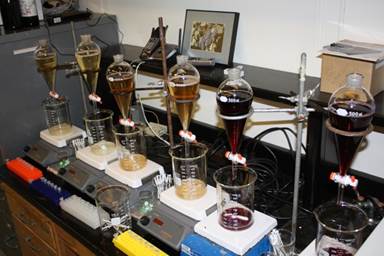
The effectiveness of seed crystals to reduce acidity is being evaluated in La Crescent, Frontenac, and Frontenac gris in a study at Cornell University.
photo: Chris Gerling
One of the challenges in making wine from cold-hardy cultivars is the high acid levels in the grapes. Therefore, one of the objectives for the Northern Grapes Project Enology Team is to optimize deacidification methods for these cultivars, which has been a focal point in their research projects and outreach activities.
As harvest is either underway or complete in most of the cold-climate states, now is a good time to review deacidification strategies. Two Northern Grapes Project webinars (Managing Acidity in the Wineryand Malolactic Fermentation) and two newsletter articles (Necessary Evil: Chemical Deacidification for High Acid Wineand Using Selected Yeast Strains to Reduce Wine Total Acidity) have focused on this topic.
Additional Resources:
Practical Considerations for Managing Wine Acidity by Ellen Butz.
Managing High Acidity in Grape Must and Wine by Jim Harbertson and Thomas Henick-Kling.
August 25, 2014
As part of the Vermont Working Lands Enterprise Initiative-funded project “Apple Market Optimization and Expansion through Value-Added Hard Cider Production,” we are conducting a survey of orchards and commercial hard cider makers to assess demands and production capacity for apples that may be destined for the hard cider market. There are two surveys, please complete the one most appropriate for your business. If you both grow fruit and make hard cider as separate or related businesses, please feel free to complete both surveys. Wineries that produce apple-based products are also invited to participate.
Even if you don’t make cider or sell fruit to cideries, it is important to complete the survey in order to assess Vermont’s capacity to continue to serve a leading role in this growing market.
Orchard survey:
https://survey.uvm.edu/index.php/635332/lang-en
Cidery survey:
https://survey.uvm.edu/index.php/957663/lang-en
Please complete these short surveys before September 1.
The hard cider industry is growing at a rapid pace, with annual sales growth of over 50% for each of the past five years. Through this project we will: identify production capacity and needs for market expansion; identify orchard production system and varieties suited for hard cider; and conduct economic analysis to determine price points for cider apples. This survey will provide important baseline data that will inform this and future apple research that will support increased market expansion for Vermont-grown fruit.
Terence Bradshaw, UVM Tree Fruit and Viticulture Specialist

Where trade names or commercial products are used for identification, no discrimination is intended and no endorsement is implied.
Always read the label before using any pesticide.
The label is the legal document for the product use.
Disregard any information in this newsletter if it is in conflict with the label.
The UVM Tree Fruit and Viticulture Program is supported by the University of Vermont Agriculture Experiment Station, a USDA NIFA E-IPM Grant, and USDA Risk Management Agency Funds.
This is a forwarded request from the Vermont Agency of Ag to complete a survey to assess opportunities for produce growers to sell to local wholesale and institutional markets. TB.