
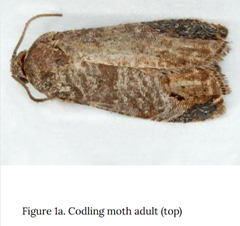
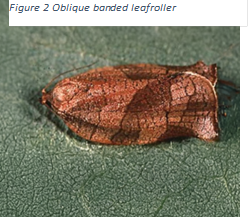
Given the long stretches of cool-to-cold weather, bloom has been stretched out all over the place in Vermont orchards. In warmer sites, apples are at petal fall, yet many trees in most sites are holding on to significant blossoms. Don’t jump the gun on applying insecticides to your orchards, wait until petals are gone and plan to mow flowering groundcover ahead of applications to discourage wild pollinator activity before managing insect pests. We are still seeing low captures of European apple sawfly in monitored orchards, and while we can expect that plum curculio moved into trees with the warm weather earlier this week, they aren’t really active in ovipositing on fruit until they reach about 6 mm / 1/4” diameter. We are seeing first catches of codling moth in some traps which sets the biofix date for their management. Codling moth have a distinct reddish-brown band on their wing tips, this fact sheet from Cornell IPM program portrays it well. They are also mostly gray in color and have a roughly triangular body. We are seeing some codling moths in other traps, including oblique banded leafroller traps for some reason this year. OBLR are quite different in appearance, with a somewhat peach-tan color and an arrowhead-shaped body.
 |
 |
||
The main management concerns right now are continued disease management at crop load management. With rains coming tomorrow, we expect another apple scab infection period. While we are nearing the end of primary ascospore season for many orchards, it is too early to stop management so keep covered. Fire blight is on many folks’ minds, and most orchards did have a likely infection event during the warm weather earlier this week. With the cool temperatures that came in, the estimated infection potential (EIP) has gone down but coverage with streptomycin to emerging open blossoms may be warranted in later-blooming orchards. I recommend application of low rates of Lifegard or Actigard and prohexadione calcium (e.g., Apogee, Kudos) to orchards in 2-4 application to stiffen cell walls in developing shoots and stimulate the plants’ defense systems to reduce shoot blight which we may see in the coming weeks. If there are no blooms, streptomycin should not be applied to fire blight affected orchards except in specific situations involving trauma, e.g. hail or extreme windstorms.
Crop load management is on everyone’s mind now, and I don’t have a good general answer. There are a lot of considerations:
- Many orchards were heading into the season with substantial fruit buds, which would have lent toward a relatively heavy thinning plan.
- Where the April 20 frost damaged flower buds at the tight cluster bud stage, growers may wish to be more cautious in their thinning and many even considered applying plant growth regulators to encourage fruit set (e.g., Promalin).
- Bloom for many orchards in the lower elevation areas of the state occurred during a period of extended cool weather which could have prevented optimal pollination
- For most orchards there were ideal pollination conditions Sunday through Tuesday this past week which likely led to good pollination in orchards that were in bloom then
- Optimum weather for most thinning materials is warm and cloudy after thinner application. We are expecting cool weather the next couple of days but expect a warm up midweek in the 80s.
- A light frost that occurred yesterday morning in some areas may have damaged some blossoms, but as I was checking the weather around the region I saw few temperatures that dipped into the 28° F range where we expect any substantial damage to occur
- Thinning materials are most active when fruit are in the 8 to 12mm size class, but it is recommended that growers apply multiple applications rather than wait until one idealized spray timing that may never come.
- It is often recommended to start thinning at bloom or petal fall period since there is likely still blossoms in many orchards, we do not recommend the use of carbaryl in thinning sprays until all blossoms have dropped their petals.
Here’s my general take on things in the thinning space. You should have a good sense of any cold damage that may have occurred in your orchard in the past month from observing dissected fruit buds in looking for damaged ovary tissue. Where you have substantial damage, you may want to wait on thinning until fruit size up a bit and you have a better sense for what crop is out there. That said, you should still be prepared to thin especially in cases where the king blossom was damaged but lateral blossoms were not, as that may set you up for clustered fruit which can be difficult to thin and may lead to overall small fruit size. Orchards that are at petal fall may consider a Normal application rate of an appropriate thinning material. It is good to check the apple carbohydrate thinning model in NEWA to get a sense of the likely activity of applied thinners.
To sum this up in our own orchard at the UVM horticulture farm, this afternoon I will be applying Captan and Inspire Super for protection apple scab, Lifegard and Kudos to strengthen the tree against fire blight infections, and a moderate rate of NAA to start our thinning program. I will not be adding carbaryl to that spray, as we have many blossoms still open.
Good luck with things and reach out if you have questions.
__
Terence Bradshaw (he/him)
Associate Professor, Specialty Crops
Chair, Dept of Agriculture, Landscape, and Environment
(formerly Plant and Soil Science)
College of Agriculture and Life Sciences
University of Vermont
117/210 – Jeffords Hall | 63 Carrigan Dr
Burlington, VT 05405
(802) 922-2591 | tbradsha
https://go.uvm.edu/alebradshaw
UVM Commercial Horticulture | UVM Fruit Blog
Horticulture Research and Education Center
Message me on Teams
UVM’s Our Common Ground Values:
Respect | Integrity | Innovation | Openness | Justice | Responsibility

UVM is subject to the Vermont Public Records Act and communications to and from this email address, including attachments, are subject to disclosure unless exempted under the Act or otherwise applicable law.