Vermont Apple IPM: Quick codling moth alert

We caught our first codling moth in pheromone-baited Traps on May 20th, which set our biofix date for the degree day model used to track egg hatch and larval development. As of today we have reached the threshold for treatment in South Burlington, and will be treating our orchards tomorrow morning. It is important for growers to ascertain their biofix date for their own operation, so that they may specifically target this particularly damaging test. If you do not have traps in your orchard, you may assume somewhere around May 20th if in the northern Champlain Valley, and probably a week to 10 days after that if in a cooler inland or upland site. Warmer sights in the southern Champlain Valley or southern Vermont may need to advance that, but it is always best to maintain your own traps. This biofix date may be used in the NEWA codling moth model. Treatments for the first generation with most insecticides are best applied at 220 degree days base 50°F after the biofix date.

Other things to keep in mind during this part of the year:

  • Honeycrisp trees could receive low-level (2-4 oz per acre) NAA applications for the next four weeks to improve return bloom.
  • Keep an eye on the results of any thinning treatments and consider one final application if inadequate numbers of fruit have thinned off. Most orchards are reaching the end of the window for most effective thinning.
  • All cultivars, and especially Honeycrisp, will benefit from regular applications of foliar calcium now through mid summer.
  • We are nearing the end of the window when soil applied nitrogen fertilizers should be applied.
  • Apple scab should be largely finished with its overwintering spores so preventative management of that disease should be done in near every Vermont orchard. It is very important to carefully scout orchards for any scab that may have broken through spray applications before secession of fungicide applications. If fresh scab is found, growers should maintain regular preventative fungicide applications for at least another month.

The UVM Tree Fruit and Viticulture Program is supported by the University of Vermont Agriculture Experiment Station, UVM Extension, USDA NIFA E-IPM Program, and USDA Risk Management Agency.

Issued in furtherance of Cooperative Extension work, Acts of May 8 and June 30, 1914, in cooperation with the United States Department of Agriculture. University of Vermont Extension, Burlington, Vermont. University of Vermont Extension, and U.S. Department of Agriculture, cooperating, offer education and employment to everyone without regard to race, color, national origin, gender, religion, age, disability, political beliefs, sexual orientation, and marital or familial status.

Where trade names or commercial products are used for identification, no discrimination is intended and no endorsement is implied. Always read the label before using any pesticide. The label is the legal document for the product use. Disregard any information in this message if it is in conflict with the label.

Immediate prebloom in grapes

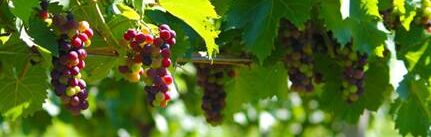
Grape bloom is looming in many Vermont vineyards, and this is a critical time for disease and vine management. As we mention in our initial IPM strategy for winegrapes, all of the major diseases save for late-season fruit rots are sensitive to management right now. That means that fungicide applications should be made, using a material or materials with broad range of coverage against powdery mildew (PM), downy mildew (DM), black rot (BR), anthracnose (Ant), and that last bit of phomopsis (Ph) for the season. Generally, this means a combination of materials, including a protectant (mancozeb, most effective against Ph, BR, PM, or captan (Ph, DM)) plus a systemic or more narrow-spectrum material. Those may include Vivando / Quintec (PM only); a DMI material like myclobutanil or tebuconazole ((BR, PM); or a strobilurin (BR, PM, also excellent against botrytis so save until later in the season in July if you have issues with that disease). I’ll mention other materials with excellent efficacy against DM and botrytis later when those diseases are of greater relative concern.

For organic growers, be sure to maintain your copper and/or sulfur sprays, watch for phytotoxicity, and remove diseased leaves and clusters as soon as you see them. The good thing is that it has been relatively dry this season, so disease pressure should be manageable. That said, in this vulnerable period, spray coverage should be applied prior to expected wetting events.

Insect activity is usually pretty quiet at this time of the season. Keep an eye out for bloom on wild grapes, as that sets the clock for the degree day model used to time management of grape berry moth (GBM). We typically add BT (Dipel, Javelin, etc.) or another material specifically active against lepidopteran pests soon after bloom at the earliest, so there’s time before we consider managing for this pest. GBM isn’t always a problem in every Vermont vineyard, we’ll talk about scouting for that pest in an upcoming bulletin. While we’re on the subject of insects, I haven’t seen much / any grape tumid gallmaker (GTGM) at the Hort Farm vineyard this year, but it has been a somewhat unlikely yet injurious pest in local vineyards in the past couple of years. I do not want to get into recommending treatment for minor pests of likely little economic importance, but if yours is one of the handful of vineyards which as suffered from extensive damage in recent years, consider using Movento or Assail if you see the first stages of galling by overwintering midges as they are hatching out now. There are only a very few vineyards where I’m even suggesting treatment for this- if you don’t remember this pest and its’ damage, then don’t worry about it on your farm. For more information on GTGM check the link above or my previous bit on them here.

Horticulture: There are two good times to collect petiole samples to assess vine nutrient status, bloom and veraison. Generally, you should stick with whichever timing you have been using so that you may compare to past tests. Dr. Joe Fiola at University of Maryland has a good fact sheet on petiole sampling. We recommend the Cornell Nutrient Analysis Laboratory for petiole sampling, as they have extensive experience in providing nutrient recommendations for grapes. Should nutrient applications be needed, this is a good time to apply boron, magnesium, and nitrogen as they are needed during this period of rapid shoot and fruit growth.

Other activities that I don’t need to tell you about: shoot thinning can continue, but shoots aren’t lignified at the base enough to comb them, they’ll just break off. Keep the vineyard mowed to improve airflow, but a golf course mowing regime isn’t necessary unless that’s your aesthetic choice. Keep the in-row weeds down however you can, but most herbicides should be put away for now because of likelihood of vine damage.

Terence Bradshaw
University of Vermont
Sent via Mobile

VT Apple IPM: Thinning time

Apple scab ascospore maturity models for essentially every weather station in the state indicates that we are at the end of the primary scab infection season. That means spores that could cause apple scab have matured and either has or likely will release after the next good wetting event. However, growers should maintain protective fungicide coverage on all trees for the next 1 to 2 weeks and should inspect their orchard carefully to ensure that infections have not occurred before backing off from coverage for the season. This is a good time to use group 7 or 11 fungicides to also provide protection against powdery mildew and apple rusts.

The warm weather we are expecting this week could cause fire blight infections in susceptible varieties with lingering blossoms such as newly planted trees. Consider protection if your orchard is in that situation. This is also a good time to maintain a program of 3-4 sprays of prohexdione-calcium (e.g., Kudos, Apogee) at 6 oz per acre or 2-3 oz per acre with Actigard at 2 oz per acre to stiffen up cell walls in developing shoots to reduce shoot blight susceptibility.

Plum curculio is active in orchards. If full block insecticide coverage was applied at petal fall, only border row sprays may be warranted until you have reached 308 degree days base 50F after petal fall, after which the insect is no longer actively laying eggs and causing fruit damage.

Codling moth are slow to take flight around the region. Growers should check pheromone baited traps daily and set the biofix for the management model as the first date of trap capture. The NEWA model will calculate accumulated degree days (base 50F) after sustained flight to predict egg hatch, most insecticides should be applied 100-200 DD later to be most effective. We don’t expect that to occur until next week, anyway.

The big management activity for this week should focus on thinning applications. The warm weather we are expecting today through Friday coupled with low wind conditions mean that thinners will be particularly active this week. In most orchards that I have seen in the state that were not affected by the April 20 freeze, I am recommending an aggressive thinning strategy this year to prevent a large crop of small fruit and subsequent biennual conditions next year and the years following. The weather conditions in the next few days are especially conducive to using the 6-BA thinning materials, which are especially useful on small fruited cultivars such as Empire, Macoun, and Gala. Larger fruited cultivars may benefit from NAA applications. Either of those would be enhanced with the inclusion of 1 pint of carbaryl per 100 gallons. This is the most important window for you to manage this year’s crop, so take advantage of it.

Terence Bradshaw (he/him)

Associate Professor, Specialty Crops

Chair, Dept of Agriculture, Landscape, and Environment
(formerly Plant and Soil Science)
College of Agriculture and Life Sciences

University of Vermont
117/210 – Jeffords Hall | 63 Carrigan Dr
Burlington, VT 05405

(802) 922-2591 | tbradsha
https://go.uvm.edu/alebradshaw

UVM Commercial Horticulture | UVM Fruit Blog
Horticulture Research and Education Center
Message me on Teams

UVM’s Our Common Ground Values:
Respect | Integrity | Innovation | Openness | Justice | Responsibility

UVM is subject to the Vermont Public Records Act and communications to and from this email address, including attachments, are subject to disclosure unless exempted under the Act or otherwise applicable law.