Fire blight pt II

By Terence Bradshaw

Sometimes you need to check the latest weather before hitting ‘send’…

After I just sent that last missive, I double-checked conditions in western Vermont, specifically Shoreham and Bennington, and the weather prediction is indeed for warmer weather than when I last looked. NEWA is now calling for “Infection” on Monday for those two sites, but the EIP is just barely over 100 (107 and 103, respectively) and drops down the next day as cooler weather moves in. I’m going to stick with my old gut response to not worry about fire blight, with a slight caveat. If you have a history of the disease, have especially susceptible plantings (Gala, Fuji, some cider varieties), are in bloom on Monday, and things warm up over the weekend, consider applying streptomycin on Monday or Tuesday, within 24 hours of infection. Keep an eye on NEWA for further details.

Where trade names or commercial products are used for identification,

no discrimination is intended and no endorsement is implied.

Always read the label before using any pesticide.

The label is the legal document for the product use.

Disregard any information in this message if it is in conflict with the

label.

The UVM Tree Fruit and Viticulture Program is supported by the

University of Vermont Agriculture Experiment Station, a USDA NIFA E-IPM

Grant, and USDA Risk Management Agency Funds.

Apple scab, what would we do without you?

By Terence Bradshaw

Here’s a quick note to remind everyone that we’re in the middle of an extended wetting and apple scab infection period that is likely to peak on Monday. Every orchard in the state still has mature ascospores in the leaf litter from last year, so stay protected. We’re also still in rust season, so it’s not a bad idea to make sure your fungicide products have some efficacy against that disease. If you’ve had more than an inch or so of rain between spray events, and especially if more than 1.5-2”, you should really think about applying a DMI (FRAC 3, e.g., Indar, Rally, etc., high efficacy against rust), strobilurin (FRAC 11, e.g., Flint high efficacy against rust), or SDHI (FRAC 7 e.g., Merivon, moderate efficacy against rust) with your protectant material (captan is good, no rust efficacy; or mancozeb, good rust efficacy but only allowed four applications through bloom at 6 lb/acre rate so you may have used that up). Remember to rotate between FRAC codes to avoid resistance development, and the mix products like Inspire Super (3+9) or Luna Tranquility (7+9) or Sensation (7+11) count as both when planning your rotations. That is, if you use two back-to-back application of Luna Sensation (7+11), your next spray including one of the single-site products should be a DMI (3) or anilinopyrimidine (9, which are less effective as temperatures warm) material. More information on fungicide resistance management is available in the New England Tree Fruit Management Guide.

For organic growers, the standard is still sulfur, and possibly judicious use of lime sulfur if you’ve missed some coverage and need some protection to reach backwards. Remember though, lime sulfur is nasty stuff, so use judiciously and take all necessary precautions. For rust, sulfur isn’t very effective. I have heard reports that Regalia, a biological fungicide, has some efficacy against rust so this is as good a year as any to try it out.

One great bit of news on the disease front- fire blight should be a complete non-issue this year. That could change for late-blooming cultivars or if active cankers are leading to shoot blight later on, but for now, it’s just too cool for any activity from the bacteria that causes the disease. NEWA’s Cougarblight model shows “high” risk for Sunday and Monday, but that’s to be taken with a grain of salt. There are four conditions necessary for blossom blight to occur: open blossoms (check); wetting (check); sufficient heat, measured in degree hours, over 60°F during the infection event (maybe); and sufficient heat leading up to infection to allow the bacterial population to increase to a level high enough to cause disease (nope). Using NEWA’s fire blight model, keep an eye on the “Infection Potential EIP Value”, that should reach 100 before you need to be concerned about blossom blight. Cougarblight assumes “High” risk if three of the four conditions are met, even if the fourth necessary condition (EIP in this case) is not likely to be met. We would need temperatures a good ten degrees higher than predicted tomorrow through Monday to move that EIP into any range to worry about.
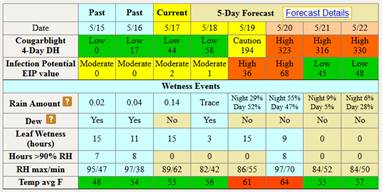
Figure 1 NEWA fire blight model for Putney, VT. Most sites in the state will have even lower risk than this. Take-home: don’t worry about blossom blight now.

Orchards are in or entering bloom. That means a few things. First, get those blossoms and the ovules they’re attached to in good shape by applying a foliar fertilizer if you haven’t yet, I’ copying my own text from 5/5 here for that: Rates are dependent on the products used, and are intended to boost blossom vigor as the trees enter the stressful bloom period Dr. Wes Autio’s (UMASS) recommendations for Prebloom Nutrient Applications for Apple Trees: 3 lbs/100 gallons (dilute equivalent) urea; 1 lb/100 gallon Solubor (or equivalent); and label rates of zinc chelate. Ground-applied or fertigated fertilizers can also start to go on any time now. Organic growers may want to apply fish and/or seaweed products at this time.

Remember, bloom means bees, bees pollinate, and pollination = ovule fertilization = fruit. Protect them, both managed and on-managed (wild). That means avoid spraying anything, if you can, during bloom. Even some fungicides, DMIs in particular, have shown adverse effects on bees when applied to blooming orchard crops. Mow your dandelions to both force bees into the trees to work and to reduce their (the bees’) presence after bloom when you think about applying a petal fall insecticide. And for heaven’s sake, do not apply insecticides when there are flowers (apple blossoms or dandelions) in the orchard. The exception to that is Bt or other lepidopteran-specific products. On to insects…

Insect activity is really slow this season. The only insect captures of note have been European apple sawflies. If you’re at pink (i.e., ZERO blooms open) and have a population above threshold (five per white sticky trap, average), this may be a warranted application. But, application of insecticides so close to bloom is still a dangerous endeavor. Many wild bees are moving now, and since they often fly in cooler, wetter, windier conditions than managed honeybees, they may be especially important this year given the crappy weather we’re having. If you can hold off until post-bloom, I strongly recommend it.

Get your codling moth and obliquebanded leafroller traps up ASAP and check daily to set the biofix you’ll use to manage the larvae in a few weeks.

On a final note, herbicides, if used, can be applied any time, and application to weeds 6” or shorter is always more effective than waiting. Be careful with contact to trees, including mature bark, with glyphosate or glufosinate. Extra time spent is well-worth it to avoid trunk damage.

Are we having fun yet?

-Terry

Where trade names or commercial products are used for identification,

no discrimination is intended and no endorsement is implied.

Always read the label before using any pesticide.

The label is the legal document for the product use.

Disregard any information in this message if it is in conflict with the

label.

The UVM Tree Fruit and Viticulture Program is supported by the

University of Vermont Agriculture Experiment Station, a USDA NIFA E-IPM

Grant, and USDA Risk Management Agency Funds.

Apple scab infection period now… (May 13)

By Terence Bradshaw

This is a very brief message to Vermont apple growers that we are in a dry and relatively windless slot between significant wetting events and it would be wise to make sure that your fungicide coverage is maintained. I wouldn’t worry about insects now, unless you are treating for scale, but a quick reapplication of anything that may have washed off if you sprayed prior to Friday is called for. I’m heading out right now…

Where trade names or commercial products are used for identification,

no discrimination is intended and no endorsement is implied.

Always read the label before using any pesticide.

The label is the legal document for the product use.

Disregard any information in this message if it is in conflict with the

label.

The UVM Tree Fruit and Viticulture Program is supported by the

University of Vermont Agriculture Experiment Station, a USDA NIFA E-IPM

Grant, and USDA Risk Management Agency Funds.
REGISTRATION for May 16 Apple Scouting/IPM meeting

By Terence Bradshaw

The UVM Fruit Program will host a hands-on program on apple orchard Integrated Pest Management and scouting on May 16, 2019. The program will run 1:00 – 4:00 PM. In the event of rain, we will hold the meeting on May 17. We will contact attendees the day before if we need to make that call.

This workshop will be held at the UVM Horticulture Research & Education Center, located at 65 Green Mountain Drive, South Burlington, VT. A short program may be held in the Blasberg classroom to introduce IPM concepts before heading out into the orchards with Fruit program staff Dr. Terence Bradshaw, Sarah Kingsley-Richards, and Jessica Foster.

There is no fee for this workshop, but please pre-register so that we may have an accurate counting of attendees: https://survey.uvm.edu/index.php/266459?lang=en

Thank you,

Terry Bradshaw

Where trade names or commercial products are used for identification,

no discrimination is intended and no endorsement is implied.

Always read the label before using any pesticide.

The label is the legal document for the product use.

Disregard any information in this message if it is in conflict with the

label.

The UVM Tree Fruit and Viticulture Program is supported by the

University of Vermont Agriculture Experiment Station, a USDA NIFA E-IPM

Grant, and USDA Risk Management Agency Funds.

Grape flea beetle, weed management

By Terence Bradshaw

May 5, 2019

Buds are swelling in Vermont orchards. I haven’t looked at our vines in South Burlington since Friday, and they were fully swelled then, but I cleaned up my vines at home (1500’ elevation, Washington county) today and they were quite swelled up. I expect bud break any day now. Flea beetles are the main insect of concern at this point, and really only when bud swell through 1” shoot growth is slowed and the buds remain at this susceptible state for more than a week or so. It’s a good idea to keep an eye on buds and consider treating if more than 2% of buds are damaged. Remember, buds are no longer susceptible after 1” shoot growth, so if you make it past that stage, then don’t worry about them. This is really only a problem in years with a cool, drawn-out spring, and even then, the damage is rarely of economic significance. Clearing brush piles from around vineyard edges can help to reduce this pest.

Now that buds are swelling, I’d avoid use of systemic herbicides in vineyards unless you have a really good shield system to avoid contact with green tissue. This is a good time to burn down weeds, though, and an application of glufosinate can be effective now. Adding a premergent material like Chateau can extend weed control for a longer period. On the other hand, I find that in-row vegetation can help with excess soil moisture and vine vigor, as long as it is managed. I’m not promoting just letting the weeds go in a planting, and groundcover should be mowed and kept out of the canopy during the growing season.

Where trade names or commercial products are used for identification,

no discrimination is intended and no endorsement is implied.

Always read the label before using any pesticide.

The label is the legal document for the product use.

Disregard any information in this message if it is in conflict with the

label.

The UVM Tree Fruit and Viticulture Program is supported by the

University of Vermont Agriculture Experiment Station, a USDA NIFA E-IPM

Grant, and USDA Risk Management Agency Funds.

Pest management in orchards this week, May 5

By Terence Bradshaw

First note, please remember that we will be hosting an Orchard Scouting Field Workshop at the UVM HREC on May 16, 1-4 PM to help growers with implementing scouting programs and to discuss upcoming management strategies. I’ll have a registration link ready later this week. The event will be free, but I’m looking for a head count. Also. Don’t forget that we have hard copy New England Tree Fruit Management Guides available at: http://go.uvm.edu/netfmghc.

Bud stages in Vermont orchards run the gamut, from pink and maybe even the very beginning of bloom in the south to green tip at my house at 1500 feet elevation in Washington county. At the UVM Horticulture Research Center, trees are at a solid tight cluster and will move more tomorrow. We’re in a window of relative calm, so unprotected orchards may deserve some fungicide coverage before Tuesday when enough rain is expected to cause a scab infection period. It will be cooler and drier on Wednesday, so another option would be to apply on Wednesday after the rain, assuming that you already have some coverage remaining from last spray and you’re ready to apply a site-specific fungicide (like an SDHI, QoI, or DMI material) that will have some kick-back activity and cover for the prior day’s infection. Reliance on kick-back materials speeds development of resistance in the scab pathogen, so I only recommend that strategy if you already have some coverage like from a spray last Wednesday, and I always recommend tank mixing with a multi-site protectant like mancozeb, captan, or sulfur if organic. (For growers following an organic schedule, I don’t have a good answer for a recommended kickback material. Liquid lime sulfur is a very heavy bomb that will negatively affect trees and is better saved for rescue situations; Oxidate or one of the bicarbonate materials like Kaligreen can have some post-infection activity if applied very soon after initiation of an infection period, but I wouldn’t count on getting good control if you wait any real amount of time after to apply or if there is a heavy infection period.)

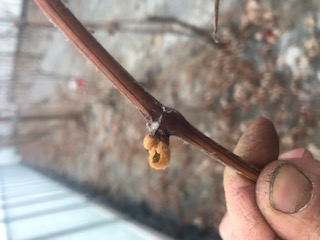
Cedar apple rust galls (sixth picture) are active on red cedar and other junipers in the Champlain valley, and I recommend treating for this disease in any orchard that has had an issue with it in the past as the cool, wet conditions of last week and this week are conducive to disease development. The good news is that mancozebs (a multi-site protectant fungicide class) are effective against CAR; DMI (Indar, Rally, Rubigan, etc.) and strobilurin (Flint) fungicides are highly effective, and SDHIs (Aprovia, Fontelis)have moderate efficacy. A tank mix of those materials (one protectant and one of the other single-site classes should provide good protection. Remember, do not apply single-site fungicides with the same FRAC code more than twice in succession before rotating to another chemistry (FRAC code).

As bloom approaches, plan on completing a few activities to improve tree’s response to pollenization and fertilization. A prebloom foliar nutrient mix of nitrogen, zinc, and boron should be applied. Rates are dependent on the products used, and are intended to boost blossom vigor as the trees enter the stressful bloom period Dr. Wes Autio’s (UMASS) recommendations for Prebloom Nutrient Applications for Apple Trees: 3 lbs/100 gallons (dilute equivalent) urea; 1 lb/100 gallon Solubor (or equivalent); and label rates of zinc chelate. Ground-applied or fertigated fertilizers can also start to go on any time now.

Now is probably past time to make bee plans, but growers should certainly plan on coordinating with their beekeeper on hive delivery and placement. We are focusing on pollinator health more than ever these days, so be smart about protecting both kept and wild bees on your farm. Avoid applying insecticides right before bees are brought in, only apply after mowing or when flowering weeds are absent from the orchard, and avoid DMI fungicides during bloom as they are now recognized as harmful to bees.

On the insect front, things are quiet but the first few tarnished plant bug and European apple sawfly are flying in certain orchards. If possible, we can avoid spraying for the former (TPB); the latter is best managed at petal fall except on problematic sites or when bloom is extended. If you have been trapping for EAS, keep an eye out for the threshold of five adults caught per trap to treat; that threshold should increase to about nine per trap after bloom if no prebloom treatment was applied.

Codling moth traps should be hung at pink and checked daily until first catch is seen. That capture date will be the biofix you use when calculating degree days for subsequent management actions.

Where trade names or commercial products are used for identification,

no discrimination is intended and no endorsement is implied.

Always read the label before using any pesticide.

The label is the legal document for the product use.

Disregard any information in this message if it is in conflict with the

label.

The UVM Tree Fruit and Viticulture Program is supported by the

University of Vermont Agriculture Experiment Station, a USDA NIFA E-IPM

Grant, and USDA Risk Management Agency Funds.

Apple scab management this week

By Terence Bradshaw

Well, so much for spring. Things sure cooled down this week, with apple trees pretty much parked between green tip and half-inch green bud stage, with a little more advancement in southern parts of the state. The primary scab ascospores that drive the whole disease cycle for the year and overwinter on the orchard leaf litter are maturing a decent pace, with about 15-18% of potential spores mature in the south, 10% in the cooler northern Champlain Valley, and only 2-5% in inland Vermont. Relatively warmer weather tomorrow should push things ahead a bit. Key take-home: Those warmer areas with any appreciable green tissue showing and a history of scab in the orchard last year are entering the accelerated phase of ascospore maturity and should be prepared to maintain protective fungicide coverage before rain periods until the ascospores are all released. That means that orchards should apply between rains this week, after 1-2 inches of rain, and when new growth emerges (say a move from 1-2 bud stages and increasing shoot leaf expansion, when that starts anyway). That means that in weather like we’re seeing now, maintaining a roughly 7-day schedule. Please use NEWA to track weather and disease infection periods to best plan your spraying events. It’s getting very muddy out there, so try to minimize your trips by applying tank-mixed fungicides including a protectant (e.g., captan, mancozeb, sulfur if organic) and a kick-back material (I recommend Vangard or Scala, still, at this time of year).

Insects are still quiet, but expect tarnished plant bug and European apple sawfly to start moving with the first warm day or two.

Where trade names or commercial products are used for identification,

no discrimination is intended and no endorsement is implied.

Always read the label before using any pesticide.

The label is the legal document for the product use.

Disregard any information in this message if it is in conflict with the

label.

The UVM Tree Fruit and Viticulture Program is supported by the

University of Vermont Agriculture Experiment Station, a USDA NIFA E-IPM

Grant, and USDA Risk Management Agency Funds.

Scouting workshop May 16; apple season is well underway

By Terence Bradshaw

At the UVM Horticulture Research and Education Center (HREC), we hit the green tip bud stage on McIntosh today. This means that, even for orchards with relatively low apple scab inoculum that carried over from last year, disease management should commence any time. Today would have been a great time to put a protectant material on ahead of the rains expected tomorrow and through the weekend. For growers who had scab last year and who are at this same or later stage of bud development who did not have a protectant applied on Monday or Tuesday this past week, plan on applying a material with some kick-back action when the rain and winds die down. Scala, and Vangard are natural options at this time, as they work better in cool weather and have relatively little effect on fruit scab so they are less useful later in the season. For those who still use or planned to use it as a spring fungicide, Syllit/Dodine is no longer registered for use in Vermont, although remaining stocks may be used up. For orchards past 1/4” green tip, it is too late to apply copper fungicides at traditional labeled rates for efficacy against apple scab without risking fruit russeting. As always, check the New England Tree Fruit Management Guide for complete recommendations (hard copy guides still available at: http://go.uvm.edu/netfmghc).

On the arthropod front, this is still a good time to apply oil for management of mites, and Esteem may be applied against San Jose (SJS) and other scale insects if they are a problem in your orchard. Notice I did not recommend Lorsban (chlorpyrifos) against SJS and other insects at this time. That’s because chlorpyrifos products are no longer registered for use in Vermont.

This is a great time to start your orchard monitoring program: keep track of phenology on all cultivars are bud emerge and develop, and start hanging traps in the orchard for weekly (at a minimum) monitoring. Insect activity is generally pretty quiet now, but tarnished plant bug will start to move as days warm up. This would be a good week to get traps up for this insect pest. We recommend four white sticky traps per block hung knee high in a visible location, often at the block edges. Traps should be checked at least weekly and treatment for TPB considered if over threshold. Thresholds are variable based on tolerance for cosmetic damage- for apples marketed wholesale, three bugs per trap before tight cluster or five before pink bud would warrant treatment; for retail and pick-your-own orchards, the recommended treatment threshold is five and eight bugs per trap, respectively, for those bud stages. TPB and other insects managed at pink are usually treated with a synthetic pyrethroid material and that is still the recommendation. In order to conserve wild pollinators, we do not recommend use of neonicotinoid insecticides before petal fall.

On the subject of scouting, we will be hosting an Orchard Scouting Field Workshop at the UVM HREC on May 16, 1-4 PM to help growers with implementing scouting programs and to discuss upcoming management strategies.

Good luck out there.

Where trade names or commercial products are used for identification,

no discrimination is intended and no endorsement is implied.

Always read the label before using any pesticide.

The label is the legal document for the product use.

Disregard any information in this message if it is in conflict with the

label.

The UVM Tree Fruit and Viticulture Program is supported by the

University of Vermont Agriculture Experiment Station, a USDA NIFA E-IPM

Grant, and USDA Risk Management Agency Funds.

2019 New England Tree Fruit Management Guide available!

By Terence Bradshaw

For as long as I’ve been in this fruit business with UVM (1995-present) and well before, the cooperating Extension fruit programs of the New England Universities have collaborated on a management guide for commercial tree fruit growers. That guide has taken numerous forms, but in 2017, we switched a on online-only platform due mainly lack of funds to prepare and print the guide every year. The online guide is still available, and should be a main resource for fruit growers: http://netreefruit.org/. That guide is formatted for both desktop and mobile devices, and will always be the most up-to-date one published.

In response to demand for a printed, hard-copy guide, we formatted the online guide into a 300-page, spiral-bound version that may be useful to keep in the truck, tractor, or spray shed. I have twenty copies available at: www.regonline.com/2019netreefruitmanagementguide. Copies are $25 postage-paid, and I plan to ship Wednesday and Friday this week. If there is demand for more copies, they may be available from UMASS or other cooperating states.

Good luck out there, at the UVM orchard, the spray season already started today.

-Terry

Where trade names or commercial products are used for identification,

no discrimination is intended and no endorsement is implied.

Always read the label before using any pesticide.

The label is the legal document for the product use.

Disregard any information in this message if it is in conflict with the

label.

The UVM Tree Fruit and Viticulture Program is supported by the

University of Vermont Agriculture Experiment Station, a USDA NIFA E-IPM

Grant, and USDA Risk Management Agency Funds.

Beginning the 2019 viticulture season

By Terence Bradshaw

After a long winter, spring is here and bud break is approaching. Plan on wrapping up pruning in the coming weeks and removing brush from the rive alleys to the burn pile (and burn it, too, to reduce overwintering insects and disease inoculum).

This is a good time to review your previous season’s spray records and to identify any gaps that may have led to disease issues. Weather in 2018 was variable across the state, with areas north of about Route 4 seeing very dry/drought conditions, and areas in the southern part of the state seeing above average rainfall. Overall, disease management was fairly easy in 2018 and disease incidence low. Don’t let that lull you into thinking that 2019 will necessarily be the same.

We have updated two disease management documents in 2017 for Vermont and area grape growers: a table of relative disease susceptibility of cold-climate cultivars and an initial IPM strategy for cold climate winegrapes. More information on general viticulture and other small fruit production can be found in the 2019 New England Small Fruit Management Guide , and the 2019 New York and Pennsylvania Pest Management Guidelines for Grapes are now available and should be used in combination with specific pesticide labels to select pesticide materials for use in your IPM program.

One pesticide spray that is often considered by growers is a late dormant application of lime sulfur (LS) which aids in inoculum reduction against many diseases, especially phomopsis and anthracnose. Growers who have had more than a passing amount of either of those diseases, especially organic growers with more limited choice of materials during the growing season may consider applying this practice, but I make that recommendation with several caveats. While LS is an organically-approved pesticide, it is one of the most acutely toxic materials I have ever used, and demands special considerations for its use. It is also a restricted-used spray material, so unlicensed applicators may not purchase or apply it. LS (active ingredient calcium polysulfide) is very caustic; spray mixtures tend to have pH around 10-11, and that characteristic is what gives it its sanitizing effect as a biocide. Contact with skin or especially eyes must be avoided, and it is pretty noxious even when smelled through a respirator. This material demands respect. While those effects will dissipate in the field after sufficient washoff and degradation by rain and other elements, I would only plan on applying after pruning is finished so not to muck around in it after application. In fact, very thorough pruning out of all dead and diseased wood is an important cultural disease control practice, and if you have a lot of such wood left in the vineyard, spraying your way around pruning it out won’t help.

LS is typically labeled for application at "15-20 gallons per acre in sufficient water for coverage" (Miller Liquid Lime Sulfur). That is a very high amount of LS, and would be difficult to apply and very costly when applied to large acreages. The key is to fully soak all woody tissues in the vineyard. This may mean aiming all nozzles at the cordons, but that would leave the trunks uncovered. Alternatively, the sprayer could be operated to cover the whole zone from the fruiting wire down, which would waste a tremendous amount of spray. The best application may come from a careful handgun application, which will take a long time and should be done with full protective gear including heavy nitrile gloves, full face shield and respirator, and Tyvek or other chemical-resistant, disposable coveralls. It is hard to say how much you would apply per acre in a directed spray, since that would be much more efficient with less wasted spray than an airblast application. My suggestion would be to apply a 10% solution (1 gallon LS to 9 gallons water) by handgun to cordons and trunks in a very thorough soaking spray. If you need to use an airblast to cover more ground, I would concentrate my nozzles toward the cordons but leave one or two directed toward the trunks, that will waste spray between vines but will allow you to cover ground much quicker. Because of the reduction in efficiency, I would calibrate to apply ten gallons of LS per acre in at least fifty gallons of water.

Remember, this stuff is caustic, stinky, and degrades just about everything it touches. It’s also quite phytotoxic- application at these rates to vines after bud break will cause leaf damage if not outright defoliation. I have used a lot of LS during the growing season in organic apple production, and don’t recommend it there unless absolutely necessary. I do not have experience using it in-season (post-bud break) on grapes, so this recommended spray must be applied during the window between pruning and bud break. The spray, if left on tractors and in sprayer plumbing, will corrode hoses, gaskets, and even stainless steel. It must be thoroughly rinsed from sprayer systems and the rinsate applied back out in the vineyard, not dumped on the ground. Some growers have applied a film of vegetable oil via backpack prayer to tractors and sprayers before an LS application to prevent it from soaking into and corroding steel and other materials on equipment. It’s that bad, and I could show you sprayer hitches, mix screens, and ceramic nozzles that have been degraded by it.

With all that said, LS is extremely effective as a preventative practice to reduce disease inoculum, and I still recommend its use in vineyards where anthracnose and/or phomopsis have gotten a bit out of control. Just be careful out there and treat it with the same (and a little more) respect that you should retreat any pesticide.”

Good luck with your vineyard activities in the coming weeks, and let’s all hope for a ‘normal’, gradual spring warm-up.

-Terry

Where trade names or commercial products are used for identification,

no discrimination is intended and no endorsement is implied.

Always read the label before using any pesticide.

The label is the legal document for the product use.

Disregard any information in this message if it is in conflict with the

label.

The UVM Tree Fruit and Viticulture Program is supported by the

University of Vermont Agriculture Experiment Station, a USDA NIFA E-IPM

Grant, and USDA Risk Management Agency Funds.