Apple Pink and Bloom time considerations for Vermont

May 15, 2014

By now most orchards in the Champlain Valley should be at full pink, and a few blossoms were observed open today at the UVM Hort Research and Education Center in South Burlington. This is a critical time for management activities in the orchard, so here goes:

  1. We are still in a high fire blight risk situation for nearly all orchards in the state. Hot weather the past few days has pushed epiphytric infection potential for the fire blight bacteria to levels sufficient to cause infection. If you or an immediate neighbor have had fire blight in the past two years, you should be ready to treat opening blossoms within 24 hours. We are going to get the required wetting for infection starting on Friday, and blossoms must be covered with streptomycin within 24 hours of infection.
  2. For a more long-term, systems-based management program for fire blight, please see the guide, “Grower Lessons and Emerging Research for Developing an Integrated Non-Antibiotic Fire Blight Control Program in Organic Fruit,” available here. Frankly, if you are not bound by organic certification rules (and even for this final season organically-certified growers are allowed to use it), streptomycin is your best defense against blossom blight and will help limit shoot blight spread later in the season. This guide however offers many good strategies for use in a long-term program that taken together will reduce your orchard’s susceptibility to the disease.
  3. Bloom looks variable; I have one of my lighter crops at the UVM orchards, but I saw a very good density of fruit buds in Grand Isle County today. Anecdotal reports from Addison County indicate either a great fruit bud density or a moderate one. I would appreciate any feedback on bloom conditions in your orchard.
  4. Scab is still a significant risk, and this weekend’s rain will likely initiate a significant infection period. This is a good time to add one of the systemic SI, QOI, or SDHI fungicides to your spray schedule to cover for powdery mildew and cedar apple rust as well as scab. There is some concern with application of Captan and potential phytotoxicity around and just following bloom, so a combination of one of the ‘big gun’ fungicides and 3 lbs/acre mancozeb would be a reasonable tank mix at this time. If you haven’t used more than 3 lbs/acre of mancozeb (or another EBDC ) in any tank mix yet this season, you can continue to use it after bloom until 77 days before harvest at that rate.
  5. Speaking of scab, lesions from the first infection periods of the season, especially from around May 1, should be visible by early next week.
  6. If you haven’t applied ground fertilizers yet, now is the time to do so. Same for irrigation, new high-density plantings are thirsty, so be sure to water regularly. NEWA has a good Apple Irrigation model under the ‘Crop Management’ tab.

That’s all for now. Stay dry, but keep your orchards covered.

Terence Bradshaw, UVM Tree Fruit and Viticulture Specialist

Where trade names or commercial products are used for identification, no discrimination is intended and no endorsement is implied.
Always read the label before using any pesticide.
The label is the legal document for the product use.
Disregard any information in this newsletter if it is in conflict with the label.

The UVM Tree Fruit and Viticulture Program is supported by the University of Vermont Agriculture Experiment Station, a USDA NIFA E-IPM Grant, and USDA Risk Management Agency Funds.

Fire Blight Alert

May 13, 2014

The orchards at the UVM Horticulture Research and Education Center are at open cluster to early pink, and some blooms are expected by the end of the week. NEWA fire blight models are predicting high to extreme risk for fire blight in the next four days for all sites in Vermont except the coolest ones where bud development is still at half-inch green. Growers should consider treatment of orchards with open blooms with streptomycin if infection conditions occur. Remember that fire blight infection requires four conditions:

  1. Open blossoms,
  2. A significant population of bacteria,
  3. Wetting events (including spray application),
  4. Sufficient heat units during the infection event.

The Cougarblight model run through NEWA is the best method to assess infection risk in your orchard. If infection is predicted, streptomycin must be applied within 24 hours before or after the event. Strep only works on open blossoms, so blooms that open after treatment must be re-treated if infection conditions remain.

Please refer to the New England Tree Fruit management guide for more information on fire blight management.

Terence Bradshaw, UVM Tree Fruit and Viticulture Specialist

Where trade names or commercial products are used for identification, no discrimination is intended and no endorsement is implied.
Always read the label before using any pesticide.
The label is the legal document for the product use.
Disregard any information in this newsletter if it is in conflict with the label.

The UVM Tree Fruit and Viticulture Program is supported by the University of Vermont Agriculture Experiment Station, a USDA NIFA E-IPM Grant, and USDA Risk Management Agency Funds.

May Northern Grapes Newsletter

May 5, 2014

News You Can Use

Grape Disease Management

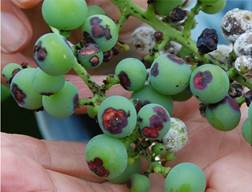
Anthracnose on grape berries. (Photo: Patty McManus)


Every experienced grape grower knows that good disease management program is a crucial component of growing high-quality grapes. Early season control is especially important, as flowers and small berries are quite susceptible to powdery mildew, downy mildew, and black rot.

Because cold-hardy grape cultivars are still relatively new, we’re still learning about the different cultivars’ resistance and susceptibility to the range of grape pathogens. Therefore, one of the objectives of the Northern Grapes Project is to evaluate disease resistance and the cultivars’ susceptibility to copper- and sulfur-based fungicides.

Below is a list of resources that will help you build an effective disease management program.

Grape Disease Management Basics (and All About Anthracnose) by Wayne Wilcox, Cornell University and Patty McManus, the University of Wisconsin. April 10, 2012 Northern Grapes Project webinar.

https://www.youtube.com/watch?v=2Bc5vdsjbI0&feature=youtu.be

The Disease Management Puzzle: Putting the Pieces Together by Dean Volenberg, University of Wisconsin Extension – Door County. June 4, 2013 Northern Grapes News (Vol. 2, Issue 2).

http://northerngrapesproject.org/wp-content/uploads/2014/04/May-2014-DiseaseMgmtVolenberg.pdf

Grape Disease Control, 2013 by

Wayne Wilcox, Cornell University. A rather lengthy document that contains an update and review of how to control grape fungal diseases in the east. (Will updated this link with the 2014 version once it’s released.)

http://www.fruit.cornell.edu/grape/pdfs/Wilcox-Grape%20Disease%20Control%202013.pdf

The 2014 Midwest Small Fruit and Grape Spray Guide. Contains

general guidelines to use as you develop your grape spray program. Also has information about fruit grower newsletters, pesticide drift, plant diagnostic lab listings, and much more.

https://ag.purdue.edu/hla/Hort/Documents/ID-169.pdf

Terence Bradshaw, UVM Tree Fruit and Viticulture Specialist

Where trade names or commercial products are used for identification, no discrimination is intended and no endorsement is implied.
Always read the label before using any pesticide.
The label is the legal document for the product use.
Disregard any information in this newsletter if it is in conflict with the label.

The UVM Tree Fruit and Viticulture Program is supported by the University of Vermont Agriculture Experiment Station, a USDA NIFA E-IPM Grant, and USDA Risk Management Agency Funds.

New Hampshire Irrigation Workshop

May 5, 2014

University of New Hampshire is conducting a drip irrigation workshop on Thursday May 22, 4:30 -8 PM, at Brookdale Fruit Farm, Hollis, NH. The program looks to be very thorough and well worth it especially if you are thinking of putting in a new system.

Click the following link for all the information.

http://extension.unh.edu/events/index.cfm?e=app.event&event_id=37173

Terence Bradshaw, UVM Tree Fruit and Viticulture Specialist

Where trade names or commercial products are used for identification, no discrimination is intended and no endorsement is implied.
Always read the label before using any pesticide.
The label is the legal document for the product use.
Disregard any information in this newsletter if it is in conflict with the label.

The UVM Tree Fruit and Viticulture Program is supported by the University of Vermont Agriculture Experiment Station, a USDA NIFA E-IPM Grant, and USDA Risk Management Agency Funds.

Vermont Apple IPM week of 5/5

May 5, 2014

All orchards in the state experienced extended apple scab infection periods from April 30 through today. Depending on your site, you may have had a break in the infection period from May 1-2, but for all intents and purposes, this was one that you needed to be covered for. If coverage was questionable, application of a postinfection material as soon as possible (today or tomorrow) would be prudent. Please keep Dave Rosenberger’s “Fungicide Considerations for Tree Fruits in 2014” article in the March 25 Issue of Scaffolds handy for easy reference. It looks like we have a dry period this week from Tuesday 5/6 through Thursday 5/8, which should give everyone a chance to get their next fungicide application on before rains begin again over the weekend.

Many orchards are at tight cluster now, and pink will not be far behind. This is a good time to apply a fungicide effective against powdery mildew, such as an SI or sulfur in combination with mancozeb or captan as a protectant. Prebloom is also a good time to consider foliar applications of nitrogen (urea at 3 lbs/100 gallons dilute), zinc (zinc-containing EBDC fungicides or EDTA zinc chelate at label rate), and boron (1 lb/100 gallons dilute) that are especially helpful in strengthening winter-weakened fruit buds. Dr. Wes Autio from UMass published a good fact sheet on prebloom foliar nutrition here.

I saw my first Tarnished Plant Bug in a fruit bud this morning. While our trap captures are below treatment threshold at this time, it is good to start thinking about your insect management program. If this cool spring continues to play out, an application of an insecticide at pink may be prudent because extended bloom may prevent application of an insecticide for quite a spell until petal fall.

Terence Bradshaw, UVM Tree Fruit and Viticulture Specialist

Where trade names or commercial products are used for identification, no discrimination is intended and no endorsement is implied.
Always read the label before using any pesticide.
The label is the legal document for the product use.
Disregard any information in this newsletter if it is in conflict with the label.

The UVM Tree Fruit and Viticulture Program is supported by the University of Vermont Agriculture Experiment Station, a USDA NIFA E-IPM Grant, and USDA Risk Management Agency Funds.

Cutworms and flea beetles in vineyards

April 30, 2014

Monitor vineyards for cutworms and flea beetles during bud swell growth stage
Time spent monitoring vineyards for cutworms and flea beetles can avoid costly pest damage.

Posted on April 29, 2014 by Rufus Isaacs, Michigan State University Extension, Department of Entomology

Bud swell of grapes is being reported in Southwest Michigan, and I have seen wild grape buds starting to reveal some green tissue this week (as of April 29, 2014). This means we are approaching the time when growers should monitor for cutworms and flea beetles, two early season pests that can feed on buds and limit crop yield. There are good rules of thumb for deciding whether damage from these insects warrants control, and information on scouting and other management components from Michigan State University Extension is provided here.

Terence Bradshaw, UVM Tree Fruit and Viticulture Specialist

Where trade names or commercial products are used for identification, no discrimination is intended and no endorsement is implied.
Always read the label before using any pesticide.
The label is the legal document for the product use.
Disregard any information in this newsletter if it is in conflict with the label.

The UVM Tree Fruit and Viticulture Program is supported by the University of Vermont Agriculture Experiment Station, a USDA NIFA E-IPM Grant, and USDA Risk Management Agency Funds.

Scab Management 4/27-29

April 27, 2014-

Anyone who had exposed green tissue on apples yesterday likely saw an apple scab infection period. This is also looking like a cool and wet week ahead, so more infection periods are likely. It looks like the best window for spray applications with low winds will be tonight, April 27, from dusk through early tomorrow morning, and possibly another similar window extending from tomorrow night through Tuesday morning, April 29. If there is any question about spray coverage in your orchard during the past infection period from April 26-27, consider adding a kick-back material to your protectant to improve disease control.

I’ll be out bright and early tomorrow applying mancozeb+Vangard in IPMN blocks and sulfur in our organic blocks.

Terence Bradshaw, UVM Tree Fruit and Viticulture Specialist

Where trade names or commercial products are used for identification, no discrimination is intended and no endorsement is implied.
Always read the label before using any pesticide.
The label is the legal document for the product use.
Disregard any information in this newsletter if it is in conflict with the label.

The UVM Tree Fruit and Viticulture Program is supported by the University of Vermont Agriculture Experiment Station, a USDA NIFA E-IPM Grant, and USDA Risk Management Agency Funds.

Weed Management in Vineyards

April 24, 2014

Now that vines are pruned it is time to shift your thinking to under trellis weed management in the vineyard. Especially in this season where many growers will be leaving shoots low on the trunk to use as replacement parts for cold-injured vines, it is important to avoid herbicide contact with green tissue. Grapes are especially sensitive to many herbicides, so early spring before bud break is a good window for application of materials if you will be using them in the vineyard. Young vines with thin bark on the lower trunk can also be damaged by herbicide contact, so shielded sprayers or waxed trunk guards should be used.

Specific herbicide materials and their use restrictions and guidelines ca be found in Chapter 6 of the New York and Pennsylvania Pest Management Guidelines for Grapes

In February 2013, a Northern Grapes Project Webinar on vineyard groundcover management was offered that can be viewed here:
http://youtu.be/pSNy08aEs4E
Also, slides from vineyard weed identification and management presentations made to growers at the Northwest Michigan Horticultural Research Center from April 17, 2014 are available here:
http://bit.ly/1kdeGWp

The window to best manage weeds with herbicide applications is short, so please consider getting out there in the next couple of weeks. Once weeds get established in the vineyard and vines start growing, under trellis groundcover management becomes very difficult without causing vine injury.

Terence Bradshaw, UVM Tree Fruit and Viticulture Specialist

Where trade names or commercial products are used for identification, no discrimination is intended and no endorsement is implied.
Always read the label before using any pesticide.
The label is the legal document for the product use.
Disregard any information in this newsletter if it is in conflict with the label.

The UVM Tree Fruit and Viticulture Program is supported by the University of Vermont Agriculture Experiment Station, a USDA NIFA E-IPM Grant, and USDA Risk Management Agency Funds.

Green tip apple scab management

April 24, 2014

Orchards in most areas of the state should be showing green tip now, and that means that protection is required to manage apple scab. Many orchards are going into this season with high overwintering inoculum as a result of the wet 2013 growing season, and growers need to be vigilant to manage this season’s disease. Wind conditions look good tomorrow, Friday April 25, for spray applications. However, there is a good chance of frost first thing in the morning. This means that oil should not be applied in sprays for the next couple of days until you have a good window of frost-free weather for 48 hours before and after application. It’s also good to make sure that sprayers are parked in a warm area overnight or all water drained from pumps, hoses, control valves, and booms. I have had booms split when filled with water and held at 28 °F. Remember, stainless steel booms are great for corrosion resistance, but stainless is a relatively brittle metal that easily splits from freeze damage.

Based on scab models run in the NEWA system (http://newa.cornell.edu/) apple scab ascospore maturity ranges from 2% to about 5% in the Champlain and Connecticut River Valleys. Some orchards saw a likely scab infection yesterday if green tissue was showing and mature inoculum present. Inland and upland orchards may just barely be showing green tissue, but upcoming wet weather and moderate temperatures will likely lead to an infection over the weekend.

Orchards are best protected now with copper, EBDC, or Captan fungicides. Do not apply Captan if you have or will be applying oil within 10-14 days before or after application. If orchards were uncovered prior to a likely infection in the past couple of days, Vangard or Scala applied tomorrow will provide some kick-back activity. Any postinfection materials should be combined with a full label rate of a protectant material to minimize the risk of the apple scab fungus developing resistance. Specific rates and use recommendations can be found in the 2014 New England Tree Fruit Management Guide. Please contact me if your guide is out-of-date and you need a new one.

You have calibrated you sprayer, right?

Terence Bradshaw, UVM Tree Fruit and Viticulture Specialist

Where trade names or commercial products are used for identification, no discrimination is intended and no endorsement is implied.
Always read the label before using any pesticide.
The label is the legal document for the product use.
Disregard any information in this newsletter if it is in conflict with the label.

The UVM Tree Fruit and Viticulture Program is supported by the University of Vermont Agriculture Experiment Station, a USDA NIFA E-IPM Grant, and USDA Risk Management Agency Funds.

Silver tip, copper, oil, and cold temperatures

April 19, 2014
Terence Bradshaw, UVM Tree Fruit and Viticulture Specialist

By the time I check the UVM orchards on Monday, I expect we’ll be seeing silver tip on many cultivars. By Friday 4/18, I called Empire and Macoun at silver tip, but most others were still looking tight, although buds were swelling on everything. I call silver tip when the bud scales at the tip of fruit buds first separate, but green tissue is not yet evident when looking at the bud from the side. Bud stage criteria can be viewed here: http://orchard.uvm.edu/uvmapple/hort/99budstage/BudStageCriteria.html

What does this mean for orchard management? The window between silver tip and green tip is perfect for applying copper to suppress fire blight and to act as your first scab spray of the season. Dave Rosenberger pulled together an excellent summary of the use of early season copper for scab and fire blight management in the March 25, 2013 issue of Scaffolds. But, while early season copper can be an excellent management tool, copper materials can be phytotoxic. That is why the early season spray is made before much green tissue is exposed. If applied when buds are closed, however, then cold temperatures immediately before or after spraying are not a huge concern. In fact, I have in many years had my airblast sprayer fan shroud ice up while applying copper- not an ideal situation, but it can happen at 5 AM when the temperature is 31 F and the velocity of air coming through the shroud contributes to rapid cooling, much like a snow gun on the ski slopes.

Oil, however, is a different story when it comes to applications before or after freezing weather. Delayed dormant, silver tip, and green tip are common times to apply an oil spray to help manage mites, aphids, scales, and other overwintering arthropods pests. When oil penetrates cells, it causes phtotoxicity that can affect frui development, especially when cluster leaves which supply most of the carbo0hydrates to developing fruit early in the season are damaged. Oil is often appluied at dilute rates, and the goal for a grower should be to fully saturate the tree as best possible. Application of oil just after or before freezing events (24 hours either way definitely, possibly 48 hours) can cause damage, so if you have seen or are expecting freezing temperatures, put the oil away for a couple of days.

Fortunately, oil can be applied right up to tight cluster-early pink bud stages, and in fact may be more effective then. We should be out of frost risk by then (otherwise we have bigger problems than oil on fruit cluster leaves), so maybe delaying your oil application would be prudent, so long as you can fit it around Captan sprays later in the season. Oil should not be applied within 7-1- days of a Captan or Sulfur spray. For more details on spring oil applications to manage mites and other pests, including rates and spray incompatibility issues, please refer to your 2014 New England Tree Fruit Management Guide.

Where trade names or commercial products are used for identification, no discrimination is intended and no endorsement is implied.
Always read the label before using any pesticide.
The label is the legal document for the product use.
Disregard any information in this newsletter if it is in conflict with the label.

The UVM Tree Fruit and Viticulture Program is supported by the University of Vermont Agriculture Experiment Station, a USDA NIFA E-IPM Grant, and USDA Risk Management Agency Funds.