Foliar analysis and final IPM activities before harvest

by Terence Bradshaw

As the calendar flips to August, it’s time to wrap up field activities in preparation for harvest in Vermont orchards.

Foliar nutrient analysis – It is the time in the growing season to collect leaf samples for analysis. Samples are usually collected between July 15 – Aug. 15. The UVM Agriculture and Environmental Testing Lab can provide analysis, but at this time their output does not generate fertility recommendations. The following are potential options of labs for analysis. It is recommended that you contact the lab for instructions and costs before samples are sent. Plus, it is important to confirm that they will send recommendations along with the analysis.

(1) University of Maine Analytical Lab: http://anlab.umesci.maine.edu/
(2) University of Massachusetts Soil and Tissue Testing Lab: http://www.umass.edu/plsoils/soiltest/
(3) Cornell Nutrient Analysis Lab: http://cnal.cals.cornell.edu/

Wrapping up spraying – Primary insects of concern are apple maggot and codling moth. Both should be managed in high-pressure orchards. AM can often be managed with a single insecticide application based on monitoring with red sticky traps. The threshold is one fly per unbaited trap, or five flies per trap if apple volatile baits are used. Codling moth are entering their second flight in many orchards, so management is advised if this pest is a problem for you. Insecticide options are listed in the 2014 New England Tree Fruit Management Guide. Dr. Arthur Agnello discusses these summer insect pests in more detail in the July 7, 2014 issue of Scaffolds .

Summer diseases – It is important to maintain fungicide coverage to protect against sooty blotch, fly speck, and summer fruit rots. Materials should be applied after every 200 accumulated hours of leaf wetness or 2 inches of rainfall, whichever occurs first. Except on later-harvested cultivars, a fungicide application made by mid-month should provide good control through harvest. For retail orchards, fungicide sprays are likely wrapped up by now.

Remember to watch pre-harvest intervals on all products at this time of year.

Possible storm damage to Vermont crops

by Terence Bradshaw
From Jake Jacobs at UVM Extension Risk Management:

Some recent passing storms have included strong winds, hail and
scattered flooding which may have caused damage to crops. Producers
with crop insurance are reminded to report damage within 72 hours of
discovering the damage and they must file a written claim within 15
days of the event. Insured producers need to contact their crop
insurance agent immediately if they suspect damage.

Northern Grapes Project July News You Can Use: Grapevine Nutrition

http://northerngrapesproject.org/wp-content/uploads/2015/07/July-2015-News-You-Can-Use-Vine-Nutrition.pdf

News You Can Use

Grapevine Nutrition

July 2015

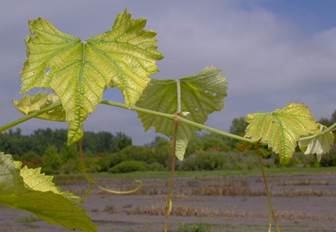
Iron chlorosis due to high soil pH.

Photo: Harlene Hatterman-Valenti, North Dakota State University

Growers of cold-hardy grape cultivars are currently relying on mineral nutrition and soil management practices developed for Vitis vinifera or V. labrusca. Therefore, Carl Rosen and James Crants at the University of Minnesota are leading the effort to develop this information specifically for cold-hardy grape cultivars. Soil and tissue samples, as well as yield data (including juice chemistry analysis) are being collected in 15 sites in IA, MN, NY, ND, and SD, focusing on Marquette, Frontenac, and La Crescent.

This issue of News You Can Use contains links to a webinar and a newsletter article that cover the basics of soil fertility and appropriate methods for collecting soil and tissue samples, as well as interpretation of the results:

March 12, 2013 “Vine Nutrition” Webinar by Carl Rosen and Paul Domoto

Link to slides

http://northerngrapesproject.org/wp-content/uploads/2012/03/Northern-Grapes-Symposium-March-12-Grapevine-Nutrition.pdf

Feb. 28, 2014 (Vol 3 Issue 1) Northern Grapes News. “Assessing the Nutrient Status of Cold-Hardy Wine Grapes” by Carl Rosen and James Crants, pg. 6-8.

http://northerngrapesproject.org/wp-content/uploads/2014/02/2014FebruaryNGPnewsletter.pdf

Additionally, the Year 3 Northern Grapes Project Progress Report contains a research report that includes the results thus far of the research effort led by Carl Rosen and James Crants:

Grapevine Nutrition and Juice Quality by Carl Rosen and James Crants.

http://northerngrapesproject.org/wp-content/uploads/2015/02/Mineral-nutrition-and-soil-management.pdf

The Northern Grapes Project is funded by the USDA’s Specialty Crops Research Initiative Program of the National Institute for Food and Agriculture, Project #2011-51181-30850

Chrislyn A. Particka, PhD

Extension Support Specialist

Cornell University

Department of Horticultural Sciences

630 W. North Street

Geneva, NY 14456

cap297

315-787-2449 (desk)

315-787-2216 (fax)

www.northerngrapesproject.org

Vineyard spraying and wet weather

by Terence Bradshaw

After one of the driest Mays on record, we are closing out June as one of the wettest in many areas, and that means the potential for diseases in Vermont vineyards. Recent weather has been excellent for development of our major diseases: phomopsis, black rot, powdery mildew, downy mildew, and anthracnose. I have often relied upon my predecessor Dr. Lorraine Berkett’s recommended initial vineyard IPM program to get us through spring and early summer, but the past few weeks would likely test that minimal approach. Here’s a recap of those recommendations:

By now, growers should be at or approaching the second post-bloom application, and I do not recommend skipping this one. Since this was written in 2009, several other fungicides have been released that may replace Sovran/ Abound or Pristine on the program, including Revus Top and the two Luna products (Experience & Tranquility). Please refer to the 2015 New York and Pennsylvania IPM Guidelines for Grapes for specific materials and rates, or contact me directly with specific questions. Also, consider shortening intervals when excessive excessive rain has fallen: the rule of thumb is that 2″ of rain washes off all fungicide protection, and newly emerged leaves since the last application will have only minimal fungicide coverage from redistribution of weathered, previously applied sprays. Organic growers who are relying on copper, sulfur, and/or biofungicide materials this season should be really tightening their schedules, and planning carefully scouting for and removing disease infected foliage and fruit. The good news is that within a couple of weeks berries will be building resistance to black rot, but downy and powdery mildew and botrytis still demand attention.

The main insects of concern are rose chafers and foliar phylloxera, although the latter are not something I would be too concerned about. Again, specific materials for use against these pests are listed in the NY/PA guide. Growers often use carbaryl against foliar-feeding beetles like rose chafer and Japanese beetle, but in many cases, tolerance is also effective as long as foliage feeding doesn’t get too overwhelming (and less tolerance should be given on young vines).

Nectria twig blight and summer insect pests.

by Terence Bradshaw

We’re in a bit of a quiet window for pest management in Vermont orchards. Apple scab primary ascospore release is done, and if you have no scab in the orchard, you’re done for the year managing that disease. For anyone with a scab issue, maintaining fungicide coverage every 10-14 days or after 2″ of rain will be important until terminal bud set when leaves and fruit become less susceptible to secondary infections. I’ve seen little fire blight, despite the infection periods predicted in the pest models. I’ve said this before- cut out any fire blight strikes as soon as you see them, and feel free to contact me to evaluate any questionable strikes. I have seen several instances of Nectria twig blight this season that look much like fire blight, but are caused by a relatively weak fungal pathogen. Nectria often infects winter-damaged wood, which I am seeing a lot of this year. The most notable characteristic that identifies Nectria compared to fire blight is that Nectria-infected shoots will have a very distinct delineation between dead (brown) and live (green) tissue at the base of the dead shoot. Fire blight shoot blight will typically show a gradation between dead and living tissue as well as water soaked cambial tissue in the area of visible infection. The only management technique for Nectria is to prune it out, and maintain the orchard with good pruning and nutrition to ensure good cold hardiness. Summer diseases such as sooty blotch/flyspeck and fruit rots are the main concern now. Dr. Dave Rosenberger’s comments from June 23, 1014 issue of Scaffolds provide good insight into managing these diseases. Take home message (read the article for specifics): Captan alone or with another material will likely be in your spray program every 2-3 weeks for the next month or two, especially if this wet weather continues.

Apple maggot traps should be hung any time now to monitor for this pest. I observed my first trapped apple maggot fly at the Hort Farm yesterday in an especially problematic block, so they will be flying in commercial orchards any day now. Other insect pests of concern potentially include obliquebanded leafroller and codling moth. skingsle ASAP.

-Terry

June 30 Orchard Tour Agenda

by Terence Bradshaw

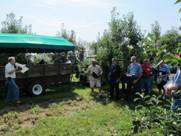
Please see the attached itinerary for the June 30 Champlain Valley Orchard Tour. Cornell Entomologist Peter Jentsch will be with us on the tour to discuss summer insect pest management.

We will begin at 9:30 AM at Hick’s Orchard in Granville, NY, then travel north to Champlain and Sentinel Pine Orchards in Shoreham, VT. This will be a self-driven, caravan-style tour. We will provide drinks and light refreshments, but please plan on packing a lunch for the day.

RSVPs are requested, please email Sarah Kingsley-Richards with your name and the number of persons who will attend at: skingsle

150630_SummerOrchardTour.pdf

Orchard management week of June 15

by Terence Bradshaw

Apparently I need to go away for a week for us to get any significant moisture, and boy did we get it. The good news is that apple scab ascospores should be all released now, so if you maintained good protection during the primary infection season, You should be done by now. If you have any question about fungicide coverage, be sure to carefully inspect the orchard for lesions that could cause secondary infections during the summer. Lesions from the May 28 infection period should be visible by now. The bad news is that no matter what was last sprayed, there is likely zero fungicide residue in orchards unless they were treated recently. Sooty blotch and flyspeck (SBFS)are the main diseases of note now, and will require treatment to manage them. Dr. David Rosenberger wrote a good summary article on SBFS management in the June 23, 2014 issue of Scaffolds. Fire blight infections should be visible in orchards by now. Please let me know if you are seeing this disease in your orchard. At this point, if you have it, the primary management strategy is to cut it out.
Codling moth eggs are hatching now, and insecticides targeted at larvae should be applied as soon as possible.
Results from apple thinner applications should be evident by now, and I am hearing from many growers that there is excessive fruit in their orchards. I do not have enough experience with ‘rescue thinning’ at this point to recommend it, your best option to reduce crop load may be to hand thin. Hand thinning at this point will have little effect on return bloom. For growers who are concerned about poor blossom bud development for next year’s crop, especially on biennial-tending cultivars (Honeycrisp especially), application of a return bloom enhancer such as Fruitone or Ethrel may be considered. Specific materials, rates, and timings are found in Chapter 11 of the New England Tree Fruit Management Guide.

Save the Date: Champlain Valley Orchard Tour June 30

by Terence Bradshaw

Please consider joining us for a tour of Champlain Valley orchards sponsored by the UVM Fruit Team, UVM Extension Risk Management Agency, Vermont Tree Fruit Growers Association, and Cornell Cooperative Extension on June 30, 2015. Final details are still being arranged, and an agenda will be forthcoming.

Cornell Entomologist Peter Jentsch will be with us on the tour to discuss summer insect pest management.

We will begin at 9:30 AM at Hick’s Orchard in Granville, NY, then travel north to Champlain and Sentinel Pine Orchards in Shoreham, VT. This will be a self-driven, caravan-style tour. We will provide drinks and light refreshments, but please plan on packing a lunch for the day.

More details will be coming soon. RSVPs are requested, please email Sarah Kingsley-Richards with your name and the number of persons who will attend at: skingsle@uvm.edu

TB