Please see the attached information regarding the November 20 deadline to apply for crop insurance for the 2017 crop.
TB
 University of Vermont
Please see the attached information regarding the November 20 deadline to apply for crop insurance for the 2017 crop.
TB
As harvest approaches, it is critical to track ripening in the vineyard to best achieve the juice chemistry values to optimize wine quality. Sampling should be methodical and regular (at least weekly, or more often as harvest approaches). Generally a 100 berry sample is sufficient to ascertain general ripeness. Berries should be randomly selected, but should come from a diverse distribution in the vineyard: from all parts (top, shoulder, bottom) of the cluster, and from clusters well-distributed through the canopy. Fruit can be collected into a plastic bag, crushed lightly, then a corner of the bag cut off to squeeze juice into a sampling jar. Juice should then be assessed for pH, sugars, and titratable acidity (TA). Remember that for most popular cold climate grapes, TA is a primary determinant for ripeness; for reds (Frontenac, Marquette), a target TA of 1.5% or lower is preferred; for whites, 1.2% should be considered the upper end, although La Crescent may frequently have higher values. Ideally, all grapes for winemaking should have TA below 1%, but that is not always possible for the cultivars that we grow. Work with any wineries you plan to sell grapes to to determine their preferred juice chemistry levels before harvest.
Juice chemistry tracking for cultivars in the UVM vineyard may be found at: http://www.uvm.edu/~fruit/grapes/uvmvineyard/2016UVMfieldtesting.pdf
A primer video on evaluating grape ripeness may be found at: http://www.extension.umn.edu/food/small-farms/crops/knowing-when-to-harvest-your-grapes/
Dr. Imed Dami at Ohio State has a good fact sheet on evaluating grape ripeness at: http://ohioline.osu.edu/factsheet/HYG-1436
Sugar level and pH are easily evaluated with simple tools (a refractometer and pH meter, respectively) available from most winemaking supply outlets. TA test kits are typically available from the same vendors. A procedure for measure TA through titration is available at: http://www.extension.iastate.edu/wine/titratable-acidity
http://northerngrapesproject.org/wp-content/uploads/2016/08/NG-News-Vol5-I3-Aug-2016.pdf

Northern Grapes News, Volume 5, Issue 3, August 2016
In this issue:
– What we Have Accomplished: Reflections on the Northern Grapes Project.
– NGP Team Profile: Ann Hazelrigg.
– Murli Dharmadhikari: Four Decades Leading the Midwest Grape and Wine Industry.
– Northern Grapes Project Survey Shows Growth.
– Managing Nutrition in Cold-Climate Vineyards.
Chrislyn A. Particka, PhD
Extension Support Specialist
Cornell University
School of Integrative Plant Science, Horticulture Section
630 W. North Street
Geneva, NY 14456
cap297
Apple harvest is just around the corner with reports of early varieties like Paulared and William’s Pride coming in as ready to pick. The use of plant growth regulators to help with harvest management and improve fruit quality is an important tool in many orchards. ReTain plant growth regulator is used to slow ethylene synthesis in ripening fruit to delay maturity and reduce preharvest drop. Given the dry and hot conditions experienced this summer, drop potential is high, and growers should plan on treating their orchards more often than not. One or two applications may be made at the rate of one pouch (11.7 oz) per acre each. Application 21 to 28 days prior to normal harvest will delay ripening 7-10 days and improve fruit storability. ReTain is especially recommended on McIntosh, and reduced rates (1/2 pouch each application) suggested for Macoun and Honeycrisp. ReTain also improves fruit quality on Cortland and Gala.
Dr. Duane Greene from UMASS recently outlined the following guidelines for ReTain use in 2016:
“Apply ReTain in a sufficient amount of water to ensure that flowers, fruits, and foliage receive thorough spray coverage using calibrated spray equipment. Adjust water volumes based on plant size and spacing. However, excessive spray application volumes resulting in spray runoff will reduce product efficacy.
Avoid applications during the heat of the day. For best results, apply ReTain under slow drying conditions, e.g. early in the morning or at night, in order to maximize adequate absorption.
Do not apply ReTain if rain is expected within 8 hours of application.
Do not apply ReTain to plants of fruit under considerable stress (i.e., heat, water, disease, insect).
Maintain application solution between pH 6-8.
For optimal response, use ReTain with a 100% organosilicone surfactant. Use a final surfactant concentration of 0.05 to 0.1% ( i.e. 6-12 oz surfactant per 100 gallons spray water) in the spray tank. To prevent possible spotting, use the 0.05% concentration when high temperature (in excess of 86°F) weather conditions prevail or are anticipated. Do not use a surfactant concentration greater than 0.1%. To reduce foaming, add the adjuvant last and minimize agitation.
ReTain may be applied in a single application of 1 to 2 packets per acre (or less), or in two applications of 1 packet per acre (or less) each. See the Supplemental Label for additional information: http://bit.ly/2bar9gZ
ReTain has a 7 day pre-harvest interval (PHI) for Apple and Pear.”
Dr. Greene’s presentation slides on PGR use in apples from the 2015 UVM Apple Program/ VTGFA Winter Meeting can be found at: http://www.uvm.edu/~fruit/treefruit/tf_meetings/PGRsVTFGA15.pdf
August 15, 2016
Grapes are at or near veraison in Vermont vineyards, which signals the start of fruit ripening. This is an important time of year for a few activities. First, bird damage can be expected to begin and increase as fruit ripen. Birds will harvest your berries just a day or two before you’re ready to, so if you don’t have damage yet, don’t think you’re out of the woods. Netting is the best method of protection. Auditory scare calls, propane cannons, and inflatable ‘used car lot’ balloons are sometimes used as well, but their effectiveness is questionable and their annoyance factor significant. Dr. Alan Eaton from the University of New Hampshire wrote a good guide on prevention of bird damage in fruit plantings, available at: https://extension.unh.edu/resources/files/Resource001797_Rep2514.pdf.
Now is the time for plant tissue testing as well. Petiole samples may be collected at bloom or veraison, and comparisons between years or blocks should be based on the same time of collection.
Samples should be collected separately for each cultivar or block. In each sample, a random collection of 75-100 petioles should be collected from throughout the planting. Petioles should be collected from the most recent fully expanded leaf on the shoot, not across from the fruit cluster as is collected for a bloom sample. Just remove the whole leaf and snip the petiole (the leaf ‘stem’ off with your pruners. Gently wash each sample in water with a drop of dish detergent, then rinse fully and place in an open-top paper bag to dry. The closest analytical lab for grape petiole analysis is the Cornell Nutrient Analysis Laboratory . Please note that they now have partnered with Agro-One Services. It is recommended that you contact them before you send any samples to confirm that recommendations will be sent along with the analysis and to confirm costs.
Video about petiole sampling: https://www.youtube.com/watch?v=8EHbojLfXek
Start making plans for harvest and crush now. This may be a good time to thin out any lagging ‘green’ clusters that developed from secondary buds and are lagging in ripeness. Remember, you’re looking for crop uniformity. You can estimate yield by counting clusters on a few representative vines and multiplying by the typical cluster weight for your vineyard. If this is unknown, use 0.25 pounds (113 grams) per cluster, which is the average we have recorded at the UVM vineyard for Minnesota cultivars from 2010-2015. Your formula should look like this:
Estimated tons/acre = average # clusters/vine * 0.25 lbs/cluster * # vines per acre /2000 (pounds per ton)
For the UVM vineyard, where we have 726 vines per acre [43560 sq feet/acre / (6 feet between vines * 10 feet between rows)] = 726, the crop estimate for 50 clusters per vine is:
4 tons/acre = 50 * 0.25 * 726 / 2000
Four tons per acre is a good crop for mature, healthy vines for most cold climate cultivars; some vigorous vines in good health may support higher crop yield but I wouldn’t push mush more than 5.5 tons per acre lest you compromise ripening. If you have too many clusters, thin out the smallest and greenest ones to get your target cluster number. This exercise will help you plan lugs, bins, and tank space, as well as allow you to communicate that information to any wineries you plan to sell to.

News You Can Use
Canopy Management and Light Interception
July 2016
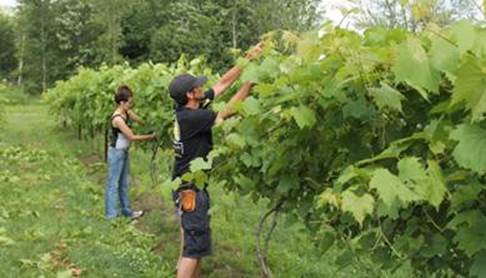
Shoot tipping and basal leaf removal in Frontenac training systems trials in Clayton, NY.
(photo by T. Martinson).
Canopy management involves manipulation of vine growth to achieve production goals such as optimizing light interception, managing disease pressure, adjusting cropping levels or maximizing fruit quality. Site selection, grape variety, training system, soil fertility, and water management will all influence the amount of canopy management needed throughout the season. However, canopy management is labor intensive, so it is important to understand the costs and benefits associated with these practices. Mike White and Tim Martinson covered various canopy management practices, and the economics of them, in the February 2012 Webinar “Nuts and Bolts of Canopy Management.”
As canopy management affects light exposure to the clusters, this month we will also review the work being done in Clayton, NY, looking at the difference in fruit chemistry between shaded and exposed clusters of Marquette and Frontenac. In short, clusters exposed to sunlight have lower titratable acidity and higher soluble solids at harvest than clusters that are shaded. A research report from the Year 4 Northern Grapes Project Progress Report has complete details.
February 2012 Webinar “Nuts and Bolts of Canopy Management” http://youtu.be/eBGfmsSVJsM
Research Report “Impact of Shading on Frontenac & Marquette Fruit Composition” http://northerngrapesproject.org/wp-content/uploads/2016/02/NY-shaded-vs-exposed-Year-4.pdf
Additional Info: 2016 Preliminary Results. This year we are looking at ways to increase light interception by using a rake wire and “downward shoot positioning,” along with cluster-zone leaf removal, on high cordon-trained Frontenac at Clayton. The two-factor experiment involves:
1. Use of a rake wire to constrain canopy (Y or N)
2. Shoot combing and/or leaf removal in the cluster zone.
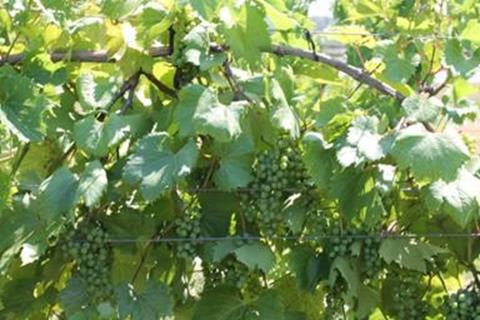
Rake Wire: Two moveable wires on each side of the canopy were used to constrain the canopy downward. They were at the top of the canopy at the start of the season and were moved down, with shoots tucked behind them, as the season progressed.
Last week we used a light meter to compare ambient light to the light reaching the cluster zone in this experiment. Preliminary results showed that shoot combing + the rake wire resulted in elevated light exposure – the range of values indicated by box plots below being similar to the “Rake Wire + Leaf Removal” treatment. Compare to the ‘no rake wire’ values at the left.
W
 |
e will collect samples to compare fruit composition under these treatments this fall.
The Northern Grapes Project is funded by the USDA’s Specialty Crops Research Initiative Program of the National Institute for Food and Agriculture, Project #2011-51181-30850
Chrislyn A. Particka, PhD
Extension Support Specialist
Cornell University
School of Integrative Plant Science, Horticulture Section
630 W. North Street
Geneva, NY 14456
cap297
CCE Fire Blight Workshop, Tuesday August 2nd, Plattsburgh, NY
This Tuesday, August 2nd from 10AM to Noon, we will be holding a Fire Blight Workshop in Plattsburgh, NY. The workshop will be held at the Valcour Brewing Company; this is a new establishment in downtown Plattsburgh, near the oval.
In light of the circumstances this season, Srdjan Acimovic, pathologist at the Hudson Valley Research Lab, and Dave Rosenberger, retired pathologist Hudson Valley Research Lab, will be presenting information on fire blight management, conditions that led to this season’s situation, and how to predict fire blight infections in the future.
Date: Tuesday, August 2nd
Time: 10AM – Noon
Location: Valcour Brewing Company, 49 Ohio Ave, Plattsburgh, NY 12901
This event is FREE. Thank you to CPS for sponsoring the event.
Anna Wallis
CCE Extension Associate – Fruit Specialist
Eastern NY Commercial Horticulture Program
6064 State Route 22 Suite 5
Plattsburgh, NY 12901
Cell: 518.410.6823
Fax: 518.561.0183
aew232@cornell.edu
Wellwood Orchards, Inc. is seeking a Working Field Manager-
Wellwoods is a diversified fruit farm.
Our 200+ acre farm has 70 acres of strawberries, blueberries, raspberries, cherries, peaches, plums, grapes, apples, pears and fall squash as well. Our retail store is a popular stop for our hand picked produce, homemade canned goods, fresh pressed cider, gift items, candies, fudge, cheese, fresh eggs, our famous cider donuts, pies and other baked goods. Wellwoods on site petting zoo is an affordable entertaining place for the young and old alike. Our family owned PYO farm has an established customer base and we continue to grow in the agritourism market with our seasonal community events.
This is a Full Time employment opportunity for a Working Field Manager that possesses a high level of practical orchard operations, entomology and tree fruit knowledge. They must also enjoy and be familiar with large farm equipment operation and repair, physical hard work, working outdoors year round, and able to work weekends during harvest and nights on occasion. This individual must be self-motivated, enjoy teaching and leading, demonstrate analytical, problem solving, communication, computer, and record keeping skills, and have excellent time and stress management abilities.
They would be pruning, planting, fertilizing, spraying, thinning, mowing, harvesting and storing fruit as well.
We’d like to meet an energetic individual that is willing to adapt and grow with us.
We are looking for at least 3 years of orchard experience, longevity and someone that wants to settle in! If that is you, please Reply to this email with your letter of interest and qualifications. References will be needed after contact.
Potential for future professional advancement.
Contact me with your resume and letter of interest at:
livefriedmanordie
Linda Mark Friedman
Heads-up on a meeting Anna Wallis at Cornell Cooperative Extension is pulling together. I’ll pass word on about location when it’s available. -TB
Please save the date for next Tuesday, August 2nd for a Fire Blight Workshop to be held in Peru. In light of the circumstances this season, Srdjan Acimovic, pathologist at the Hudson Valley Research Lab, and Dave Rosenberger, retired pathologist Hudson Valley Research Lab, will be presenting information on fire blight management, conditions that led to this season’s situation, and how to predict fire blight infections in the future.
Date: Tuesday, August 2nd
Time: 10AM – Noon
Location: Peru, NY (Location TBD)
We are in the quiet time of apple season, when growers and researchers alike can take a little time off. That said, recent heavy rain showers (ok, downpours) have likely removed fungicide residues in orchards several times this month. However, leaf wetness periods have been relatively short, so although there have been infection periods for sooty blotch and flyspeck, they have not been especially severe. Maintenance of fungicide coverage through August for wholesale fruit is still recommended, but retail and pick-your-own orchards can relax a bit.
Apple maggot fly are moving and will likely need or have already needed treatment in problem orchards. Orchards with history of light damage may get away with border row sprays, but whole orchard sprays are recommended for orchards with a history of even moderate damage. Of course, locating a red sticky ball in the orchard interior will let you know if the flies are active beyond the borders.
Codling moth second generation flight is beginning now. Plan to treat for this pest in about ten days, and use NEWA to most accurately time treatment.
All sprays at this time of year should include some form of calcium to improve fruit quality and avoid biter pit, especially on large-fruited cultivars like Honeycrisp and Cortland.
It is the time in the growing season to collect leaf samples for analysis. Samples are usually collected between July 15 – Aug. 15. The UVM Agriculture and Environmental Testing Lab can provide analysis, but at this time their output does not generate fertility recommendations. The following are potential options of labs for analysis. It is recommended that you contact the lab for instructions and costs before samples are sent. Plus, it is important to confirm that they will send recommendations along with the analysis.
(1) University of Maine Analytical Lab: http://anlab.umesci.maine.edu/
(2) University of Massachusetts Soil and Tissue Testing Lab: http://www.umass.edu/plsoils/soiltest/
(3) Cornell Nutrient Analysis Lab: http://cnal.cals.cornell.edu/