Important clarification- 5/23 New York Petal Fall meeting, no tour

By Terence Bradshaw

Sorry folks, I’ve advertised a tour that doesn’t exist. The Tuesday, May 23rd petal fall meeting will be held at 3:00 at Rulf’s Orchard in Peru, NY. There is no pre-meeting tour.

3PM: Thinning Meeting, Rulfs Orchard, 531 Bear Swamp Rd, Peru

Cornell Fruit Program Champlain Valley Petal Fall Meeting

Tuesday May 23, at 3PM

Rulfs Orchard

531 Bear Swamp Rd

Peru, NY 12972

Agenda:

Brief Introduction & Program Announcements – Wallis & Donahue, CCE ENYCHP

Fire Blight Survey – Liz Higgins, CCE ENYCHP

ENY Entomology Update – Peter Jentsch, HVRL

ENY Pathology Update – Dr. Srdjan Acimovic, HVRL

Thinning, Panel Discussion –

– Dr. Poliana Francescatto, Cornell NYSAES

– Jim Eve, Eve Farm Services LLC

– Dr. Greg Peck, Cornell University

– Dr. Terence Bradshaw, UVM

– Dan Donahue, CCE ENYCHP

– Anna Wallis, CCE ENYCHP

Where trade names or commercial products are used for identification,

no discrimination is intended and no endorsement is implied.

Always read the label before using any pesticide.

The label is the legal document for the product use.

Disregard any information in this message if it is in conflict with the

label.

The UVM Tree Fruit and Viticulture Program is supported by the

University of Vermont Agriculture Experiment Station, a USDA NIFA E-IPM

Grant, and USDA Risk Management Agency Funds.

Petal fall pre-discussion

By Terence Bradshaw

May 21, 2017

Most Champlain, Connecticut, and Taconic valley orchards are at petal fall or quickly approaching it, which means the management needs will ramp up quickly- insect and disease management; nutrient application, mowing/herbicide/cultivation; and, of course, thinning. I’ll be wrapping my head around thinning options in the next few days, but for now, virtually every orchard should receive a petal fall application of carbaryl or, if organic, lime sulfur to aid in thinning. Like every odd-numbered year since 2011, this looks like a heavy crop, and your best bet for a good crop next year is to take 80+% of it off now. This is not a year to be shy with thinners, but also recognize that foliage that developed during cool, cloudy weather, as well as trees that were drought-stressed last year, will respond more to thinners than non-stressed trees. On the other hand, sunny to partly cloudy, seasonably warm (not hot) weather like we’re expecting this week reduces the carbohydrate deficit in trees which is what drives thinning treatments, so we really can expect a fairly ‘normal’ thinning season overall.

That said, I will reserve specific recommendations until after Tuesday’s Petal Fall/Thinning meeting in New York, which all are invited to and which was discussed in a previous message. Wednesday looks like a decent spray day anyway, so I expect we’ll have a better handle on things by then.

I hope to see many of you in the Chazy/Peru (NY) area Tuesday,

Terry

Where trade names or commercial products are used for identification,

no discrimination is intended and no endorsement is implied.

Always read the label before using any pesticide.

The label is the legal document for the product use.

Disregard any information in this message if it is in conflict with the

label.

The UVM Tree Fruit and Viticulture Program is supported by the

University of Vermont Agriculture Experiment Station, a USDA NIFA E-IPM

Grant, and USDA Risk Management Agency Funds.
Disease management in Vermont grapes- the season begins

By Terence Bradshaw

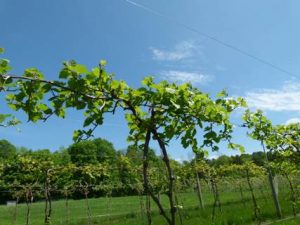
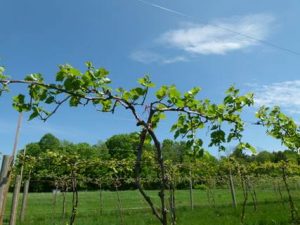
Grapes are moving fast in Vermont vineyards, with most cultivars in the UVM vineyard at about 2” shoot growth. Shoot thinning now will give best results before the vines waste energy on growth that you won’t keep. We typically aim for 4-6 well-spaced shoots per foot of canopy, selecting for the most healthy/vigorous and those with appropriate orientation for our downward training system (high-wire cordon).

Figure 1 Before shoot thinning

Figure 2 After shoot thinning

This is a typical time to start thinking about a spray program to manage disease. The primary disease of concern at this point is phomopsis, as rachis infection at this point in the season is may cause significant fruit loss at harvest. Anthracnose may also be active at this point , given the warm/hot weather we recently had. Vineyards that have had recent problems with those diseases or organic growers using copper or other less-effective materials may consider treating this week; if you haven’t had major problems with those diseases, treatment can wait until the 5-8” growth stage as long as you are using a highly effective contact fungicide like mancozeb or captan.

As a reminder, a refreshed version of the Initial IPM Strategy for New Cold Climate Winegrape Growers is available at: http://www.uvm.edu/~fruit/grapes/gr_ipm/InitialIPMStrategyGrape2017.pdf

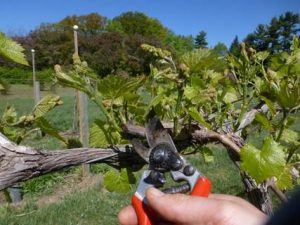
Organic growers are in for a bit more work. The standard fungicides, copper and sulfur, have only fair efficacy against this disease at best, and in a couple of weeks when black rot becomes the next disease of concern, those materials will have even less efficacy against that disease. The first line of defense in an organic vineyard is a strict sanitation program. This includes removing all mummies still in the canopy (not dropping on the ground, but actually removing them from the vineyard) as well as any obviously diseased wood. Phomopsis and anthracnose both overwinter largely on infected wood in the canopy, and removing this wood during dormant pruning or now is essential to reducing disease pressure. Stubs left at the ends of spurs should now be removed since you can see where this year’s shoot growth will resume (at the developing shoot)- these stubs will die and may become infected with phomopsis this season (or were last season) .

Figure 3 Removing stubs at end of retained spurs.

It is worth noting that both copper and sulfur (including lime sulfur) can cause phytotoxicity on certain cultivars. Dr. Patty McManus summarized her research on copper and sulfur sensitivity in cold-hardy grapes in the 2/8/16 Northern Grapes newsletter, and I’ll summarize it to say that Brianna should receive no copper; and Frontenac (all types), La Crescent, Leon Millot, Marechal Foch, Marquette, and St. Croix should receive no more than 2-3 copper sprays per season. Save those for later when black rot and downy mildew become bigger concerns. Sulfur sensitivity was observed on several cultivars, and its use (including lime sulfur) is discouraged on Foch, Millot, Brianna, and Louise Swenson; with limited (2-3) applications suggested on LaCrescent and St. Croix.

So, if you have removed all diseased wood and are ready to cover your vineyard for protection against phomopsis and anthracnose, the best choices is likely lime sulfur applied at two quarts per acre in sufficient water (25-30 gallons should do it) to wet the canopy. Lime sulfur is hot stuff: caustic, corrosive, and noxious. Use appropriate personal protective equipment and spray in cooler weather to reduce phytotoxicity. Powdered sulfur may also be a good choice, I would suggest 3-5 pounds per acre at this stage.

Where trade names or commercial products are used for identification,

no discrimination is intended and no endorsement is implied.

Always read the label before using any pesticide.

The label is the legal document for the product use.

Disregard any information in this message if it is in conflict with the

label.

The UVM Tree Fruit and Viticulture Program is supported by the

University of Vermont Agriculture Experiment Station, a USDA NIFA E-IPM

Grant, and USDA Risk Management Agency Funds.
Trauma blight

By Terence Bradshaw

May 19, 2017

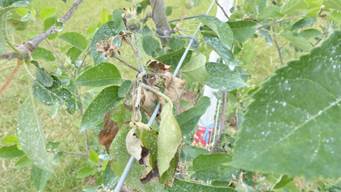
An short, extremely intense line of thunderstorms passed through the state last night, accompanied with damaging high winds and, in some cases, hail. I was cutting trees out of our road soon after to make it passable, a neighbor lost 24 around his relatively small yard, many uprooted. That type of weather event can trigger trauma blight, where fire blight bacteria is moved to new abrasions and other wounds resulting from the storm damage.

Although the storm brought cooler temperatures, which will drop the bacterial inoculum levels in most orchards, that high inoculum of E. amylovera was around right before the storm. Many growers applied streptomycin in the past couple of days to protect against the infection that likely occurred to open blossoms as a result of last night’s wetting. Now I’m going to suggest, especially in high-risk blocks that had fire blight last year, getting out there again and putting on a second strep spray ASAP (as in, between now and tomorrow morning) to protect against trauma blight.

If you had hail or other damaging weather, make sure to contact your crop insurance agent within 72 hours.

Where trade names or commercial products are used for identification,

no discrimination is intended and no endorsement is implied.

Always read the label before using any pesticide.

The label is the legal document for the product use.

Disregard any information in this message if it is in conflict with the

label.

The UVM Tree Fruit and Viticulture Program is supported by the

University of Vermont Agriculture Experiment Station, a USDA NIFA E-IPM

Grant, and USDA Risk Management Agency Funds.
Cornell Champlain Valley Thinning Meeting Next Tuesday 5/23

By Terence Bradshaw

It’s hot today, it doesn’t take an expert to tell you that. Bees should be moving; orchards all over the state including in the inland, cooler regions are at least in king bloom. Hopefully you got a fire blight spray on if you’re at all concerned about that disease in your orchard. We found a short window of relatively calm weather this morning to treat the UVM orchards.

Next Tuesday, Anna Wallace and the rest of the Eastern New York Commercial Horticulture Program will host tours of orchards in the morning and a thinning meeting in the afternoon. I strongly recommend anyone who can make this meeting do so, there will be a lot to talk about and you’ll have the experts there to cover all of your questions, From Anna:

Hello everyone-

The Champlain Valley Petal Fall Meeting will be next week Tuesday 5/23 at 3PM.

Here is the approximate agenda for the morning orchard tour and the meeting agenda. I hope you will all be able to join us for the morning tour. If not, please be in touch and we will meet with you when you are able to join us. Addresses are approximate, so please be in contact with me if you’re arriving late. My Cell: 518-410-6823.

Morning Tour – approximate agenda

9-10AM: Chazy Orchards, 9486 U.S. 9, Chazy

10:30AM: Everett Orchards, 345 Pleasant St (22B), Peru

11:30AM: Forrence Orchards, 86 River Rd, Peru

12:30 Noon: Quick Lunch, TBD

1PM: Northern, 537 Union Rd, Peru

2PM: Hart (if time allows), 2327 Rt22, Keeseville

3PM: Thinning Meeting, Rulfs Orchard, 531 Bear Swamp Rd, Peru

Champlain Valley Petal Fall Meeting

Tuesday May 23, at 3PM

Rulfs Orchard

531 Bear Swamp Rd

Peru, NY 12972

Agenda:

Brief Introduction & Program Announcements – Wallis & Donahue, CCE ENYCHP

Fire Blight Survey – Liz Higgins, CCE ENYCHP

ENY Entomology Update – Peter Jentsch, HVRL

ENY Pathology Update – Dr. Srdjan Acimovic, HVRL

Thinning, Panel Discussion –

– Dr. Poliana Francescatto, Cornell NYSAES

– Jim Eve, Eve Farm Services LLC

– Dr. Greg Peck, Cornell University

– Dr. Terence Bradshaw, UVM

– Dan Donahue, CCE ENYCHP

– Anna Wallis, CCE ENYCHP

Again if you have any concerns or questions, please let me know.

Thank you again for assisting with this meeting!!

Anna

Also: I will be along for the whole tour and meeting, so if you have any questions about where we are at any time, feel free to call me during the day at: (802)922-2591. –Terry

Where trade names or commercial products are used for identification,

no discrimination is intended and no endorsement is implied.

Always read the label before using any pesticide.

The label is the legal document for the product use.

Disregard any information in this message if it is in conflict with the

label.

The UVM Tree Fruit and Viticulture Program is supported by the

University of Vermont Agriculture Experiment Station, a USDA NIFA E-IPM

Grant, and USDA Risk Management Agency Funds.
Fire blight risk for Thursday and Friday of this week

By Terence Bradshaw
May 16, 2017

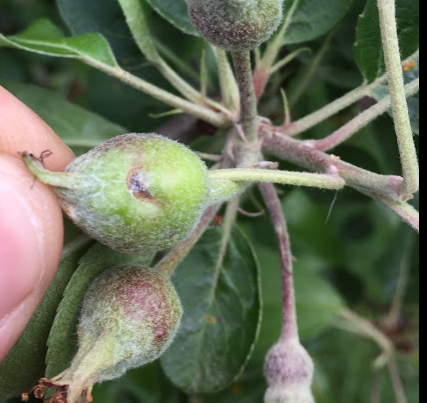
Okay, we’ve been hinting around about it for weeks, and the risk for fire blight will be upon us later this week. Warm weather today, and hot weather Wednesday and Thursday will allow for substantial increase in populations of E. amylovera, the bacteria that causes fire blight. Once that population is sufficiently high (characterized as the EIP or epiphytic infection potential in NEWA, 100 is considered high enough to cause infection), you need three factors for infection to occur: open wounds (i.e. blossoms or fresh pruning cuts); mean temperature above 60°F; and wetting, even a spray or dew event can be enough to move bacteria into susceptible openings.

This risk is pretty much widespread across the state. The thing to remember is that protective measures, i.e. application of streptomycin in most orchards, or caustic materials/biological controls in organic orchards, must be applied to open wounds or blossoms within 24 hours before or after infection. So if we assume that an infection event occurs in a rain event Thursday afternoon, you’ll want strep or another material (really, if your orchard isn’t certified organic, strep is the only material to consider) on by mid-day Friday. It will be hot Thursday, so blossoms will be opening all day (or petals falling on cultivars that have finished bloom already) and potential for phytoxicity will be greater. The later you can go, the better to make sure you cover any blossoms that open, but don’t delay and miss it. It’s also going to be on the windy side, so there’s that.

Harbour is the strep material available to most growers. I would recommend applying at 1-2 pounds per acre based on tree canopy volume, if in doubt, err on the lower end. I also recommend including a wetting agent like Regulaid or LI-700. If possible, apply on its own, without other fungicides or insecticides (you are in bloom, so no insecticides anyway). You will get leaf yellowing from this application, expect it and the tree will soon grow out of it. One application Wednesday PM-Friday AM should cover you. Once any particular blossom is treated, it’s protected. Temperatures are expected to drop after Friday, which lowers risk, but if high risk continues through the weekend and you keep having blossoms open, then a second application Saturday-Monday (I have no good idea of what the weather will be five+ days from now) may be warranted.

Trees that are at full petal fall are not susceptible, but straggling late blooms can be infection sites. Ideally, the whole orchard would be treated. If you need to prioritize, go first for cultivars that had fire blight last year or highly susceptible cultivars (Gala, Ginger Gold, Honeycrisp, Cortland, Paulared, etc), and of course blocks that are in bloom. Application well after Thursday’s infection event, on Saturday or later, will not give protection against it. Also, despite the wording on the Harbour label, continued treatment every 10-14 days after bloom is not recommended, and doing so is a) expensive, b) a waste, and, most importantly, c) the best way to develop antibiotic resistance in E. amylovera populations.

For organic growers, Actinovate, BlightBan A506, Bloomtine Biological, Blossom Protect, Double Nickel, Regalia, and Serenade are labeled biological controls. I can’t vouch for any of their effectiveness, and I know that some growers apply copper or lime sulfur (warning- both are very phytotoxic) during bloom to manage the disease but again, no promises are offered from me there. If you can, I would suggest Serenade or one of the other biological materials if you have it on-hand and to watch carefully for symptoms which will require cutting out.

I’ll be following up on this as things develop. The key here is to treat for this week’s infection, then relax.

Terry

Where trade names or commercial products are used for identification,

no discrimination is intended and no endorsement is implied.

Always read the label before using any pesticide.

The label is the legal document for the product use.

Disregard any information in this message if it is in conflict with the

label.

The UVM Tree Fruit and Viticulture Program is supported by the

University of Vermont Agriculture Experiment Station, a USDA NIFA E-IPM

Grant, and USDA Risk Management Agency Funds.
May 14 Orchard thoughts

By Terence Bradshaw

May 14, 2017

Orchards in the Champlain and Connecticut valleys are in full bloom now, and it looks like a good one. After my worrying comments last week about poor weather for bee flight, one grower last Monday told me, “You’re worrying too much. It’ll happen.” And it looks like Thursday and Friday the bees were flying. Although I am not trapping for native pollinators this year, I did notice some small native bees in trees in Putney Thursday afternoon. I wasn’t at the UVM orchard Friday, but my technician told me the bees were moving well. Orchards in cooler upland and inland spots will likely be flowering later this week, which also looks like a period of decent (>60° and sunny)bee weather.

Since we are talking bees, we need to continue to keep them in mind as we begin to think about petal fall and insect pest management. We have found extremely low levels of the usual pink/petal fall insects, tarnished plant bug (TPB) and European apple sawfly (EAS), in orchards all across the state. Some growers predicted and I confirmed a suspicion of a protracted bloom and therefore applied prophylactic insecticides at pink. In terms of bee protection, that is a valid response as long as those who applied a broad-spectrum, non-neonicotinoid material at pink use that extra protection they applied to give a little more time for all petals to drop and to clear out other attractive blooms by mowing before applying the next insecticide. This is our most dangerous timing for potentially damaging bees, because we need to get in to protect the developing crop, but there is still potential for a lot of pollinator activity in the orchard. Remember, pollinators aren’t just the honeybees you bring in to the orchard, and as we have been developing softer, more pest-specific spray programs in recent years, we are encouraging pollinator conservation in the orchards (good), which increases the number of pollinators that could be impacted when we apply that important post-bloom insecticide (not good).

I have been advising growers who are either still at pink or approaching petal fall who have below-threshold populations of TPB and EAS but who have concerns about lepidopteran pests now to consider using only a Bt spray like DiPel. Green fruitworms and obliquebanded leafroller are active now and may be monitored by inspecting 100 blossom/fruitlet clusters and terminal tips in multiple sections of the block and looking for larvae (small green caterpillars). Bt is very effective against moth larvae but has no known effect against most other insect orders, including bees.

Speaking of moths, if you have not already done so, now is the time to hang codling moth (CM) traps in the orchard. These traps are baited with either a pheromone (most common) or fruit volatile (used where CM mating disruption is used) lure and is used primarily to set the biofix date for use in the CM development model in NEWA, so daily or at least 2-4 times per week inspection is needed until the first moths are caught. Trap counts may be collected for the rest of the season to gauge population size and flight patterns. I mentioned CM mating disruption. We have been using this tactic since 2011 after suffering 65-75% damage in our organic orchards at the UVM Hort Farm. This year we have started using a Trece product, Cidetrack CMDA Meso, which reduces the needed number of applicators per acre from up to 200 to 36. This greatly affect the ability of larger-acreage orchards to hang the dispensers. Eric at CPS can provide details on availability and pricing, but growers who wish to try them must be prepared to treat the whole orchard, and should get them up as soon as possible before CM start flying and mating. A good background on using mating disruption in orchards can be found here. It’s a little bit old so the products listed may not be available or registered for use in Vermont.

Fire blight continues to be a non-issue for now, but increasing temperatures forecast for next weekend may trigger an infection, I’ll keep you posted as things develop. Keep in mind that bacteria need open blossoms to cause blossom blight, so as your petals fall, so does your risk. Scab- it’s still active, and I assume everyone is protected for today’s rain. As we get into the late bloom/petal fall window, addition of a material to the usual protectant (mancozeb/captan/sulfur if organic) schedule may be prudent. Consider a strobilurin (IRAC class 11), SDHI (7), or, if the bees are all gone, DMI (3) fungicide in your next spray or two.

Thinning is going to be interesting this year. Every orchard I have seen will need thinning, and I am going to work up some thoughts on recommendations later this week.

Finally, I have been asked to pass on to the orchard community that Dave Boyer, from Boyer’s Orchard in Monkton passed away last week. His obituary can be found here.

Where trade names or commercial products are used for identification,

no discrimination is intended and no endorsement is implied.

Always read the label before using any pesticide.

The label is the legal document for the product use.

Disregard any information in this message if it is in conflict with the

label.

The UVM Tree Fruit and Viticulture Program is supported by the

University of Vermont Agriculture Experiment Station, a USDA NIFA E-IPM

Grant, and USDA Risk Management Agency Funds.
Pink bud in Vermont apple orchards, some thoughts on bloom and pest management

By Terence Bradshaw

May 5, 2017

Ugh. Vermont orchards are largely at tight cluster (inland, cooler sites and cider cultivars) to pink (most of the Champlain Valley, Honeycrisp of course is lagging) to early king bloom in a few spots and even a little full bloom in the warmest spots. Yesterday was a decent but not great ‘bee day’

for those with open flowers, but an extra 3-5 degrees would have moved their activity up a bit. My greatest concern going into the 2017 crop is this weather we’re facing as we go into bloom- gray, wet, and cool. Hopefully bud development will slow sufficiently so that by the time we get king or at least full bloom, we’ve got good bee weather. Pollen viability extends quite a bit in this weather, up to five days or more after a flower opens, so that’s a good sign as well. If you have the ability to get any extra bees in the orchard, consider doing so. And of course if you have any bees flying in the orchard, treat them right- no insecticides, especially neonics and any materials rated highly toxic to bees; lay off sterol inhibitor/DMI fungicides, at least until we learn more about their effects on pollinators; and mow competitive flowering weeds, if necessary, to funnel them to your apple blossoms. I wish I had a magic bullet that would improve pollination/fertilization/fruit set in a tough bee year, but there just isn’t any proven snake oil you can throw at the trees to compensate for this weather, so the best you can do is to promote and protect the pollinators (managed and wild) that we do have.

That said, this may be a year to consider supplemental pollen application. We have blown pollen at the UVM orchard as long as I have been around (over twenty years), and while it’s not a commonplace practice, it’s something I’ve done partly out of tradition (it was one of the first jobs I did when I started at the UVM orchard as an undergrad in May 1995) and partly to improve our overall pollination since we don’t bring in migratory bees (but we do have seven hives on the property). I was going to skip manual pollination this year, but this bad weather had me calling Firman Pollen to order some up to apply next week. I cannot point to a good peer-reviewed study that says it works in all conditions, but supplemental pollination has, anecdotally anyway, been successful for us. Application method is a little tricky and I don’t know if Firman has the leaf blower guns anymore, but it’s worth checking with them. They also have hive inserts that you add to bee hives to increase the amount of pollen that bees are carrying as they travel through the orchard.

Thursday’s weather provided an ideal spray day between rain events, and I assume everyone took the chance to get covered up. We maintained our spray coverage at the UVM orchards- scab sprays (mancozeb + Vangard) on the IPM and cider blocks, and insecticide (Aza-Direct and Dipel) in the Vf-gene scab resistant organic block where scab isn’t a problem but European apple sawfly and green fruit worn perennially are. Those two sentences covered most of what you need to be thinking about as far as pest management in the next week. Apple scab is the primary threat now, and I expect that when it’s all over, the models will call the period from April 30 through May 10 or so one long infection period. We are entering peak ascospore maturity right now, which means the guns are loaded and each wetting event will release more spores and infection will occur unless you’re protected. Keep covered with a protectant fungicide- mancozeb, captan if you haven’t applied oil recently, or sulfur if you’re organic (and same warning with oil). Five to seven days, max, between applications, and remember that an inch or two of rain removes the coverage you just put on. If you have another perfect, dry day like we has yesterday, add in a more broad-spectrum material with kickback activity (i.e. activity after an infection has occurred but before spores penetrate the leaf cuticle) that can broaden activity against rusts or powdery mildew. Remember the tables in the new spray guide to help guide your decisions. This is a good time to use your strobilurin or SDHI materials.

Notice that I just mentioned a disease concern, but didn’t bring up fire blight. Despite my warning last week to have some streptomycin on-hand for bloom this year, the onset of cool weather has almost completely shut down concern of blossom blight infection, for now anyway. Remember that in order to have a fire blight blossom infection, you need four conditions to occur: 1) open blooms through which bacteria can enter the plant; 2) wetting events during bloom to move bacteria into susceptible tissues; 3) sufficient heat (daily average over 60°F) during an infection event to permit bacterial reproduction in susceptible tissues; and 4) sufficient levels of bacteria present going into bloom. The cold weather has shut down bacterial population growth so the last condition isn’t a concern, and I don’t see any window in the next week anyway where mean temperatures will be over 60°F in any stretch of more than a few hours. Until I say otherwise, put fire blight out of mind, but remember that a warm/hot spell during bloom could turn the situation around quickly. In the meantime, this past week’s Scaffolds newsletter from the fruit team at Cornell has a great synopsis of the fire blight situation in the region.

Insect trap captures are very low across all monitored sites, nothing that I would treat anyway. That said, we are looking like we’re entering an extended bloom period, and that means that those pests waiting in the wings can start doing damage on early-blooming cultivars while you’re waiting for petals to drop on the later ones. Growers with low tolerance for cosmetic injury or history of European apple sawfly may consider a prophylactic pink spray, but I only say that because of the drawn-out bloom. Ideally, sprays will be based on quantifiable trap data, and in no orchard have we caught even remotely enough of either to warrant a pink spray.

In between sprays, this is still a great window to get your trees in the ground, apply herbicide, and fertilize orchards. We did all three this week at the UVM Hort Farm, or at least my technician Jess and chief engineer Andy did. I had one of those days yesterday when it took me as long to spray seven gallons of material (herbicide in the vineyard() with an electric backpack sprayer as it did Jess to spray 600 gallons of materials from three sprayers in multiple orchards. The lesson here is to make sure your equipment is ready to go the day before you need it. And maybe to not let the Professor play Farmer, but I’d say I still do all right at it when I prepare properly.

-TB

Where trade names or commercial products are used for identification,

no discrimination is intended and no endorsement is implied.

Always read the label before using any pesticide.

The label is the legal document for the product use.

Disregard any information in this message if it is in conflict with the

label.

The UVM Tree Fruit and Viticulture Program is supported by the

University of Vermont Agriculture Experiment Station, a USDA NIFA E-IPM

Grant, and USDA Risk Management Agency Funds.
Wine grape webinar

Dear Northern Grapes Project Webinar participants:

Announcing the May Webinar (last webinar of the season):

“Introducing Itasca – Minnesota’s new cold-hardy white wine grape”

Matthew Clark John and Jennifer Thull
University of Minnesota University of Minnesota

Tuesday, May 9th, 2017

12:00 Noon Eastern (11:00 am Central)

7:00 pm Eastern (6:00 pm Central)

With Matthew Clark, Jennifer Thull, and John Thull

The University of Minnesota has released its newest wine grape variety. Itasca is lower in acid, exhibits improved cold-hardiness, and should be suitable for making a dry-style white wine. The final Northern Grapes Webinar will discuss the characteristics of this new variety including tasting notes, growth habit, and juice chemistries. Matthew Clark is an assistant professor of grape breeding and enology at University of Minnesota. His research focuses on traditional and molecular plant breeding techniques to develop improved cold-hardy grape varieties for wine production. Jennifer Thull, gardener, and John Thull, research professional, work in grape breeding and enology at University of Minnesota.

If you have received this email from someone other than Alex Koeberle, you need to register via the link below:

https://cornell.qualtrics.com/jfe/form/SV_6rtPeOtaWTh3xuR

Registering for this Northern Grapes Webinar will place you on the mailing list, and you will receive announcements and connection instructions.

Registration will close at 12pm (Eastern) on Friday, May 5th

Registration is NOT required if you received this email directly from Alex Koeberle, as it means that you are a member of the Northern Grapes Webinar mailing list.

All members of the Northern Grapes Webinar mailing list will receive an email the Monday before the webinar containing the web address (URL) for both webinar sessions as well as connection instructions.

Feel free to email Alex Koeberle (alk239) with any questions, if you want to check your registration status, or if you’d like to be removed from the Northern Grapes Webinar mailing list. Please DO NOT respond to the Northern Grapes listserve.

The Northern Grapes Project is online and on Facebook! Previous recordings of the 2016-2017 Webinars are now available online. Please visit this link.

The Northern Grapes Project was funded by the USDA’s Specialty Crops Research Initiative Program of the National Institute for Food and Agriculture, Project #2011-51181-30850 and through the New York State Specialty Crops Block Program.

We thank the following organizations and businesses for their support of the Northern Grapes Webinar Series:

Grower Associations Sponsors

Iowa Wine Growers Association

Illinois Grape Growers and Vintners Association

North Dakota Grape and Wine Association

Eastern Winery Exhibition

Colorado Wine Industry Development Board

Michigan Wine Industry Council

Connecticut Vineyard and Winery Association

Wisconsin Grape Growers Association

South Dakota State University Grape Program

Southern Minnesota Wine Grower Alliance

South Dakota Winegrowers Association

Industry Gold Sponsors

Double A Vineyards

Agro K

Bevens Creek Vineyard & Nursery

Mariposa Fields Vineyard

Industry Silver Sponsors

Scott Labs

Buds swelling in local vineyards

By Terence Bradshaw

Grapevine buds are showing significant swelling in vineyards both in the Champlain Valley and at my house at near-1500 feet in Washington County, so bud break is right around the corner. However, This extended cool weather expected this week will leave those buds in this swollen state for an extended period, which leaves them susceptible to damage from grape flea beetle and climbing cutworms. It may be a good idea to scout vineyards this week; feeding damage on more3 than 2% of buds scouted may indicate a need to treat; carbaryl or a pyrethroid material (Including, for organic growers, Pyranic) would be effective options. However, once vines have pushed 1” or more growth, they are no longer susceptible to damage from these pests, so don’t bother treating if you get that far without having done so.

The window to treat vines with liquid lime sulfur (LLS) is closing as vine growth increases, do not consider applying high doses of that material to vines with green tissue showing. I described the use of LLS in my April 3, 2017 message.

If you will be using glyphosate to manage in-row weeds this spring, your window for safest application to the base of vines is now, before any foliage that is susceptible to herbicide uptake develops. I would still use a shield of some sort to keep the material off of vines.

Reminder: NY-PA Grape IPM Guidelines are available for order at: https://cropandpestguides.cce.cornell.edu/

Where trade names or commercial products are used for identification,

no discrimination is intended and no endorsement is implied.

Always read the label before using any pesticide.

The label is the legal document for the product use.

Disregard any information in this message if it is in conflict with the

label.

The UVM Tree Fruit and Viticulture Program is supported by the

University of Vermont Agriculture Experiment Station, a USDA NIFA E-IPM

Grant, and USDA Risk Management Agency Funds.