• A-Z
  • Directory
  • myUVM
  • Loading search...

Home – Child Mental Health Blog

Vermont Center for Children, Youth and Families

Posted: April 3rd, 2013 by David Rettew

Welcome to a new format to assist Vermont primary care clinicians and the general community to access new and quality information to help improve child mental health assessment and treatment.  We know the problem all too well:  emotional and behavioral problems are extremely common, affecting at least 1 in 5 children.  Vermont like every other state has a critical shortage of child psychiatrists, and primary care clinicians are often needed to deliver this important care.   Unfortunately, most pediatricians and family medicine physicians have had little formal training in mental health, and consequently are uncomfortable addressing emotional behavioral problems in their patients.

David Rettew, MD

This blog developed by the Vermont Center for Children, Youth and Families and supported by the Vermont Child Improvement Program (VCHIP) is designed to offer practical and easily assessable information related to child psychiatry.  The regularly updated information will offer the following.

  • Regular postings from VCCYF staff about the assessment and treatment of common child emotional behavioral challenges
  • Links to important local and national resources
  • An ability to send clinical questions to VCCYF faculty that will be responded to in a timely manner

The central model that will be used is the Vermont Family Based Approach – a strategy developed by Dr Jim Hudziak that expands the focus of assessment and treatment beyond the individual symptoms of the child and towards the entire family environment.

Waitlist

Vermont Pediatricians Call for Action on Gun Violence

Posted: May 22nd, 2013 by David Rettew

This month, the Vermont chapter of the American Academy of Pediatrics (AAP) sent a letter to members of the Vermont legislature, executive leadership, and our US senators and representative, calling for specific action to prevent gun violence in the wake of tragedies like the Sandy Hook school shooting last December.   The effort was led by Vermont AAP President Louis DiNicola, MD, FAAP and UVM and Fletcher Allen pediatrician Eliot Nelson.  The letter acknowledges the legitimate use of firearms for many Vermont citizens but urges our government officials to enact tougher measures to decrease the chances of future horrific events.  Specific measures include the following.

  • Better background checks without loopholes
  • Holding gun owners responsible for recklessly stored firearms
  • Limiting access to assault-style weapons and high capacity magazines
  • Tougher gun trafficking laws
  • Removal of federal restrictions that impede firearm injury research
  • Improved mental health care and identification of those with “specific” conditions that would make owning guns unsafe
  • Increased education and research about the root causes of violence

Over 90 pediatricians signed the letter, and an enthusiastic response of support was sent by Senator Leahy.  According to Dr. DiNicola, however, Governor Shumlin “remained committed  to his desire to wait to do anything in Vermont until the federal government acts on this issue.”

While the Vermont legislature is now out of session, the AAP encourages continued advocacy on this issue to our local and national leaders so that another year does not pass without effective measures being undertaken.

Gun letter 1Gun letter 2


Causes of Adolescent Depression

Posted: May 21st, 2013 by David Rettew

A recent posting on Babysitting.net describes 10 Common Causes for Teenage Depression.  I thought it was a useful post and worth passing along.   I think it is also certainly worth noting that most frequently there isn’t a single cause but several that can conspire to work together.  A child with a genetic predisposition for depression (#6), might be raised in an environment where he or she does not get a lot of parental attention (#8, perhaps due to the parent’s own depression) which can make this adolescent very vulnerable to common stressors like a romantic breakup (#3).

Baby Sign Shown Not to Accelerate Language Development

Posted: May 15th, 2013 by David Rettew

An increasingly popular activity for parents of infants and early childhood education centers is to demonstrate to babies and encourage the use of basic sign language or “baby sign” for words such as “milk” or “hot.”  One touted benefit of the practice is the possibility that such activities foster accelerated language development, although this finding is inconsistent and has not been subjected to rigorous evaluation. This study by Kirk and colleagues, recently published in the journal Child Development, is the first randomized controlled study of the impact of infant signing on language development.Baby Sign

Participants included 40 typically developing infants from the age of 8 to 20 months and their mothers.  Subjects were randomized to four conditions: baby signing, British sign language and two control conditions, a nonintervention and a verbal training condition.  The authors assessed language development using standard measures.  In a second study using a subset of the original sample, recorded and coded interactions were used to assess infant-mother relationship qualities at multiple home visits when infants were at ages 10, 12, 16, and 20 months.

Results showed that the program to encourage baby sign did not result in any improved outcomes with regard to spoken language development, although the infants taught gestures generally were able to use them to communicate.  There was, however, an indication that a few infants, especially those with lower baseline expressive language, may have benefited more than others.  In the second study, significant differences were found in other areas, with mothers who participated in the sign training found to be more attuned to infants’ nonverbal cues and more encouraging of infant autonomy than those in the control group.

The authors concluded that while there was no evidence of accelerated language development with the use of baby signing, benefits were observed for the practice in other areas of the mother-infant relationship.

In light of the expanding market for baby signing classes and products, this study suggest that such things may be unnecessary, at least with regard to typically developing infants and language acquisition.  The authors acknowledged some limitations of the study including recruiting a fairly high SES group of mothers and having a small sample size. Thus, it is possible that there may be benefits to the technique but in groups, unfortunately, that are typically less likely to try baby signing in the first place.  The bottom line here is that there may be good reasons for parents to want to do some baby signing but giving them a leg up in terms of language development probably isn’t one of them.

Study Challenges Youth Overmedication Perception

Posted: April 29th, 2013 by David Rettew

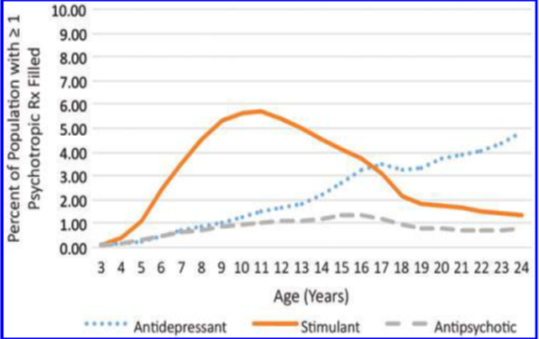
Are children and adolescents in the United States too easily given psychiatric medications?  There has been a lot of attention to this question lately with many people both within and outside of the mental health community believing that the answer is a resounding yes.   Yet while there is ample evidence suggesting that the percentage of youth taking psychiatric medications is rising, there remain fewer data that weigh in on the question of whether those who meet criteria for a psychiatric illness have been saturated with too much treatment.  Into this debate comes an important study by Merikangas and colleagues from the National Institute of Mental Health that was recently published in the journal JAMA Pediatrics.

The data from this study comes from the National Comorbidity Survey – Adolescent Supplement.  The participants are a nationally represented sample of over 10,000 adolescents between the ages of 13 and 18 who were assessed directly at home or at school for the presence of DSM-IV psychiatric disorder using a structured interview.   Medication usage over the past year was also assessed. Medication usage table

Results showed that of youth meeting criteria for any psychiatric disorder, only 14.2% were taking a medication in the past 12 months, with only approximately a quarter receiving any mental health services.  The types of medication participants were taking reflecting the nature of their disorder, although rates of medication usage tended to be low for all disorders.  A total of 20.4% of youth with a diagnosis of ADHD were being treated with stimulants, while 14.1% of adolescents with a mood disorder were taking an antidepressant.  The rate of antipsychotic usage was found to be 1.0% and was generally being prescribed for those with developmental disorders. The proper correspondence between type of disorder and class of medication was found to be more common among youth in the mental health system in comparison to those in general medical care. Looking at the flip side, only 2.5% of adolescents who did not meet criteria for a psychiatric illness had been given a prescription medication.

The authors concluded that the vast majority of youth with mental disorders are not being treated with psychiatric medications.  They argue that their study challenges the common perception that youth are being overprescribed psychiatric medications.

After reading this study, the rates of medication usage in this study are amazingly low.  Perhaps some subjects previously were taking medications but no longer were due to side effects or poor response. Others have questioned the claim that this sample truly is nationally representative with a concern that lower SES groups may be underrepresented (who also tend to have higher rates of medication usage). In the end, however, it is undeniably true that there exist children both who could benefit from medication but don’t take it in addition to those who take medication but don’t need it.  Our efforts might be best utilized by trying to reduce both of these groups rather than arguing over which group is larger.

Reference

Merikangas K, et al. (2013) Medication Use in US Youth With Mental Disorders.  JAMA Pediatrics 167(2):141-148.

Same Genes, Different Disorders

Posted: April 10th, 2013 by David Rettew

The phenomenon of comorbidity is extremely common in psychiatry.  While the term is used to denote the occurrence of two or more independent psychiatric disorders in the same individual, there is increasing evidence to suggest that different types of psychopathology share common etiologic factors.  This molecular genetic study, recently published in The Lancet, was done to examine the question of whether different categories of disorders were associated with common risk genes.

The study comes from the Psychiatric Genomics Consortium.  It compares a group of 33,332 individuals with various psychiatric disorders to a group of 27,888 controls. The types of psychiatric disorders examined included autistic spectrum dnadisorders, ADHD, bipolar disorder, major depressive disorder, and schizophrenia.  The subjects have previously been involved in genetic studies looking that tried to pair specific genes with a single disorder. The authors performed a genome-wide association study or GWAS that was able to examine associations between these various disorders and single nucleotide polymorphisms or SNPs.

Results showed that four SNPs attained statistical significance at the genome wide level, which controls for the number of tests made. Significant associations were found at four loci, including 3p21, 10q24 and in two SNPs that involved genes that encode for L-type voltage gated calcium channel subunits.  These SNPs were associated with multiple psychiatric disorders, with the two calcium channel signaling genes related to all five disorders tested.

The authors concluded that there was evidence for some common genetic factors that were related to multiple types of disorders.  The authors advocated for a classification system that went beyond symptom description and was informed by disease mechanisms.

This is an important study in many ways.  Clinicians have long been aware of the fact that the boundaries between supposedly distinct categories of disorders are not very clear, and these data suggest that one of the reasons that these lines can be so fuzzy is that many disorders share a common genetic diathesis.  What is significant further is the hint at what exactly these common genes are, giving researchers a potential target for interventions that could cut across many types of psychopathology.

Reference

Smoller J et al.  Identification of risk loci with shared effects on five major psychiatric disorders: a genome-wide analysis. Lancet. Published online Feb, 2013.

Helicopter Parenting: Little Study, Big Soundbites

Posted: April 4th, 2013 by David Rettew

The media has been full lately with discussions and advice about the merits of different types of parenting (see previous blog posting of June 2012: Tiger-Attachment-Ferberization Parenting).  Adding further to the debate is a recent study by Schiffrin and colleagues from the Journal of Child and Family Studies regarding a more intrusive and controlling parenting style, also known as helicopter parenting.

The subjects of the study were 297 college students (88% women) who completed very brief questionnaires regarding their current mental health and life satisfaction and their perceptions of the way they were parented.  The authors developed their own measure of helicopter versus autonomy-supported parenting (specifically mothering) that the students completed regarding CURRENT parenting behavior.  Path analyses were used to test for significant associations and the hypothesis that the associations between helicopter parenting and negative outcomes were due to feelings of reduced autonomy.Helicopter

The results indicated that subjects who reported having more overcontrolling parents manifested significantly higher depression scores (although they were not clinically depressed) and lower scores on life satisfaction.  This effect appeared to be mediated through the subjects’ feeling that their developmental needs for autonomy and independence were not met adequately.

The authors concluded that excessively high levels of parental monitoring and control are related to negative child behavior and lower life satisfaction. They interpreted their results in the context of self-determination theory which posits that individuals have innate needs for autonomy, feeling competent, and being involved in caring relationships. However, they acknowledged that their data were cross-sectional and thus they could not be sure that more helicopter-style parenting was a result rather than a cause of more depressed children.

While this is certainly an interesting study worthy of discussion, the article received an usually high degree of media coverage for a study that essentially gave college students several questionnaires at a single point in time. This attention was due to the timeliness of the topic.  Indeed, the way this study was portrayed in the media is as much of the story as the study itself, in my view.  Many summaries of the article, such as what appeared in Time magazine,  featured a picture of a much younger child. Obvious flaws in the study were rarely discussed except, ironically, by the authors themselves. Questions about nonlinear relations between supervision and child outcomes (in other words, maybe there is a bell shaped curve rather than a line in the relations between monitoring and child health) or about different levels of supervision needed at different developmental levels were absent. Patients and family members often are influenced by these quick media summaries of scientific articles, and it is important for clinicians to help educate others not only about the findings of a study, but also its limitations.

Reference

Schiffrin H, et al.  (2013) Helping or hovering? The effect of helicopter parenting on college student’s well being.  J Child Fam Studies.  Published online in Feb, 2013.

ADHD Diagnosed in 11% of Youth, According to New York Times

Posted: April 1st, 2013 by David Rettew

The New York Times is reporting data they received from the CDC’s National Survey of Children’s Health that the number of children who have received a diagnosis of ADHD has risen to 11% with some segments of the population, such as high school boys, as high as 20%.  The data come from phone interviews of over 76,000 parents who participated in this survey that asked about wide ranging health issues.  Of note, the Times reports that they received the raw data themselves and compiled these figures.  The findings have not been reported in scientific journals or subjected to a peer review process, although the next edition of the Journal of  the American Academy of Child and Adolescent Psychiatry is expected to feature an article about the CDC survey.

As would be expected, the report has generated a firestorm of discussion and debate with many concerned that this rise in ADHD diagnosis represents an excessive broadening of the criteria that subjects too many youth needlessly to the dangers associated with ADHD medications.   Unfortunately, these data are unable to answer this question.  According to the graph accompanying the article, the rate of diagnosed ADHD in Vermont is around the national average.ADHD rate

As people debate the important questions raised by this survey, it may be important to keep a few things in mind.

1.  ADHD is a real brain-based phenomenon with overwhelming scientific evidence to support its validity.

2.  ADHD likely exists more like a continuum (similar to blood pressure or cholesterol) rather than in binary form.  Consequently, there is no clear boundary or cut-off between typical and abnormal levels of these behaviors.

3.  Establishing a diagnosis of ADHD requires a careful evaluation that includes input from multiple sources and assessment of behaviors relative to expected norms of others of the same age and sex.

4.  Family-based multimodal treatment of ADHD can result in substantial improvement but need to be weighed against the potential risks of medications.

Bottom line:  Are there kids being diagnosed with ADHD and treated who don’t meet criteria for the diagnosis?  Yes.  Are these also youth who do meet criteria for ADHD who are suffering needlessly because a lack of diagnosis and treatment?  You bet.  Let’s work then, to reduce BOTH scenarios and leave the finger pointing to those who don’t have kids to care for.


Preschool ADHD: The Picture Six Years Later

Posted: March 27th, 2013 by David Rettew

It is commonly believed inattentive and hyperactive preschool children will likely “grow out” of these problems later in life.  Good data to support this claim, however, are lacking.  The Preschool Attention-Deficit/Hyperactivity Disorder Treatment Study  (PATS) was one of the most comprehensive studies to date on very young children with ADHD.  This recent report on the status of these children at follow-up offers important data regarding the stability of early appearing ADHD symptoms.jaacap

Of the 304 original participants in PATS, 207 participated in follow-up.   Children had an average age of 4.4 years at baseline and 10.4 years at 6 year follow-up. Children were also assessed 3 and 4 years after baseline, at which point they were being treated in the community. The sample was 75% male.  Diagnostic assessments included a comprehensive clinical evaluation, enhanced with the use of both quantitative instruments such as the Conner Rating Scales and a structured diagnostic interview.

Results showed that ADHD symptoms significantly dropped from baseline to the first follow-up 3 years later but leveled off after that.  On a relative basis, girls tended to have higher baseline scores and steeper drops in symptoms than boys.  At follow up assessments, average ADHD scores continued to be in the moderate to severe clinical range for parent ratings, with a surprising 89% of the sample still meeting criteria for ADHD 6 years later. Medication status was not significantly related to whether or not a child met criteria for ADHD at follow-up. Similar patterns were observed for both inattentive and hyperactive/impulsive symptoms.

Study authors concluded that the diagnosis of ADHD in preschool is fairly stable and associated with chronic symptoms into later childhood, even with treatment.  They suggest that the conventional tendency for a more hands-off approach to preschool ADHD may be misguided and, by contrast, early and more intensive treatment may be required, including parent training, school-based behavioral interventions, and more effective medications.

Of note,  this article focused on ADHD symptom stability and further reports are expected related to other domains such as cognitive and academic functioning.  This sample of children, seen in academic medical centers for ADHD, is likely more symptomatic than children seen in the community which could affect the generalizability of the results.  Further, the fact that subjects were no longer randomized at follow-up severely limits firm conclusions about the long term benefits of medications.  Nevertheless, the number of symptomatic children overall raises concern that the outlook for typical medication treatment, at least for those with preschool-onset ADHD, is not as positive as generally believed.  It is interesting that the authors interpreted this finding as evidence for needing more intensive treatment (under the notion that regular treatment is not enough but could be effective at higher levels) rather than evidence for doing less (under the notion that treatment in this group is not that effective anyway).  Obviously, more research will be needed to answer that important question.

Reference

Riddle et al., The preschool ADHD treatment study (PATS) 6-year follow up.  (2013)  J Am Acad Child Adolesc Psychiatry 52 (3):264-278


Joint Custody Initiative Building Momentum

Posted: March 17th, 2013 by David Rettew

It might come as a surprise to many Vermonters, but we are one of the only states left in the country in which judges do NOT have the right to grant joint custody of children in divorce proceedings unless BOTH parents ask for it. As a result, judges are forced to make Solomon-like decisions by awarding full custody to one parent.  This policy essentially is a state sanctioned way of marginalizing the non-custodial parent, pushing them into the role of weekend entertainer.Joint Custody

Research shows that children of divorced parents do best when both parents are actively involved in the lives of the children.  If we say we want  both parents to make the emotional, financial, and time investments required to raise a child right, we cannot perpetuate a legal policy that works so effectively against that goal.

Fortunately, a growing movement, headed by Chris Weinberg of Jericho, is trying to move Vermont forward and encourage our legislature to change this antiquated and destructive policy.  There has been some opposition to the proposal, based on the concern that incompetent parents will be given too much access and control.  This worry is misguided in my view.  To be clear, nobody supporting this legislation is interested in having unfit or abusive continue to influence their children’s lives, and judges would be free to award single custody when that is in the best interests of the child.  What would change is that judges would no longer be forced to send a good parent to the sidelines when joint custody would be more appropriate.

You can find out more at JointCustodyVT.org and sign an online petition at Change.com.  To make sure this issue gets the attention it deserves in January, we need to convince our legislature that Vermonters want this issue on the agenda in 2014 with no more delays.

Contact Us ©2010 The University of Vermont – Burlington, VT 05405 – (802) 656-3131