This is the concluding part of a three-part article. Part 1 can be found here, Part 2 here. They should be read in the sequence in which they were published.
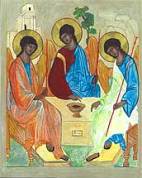
The True, the Good, and the Beautiful
All of this can be related to the triad of the True, the Good, and the Beautiful — or, in their Peircian sequence, aesthetics, ethics, and logic. Aesthetics, as Peirce conceived it, is most directly concerned with firstness; ethics, with secondness; and logic, with thirdness.
I’ve elsewhere suggested that “logic” may not be an adequate term for the kind of understanding that thirdness implies, and that “eco-logic” may be better, since logic suggests a process for understanding (in general), whereas “ecology” specifically suggests a process for understanding relation, wholeness, and “patterns that connect.”
It may also be appropriate to use Ken Wilber’s term “vision-logic” here, even though my use of it would be somewhat different than his. Wilber characterizes “vision-logic” as a historical stage of development that emerges only with the transcendence of a postmodern “green” stage (in his color-coded Spiral Dynamics lingo). I would posit it instead, for the purposes of the model being developed here, as attainable, in some specific way, by any bodymind from within its own particular situatedness.
A few definitions, then:
- Aesthetics, in this system, is the cultivation of skillful observation and perception of appearances or “arisings.”
Traditionally, aesthetics has been defined according to some definition of “beauty,” but the latter is culturally variable. Observation, on the other hand, is thought to be measured according to the criterion of “accuracy,” but this, too, is culturally variable (as scholarship in science and technology studies has shown). Once we move out of mind-matter and subject-object dualism, however, and into the space of nondual “flow,” it becomes evident that aesthetics involves the perception of the wholeness of what appears in its arising and passing, i.e. as flow — as forms that emerge in patterned relationship with other forms. This is observation of something (anything) brought to its thirdness, or to its completion.
- Ethics, analogously, is the cultivation of skillful action in response to others (which means in response to “arisings” that we know arise independently of us yet are fundamentally like us, whatever it is that we are).
When self and other are perceived as dynamically interactive forms arising out of patterned relational dynamism (i.e. as flow), then ethics becomes not a matter of rules and injunctions, but a matter of pure action. As secondness, it always encompasses a firstness; the ethical is, in this sense, built on the foundation of the aesthetic. It includes perception and action.
- Logic, if considered in its more complete form as ecologic or “vision-logic,” is the cultivation of skillful understanding of relational pattern and generality.
In this sense, it is inclusive of perception, action, and the sense of the whole within which both find their meaning. It is thirdness inclusive of seconds and firsts. In its nondual form, it is the cultivation of skillful understanding emanating as praxis, since there are no stable interiors and exteriors in nonduality, only a ceaseless interchange of qualities.
Back to Basics: Return to the Things Themselves, Differently
Maps like the one presented here make it sound as if the goal is to accede to the “top,” which is the level of complete thirdness, complete Realization in and as “flow.” But if that’s the case, why then are meditation systems most commonly geared toward the “lower” levels of this diagram, especially the observation of mere internal experience?
The reason for this is that by the time we get to the stage in our lives at which a rigorous meditative or spiritual practice comes to seem necessary, the world has for us become so preinterpreted and predigested, its meanings and thirdnesses so settled and overburdened with habit that a return to the basic building blocks becomes necessary. (It’s true that, for Peirce, habit is in the nature of all things, and always on the increase, but it is always habit shot through with chance and infinitely revisable. It is habit raised to the level of meaningfulness and reasonableness, in the best sense of this word.)
It’s precisely because self and other, subject and object, interior and exterior, are so settled (and at the same time so shot through with dissatisfaction!) that one must go back to firstness (and then secondness) with an eye for unsettling them — to see how they are not what we think they are, but rather, that they are a flow which overflows the boundaries in which we have attempted to contain them all along. Once this flow is observed in experience and lived in action, it can be realized as a complete experience of firstness-secondness-thirdness.
Observation is thus the first step of a disciplined program for learning what the bodymind can do. But this observation, if it successfully notices the process nature of all things (including self and world, subjects and objects), becomes a movement with what is observed. There is no halting the process at firstness, or for that matter at secondness. Conscious firstness is secondness; conscious secondness is thirdness; conscious thirdness is completion in the moment.
As always and ever moving, we (bodyminds) enter into relations with other bodyminds — entities or processes characterized both by mentality and materiality — which are all moving in their own ways, and which are ultimately never quite “their own.”
Even if one follows an object-oriented metaphysics here and opts for thinking of these as entities that ultimately withdraw or withhold something from all relationality, that withdrawn essence, in a process-relational view, is always a withdrawing-to: it is never simply a withdrawing into, i.e., a withdrawing into something stable, steady, and predetermined called “oneself.” What the withdrawal withdraws to is the source of the flow that gives rise to it, which is the destination for the dark matter-energy of the universe, and which is always — if we follow Deleuze and Whitehead — becoming different from itself. It is, in a word, elusive.
The stream moves as we speak, as Heraclitus suggested and as Derrida, in his wordsmithy ways, demonstrated. (Derrida demonstrated it only for words, but we can take the next step — beyond words — with him, or with Nagarjuna, or with the meditative experience itself.)
The upshot: How to move with other(nes)s gracefully (beautifully), respectfully (ethically), and completely (eco/logically) is the task at hand for any bodymind-in-process.
Final thoughts and caveats: on “realization” and “flow”
I’ve been a little shifty here, patching things together to suit my purposes rather than developing a fully-consistent and stable system. This is what maps tend to do when we use them.
For instance, in suggesting a triad of “Observe–Act–Realize,” I’m combining terms from two categories. The first of these describes intentions or actions (observation, action, interpretation), the second describes the outcomes of those actions (perception, doing, realization). Not all observations result in actual perception; not all actions result in actual doings (deeds); not all interpretive activity results in realization. Not all realizations, for that matter, are accurate, useful, or viable. The potential for slippage between effort and result is always there, in a dynamic universe such as ours.
I think I favor this final articulation of the triad as “Observe–Act–Realize” because it’s a helpful three-term condensation of what the bodymind can do. We can stop and attend to things, bracketing out our assumptions and pre-interpretations in order to see what they really look, sound, and feel like. We can act on things, playing along with the score, the orchestration, and the other players, in our own contrapuntal, harmolodic ways. And we can interpret the whole as it proceeds between perception, action, and result. In contrast to “interpret,” however, the verb “realize” suggests that there is a goal, a generative and open thirdness that pulls the ceaseless interpretive process forward. It is a path whose destination is laid down in the walking, a telos always in the process of being formulated, but a telos nonetheless.
A final admission is that I’ve left my central term, “flow,” vague enough that it may seem philosophically too casual and ill-defined. Shinzen’s notion of “flow” builds upon Buddhist as well as non-Buddhist ideas of change, impermanence, temporality, and subject-object interdependence. Among other things, he refers to wave-particle duality and other ideas from modern physics and mathematics.
It’s difficult to get around the fact that these ideas may not exactly line up very consistently with each other. Leaving aside modern physics and whether or how it might apply to actual experience, just the bringing together of Buddhism (or Daoism) and modern process philosophies can raise various thorny and unresolved issues.
Unlike many forms of Buddhism, for instance, A. N. Whitehead adamantly insisted that the relationality of things is asymmetrical, which means essentially that the universe is always building up: it’s not just running up and down at the same time, resulting in a cancellation of opposite forces, but is always accumulating force as it goes, evolving forward into newness while at the same time, on some level, bringing the past along with it. That’s the role of Whitehead’s God: to redeem the passing of all things by preserving their beauty and emotional force.
Like Whitehead, Peirce also maintains an optimistic evolutionism. Wilber explains this as one of the innovations of western evolutionary science (another being the West’s discovery of the ego’s “shadow,” and thus of depth psychology), though he places it into a broader “Kosmic” context by which the universe “involves” and “evolves” in a single rhythmic movement.
There are versions of Buddhism that incline in this direction of such an upward, evolutionary emergentism, but, for the most part, they haven’t been the mainstream view throughout the 2500-year history of that tradition. The debate between these two positions is one I can’t even try to resolve in a short blog post, so I just mention it here to indicate that “flow” may be a loose enough concept to be accommodated in both, and still be useful for a practical map for living.
This system is very much in motion, in any case — in flow, as it should be — and comments on any aspect of it are most welcome.

I think that “flow” is about awareness in our lives and how everything relates. The more we become aware, the more we see where the flow is taking place or it is stuck within our mind body connection. To me, it is the essence of living in a human body traveling through this journey called life.