National Consumer Protection Week Feature: Car Savvy Consumers

Auto complaints are a top complaint received by the Consumer Assistance Program every year. Cars are both an important transportation resource and, sometimes, an extension of personal identity. Outside your home, a car purchase may be one of the most expensive purchases a person may make. Consumers may be eager to buy a new car after long periods of saving. Usually buying a handful of cars in their lifetime, consumers are at a disadvantage to dealers, who sell cars every day. There is an emotional component to buying a car that consumers should also be aware of – this is true of brand-new cars, or “new to you” used vehicles that may have had previous owners.  

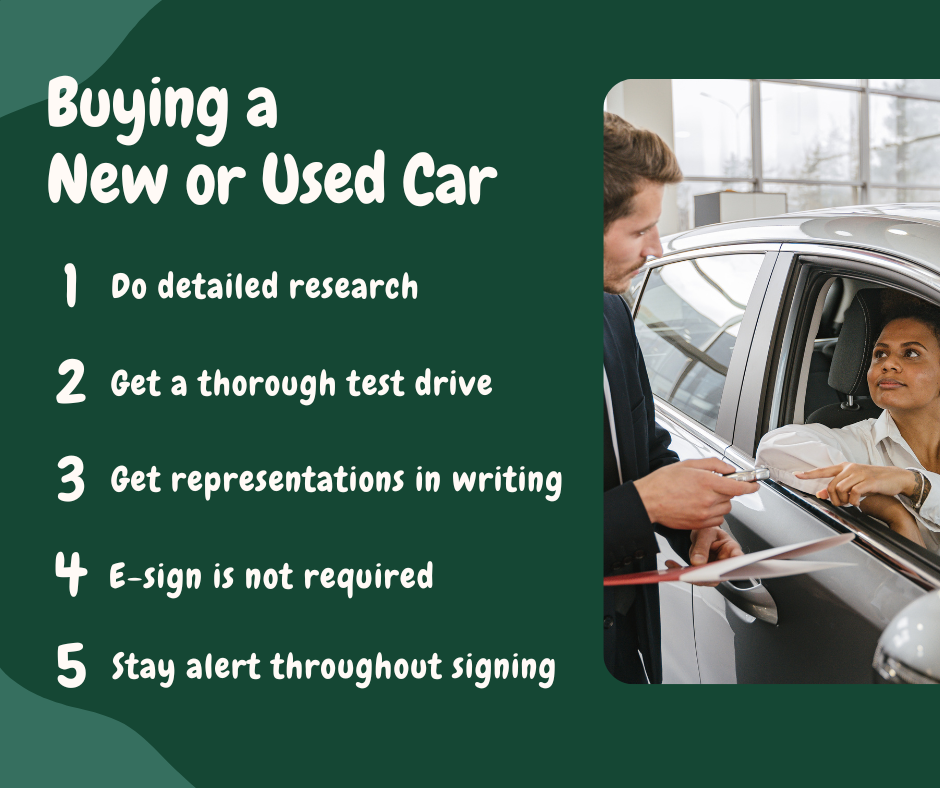
Buying a New or Used Car: 1) Do detailed research, 2) Get a thorough test drive, 3) Get representations in writing, 4) E-sign is not required, 5) Stay alert throughout signing

Online Research: Using the Internet as your tool, research different makes and models that have the features you are looking for. Once you have a new car in mind, look up the Manufacturer Suggested Retail Price (MSRP), which is the manufacturer’s recommendation on vehicle pricing. You can usually find this information on the manufacturer’s website. Also check pricing through online forums, such as Reddit, where many consumers post about their experiences with different cars. Don’t take everything you read from other consumers as fact. Gather information that will help you make an informed decision.   

Test Drive: Once you have a clear idea of the car you want, it is time to go to the dealership. Make clear to the salesperson what you want to try without expressing your interest in buying. If you share how much you like the car, or are excited, salespeople may seek to capitalize on this knowledge when negotiating. Try to stay calm and neutral to help get the best deal.  

Trust your own research over verbal representations. After selecting a car, you will move on to the paperwork, a process which can feel cumbersome for consumers. People tend to relax after selecting the car they want, which is a huge choice. Stay alert throughout the signing.  

Most people do not buy cars frequently, but a salesperson sells cars every day. Because of this, they are better at selling than you are at buying. One very common strategy used in car sales is to stretch out the car deal. This can be exhausting for the consumer, making it harder to make thoughtful decisions. 

You may be asked to provide an electronic signature on a tablet or computer. This can be problematic as you may not see or comprehend the document. It is easy to miss key facts when reading on the digital screen. You can ask the salesperson to print out any contract you are expected to sign and read the contract carefully. You have the right to get printed documents before you sign, as well as to choose to sign in writing.  

If financing with the dealer, be careful to avoid “yo-yo deals,” where the dealer reserves the right to cancel the agreement and re-finance at a higher interest rate and payment. Sub-prime auto loans often have high interest rates and prepayment penalties for paying off the loan early. Getting pre-approved by your bank—or even having your bank pay with the auto as collateral with a bank auto loan, is also an option.  

For used cars: ask for a Car Fax report or other documentation showing its driving history; check the odometer disclosure statement. A new Vermont law also requires used car dealers to provide an inspection disclosure (meaning: the dealer is required to tell you when the vehicle was last inspected, how long until inspection is due, and that you have a right to have it inspected before you purchase). This is an important new consumer protection because instead of paying for a used car, only to find out three months later that it may be deemed “un-inspectable” (or require more money for repairs before it passes inspection) ensures that you have full information and know your rights before making a purchase.

If you have experienced an issue in car buying, contact the Consumer Assistance Program.  


This piece is adapted from an earlier edition, “Buying a New Car” brought to you by one of the Consumer Assistance Program’s (CAP) service-learning interns. UVM undergraduate students make significant contributions to our program and Vermont through their participation in our service-learning lab, where they learn about consumer protection while honing their professional skills.   

References: 

FDIC – Electronic Signatures 

Federal Trade Commission 

Investopedia – Subprime Auto Loans 

NPR – Yo-yo Sales 

National Consumer Protection Week Feature: Winter is a great time to start thinking about your next home improvement project

By Jonah Brodtman, CAP Intern

Next time you’re sitting by the fire, enjoying your favorite seasonal beverage, why not take a moment to start thinking ahead about that roof repair, bathroom renovation, or other home improvement project that you’ve been delaying?

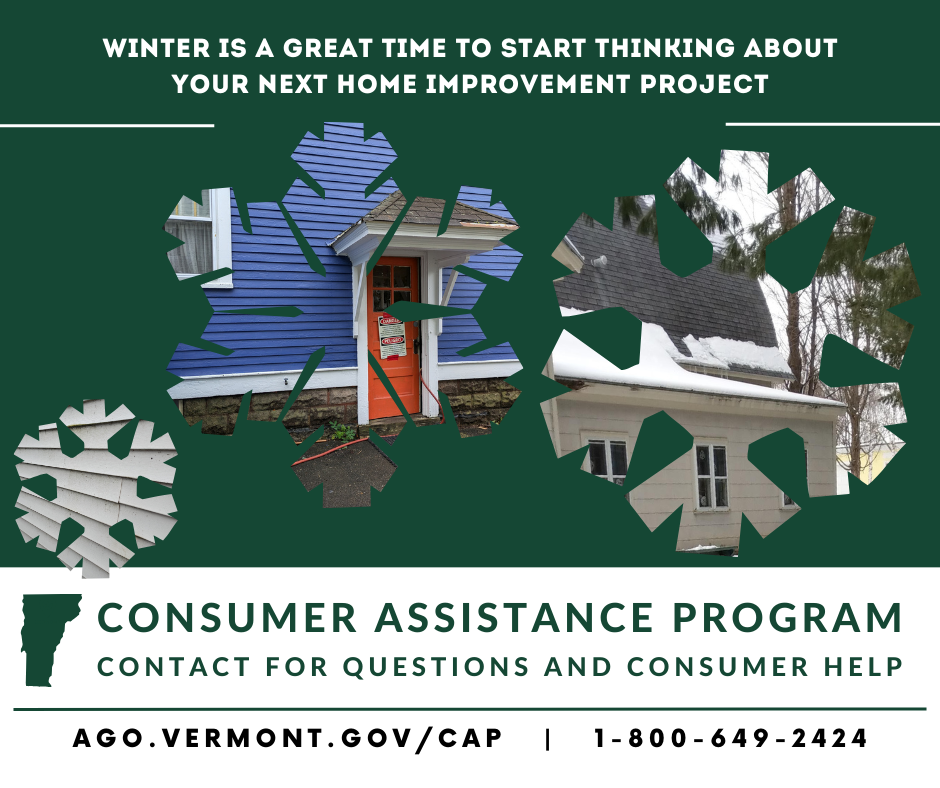
Winter is a great time to start thinking about your next home improvement project. Contact the VT Consumer Assistance Program for questions and consumer help. 1-800-649-2424

It might seem counterintuitive or maybe it’s just not on your mind while there is two feet of snow in your driveway. A few key considerations might make you think twice about further delaying a call to a contractor and getting on their schedule.

In Vermont, contractors and other home improvement specialists are in high demand during the prime building season (summer/fall) and can book several months in advance. So, call now and get on their schedule early.

Gabriel Taylor-Marsh, our Home Improvement Specialist, encourages you to “Be preemptive, proactive and forward thinking about your next Home Improvement Project.” He welcomes folks to contact him directly at the Consumer Assistance Program to learn about best practices in hiring your next contractor. He says, “Making the right investment into your home will save you time, money and resources down the line.”

Thinking ahead to your spring/summer home repair project will help to ensure that you will have enough time to check off every step of the Home Repair How-To Checklist on the Attorney General’s website (https://ago.vermont.gov/home-improvements), including checking contractor registration and obtaining quotes from three contractors.

Planning ahead in the winter months will help to set you up for the smoothest possible project. You may not be able to predict every bump in the road. However, if you do your due diligence as a consumer and start shopping around early, you could set yourself up for less delays, and a smoother experience overall.

For more home improvement tips and information, including energy project considerations, visit the AGO’s website home improvement page. If you have further questions, call our Consumer Assistance Program to speak with our Home Improvement Specialist.

Is it a secret admirer or a scam?

Did you know that scammers have a 40+ page “playbook” that they use to spark romantic interest? It is equipped with charming come-ons and jokes to make you laugh. Their play? Flattery and laughter can bring on your feel-good emotions, which helps make it easier to fall in love. This knowledge can help you question whether a person seeking connection online is genuine admirer, or a scammer.

Who sent that gift? Secret admirer? Scam? Watch your mailbox for unsolicited gifts. They could be from scammers.

Do you know what else brings on feel-good emotions? Gifts. Scammers have a new move: send an unexpected package addressed to you at your home from an unknown sender. With the day of love celebration around the corner, when you receive such a gift you may think you have a secret admirer. Sadly, this is another scam trying to get your information. When you open the package, a note says it is a gift, but it still doesn’t say who sent it. You really want to know if someone out there thinks you are awesome. Conveniently, there is a QR code. The QR code leads you to a website that phishes for your personal information or exposes you to malware and hackers.

QR codes are easy to scan, and they lead you straight to a website of choice. This can be useful when working with legitimate sources, but harmful when linked to the unknown.

  • Always think twice before scanning a QR code.
  • Only scan QR codes from sources you trust.
  • When using QR codes, be especially suspicious when the scan displays an unknown website address and when website addresses are hidden, such as when a URL shortener is used (Bitly, TinyURL, Ow.ly, etc.).

Did you receive a gift that did not include a QR code or any information about the sender? I am sorry to say that this is still likely not an admirer. Scammers that find your address or other personal information online might send you unsolicited products to use your name to make online reviews to support a disreputable company. This is concerning because it means your information is compromised and unsuspecting consumers will make purchasing decisions based on lies.

If your personal information has been compromised, review these helpful tips from the FTC:

  • If you scanned the QR code and entered your credentials, like your username and password, into a website, change your password right away. Create a strong password that is hard to guess and turn on two-factor authentication.
  • If you’re concerned someone has your personal information, get your free credit report at AnnualCreditReport.com. Look for signs that someone is using your information, like accounts in your name you don’t recognize.
  • Also review your credit card bills and bank account statements and look for transactions you didn’t make. And consider taking other steps to protect your identity, like freezing your credit or putting a fraud alert on your credit report.
  • If you think someone stole your identity, report it, and get a personal recovery plan at IdentityTheft.gov.
  • What else can you do to protect your personal information? Regularly update your computer software and your phone to get the latest security patches. And learn to recognize a phishing email or text message.

And what about the package? It sounds like it was a gift (ftc.gov).

Want to know more about scams? The Consumer Assistance Program is your local Vermont resource for scam prevention information: ago.vermont.gov/cap or 1-800-649-2424

References:
https://consumer.ftc.gov/consumer-alerts/2025/01/scam-alert-qr-code-unexpected-package?utm_source=govdelivery

https://consumer.ftc.gov/articles/what-do-if-youre-billed-things-you-never-got-or-you-get-unordered-products#unordered

When your child’s information is subjected to a data breach

I get so many data breach notices that I am starting to view them as routine. Because of this, I decided to freeze my credit a long time ago. It is free, I am not looking for credit right now, and it gives me peace of mind that an identity thief cannot easily go about opening new accounts in my name without my knowledge or consent. When I got a notice yesterday that PowerSchool accounts related to my children were compromised, my stomach twisted into a knot. This is something new. This is something I am not used to having to think about. This is something I will need to address. 

As parents, we have a responsibility to keep our children safe and help them find their way to prosperity. When a notice says that some of our child’s information has been obtained by sources unknown to us, the alarm sounds that the child’s financial future might be jeopardized if their currently nonexistent credit record is ransacked by fraudsters.

What is a parent to do?

Monitor: Keep track of the information sent from the school and the breached company to stay informed on what information was breached. If you are identified as an impacted individual, you will likely be contacted again. It is important to verify the source of the contact and the information. The Attorney General’s Office posts breach notice letters so that you can verify the information on the notice you received is legitimate. Also, continue to regularly review credit reports.

More on credit monitoring

You can get a free credit report from each of the three credit reporting agencies annually, online, at www.annualcreditreport.com, or you can mail in a form


Safeguard: Be vigilant. Consider placing a freeze on your child’s credit report now, so you can worry less about potential identity theft. Children aren’t opening accounts right now anyway.  

You can freeze yours too, while you are at it. Before you start this process, decide on a secure place you will keep the passwords or pin numbers. There will likely be a day you will need to access credit and you will want to lift the freeze at your convenience. 

More on credit alerts and freezes

Place a fraud alert or freeze on your credit reports. You can find out more information from the Federal Trade Commission about fraud alerts and freezing your credit files. To place a fraud alert or freeze on your credit files, contact the three credit reporting agencies listed below.

Credit Bureau Fraud Contacts:
EQUIFAX 1-800-685-1111 
EXPERIAN 1-888-397-3742
TRANSUNION 1-888-909-8872


Be on guard: Name, address, and birthdate are pieces of information needed to open credit. So, be particularly cautious of phishing attempts that may contact you to obtain the Social Security number, or part of it. 

There are more scams than just identity theft to watch out for. The fact that phone numbers and email addresses were breached may not seem as problematic, but don’t forget that scammers like to use phone numbers to robocall and emails to spam. You may be less cautious if you think the contact comes from the school district, such as with spoofed phone numbers. You will need to verify every communication that requires your action. 

Know the experts: For thorough step by step guides on identity theft prevention after a data breach, the Federal Trade Commission is your primary resource:

Breach next steps:
https://www.identitytheft.gov/databreach

Child identity theft:
https://consumer.ftc.gov/articles/how-protect-your-child-identity-theft

Learn more on the Vermont Attorney General’s website:
https://ago.vermont.gov/cap/scam-prevention-through-awareness-and-education/identity-theft

What to Do After a Data Breach video by the Federal Trade Commission (consumer.ftc.gov and identitytheft.gov)

References:

Federal Trade Commission: consumer.ftc.gov and identitytheft.gov

VT Digger: https://vtdigger.org/2025/01/08/nationwide-data-breach-affects-student-staff-information-at-vermont-schools/

Called for Jury Duty, or a Jury Duty Scam?

Scammers posing as local law enforcement are calling, saying you missed jury duty and are threatening “serious legal consequences”. They first leave a message for you to call back, visit a website, or schedule a meeting. Next, they may demand payment of a fine and ask for your sensitive personal information. They may claim there is a warrant out for your arrest.

Jury Duty Scam Alert by VT Attorney General issued December 4, 2024.
Called for Jury duty, or...a jury duty scam? -Demands fee payment now! - Requires sensitive personal information, -Claims to be local  law enforcement calling, - Threatens arrest or says there is a warrant for arrest. Hang up on unknown callers. Take steps to verify. Ago.Vermont.gov/cap | 1-800-649-2424.

While all these claims are very jarring, hang up and do not pay! Always take steps to verify the legitimacy of unknown officials, using publicly available resources. Connect with people you trust to discuss unexpected, urgent, unsettling, or unknown communications.

For jury duty specifically, know that you would be issued a letter, and you would not receive a threatening call about it, even if you actually did miss an actual jury duty assignment. Also know that, in order to serve jury duty, you first have to be selected through a process called a jury draw that occurs at the courthouse. If you were supposed to serve as a juror, you would have been informed.

When in doubt, check it out. The Consumer Assistance Program is your local Vermont resource for scam prevention information: ago.vermont.gov/cap or 1-800-649-2424.