VT Scam Alert System is Live

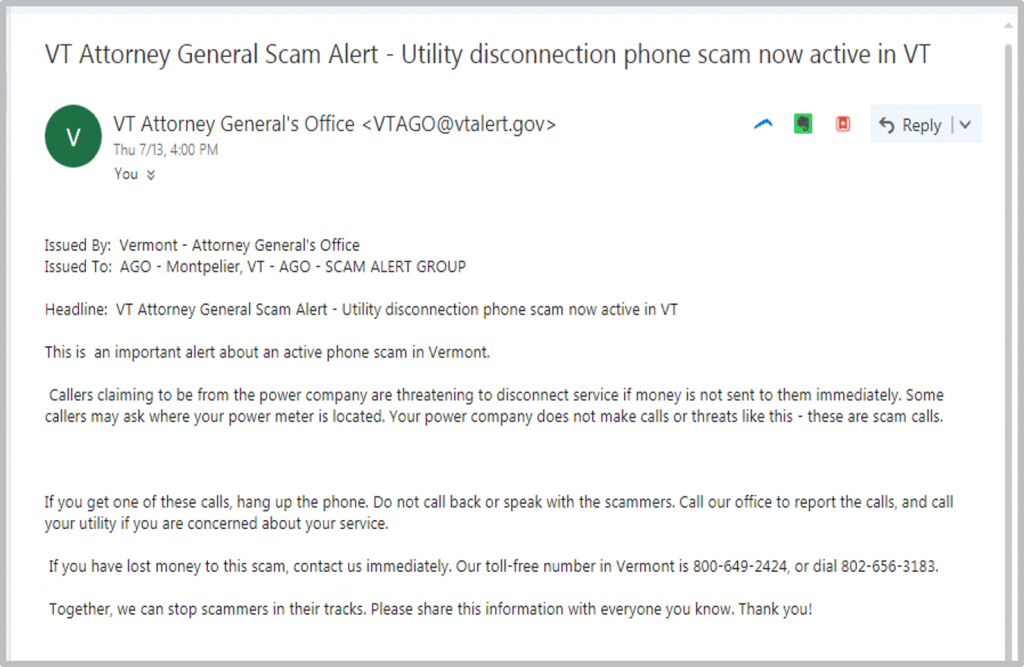
Last week our office sent out the first scam alert through the VT Alert System to warn Vermonters about an active utility disconnection phone scam (listen to the alert here).

This exciting program started three weeks ago when the Attorney General’s Office partnered with Vermont Emergency Management to use their existing “VT Alert” emergency notification system. The system lets you get instant alerts by email, text message, or a phone message. We’ll be using this system to alert Vermonters about scams going around the state. You must sign up to get these alerts.  So far, 677 people have signed up through our website and over 3100 signed up through the VT Alert portal!

We don’t want to send out too many alerts, so we’ll only use the system to let you know about scams that are new, have changed, or are happening most often. We also might send you alerts about scams that are happening in your town or county specifically.

Signing up is free and easy. Call us at 802-656-3183 or 1-800-649-2424 (toll-free from a VT phone). You can also visit our website consumer.vermont.gov and click on “Sign Up for Scam Alerts!”  You can choose to get alerts by text message, email, or a prerecorded telephone message from Attorney General Donovan.

We want to help you stay informed and stay ahead of scammers trying to defraud Vermonters.  Once you sign up for the Scam Alert System, we encourage you to spread the word by sharing the alert message with your friends, family, neighbors, and communities.  Together we can get informed, spread the word, and stop the scams.

Example of an email alert:

VT Alert Scam Alert Example

Our office would like to extend a special thank you to our partner at the Vermont Department of Pubic Safety, Emergency Management System–and in particular Director Erica Bornemann, Public Information Officer Mark Bosma, and Administrator Randy Bronson.

VT Alert Logo


Contributing Writer: Crystal Baldwin

Welcome to CAP Connection

Welcome to CAP Connection, the new blog for the Consumer Assistance Program of the Vermont Attorney General’s Office.  The Consumer Assistance Program has been connecting with local Vermont communities for more than 35 years.  Our hope in producing this blog is to make the information and experiences that we gain by connecting with Vermonters available to everyone.  When it comes to scams, the best form of prevention is awareness.  When problems arise, it’s helpful for consumers to know they have a place to go for help.  When it’s difficult to locate appropriate resources, we may be of assistance too.  Ultimately, through this blog we hope to connect Vermonters to resources and information that will be helpful and useful.

This blog replaces the previously produced Pure Vermont Newsletter, which was issued for four years.  This new communication format is intended to provide the public with up-to-date access to consumer and business news and information.  Check back often for scam alerts, general consumer and business information, business compliance assistance, and reports on consumer and business experiences in the marketplace.  Connect with the Vermont Attorney General’s Office on Facebook and/or Twitter to get the latest updates.  Links to this blog will also be posted on social networks when a new blog is updated.  Don’t hesitate to continue to contact our office to report your concerns.

Ban the Box (effective 7/1/17)

What does the law ban?

The law bans questions about an applicant’s criminal history record on the initial employment application form.

Do I have to hire an applicant with a criminal history record?

No.  You are permitted to ask an applicant about a criminal history record during an interview or after the applicant has been found qualified for the job.  The law is not designed to force you to hire a person with a criminal record.  The law is designed so that promising candidates are not simply screened out in the initial application process.  You must follow the procedure.

What happens if a candidate informs us about his or her criminal history record after the initial application process?

He or she must be given a chance to explain the circumstances that resulted in the criminal history record and to describe any post-conviction rehabilitation before you decide whether to make an offer.  The exception is if a federal or state law prevents you from hiring the applicant.

Are all employers covered?

There is an exception: If a federal or state law bans hiring persons with a criminal history record for the job, then the question can be asked on the initial application. However, if that federal or state law bans only specific types of criminal offenses, then the application can only ask about those offenses.

What’s the penalty for violating the law? 

The law provides for a $100 civil penalty per violation.  In addition, the Vermont Attorney General may seek a court order to compel compliance with the law . Employers who retaliate against employees who oppose or report violations of the law may also be subject to a private or Attorney General lawsuit for damages.

Finally, violations might also be used as evidence show other violations, such as race discrimination. 

Here is the complete Ban the Box statute. Special thanks to Attorney Heather Rider Hammond and AAG Julio Thompson for their expertise.

Posted in Uncategorized | Tagged

Pregnant employees (effective 1/1/18)

What if an employee becomes pregnant?
Pregnancy or childbirth may limit a woman’s ability to perform a job. Under Act 21, employers must provide reasonable accommodations to such women, unless those accommodations would be an undue hardship on the employer.

What if the job involves heavy lifting?
The employer must provide reasonable accommodations, such as providing lifting equipment. 

What is an “undue hardship”?
An “undue hardship” is an accommodation that would be significantly difficult or expensive to put into place. 

What if the woman can no longer perform the essential functions of the job?
The employer must engage in an ongoing discussion with the employee to explore different options that may accommodate the employee so that she can perform the essential functions of the job.  At the end of the day the employee must be able to perform the essential job functions, with or without accommodations.

When does this law take effect?
January 1, 2018.

Beware: existing disability law has the same requirements.  As an employer, you should provide reasonable accommodations to women with limitations caused by pregnancy, childbirth and related issues.

What are the penalties for failure to provide accommodations?
All the sanctions of the Fair Employment Practices Act, including damages and attorney’s fees. 

Equipment leases

What is an equipment lease?
The most common complaints received by CAP from business consumers involve credit card equipment leases.

The leases are generally financed by third parties. An “independent” salesperson works to sell you, the business consumer, a lease. Typically, credit card machines cost less than $500. Yet, in the typical credit card equipment lease, however, you end up paying thousands of dollars—pure profit for the salesperson and finance companies.

Can I cancel my lease?
The typical lease’s term is 4 years, and is expressly not cancellable. Nonetheless, under Vermont’s Home Solicitation Sales Law, you usually have a legal right to cancel a sale made either in person or by phone within three days of the sale provided certain requirements are met. The seller must provide you with notice of this three-day right to cancel. If you did not receive such notice, then you may cancel your lease at any time until that notice is provided.

Is it ok to sign a personal guaranty with an equipment lease?
The standard lease includes a personal guaranty. This means that even if your business closes, you personally are on the hook to continue paying the lease — even if you can’t use the credit card machine.

Does the salesperson who sold me this lease work for the company financing my lease?
Financing companies recruit salespeople with promises of a lucrative career selling equipment leases. However, financing companies try to limit their responsibility by treating their salespeople as independent contractors. It is important to remember that while you may be signing up with a person who has made you promises, your lease is with the financing company. Promises made by the salesperson must be reflected in the written lease. Otherwise, the financing company may refuse to honor a salesperson’s promises.

Where should I research a lease?
Your local Chamber of Commerce may have references for responsible local suppliers. You can also call us at CAP (800-649-2424) to see if we have recent complaints of a supplier you are considering.

Posted in Uncategorized | Tagged