Q + A with Co-Chief of the Community Justice Division, David Scherr

Attorney General T.J. Donovan has been spearheading criminal justice reform, most recently calling for reforms to the bail system so low-income Vermonters don’t get stuck in jail for low-level crimes. In 2016 he created the Community Justice Division to protect public safety, increase fairness, promote equal access to justice, and reduce incarceration. He was also a leading advocate for the passage of Act 61, which expanded pre-trial services and diversion. Act 61, among other provisions, created the Tamarack Program, a treatment-oriented diversion program aimed at adults with serious mental health and substance abuse issues. Since Act 61 took effect in July of 2017 the rate of referrals to diversion programs has more than doubled statewide, from 10% to 24%.

We caught up with Co-Chief of the Community Justice Division David Scherr to get more background on why criminal justice reform matters and how we’re making a difference here in Vermont.
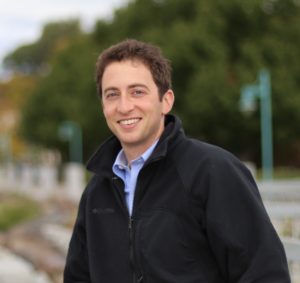
David Scherr, Co-Chief of the Community Justice Division.

What is the reason for the creation of the Community Justice Division? Why is this issue so important to the Attorney General?

The Attorney General created the Community Justice Division to focus on the issues of criminal justice reform. The division seeks to increase public safety by promoting equal access to alternative justice programs and increasing fairness in the application of the law. The division does everything from administering the statewide Diversion and Pretrial Services Programs to creating new legislation that supports criminal justice reform efforts—including initiatives like bail reform.

These are key issues for the Attorney General. He made them a cornerstone of his platform during his candidacy, and he created this new division to enact real reform.

What work is going on nationally on criminal justice reform? How does Vermont fit into that?

There is an amazing amount of work being done nationally on criminal justice reform. States across the country, and the federal government, are making significant changes in how they approach crime, punishment, and rehabilitation. Nationwide people recognize that mass incarceration is an unjust and ineffective way of dealing with crime—particularly nonviolent crime. It is also systemically racist, incarcerating African American men at disproportionate rates.

The same problems exist in Vermont and need Vermont solutions. Vermont has the most disproportionate rate of incarcerating African American people in the nation. Our office is working hard to provide equal access to justice and strongly supports efforts to root out systemic racism in our criminal and juvenile justice systems.

What inspired you to work in criminal justice reform?

Before I arrived at the Attorney General’s Office I worked mostly as a public defender based in Burlington while working on cases all over the state. In my role as a public defender I saw firsthand the challenges, inequities, and unfairness of our criminal justice system. The people involved in the system are largely poor, with few resources—economic or social—to provide support.

Underlying causes of behavior, like addiction and mental health issues, are not adequately addressed in the standard criminal justice system.  By assisting people with the issues that lead to offenses and recidivism we are protecting public safety by making it less likely that people will reoffend.

Although I enjoyed helping people one at a time my view of our system made me want to have a system-wide impact by changing policies and laws. The Attorney General’s office has given me a place to do that, and I am grateful.

What are the Attorney General’s Office’s goals regarding criminal justice in Vermont over the next 5-10 years? How are we getting there?

Our long-term goals are to increase public safety by having robust alternative justice systems—working in close cooperation with our public health system—to adequately address underlying causes of criminal justice involvement, and to reduce the incarcerated population to the people who really need to be there. The work we are doing presently around our Diversion and Pretrial Services programs, along with legislative and policy efforts like bail reform, will move us in the right direction.

Thanks to David Scherr for sharing his expertise today! You can follow up with any questions you might have at david.scherr@vermont.gov.


Posted in Uncategorized | Tagged

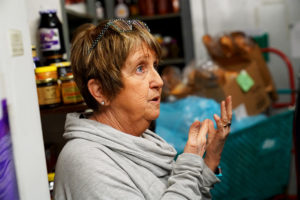
Vermonter of the Month: Sharon Russell

This is a monthly series in which the Attorney General will feature a Vermonter doing exemplary work in their community. Have someone you think should be featured? Email AGO.CAP@vermont.gov.

Sharon Garafano Russell is the Executive Director of the Rutland City Rescue Mission, better known at the Open Door Mission. The Open Door Mission houses 51 people and this year they provided 36,000 meals in the Soup Kitchen which serves residents of the Mission and people on the street. They have a staff of 11 that work around the clock providing meals, clean bedding and a clean and safe home for both residents and those just staying a few nights. The Mission serves three meals a day and runs on the proceeds of their thrift store, an annual golf tournament and individual donations. Under Sharon’s leadership, this structure has become a model for veteran shelters across the country.

Sharon has dedicated her life to helping the disenfranchised, supporting all people independent of their appearance, past or place in life. She has received countless awards over the years, most recently “The Unsung Hero Award” from her alma mater Mount St. Joseph Academy (MSJ Class of ’65).

After growing up in Rutland, Sharon completed her bachelors in early education from the University of Maryland. She then taught special education and served as the head of the Adult Education Program at the Brandon Training School for eleven years. This was followed by the state exam for social work, which led her to the Open Door Mission.

Sharon lives in Rutland with her two children, two grandchildren and two great-grandchildren.

What inspires your work with the Open Door Mission?

What inspires me most is I went to MSJ and was always taught by nuns who said we should pay our good luck forward, and so too again when I attended The College of St Joseph. Second, and probably the most important, is that Jody Fish, a classmate at MSJ, went to Vietnam and never returned. That is why I contract with the VA to work with veterans.

What impact has the Open Door Mission had on your community?

The impact on our community is that the disenfranchised and the homeless veteran has a warm bed and 3 hot meals daily in our soup kitchen, where we serve 120 meals daily. We also serve folks from the street. There is nothing better then to see a small child go home with a full tummy and a smile–it makes my day–or when a veteran who has been on the streets in larger cities tells us how special our food is.

What have you learned from your work at the Open Door Mission?

Every day I learn something new. A few of those lessons are: but for how my life has been I could be on the streets; I have learned that labels are for cans, not for people; and we don’t always know what is causing people to have addictions or mental illness. I have learned if each one of us tries, we can make a difference in the world.

What advice do you have for others looking to impact their community?

My advice for others is to make a impact on the community, stop and look around. You will see the need. Don’t judge people, for you will find that most are good people who have chosen that road that is too often traveled. I suggest instead, as Robert Frost wrote, to take the one “less traveled” in order to make a difference.

Resources for the Agricultural Industry

Below are a list of resources for some of the most pressing concerns in the agricultural industry. Know a link or issue that should be included? Email AGO.smallbusiness@vermont.gov.

Forms of Credit Available to Farmers

Food Safety Requirements

Intellectual Property and Labeling

Legal Options for Distressed Farmers

Match or Mooch? Preventing Romance Scams

Too often, Vermonters reveal to us that a scammer lied to them about being in a long-distance relationship. These scams can be heartbreaking. They are not uncovered until the love interest asks for money—or once money gets sent. Sent money can’t be retrieved, making the betrayal more painful.

Vermonters lose tens of thousands of dollars each year to romance scams. This scam continues to affect more people than other wire transfer scams. So, what’s going on?
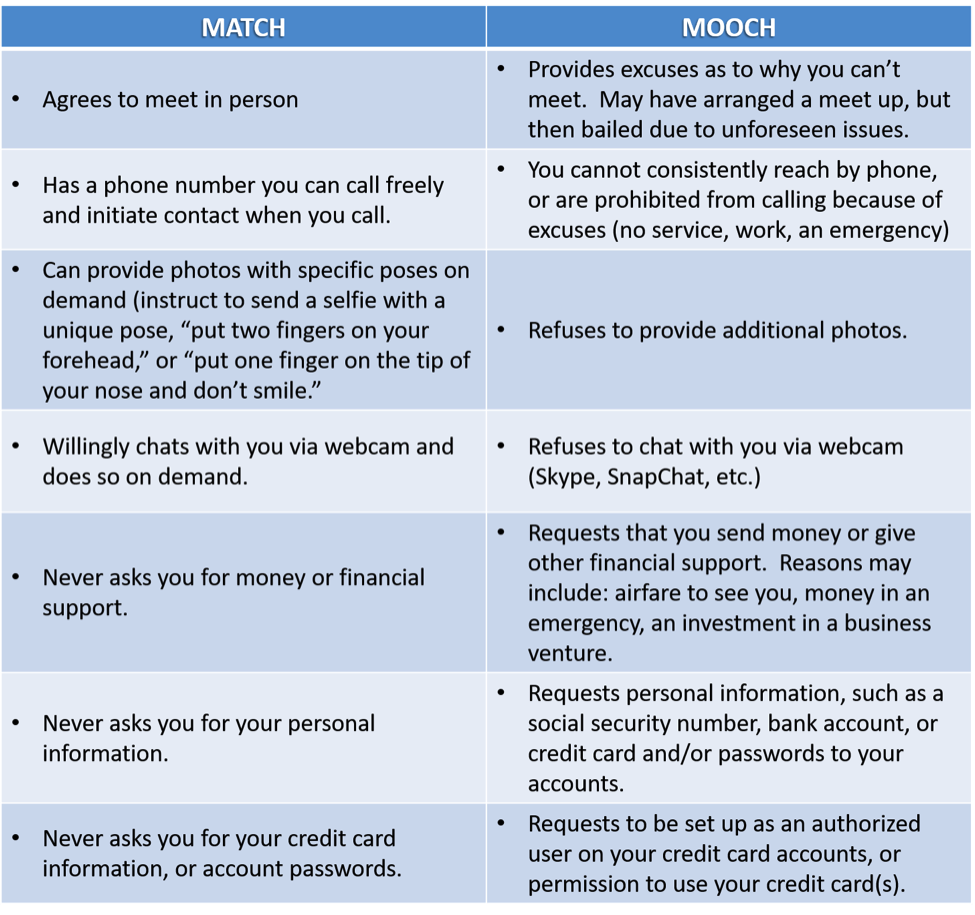
Most romance scams initiate through dating websites and apps, like Match, Zoosk, Senior People Meet, OK Cupid, and Meet Me. Connecting online and through apps makes it easy for scammers to hide their identity. You could be chatting daily with a person who describes themself as “tall, dark, and good-looking”—but is not. Scammers succeed because online dating gives the option of communicating without ever meeting in person, or talking on the phone.

Not all online dating is bad. In fact, Consumer Reports found in a survey that 44% of respondents said online dating led to a serious long-term relationship or marriage. With such high odds in finding “the one,” how can you continue to use online dating and stay safe when looking for love?

We’ve created a table to help you determine if you’re being contacted by a MATCH or a MOOCH.

In 2016, a law was passed that requires internet dating services to notify Vermont members of noticeable changes in their account, such as when their account is hacked and being used maliciously by a romance scammer. Internet dating services must also alert Vermont members who had previously corresponded with a newly banned member, letting them know they may have been contacted by a romance scammer. So this Valentine’s Day, protect yourself from romance scams and find a match, not a mooch.

Contributing Writer: Crystal Baldwin

Vermonter of the Month: Darcie McCann

This is a monthly series in which the Attorney General will feature a Vermonter doing exemplary work in their community. Have someone you think should be featured? Email AGO.CAP@vermont.gov.Darcie McCann has served as the Director of the Northeast Kingdom Chamber for 23 years. She is a native of the Northeast Kingdom, and supports her community in myriad ways.

Darcie is an avid sports fan, known for her chocolate chip cookies, writes a biweekly column for the Caledonian-Record and has been involved in many local community groups and organizations. This includes: mentoring local students, serving on the boards of the Northeastern Vermont Regional Hospital and Burklyn Arts Council, participating in the Regional Tourism Council and her local church, and supporting Vermont chambers across the state as President of Chamber Benefits, Inc.

Darcie tirelessly promotes the NEK as a place to visit, or live and start a business. She travels to Eastern states and Canada, and plans the Colors of the Kingdom and Business Celebration events through her role at the Chamber. She also spearheaded the creation of an Online Business Resource Guide — an exceptional effort to bring vibrancy back to the Kingdom.

Darcie returned to the Kingdom after a career in journalism, after serving as the executive editor of the Wellesley Townsman in Massachusetts and a reporter and section editor at a San Diego paper. She worked in college public relations at Merrimack College and Lyndon State College before taking the Northeast Kingdom Chamber post. Married for 29 years, the recently widowed mother of two adult children is looking forward to her daughter getting married in May 2018.

How did you get involved with the Chamber?

I got persuaded to try for the Northeast Kingdom Chamber position by the previous director, a good friend, who was leaving the post for another job.  I figured I would stay at the chamber job, tops, for 10 years … and here I am, celebrating my 23rd year at the chamber. I wouldn’t be here if I didn’t still love it and it wasn’t a challenge. I never know what the next day will bring.

How have you supported the community through your work with the Chamber?

Working at a chamber in the Northeast Kingdom means that you not only have to look at the economic climate of the region but also its socioeconomic variables. I have tried to not only get involved with regionwide and statewide organizations that strengthen the economic landscape but look at the reasons why we have historically had the weakest economy in the state and work to solve those problems as well.

How does supporting the NEK business community support the community at large?

The Northeast Kingdom business community is, in fact, your neighbors. What we strive to do at the chamber is to remove some of the roadblocks that businesses face to help our fellow residents succeed. We not only help bring in additional business through aggressive marketing but also save them money through our many discount benefit programs. I am a native of the Kingdom. I think that is one of the reasons I am still here at the chamber after 20 years; when you love a place so much, you want to see it not only flourish but thrive.

What advice do you have for others looking to impact their community?

My advice for anyone thinking of helping out in their community or region is that it is not a burden but a privilege. I have gotten far more from being involved in the Kingdom than I have given, I can tell you that. I have gained a legion of friends, satisfaction from helping the Kingdom and a really broad and diverse support system. If you love what you are doing, it is never a chore.