Help Stop Elder Abuse: Report It

Contributing Writer:  Crystal Baldwin

I can’t tell you how sad the topic of elder abuse and neglect makes me.  Since I was a young girl, I loved the elders in my life and maintained such deep respect for them and their life experience.  Unfortunately, “each year, an estimated 5 million older adults are abused, neglected, or exploited” (ACL.gov).  

Abuse is not just physical, it can be emotional and psychological, or include financial exploitation.  Neglect is of grave concern, too, because in cases of neglect elders are not getting the care they need and deserve.  Abusers can knowingly or unknowingly engage in such acts and may even demonstrate that they have good intentions.  Abuse and neglect, no matter how it is posed, is unacceptable.  

During the COVID-19 pandemic, isolation recommendations continue for those most susceptible to experience severe illness caused by the disease, including those 65 years of age and older and those with severe underlying medical conditions like heart or lung disease or diabetes (CDC).  Before the pandemic, social isolation was already a concern and an issue reported to our office’s Elder Protection Initiative.  Now, while those most susceptible to illness remain in isolation, abuse and neglect can continue to occur for a longer period before it is seen by a bystander and reported.  Each of us must commit to protecting older adults.  

Know the signs of elder abuse.  The National Center on Elder Abuse has outlined the signs as follows:

Emotional and Behavioral:  unusual changes in behavior, or sleep, fear or anxiety, isolated or not responsive, sadness

Physical:  broken bones, bruises, and welts, cuts, sores, or burns, missing daily living aids, such as walker and hearing aids, torn or bloody underclothing, STDs without clear explanation, poor living conditions

Financial:  unusual changes in bank account or money arrangement, unusual or quick changes in will or other financial documents, fake signatures on financial documents, unpaid bills

Today is World Elder Abuse Awareness Day.  On this day, let’s commit to reporting elder abuse and neglect and financial exploitation when we see it.  As good neighbors and compassionate people, we must report whenever we see signs of abuse and neglect.  We may be the only one who sees it and the only one who can report it.  

As a reporter, you are not alone, there are many agencies and organizations that are essential to eliminating elder abuse.  To simplify the reporting process, the following is a list of resources.

REPORT CONTACT
Life-threatening
situation
911
Suspected elder
abuse, neglect or
exploitation, including
financial exploitation
Local Police and
Adult Protective Services of the
Dept. of Aging and Independent
Living (800-564-1612), if about a
vulnerable adult
Abuse of a person
living in a nursing
home, assisted living
facility, or board and
care home
Long Term Care Ombudsman of VT
Legal Aid (800-889-2047)
Concerns regarding
licensed health care
facilities
Survey and Certification of the
Dept.of Aging and
Independent Living
(888-700-5330)
Domestic Violence VT Network
Domestic Violence Hotline
(800-228-7395)
Sexual Violence VT Network Sexual Violence Hotline
(800-489-7273)
Misuse of Social
Security
Benefits
Social Security Administration
Office of the Inspector General
(800-772-1213)
Medicaid Fraud and
Abuse
VT Attorney General’s
Medicaid Fraud Unit (802-828-5511)
Unauthorized Real
Estate Transfers
Vermont Legal Aid (802-775-0021)
Broker and Investment Advisor Fraud Dept. of Financial Regulation:
Securities Division (802-828-3420)
Bank Fraud Dept. of Financial Regulation:
Banking Division (888-568-4547)
Insurance Agent,
Adjuster, or
Carrier Fraud
Dept. of Financial Regulation:  
Insurance Division (800-964-1784)
Scams and
Identity Theft and
Consumer Fraud
VT Attorney General’s
Consumer Assistance Program
(800-649-2424)

If you are still not sure who to contact, call United Ways of Vermont 2-1-1 information and referral hotline (dial 211 or 802-652-4636).  They are a great resource, connecting Vermonters to organizations and agencies.  

More Resources:  
WEAAD: World Elder Abuse Awareness Day
National Center on Elder Abuse
Videos: Strengthening the Structure of Justice to Prevent Elder Abuse by the NCEA
Elder Abuse-Learn the signs and break the silence
Event Cancellation Guidance

As a result of the COVID-19 emergency, countless Vermonters have dealt with the cancellation of travel plans and other event reservations. Although disappointing, these cancellations are helping keep the public safe and slow the spread of the virus. To assist Vermont consumers and businesses in understanding their rights and responsibilities related to these canceled plans, the Attorney General’s Office offers the following guidance:

Step 1: Look at the contract or agreement

  • To determine whether a business must refund a consumer’s payment, read any cancellation policies or other similar terms in any contracts or agreements that were in place at the time of payment.

Step 2: Locate cancellation policies

  • If a properly disclosed cancellation policy states that some or all of a consumer’s payment may be non-refundable, consumers’ options may be limited.
  • If a cancellation policy is not properly disclosed – for example, because it was given to the consumer only after the contract or agreement was signed – then the cancellation policy may not be valid.

Step 3: If necessary, the Consumer Assistance Program is available to mediate

  • If a cancellation policy says that a consumer is entitled to a refund in the event of an involuntary cancellation but the business refuses to provide a refund, the consumer may file a complaint with the Consumer Assistance Program by calling 1-800-649-2424 or visiting https://ago.vermont.gov/cap/.
  • If there are no contract terms or other policies that apply to cancellations under circumstances like these, the Attorney General’s Office urges businesses to work with consumers to find acceptable solutions. While it may be reasonable for a business to keep some portion of its fees to cover costs that were actually incurred before cancellation, businesses should work with consumers to come to a satisfactory resolution for both parties.
  • Like individual consumers, businesses also may have protections when they are in the role of consumers. For example, a business is a consumer when they are purchasing items that are not for resale, such as supplies or equipment for use by their business. If you own a business and have a consumer-type problem, you can also contact the Consumer Assistance Program to file a complaint.

The Attorney General’s Office recognizes that Vermonters are facing unprecedented hardships at this time, and encourages business owners and consumers to work together to find reasonable resolutions of their disputes. If any consumer feels a business is not living up to the terms of their agreement or is otherwise not playing fair, they should contact the Attorney General’s Consumer Assistance Program to file a complaint by calling 1-800-649-2424 or visiting https://ago.vermont.gov/cap/.

Extortion Email Scams

On April 27, 2020, our office issued a scam alert to warn about an email extortion scam that has been contacting Vermonters.

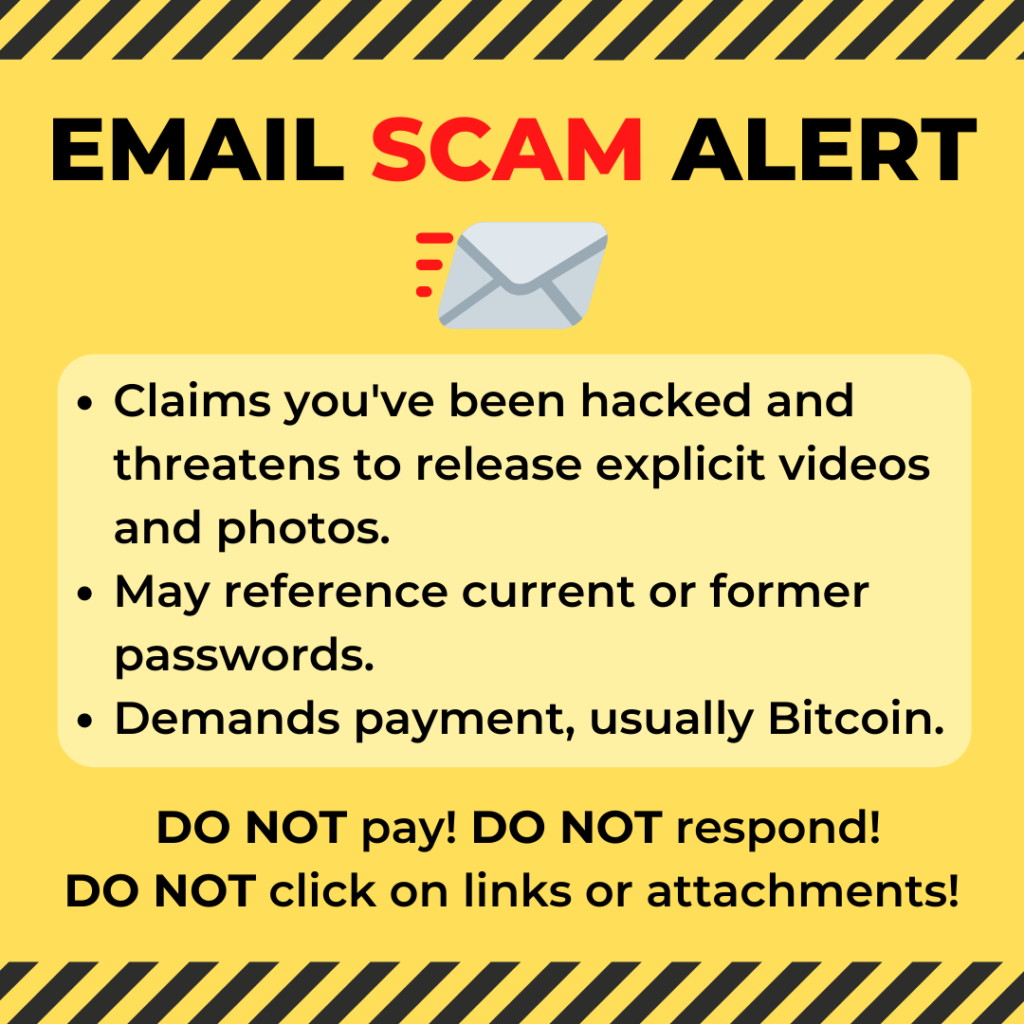
The email threatens exposure of compromising home video and pictures, unless you pay, usually in Bitcoin. The email claims you have been hacked and may reference a current or former password you may have used. The sender claims that they have access to your computer and webcam and threatens to release embarrassing photos and video unless you send them money.

These emails are scams. If you receive one of these e-mails, DO NOT send money. Do not click on any links or attachments. If you find that your current password is listed in the email, change your passwords from another computer and run virus scans. To learn even more about this scam, scroll to the “Sextortion Scam” section of our online relationship scams blog.

You can help stop these scams from hurting your community by sharing this information with people you know.

Call us at 800-649-2424 if you have questions, concerns, or need help determining if you have been a victim of a scam.

Report these scams to the FBI’s Internet Crime Center at ic3.gov

For more information about how to protect yourself from email phishing scams, visit the Federal Trade Commission’s website.

Is price gouging in your community?

When I went to the pharmacy today, there was a handwritten sign on the entrance, “No more hand sanitizer and face masks.”  Like many of you, my email inbox has been flooded with precautionary warnings of the COVID-19 virus and advice as to what people can do to stay healthy.  With very few reports of the virus in Vermont as of today, the sign at the pharmacy was confirmation to me that Vermonters are worried; so worried that my fellow neighbors bought the pharmacy’s entire stock of hand sanitizer and face masks. 

I wasn’t shopping for hand sanitizer and face masks today, but if I were, I might have ventured down the road to the next pharmacy.  The question on my mind now is, if the next pharmacy had stock, how much would the products cost?  I’ve seen news reports of stores in other states charging $130 for an average bottle of hand sanitizer.  Last I checked locally, before COVID-19 virus news, hand sanitizer cost between $3 and $7 depending on brand and price.  Going from $7 to $130 is about a 1800% increase.  To me, such an increase is considered price gouging. Generally, price gouging is when sellers unfairly hike prices of essential consumer goods and services during an emergency or disaster.

Many states have very specific regulations about price gouging, identifying price increases of more than 10% over the cost of the item as gouging.  Vermont has a price gouging statute specifically referencing the prohibition of gouging on the price of petroleum products and heating fuel products once a market emergency has been declared by the Governor (9 V.S.A. § 2461d).  As of today, such a declaration has not been made, and the Consumer Assistance Program has heard only one complaint about fuel cost increases due to COVID-19.  In addition to this statute, price gouging in Vermont may be considered unfair and deceptive.  Vermont’s consumer protection statute informs that “unfair methods of competition in commerce and unfair deceptive acts or practices in commerce” are unlawful.  Businesses setting unconscionable prices on essential items during a crisis, such as a price increase of 18 times the typical retail value as in my example above, could be in violation of the Consumer Protection Act, 9 V.S.A. §§ 2451 et seq.   

If you have noticed steep price increases of essential items and related services at specific businesses following the alert of the COVID-19 virus, file a complaint with the Consumer Assistance Program by calling 800-649-2424 or visiting ago.vermont.gov/cap.

Other resources:
Centers for Disease Control and Prevention COVID-19 virus resources
Vermont Department of Health COVID-19 virus updates

Contributing Writer: Crystal Baldwin

Gift Card Scams on the Rise in Vermont

Vermont Scam Alert by the Vermont Attorney General

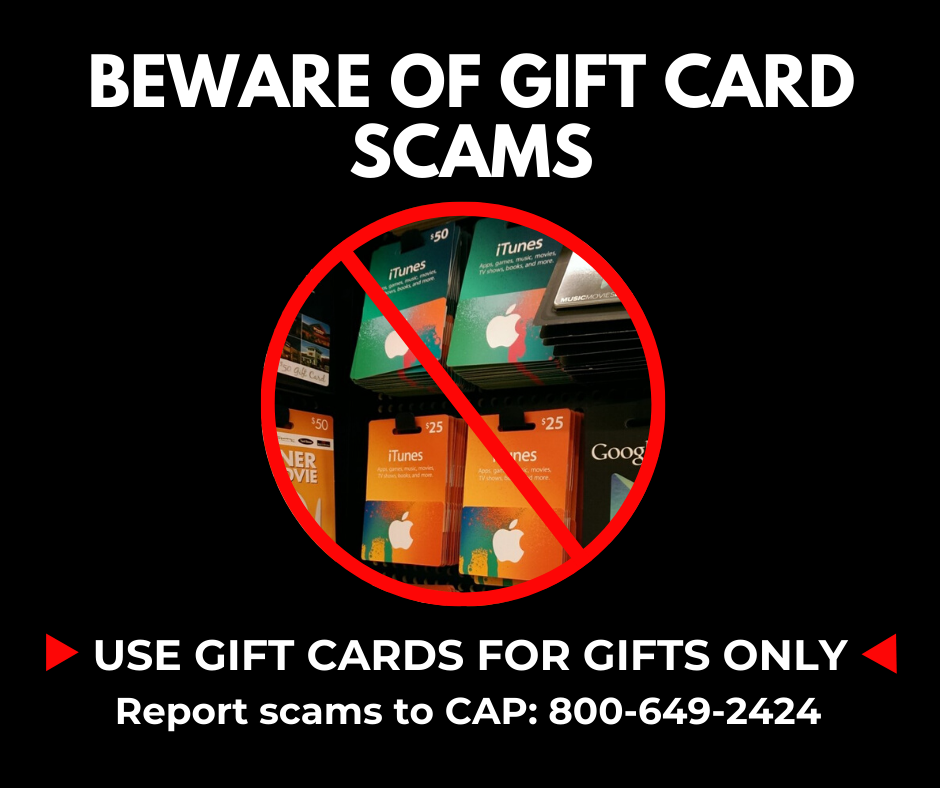
The Consumer Assistance Program has recorded a 220% increase in gift card scams with loss reports since December.

Gift card scams take many forms; however, all request a gift card as payment and for the numbers on the back of the card to be provided to the scammer.

Be in the know:

  •    Using gift cards as payment is like sending cash.

  •    Providing the numbers on the back of the card is like giving cash:  Scammers may ask you to take pictures of the  card or relay the numbers of the phone.

  •    Scammers may say you must pay with a gift card because your credit card or another form of payment won’t work.

  •    Scammers may claim that using the gift cards will provide you certain incentives or free money opportunities.

  •    Gift cards are only valid forms of payment when used with the card’s identified retailer.

  •    Retail businesses can’t refund gift card funds that have been spent.
Gift Card Scams video produced by the Federal Trade Commission

Watch out for this and other similar scams that ask you to act quickly by providing gift card information, cash or money order, or by sending a wire transfer or peer-to-peer payment.

If you are asked to pay with a gift card, contact CAP right away at 1-800-649-2424.

Contributing Writer: Crystal Baldwin