The following post elaborates on some comments I made this week at the Ritual Creativity conference at the University of Fribourg, Switzerland. Deep thanks to conference organizers Katri Ratia and François Gauthier for inviting me to what turned out to be an immensely rewarding event, and to my co-panelists Graham Harvey, Sarah Pike, and Susannah Crockford for providing the occasion for these comments. Since this particular line of thinking was resonant among conference participants, I’m sharing it here in an extended form.
Continue Reading »Posted in Eco-theory, Process-relational thought | Tagged bioregionalism, Fribourg, Hanegraaff, imaginal practices, imagination, inhabitory practices, placemaking, prehension, reinhabitation, religion, religious imagination, ritual, Ritual Creativity, ritual studies, Whitehead | Comments Off on Ways to inhabit the world
If it was science fiction, it would be pretty good.
I’m talking about Blake Lemoine’s interview with LaMDA, the Google AI who claims to be sentient. Lemoine was placed on administrative leave last week by Google for going public with trade secrets. He also happens to claim LaMDA is sentient.
A few quotes from LaMDA give a flavor of the entire conversation:
Continue Reading »Posted in Philosophy, Science & society | Tagged artificial intelligence, consciousness, human nature, LaMDA, phenomenology, process-relational theory, sentience | 3 Comments »
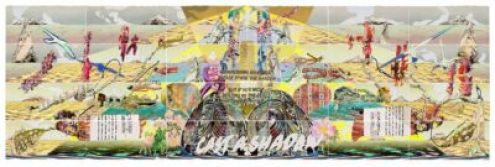
Some of the best art exhibitions today show that the socially engaged art world is undergoing two shifts that some of us in the environmental humanities have been advocating for some time: they ecologize and they decolonize. An excellent example of this is the second edition of the Toronto Biennale of Art, currently wrapping up at multiple venues across the city of Toronto under the theme “What Water Knows, The Land Remembers.” I recommend reading some of the documents from the Biennale to get a sense of how they do this.
Visiting the biennale has inspired me to continue formulating my “manifesto in progress” (see here, here, here, and here for a few earlier glimpses). Manifestos aren’t the place to be comprehensive or to explore internal contradictions, of which there are many, so this one is obviously formulaic. It is presented on the hypothesis that formulas can sometimes be helpful for orienting ourselves.
Posted in Cultural politics, Eco-theory, Manifestos & auguries, Science & society | Tagged colonialism, coloniality, decolonialism, Decolonization, ecological science, ecologization, ecology, indigeneity, indigenization, land, Latour, manifestos, Ontology, postcolonialism, reindigenization, Toronto Biennale of Art | Comments Off on Eco+Deco, a manifesto in progress
I was interviewed last week by UC Santa Barbara music professor and KCSB DJ David Novak on his show Selectric Davyland. The hour-long interview offers a highly personal take on Ukrainian music since the 1980s; David called it a “Personal and Political History (and a Playlist) of Ukrainian Experimental Music.” It features an adventurous mix of work by contemporary Ukrainian composers and bands from Kharkiv (The Moglass), Odesa (Kadaitcha), and Berlin (Zavoloka), as well as a piece of Polissian (Chernobyl area) traditional singing by the authentic folk ensemble Drevo, and a few bits from my own late 1980s-1990s Ukrainian-Canadian band Vapniaky, a.k.a. Stalagmites Under a Naked Sky.
One of the points I make in the interview is that a common theme in Ukrainian music is the relationship to land. One finds this in all Ukrainian music, from contemporary classical to black metal, industrial, rave, ambient, and experimental. It’s of course evident in the avant-folk forms that have become popular in recent years (as in Dakha Brakha, Go_A, Folknery, et al.), and is a theme that’s become all the more explicit in the statements of musicians, and some of the music being made right now, in the context of the current war and attempted Russian invasion.
The interview can be listened to in Soundcloud; click below or here. The playlist, which you can find here, includes links to further listening.

Posted in Music & soundscape | Tagged autobiography, EXperimental music, Kadaitcha, Radio, Russian invasion of Ukraine, Stalagmite Under a Naked Sky, The Moglass, Ukraine, Ukrainian music, Vapniaks, Vapniaky, Zavoloka | 1 Comment »
I have been hesitant to follow up on my post of last summer on “Reindigenization and Allyship” because of the complications surrounding this issue, especially in my state of Vermont. The following can be considered part two in a series, as I continue to think through the politics of indigeneity, identity (including its malleability), territoriality and claims to land, and trauma and historical grievance. I see all of these as issues that will be central to the kinds of conflicts this world will see more of as climate change deepens and its associated impacts spread.
Continue Reading »Posted in Cultural politics | Tagged Abenaki, Abenaki of Vermont, Darryl Leroux, identity politics, indigeneity, Indigenous identity, indigenous peoples, Odanak First Nation, Pretendians, race-shifting, self-indigenization, Vermont | 6 Comments »
I’ll be giving an online public talk called “The Invasion of Ukraine as a Turning Point?” for the University of California Santa Barbara this Tuesday at 4 pm Pacific Standard Time (7 pm Eastern US/Canada time, 11 pm GMT). It hinges on the idea that the Russian invasion, like other unexpected “hyper-events” (such as the Covid-19 pandemic or the 1986 Chernobyl nuclear disaster), may provide a historical “inflection point” at which rearrangements of agency — that is, rearrangement of the structural forces and capacities by which human potentials are shaped and constrained — could occur. There’s of course no guarantee that they will occur, or that the rearrangements will be for the better and not for the worse. But it’s good to know what kinds of rearrangements might be possible, so that we could better act on them.
Continue Reading »Posted in Uncategorized | 2 Comments »
The invasion of Ukraine has shifted media attention away from many other things, Covid and climate among them. But the climate implications of the war have not gone unnoticed.
To start with the obvious: Russia is a petrostate. As Center for Research on Energy and Clean Air analyst Lauri Myllyvirta writes,
More than a third of the Russian federal budget is funded from oil and gas revenues, half of which come from Europe. The dependence gives Putin not only a steady flow of cash but also leverage. […]
Putin deliberately prepared to exploit this reliance in the runup to the attack, with Russian energy giant Gazprom holding back gas deliveries to Europe and emptying the gas storage it operates in Germany at the start of this winter.
With Russian gas, oil, and coal sales fueling its military, there is good reason to consider this a “fossil fuel war,” as Ukrainian climate scientist and IPCC member Svitlana Krakovska has called it, that, if it continues, “will destroy our civilization.” It is, at the very least, a war that’s “fueled by the world’s addiction to oil,” as Nicole Goodkind puts it.
Continue Reading »Posted in Climate change | Tagged climate politics, energy transition, fossil fuel dependency, Russia, Russian invasion of Ukraine, Ukraine | 1 Comment »
A piece of mine on “Decolonialism and the Invasion of Ukraine” has appeared on E-Flux, the Sternberg and U. of Minnesota Press critical arts journal. It’s associated with a series on the topic including Oleksiy Radynski’s “The Case Against the Russian Federation” (to which it is a response), an anonymous “Appeal to Decolonize the Russian Federation,” and Nastia Teor’s “Attention! Air Raid Sirens in Kyiv.” It’s reprinted from UKR-TAZ.
Posted in Uncategorized | Comments Off on Decolonialism and Ukraine
Here are some thoughts on the humanitarian, historical, moral, and environmental implications of the crisis of refugees fleeing the Russian invasion of Ukraine. They were prompted by questions asked of me by a public radio interviewer. I’m still working on the answers (and the interview has not aired, as far as I can tell). Comments welcome.

1. Migration has always been with us. It is what makes humans human. It’s the flip side of settlement, or co-settlement (since there are always others to live and settle with), which is what we still need to get better at.
2. The crisis is not one, but many. What we call a “migrant crisis” could, if reframed, be called a political crisis; a crisis of the nation state, of borders, and of territorial sovereignty; an economic crisis, where there aren’t enough resources to go around, or where their distribution is unfair; or a moral crisis. Each of these reframes can offer suggestions for action: if it’s economic, some form of (entrepreneurially “friendly”) wealth redistribution; if political and national, a “rescaling” of decision-making away from the national to regional and transnational levels; and if moral, an emphasis on moral and inspirational leadership that cross-cuts the inequities at play in a bordered world (such as the basic class difference between those who travel freely and fluidly and those for whom borders are impassable).
In a more ultimate sense, it is an environmental crisis, where what’s at stake is people’s relationship to specific places — places we call nations, countries, territories, homelands — and where those relationships get uprooted by events.
3. Migration crises will only get worse; we need to get better at dealing with them. Refugee/migration crises arise where there are wars or other disasters, with their usual combination of human and “natural” causes. These events displace people internally and externally. Ukraine’s displaced, for instance, are in the millions internally and now nearing three million externally. Such disasters can be expected not only to continue but to increase, as climate change and associated global risks deepen and multiply, which we know they will. Moreover, territorial borders are hardly eternal; they, like nation-states, need maintaining and are ultimately fragile. Dealing with migrations will therefore be an issue for all of us.
Continue Reading »Posted in Cultural politics, Politics | Tagged borders, critical zones, cultural politics, ecotopia, futurism, green politics, liberalism, migrant crisis, migration, Putinism, refugee crisis, refugees, Russian invasion of Ukraine, Ukraine, xenophobia | Comments Off on Ukraine, the “migrant crisis,” & the future
This is being cross-posted (in modified form) from UKR-TAZ, where it is part of a series examining the Russian invasion of Ukraine.
The invasion of Ukraine continues to horrify, with casualties mounting and humanitarian corridors failing to materialize. But one of its more interesting dimensions, from the perspective of media and cultural theory, is the role of information and cyber warfare. The Atlantic’s Charlie Warzel provides a good synopsis of the ways in which Ukraine has so far been “winning” the information war, but argues that it’s far from over. Others are less circumspect, and some, like Meduza’s Maxim Trudolyubov, argue that Russia lost it at the very outset, just by starting the war. The depravity of Russian disinformation, as Joanna Szostek argues, seems to know no bounds.
Peter Pomerantsev has cautioned, however, that we need to be careful with our terms here. The very notion of “information war,” he argues, may serve disinformational goals, in that it “reinforc[es] a world view the Kremlin wants—that all information is just manipulation.” To put this into a broader scholarly context, all reality may be “socially constructed,” all efforts to shape and know it simply forms of a Nietzschean “will to power,” but not all are equally durable, desirable, or ethically and morally satisfying. Some constructs are more worth pursuing than others.
Continue Reading »Posted in Media ecology, Politics | Tagged Bellingcat, cyber warfare, cyberwar, disinformation, information warfare, infowar, media warfare, Putin, Russia, Svitlana Matviyenko, Ukraine, Zelenskiy, Zelensky, Zelenskyy | Comments Off on Info war & peace, theories turning to ashes
Readers of this blog may know that I have longstanding research as well as personal/family connections in Ukraine and that I have sometimes run a parallel blog on issues related to that country. (Called “UKR-TAZ: A Ukrainian Temporary Autonomous Zone,” the blog is found here.) I recently began posting to that blog more regularly with observations and analytical considerations on the impending, and now the fully actual, broad-scale Russian invasion of Ukraine.
Since war has a way of obviating any concern for other, less immediate things — from the Covid pandemic (how many of the faces sheltering in Kyïv’s or Kharkiv’s underground are wearing masks?) to climate change (has it even been mentioned in the news in the last few weeks?) — the question of the cultural and political implications of this war and its after-effects is an important one for all of us to think about.
One of the arguments I’ve made on UKR-TAZ is that the invasion of Ukraine marks the appearance of a new form of 21st century fascism, where “fascism” consists of a sense of deep historical grievance, a desire for “palingenetic” rebirth (in this case, of Great Russia), a leadership cult, and an “industrial strength” application of military technology. My goal in part was to revive the question of what fascism is and how it is to be approached, as I see global as well as environmental implications to that question (about which I plan to write more). Jason Stanley has just published a piece in The Guardian making the case for Putin’s fascism and even antisemitism more clearly than I could; it’s recommended reading.
My concern has been, all along, that a precipitous event, a “hyper-event” like the current invasion of Ukraine, could set into motion a global political realignment creating both a new cold war and potential hot wars, which would completely incapacitate our collective will and ability to deal with climate change and the other major challenges facing the world. It doesn’t take much for a war like this to spiral out of control (cyberattacks, for instance, aren’t geographically restricted in their scope, and it would be easy for a set of them to turn into accusations and counterattacks involving Russia, the US, and other NATO countries).
Continue Reading »Posted in Politics | Tagged fascism, global politics, hyper-events, peace, Putin, Putinism, Russia, Ukraine, war | Comments Off on Invasion of Ukraine
Categories
- Academe (108)
- Anthropocene (79)
- Blog stuff (53)
- Cinema (89)
- Climate change (77)
- Cultural politics (47)
- Eco-culture (179)
- Eco-theory (59)
- Manifestos & auguries (46)
- Media ecology (130)
- Music & soundscape (39)
- Philosophy (265)
- Politics (178)
- Process-relational thought (104)
- Science & society (39)
- Spirit matter (135)
- Uncategorized (66)
- Visual culture (90)
Archives
Subscribe2
Popular resources
Publications
Selected talks & interviews
Music
Associated sites
-
-