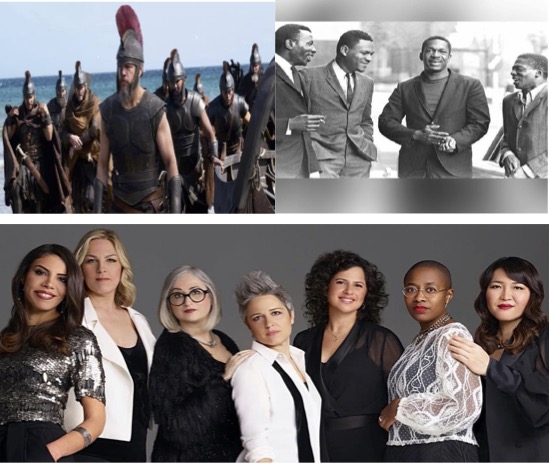
The media buzz this summer surrounding Christopher Nolan’s recent film adaptation of The Odyssey led me to discover a number of female authors who have reinterpreted Homer’s classic poem in various ways. These include Margaret Atwood, whose 2005 novelette The Penelopiad retells the Odyssey from the point of view of Odysseus’s wife, as well as more recent writers, chief among them Emily Wilson, whose 2017 version of The Odyssey made her first woman to translate Homer’s poem into English. Following Wilson’s translation, Madeleine Miller’s novel Circe was published in 2018, and in 2023, Lisa Peterson’s play Odyssey, based on Wilson’s translation, was first performed.
While not all of these authors identify specifically as feminists, all of their work highlights female characters in various ways. Wilson’s translation makes the female characters (as well as others previously regarded as peripheral, such as enslaved people) more three-dimensional in the context of the original narrative. Atwood and Miller create new stories by placing female characters in leading roles, and Peterson makes four modern-day female refugees the narrators of the original poem. The effect of all this work is to bring the world of the poem into the twenty-first century by acknowledging that all characters in the story, not just the hero, have their own needs, complexity and inner life.
As I read about these authors, listened to interviews with them and read their work, the way that they give the original poem new relevance began to remind me of the work of women jazz improvisers and the way their work brings overlooked and marginalized approaches to improvising into the foreground. This in turn led me back to a theory I have had for a while about five myths of improvisation, and ways I have noticed that female and LGBTQ jazz players challenge these myths in their improvising, just as Atwood, Miller, Wilson and Peterson breathe new life into The Odyssey in their works. (I have documented the work of a number of female jazz musicians through transcriptions I have done of their solos, all posted on this blog.)
The controversy over Nolan’s film adaptation centered on the diversity of the cast and creative team he assembled. Nolan has mentioned that one of the inspirations for his script was the first line of Wilson’s translation: ‘Tell me about a complicated man’. Nolan also made a number of non-traditional casting choices which added some diversity to his cast, including Lupita Nyong’o as Helen and Clytemnestra, Zendaya as the goddess Athena and Eliot Page as Sinon.
In a recent New Yorker piece, ‘Why The Odyssey Keeps Defeating Filmmakers’, David Denby wrote before seeing Nolan’s film that the star-studded cast and IMAX technology used to shoot it don’t guarantee that it will be a successful adaptation. Denby writes that The Odyssey is one of those books ‘so closely woven into us that some part of us doesn’t want to see them externalized as spectacle’, and that for a filmmaker to adapt it is ‘a death-defying risk’. He discusses a number of adaptations, most of which he rates as failures, including a 1954 adaptation starring Kirk Douglas that he calls a ‘schlockfest’, and a 1968 Italian adaptation he describes as ‘highbrow kitsch’ and in which he says ‘the moviemaking is faithful, literal, and dead’. In a recent review, Wilson pans Nolan’s film as emphatically as Denby did the earlier versions, writing ‘It’s a family-friendly audiovisual spectacle, like an elaborate Fourth of July fireworks display – and with about the same level of narrative and emotional depth’.
Denby points out that in addition to retellings of The Odyssey that place itin its original Bronze Age setting, Homer’s epic has inspired many literary works that adopt its narrative structure or plot elements but adapt it to a different era. A short list of works of this type includes The Aeneid (a Roman analog to The Odyssey), Gulliver’s Travels by Jonathan Swift, James Joyce’s Ulysses and the Coen Brothers’ film O Brother Where Art Thou?
Just as The Odyssey has inspired multiple reinventions through the centuries, in the comparatively short history of the jazz tradition, a number of song forms and chord progressions have been reimagined in multiple eras. For instance, the standard How High The Moon was adopted by Benny Harris and Charlie Parker in Ornithology, by Lennie Tristano in Lennie-Bird, by John Coltrane in Satellite and by Barry Harris in Luminescence. Just as each new work that borrows the structure or plot elements of Odyssey views the original through the lens of its writer’s cultural and historical orientation, each of these tunes uses the basic harmonic structure of How High The Moon to explore a concept that interests the composer. As I mention in another post, my research indicates that although Ornithology is typically credited to Parker alone, its title is a clue that encapsulates the study of three different phases of Parker’s career by Benny Harris, who was a Parker superfan. Lennie-Bird features Tristano’s personal fusion of rhythmic complexity and harmonic abstraction with bebop language, while Satellite features Coltrane’s trademark ‘Countdown’ chord progression, which expands a single-key ii-V-I progression so that it covers three key areas. Luminescence encapsulates a number of Barry Harris’s concepts about the rhythmic DNA of bebop.
In an NPR review of Wilson’s translation, Annalisa Quinn writes that the poem was originally ‘not written, but oral, probably composed by many different poets, who passed it down performance by performance’. This also describes the origin of many jazz compositions, including Ornithology, which exists in at least two versions and includes contributions by Harris, Parker and possibly others, as I explain in my post.
Just as there are at least two kinds of interpretations of The Odyssey, one that focuses on ‘the hero’s journey’ and one that also values collaboration and collective action by groups of characters, there at least two ways to look at the work of great jazz improvisers. They are most often understood as improvisational nomads, carrying a fundamentally unchanging musical conception through various musical situations and expressing it primarily in the somewhat solitary melodic monologue the jazz world calls a ‘solo’. A much less common way of understanding their work is to also acknowledge and appreciate their abilities as musical conversationalists. In trying to understand the first view, which I will explain shortly as the ‘great heroic jazz soloist’ theory, I have identified five myths of improvisation which can sometimes confuse or paralyze younger players. First, however, it is necessary to look at two very different definitions of the word ‘myth’.
‘Myth’ has developed a negative connotation in recent decades, as in the problematic term ‘urban myth’. Cambridge Dictionary defines ‘urban myth’ as ‘a story or statement that is not true but is often repeated and believed by many to be true.’ An example of an urban myth (sometimes also called an urban legend) is the claim that there was once a town called Doveland, Wisconsin, although there is no physical evidence or historical record of it. According to the blogger John Coon, this idea seems to have gained traction around 2010, which is apparently when the Google search engine began adding ‘Wisconsin’ to searches on the word ‘Doveland’.
A very different definition of myth was articulated by the philosopher Joseph Campbell, who wrote in The Hero With A Thousand Faces that “every myth is psychologically symbolic. Its narratives and images are to be read, therefore, not literally, but as metaphors.” In his book The Power Of Parable, the biblical scholar John Dominic Crossan expressed a similar thought in reference to the ‘road to Emmaus’ story in the Gospel of Luke. This is the story where, following Jesus’ arrest and execution, two of his disciples are walking on the road to Emmaus, when they meet a fellow traveler who accompanies them for a while before they recognize him as the resurrected Jesus. About this story, Crossan writes: ‘Emmaus never happened; Emmaus always happens.’ For Crossan, the Emmaus story, which defies medical reality as we know it, is neither a historical description of a miracle (as a literal interpretation of the bible might claim) nor a meaningless fiction (as an atheist might claim). It is instead a deeply poetic and symbolic representation of how the ideas of a spiritual and political revolutionary can endure. In other words, it is a myth on the deepest level and in the most positive sense of the term.
While John Coltrane’s solo on Giant Steps was a historical event that was documented through an audio recording, it has, like the Emmaus story, achieved mythical status in the sense of being a model many strive to emulate. We can say that in some sense ‘the Giant Steps solo, like the Emmaus story, ‘always happens’, because its influence is likely to be present anytime an improviser takes an extended solo over a complex chord progression at a fast tempo, as in Joe Henderson’s solo on his tune Inner Urge.
While some passages in the Odyssey are dominated by Odysseus’s soliloquies, like his lament over a brutal storm at sea and his appeal to the angry sea god Poseidon in Book Five, in other sections he excels at dialogue, where often displays his gift for deception. The alternation in The Odyssey between scenes where Odysseus commands and cooperates with his men, like the Sirens episode, and situations where he is alone in some sense, like on the island of Calypso, allows readers to decide for themselves whether his ‘inner monologue’, or his skills as a commander and collaborator, or some balance of the two are the main engine of the narrative. For example, Odysseus’ strategy for escaping from the Cyclops emerges from his conversation with himself, his dialogue with his crew members, and his dialogue with the Cyclops. In the Giant Steps solo, Coltrane is in his better-known role as a improvisational monologist, like the Odysseus of the Book Five monologues. When he trades fours with Sonny Rollins on Tenor Madness, he is in his less appreciated role as a melodic conversationalist, like Odysseus with the Cyclops.
Margaret Atwood’s novella The Penelopiad retells and expands on The Odyssey from a feminist perspective. Atwood alternates between the perspective of Odysseus’ wife Penelope, who speaks as a first-person narrator, and that of her maidens, who speak both as unnamed individuals (‘first maid’ etc.) and in a collective voice in sections titled ‘A Chorus Line’. Penelope gives the backstory of her early years with Odysseus, describes her home life while he is away and relates the conflicting reports she hears about his travels while waiting back in Ithaca for his return. While Penelope’s maidens are mostly silent in The Odyssey, Atwood gives them a collective voice in The Penelopiad through which they describe the frequently grim life of female slaves in the Bronze Age, often with blithely morose humor. Through making Penelope the central protagonist and alternating her solo narrative with the group narrative of the maidens, Atwood retells and expands on The Odyssey through a change of perspective and a radical shift away from Homer’s omniscient perspective.
In The Penelopiad, Atwood pushes back on conventional views about The Odyssey, including the idea that it is the primarily the heroic journey of one man. The pervasiveness of this idea can be seen in the Cambridge Dictionary definition of the word ‘odyssey’, which deals with its meaning outside the context of the poem. Of the fifteen examples given for modern use of the word, six are from narratives where it is used to describe the journey of a solitary person (or, in one case, a solitary onion).
In one scene from the iconic mockumentary This Is Spinal Tap, directed by the late, great Rob Reiner, the band plays a piece called ‘Jazz Odyssey’ at a gig where their collective ego has been injured by having to be the opening act for a puppet show just after one of their principal members has quit the band. A clip from the film shows how ‘Jazz Odyssey’ is performed in response to some backstage cajoling by the band member who composed it, bassist Derek Smalls. Smalls is introduced onstage by fellow band member David St. Hubbins as ‘Derek Smalls, our bass player, he wrote this’, in a tone of voice that makes it clear St. Hubbins thinks the piece is a disaster that should be completely blamed on its composer. The title seems to refer at least partly to a self-indulgent bass solo by Smalls, an excerpt of which we hear at the end of the clip, but it could also describe his solitary quest to have the piece performed.
Critics, biographers, fellow musicians and jazz educators often praise and valorize great jazz players for their ability to navigate the extended, single-player improvised solo, while ignoring or marginalizing their ability to engage in what might be called ensemble improvisation: dialogic improvising (like trading fours), collective improvisation (two or more simultaneous improvised solos) and supportive improvising (such as spontaneously creating background lines). This view of jazz history is epitomized by a quote from jazz critic Gary Giddins, who states in the Ken Burns documentary Jazz that Louis Armstrong’s iconic ‘West End Blues’ solo ‘establishes almost single handedly that jazz is going to be a soloist’s art, not an ensemble music’. (Giddins’ comment from the video is quoted by Scott DeVeaux in his article Struggling with Jazz.). It is a mistake to interpret Armstrong’s work in this way. Armstrong plays a featured solo on ‘West End Blues’ which is justly famous for its four-bar-long high B flat among other aspects, but he does not abandon ensemble improvisation in this performance. In addition to his trumpet solo, he takes an equally great but less critically acclaimed vocal solo in which he has an improvised melodic conversation with clarinetist Jimmy Strong. Armstrong was equally gifted as a featured soloist and as an ensemble improviser and remained devoted to both approaches throughout his career, as one can hear from the vivacious collective improvisation on his 1958 version of Basin Street Blues.
Giddins’s quote is the clearest encapsulation I have found of the ‘great heroic jazz soloist’ theory, which I believe has led to confusion and anxiety for some jazz players and paralysis for other players who decide to abandon improvising because of it. This theory is powerful enough to have spawned what I call five myths of improvisation. In some modern jazz playing or ‘jazz-inspired’ playing, one can hear players struggling to fulfill one or more of what I call five myths of jazz improvisation. These are not myths in the ‘urban myth’ sense of being complete falsehoods, but symbolic myths which, like The Odyssey, the Emmaus story and the Giant Steps solo, can inspire both good and bad kinds of imitation and which need to be challenged with revisions, reimaginings and alternative narratives like the one Atwood provides in The Penelopiad.
Stated concisely, the myths are that a solo should have one or some or all of the following characteristics: it should be totally original, containing ideas that originate with the player, and/or totally spontaneous, something the player has never played before, and/or impressive, better in some sense than a previous solo. Also, despite having people onstage or in the studio who are playing with them, the player is essentially alone and must perform it the solo all by themselves, with no assistance or collaboration. Finally, the player must sustain this original, spontaneous, impressive and solitary creative act for as long as possible. What follows are examples of spoken comments by great improvisers and solos by improvisers of various kinds have propagated or fulfilled myths about improvisation, as well as solos that have dispelled the myths by falling short in the often superhuman task of trying to fulfill them, or challenged the myths by creating great improvisations while doing the opposite of what the myths dictate.
Myth #1: You have to create something totally original, something with no relation to anything anyone has improvised or composed before. While I haven’t found an instance of a jazz player stating this mythical rule explicitly, it is implied in quotes by Miles Davis and Thelonious Monk, two artists who created a mystique of unprecedented originality around themselves while concealing what skillful borrowers they were. In Davis’ autobiography, his co-writer Quincy Troupe quotes him as saying, ‘when you’re creating your own shit, man, even the sky ain’t the limit’. While he also claims authorship in the book of the classic bebop tune ‘Donna Lee’ that is often attributed to Charlie Parker, a claim that has been supported by more recent scholarship, he seems not to have acknowledged the considerable melodic material in this tune he borrowed from Fats Navarro. (Both Davis’ authorship and his borrowings are detailed by Douglass Parker in his fascinating article ‘Donna Lee’ and the Ironies of Bebop.)
A widely shared page of Monk quotes written down by saxophonist Steve Lacy includes the line ‘a genius is the one most like himself’, yet there is no acknowledgement by Monk of how significant sections of two of his best known compositions, ‘Rhythm-A-Ning’ and ‘Hackensack’, were borrowed from two works by Mary Lou Williams, ‘Walkin’ and Swingin’ and her arrangement of ‘Lady Be Good’.
Although Miles and Monk reached the height of their careers at a time before feminism had its greatest impact on American culture and long before the scarcity of women instrumentalists, improvisers and bandleaders began to be seriously addressed in the jazz community, it is still worth noting the gender exclusivity in the language they chose. Monk, like many (perhaps most) jazz musicians of his generation, never had a female musician in his band, and Miles hired exactly one female musician in his nearly fifty-year career: percussionist Marilyn Mazur, who played with him for two different periods of less than a year in the late 1980s.
In a commemoration of alto saxophonist Lee Konitz, his student and collaborator Ethan Iverson states: ‘Charlie Parker was so dominant that almost all musicians on any instrument copped some of Charlie Parker’s language. But Lee Konitz didn’t sound like Charlie Parker. I never once heard Konitz play one of Bird’s lines while improvising. Never.’ He also describes Konitz as ‘someone who loved Charlie Parker so much that they would never dare to play a phrase stolen from Bird’. Iverson implies that part of Konitz’s greatness was that he didn’t sound like any other player, which is certainly true. However, although my knowledge of Konitz’s work is not as extensive as Iverson’s, I take issue with Iverson’s assertion that Konitz didn’t sound like Charlie Parker because he borrowed nothing from him. Konitz developed an improvising style that had no easily detectable similarity to Parker’s melodic language. He did this by borrowing smaller pieces of Parker’s language than other players borrowed.
Near the end of his solo on one of his most famous tunes, Subconscious Lee, there are a series of triplets preceded by eighth note upbeats which was one of Parker’s signature moves. Where Parker would typically use this to begin a phrase, as in bar 21 of his solo on Koko, Konitz’s innovation here is to use the gesture four times in a row, outlining different chords each time, with only the second time matching the intervals Parker uses. While this may not be ‘one of Bird’s lines’, it is one of his licks. Contrary to Iverson’s assertion that Konitz ‘would never dare to play a phrase stolen from Bird’, on Konitz’s version of Billie’s Bounce, he and trumpeter Don Ferrara play Parker’s solo in its entirety before returning to the theme.
The myth of complete originality being a prerequisite for improvisation is disproven by great performances where improvisers borrow sections of great solos by other players or, as in Konitz’s case, complete solos by those players in addition to their own improvising. I share transcriptions of a number of these in my blog post Oh, Play That Thing! The solos I discuss in this post demonstrate that while an improvised jazz solo needs to include some original material, building from borrowed material can be a way of working toward original material.
Myth #2: You have to create something completely spontaneous, something that includes nothing you have played previously or planned in any way. This is disproven by great soloists who keep elements of a solo from one performance to another, as in Charlie Parker’s solos on What Is This Thing Called Love, which I discuss in my post What Is This Scale Called? Miles Davis’ solos on Walkin’ and Bags’ Groove also have a significant amount of similar material. Bassist/composer Steve Swallow and pianist/composer Carla Bley have also mentioned great soloists who build a solo across multiple performances.
Myth #3: You have to play something impressive, something that in some sense surpasses a preceding solo. This could be either a previous solo in the tune you are currently playing, or something in a performance at some time further in the past. One source of the idea that consecutive improvised solos need to be progressively more impressive is the tradition of a ‘battle’ between two soloists, as in the trading between Sonny Rollins and Sonny Stitt on The Eternal Triangle from the album Sonny Side Up (Rollins’s phrases are in red on the linked video and Stitt’s are in blue). Ella Fitzgerald’s ‘battle’ with Paul Gonsalves on a live version of another rhythm changes, Cottontail, is a version of the ‘tenor battle’ with one of the tenors replaced with a voice, and is comparable on a jazz level to Billie Jean King’s ‘battle of the sexes’ on the tennis court with Bobby Riggs. It is possible to see these kinds of situations as spirited collaborations where two players inspire and encourage each other, rather than (or in addition to) being competitions where one player is trying to outdo (and possibly somehow defeat) the other.
There are also examples of great soloists who play with a different musical language and sometimes a simpler technical approach than preceding soloists in the same performance, as in Thelonious Monk’s solo on Bags’ Groove Take 1 from the Miles Davis album Bags Groove . After solos by Davis and Milt Jackson which use ornate bebop language across a wide range of their instruments, Monk responds with a piano solo that uses a narrower range and considerably more repetition and space than Davis and Jackson. I hear this solo as Monk ingeniously channeling the anger he reportedly felt at Davis, who insisted that Monk not accompany his trumpet solo.
In the section of Tenor Madness where John Coltrane and Sonny Rollins trade fours, there is an instance where Sonny Rollins demonstrates that he can play the same kind of concentrated, high-energy 16th note line as Coltrane, but he also demonstrates that he prefers not to extend this technique as long as Coltrane. (I will discuss this further in a forthcoming blog post about the trading on Tenor Madness). While the narrative of the player who tries to continually challenge and outdo themselves and others is well known, there are also examples of great players who give increasingly simple performances of the same piece, as in Shirley Horn’s progressively slower versions of How Insensitive, which I discuss in The Quantum Mechanics Of The Ballad, a short section of a longer collaborative post called In Praise of hibernating, returning to old challenges and (sometimes) slowing down.
Myth #4: You have to improvise all by yourself, in other words, the primary responsibility of the jazz improviser is the improvised monologue. A corollary of this myth is that improvisational approaches more focused on mutuality, such as trading phrases and collective improvisation, are secondary, less important forms of improvising. The way jazz has been presented and recorded from the bebop era to the present has supported the powerful myth that creating improvised monologues is the sole occupation of all great improvisers. This myth is challenged by recorded examples of trading fours where improvisers who famous for their multiple-chorus solos display an equal facility with this conversational form of improvising. One example of this is the trading fours between Charlie Parker and Miles Davis on Big Foot. My transcription of this passage and a link to the recording can be found in my blog post Ellavolution. Another example is, again, the trading section between Sonny Rollins and John Coltrane on Tenor Madness, which musicians and analysts tend to ignore, focusing on the extended individual solos. All these are examples of trading between melodic-line instruments which tends to be less common in modern jazz recordings than the more frequently heard trading between melodic-line instruments and drums.
It is interesting to me that the two most recent recordings I can find where players begin the improvising with trading and make it the focus of the arrangement are both by recent female jazz artists: pianist Helen Sung’s trio arrangement of Duke Ellington’s Cottontail and pianist Renee Rosnes’s arrangement of Lee Morgan’s The Sidewinder for the jazz supergroup Artemis (which consists entirely of female players). What I find rare and refreshing about these recordings is the way that they highlight what Emily Wilson in a recent interview on Fresh Air called ‘multivocality’. She used this term to describe how The Odyssey in the original Greek has ‘different characters who speak in different voices [and] have different perspectives’. Wilson added that this quality was ‘very often flattened out in existing translations that I’d used with my students, and a need to remedy this flatness was one of the inspirations for her own translation’. I wonder whether Sung and Rosnes’s arrangements might have been inspired by noticing, as I have, how the tendency of jazz arrangements to focus on long individual solos can sometimes flatten the multi-vocality of a jazz group.
While collective improvisation (i.e. two or more simultaneous improvised solos on melodic instruments) is less common than trading, it was a regular feature of early jazz and continues to be employed by composers and arrangers today. There are many examples where great improvisers show they are equally adept at this form. Collective improvising is featured in many of Louis Armstrong’s recordings, for example, in the closing sections of King Oliver’s 1923 ‘Dippermouth Blues‘ (on which Armstrong was among King Oliver’s sidemen. A number of great and more recent recordings feature collective improvisation immediately following the statement of the theme, including Dave Holland’s original 1973 version of Conference Of The Birds, featuring Anthony Braxton on soprano saxophone and Sam Rivers on flute, the version of Charlie Parker’s Bloomdido from the 2017 album The Passion Of Charlie Parker, featuring Donny McCaslin, Luciana Souza and Craig Taborn, and Mark Turner and Gary Foster’s version of Lennie’s Pennies from their 2019 album. The Artemis version of The Sidewinder mentioned above is also remarkable for the way that trading between the three main soloists, which is the focus of the arrangement, segues into to a short collective solo.
Myth #5: Certain classic jazz recordings have contributed to the myth that the length of a solo can be part of its greatness. One of these is the John Coltrane Quartet’s studio version of Rodgers and Hammerstein’s My Favorite Things, recorded in October 1960 and released in 1961, which had the longest running time of any song Coltrane had recorded up to that time. The recording became a commercial success on the radio by being split into two separate singles, with Part 1 running just under three minutes and Part 2 running just over three minutes, largely eliminating McCoy Tyner’s iconic piano solo. Still, for its time, it was one of the longest successful jazz recordings to date. I discuss some of the motivic relationships between Tyner’s and Coltrane’s solos on My Favorite Things in my blog post Sevenths Reaching For The Heavens.
In January of 1967, the rock group The Doors released their debut album which included the song ‘Light My Fire’. Both the song’s chief composer, guitarist Robby Krieger and keyboardist Ray Manzarek, who contributed the song’s iconic intro, have repeatedly claimed that the Coltrane quartet’s ‘My Favorite Things’ was an influence on the song’s extended improvised solo section. However, Manzarek and Krieger’s solos on ‘Light My Fire’ indicate that they were mainly influenced by only one of two improvised solo sections from the Coltrane ‘My Favorite Things’, and that their understanding of that section was only partially accurate. As I explain in Sevenths Reaching For The Heavens, Coltrane and pianist McCoy Tyner improvise over two vamps, one in E minor and the other in E major. In both vamps, a tonality is established by two chord voicings moving back and forth while the bass part drones on the root and fifth of the first chord, establishing a single tonality defined more by a scale than by a chord (one definition of modal jazz).
Manzarek indicates the gaps in his understanding of the Coltrane arrangement in a passage from his memoir that is quoted in a story in The Independent: ‘”The chords [of the solo section in ‘Light My Fire’] are based on Coltrane’s version of ‘My Favorite Things’. He just solos over A minor and B minor, which is exactly what we did.” This statement conveys both a desire to be associated with the mystique of jazz (arising from genuine admiration) and a belief that it is easy to emulate, which stems from misunderstanding some concepts and being unaware of others. While Manzarek is confused about the key of Coltrane’s arrangement, he is also missing that Tyner’s and Coltrane’s solos include extended sections in two different keys, E minor and E major, with melody statements as gateways between them. Manzarek and Krieger instead only improvise over a single two chord vamp for the duration of their solos. Had they incorporated the single change of key that Coltrane uses, it could have introduced a change of harmonic and melodic energy into the harmonic statis that hangs over the ‘Light My Fire’ solos, despite their rhythmic energy.
On ‘Light My Fire’, Manzarek takes the two voicings played by Tyner on ‘My Favorite Things’ and gives each one their own walking bassline outlining the root, third and fifth. This changes the mystical sound of the Coltrane’s modal vamp to two chords alternating mechanically like flashing yellow traffic light. (Manzarek seemed to take pride in the diverse influences that came together in ‘Light My Fire’, citing Fats Domino’s Blueberry Hill as an influence on the bassline and Bach’s two part invention in F major as the inspiration for the intro, although his intro’s relationship to the piece is even more loose than the solo section’s relationship to Coltrane.).
Krieger and Manzarek’s solos on both the studio version and a number of live versions also indicate that another aspect of Coltrane’s ‘My Favorite Things’ they sought to emulate was its length. While their solos on ‘Light My Fire’ do move through a variety of motives, indicate an awareness of the whole piece (Manzarek’s solo references the motive from the intro, while Krieger begins his solo with a motive similar to the one Manzarek opens with), and even include a short collective improvisation, they also show that Manzarek and Krieger may have missed the use of instrumental range in the Coltrane ‘My Favorite Things’ and the Coltrane quartet’s subsequent evolution.
Tyner and Coltrane both use nearly the entire range of their instruments in their solos. Although Manzarek builds his solo on ‘Light My Fire’ to a climactic point, he leaves an entire octave of his instrument unused during the solo1. He thus unwittingly fulfills the song’s lyric ‘I would be a liar/if I were to say to you…we couldn’t get much higher’. Tyner’s solo on My Favorite Things also leaves an octave of the piano unused but still uses a wider range than Manzarek. Coltrane as well uses the upper reaches of the soprano saxophone’s range. My point here is not that solos with a wider and/or higher range are necessarily better than solos with a more limited range (a bane of many trumpet and guitar solos) but that preoccupation with the kind of rhythmic or technical display Manzarek uses (or harmonic ‘change running’ in chord progressions more complex than ‘Light My Fire’), can keep a player unwittingly moored in a limited range. This is a particular challenge in improvised keyboard solos to which Manzarek is not immune.
Manzarek also evidently did not follow the evolution of the Coltrane quartet’s approach following the studio version of My Favorite Things and the album Ole. (Manzarek has curiously cited Ole as another influence on ‘Light My Fire’, although ‘Light My Fire’ bears little resemblance to it.). Between the release of those recordings and the time Light My Fire was composed in 1966, many more Coltrane albums were released including Africa/Brass, Live At The Village Vanguard and the monumental A Love Supreme. Over the course of these albums and others, Tyner evolved his quartal approach to comping (i.e. chords built in fourths), which could have opened up the sound of the Light My Fire solo section. The song is fascinating for being an emulation of a jazz classic based on limited understanding but great admiration that was nevertheless a great success. It has been covered by many artists including Wynton Kelly, who skips the modal solo section and instead delivers a rollicking bebop-heavy solo over the verse and chorus changes.
In the introduction to her translation of The Odyssey, Emily Wilson writes: ‘In using language that is largely simple, my goal is not to make Homer sound “primitive,” but to mark the fact that stylistic pomposity is entirely un-Homeric. I also hope to invite readers to respond more actively with the text. Impressive displays of rhetoric and linguistic force are a good way to seem important and invite a particular kind of admiration, but they tend to silence dissent and discourage deeper modes of engagement.’
Wilson suggests here that simplicity and concision can make for more powerful storytelling than long-winded displays of technique. She is challenging the myth that there is more heroism and technical mastery in the creation of a longer, more complex statement and that shorter statements are by definition less consequential, less impressive, less accomplished. Wilson’s choice of a shorter and much simpler poetic meter – five feet of two syllables each rather than the six feet with variable syllable counts found in the original – is comparable to great solos by jazz players who choose to play shorter or more concise solos than other players in the same performance.
In conclusion, I’d like to briefly discuss two extraordinary solos, both by female improvisers, which are not only short but show the ability to spontaneously create a solo at the end of an ensemble performance that incorporates allusions to multiple preceding solos. One of these is Ella Fitzgerald’s solo on her studio recording of Duke Ellington’s Cottontail from the essential album Ella Fitzgerald Sings The Duke Ellington Songbook where she alludes to motives from preceding solos by tenor saxophonist Ben Webster, violinist Stuff Smith and either Herb Ellis or Barney Kessel on guitar. Fitzgerald quotes both phrases that are unique to individual soloists as well as motives that are developed through multiple solos.
Another example of a great short summary solo is pianist Renee Rosnes’ solo at the end of her arrangement of Lee Morgan’s The Sidewinder, performed on the debut album by the all-female jazz supergroup Artemis. This group, like a recent moon-orbiting NASA mission, is named after the goddess of hunting, wilderness, wild animals and transitions (among other things), who is invoked a number of times in The Odyssey. While Fitzgerald’s solo references ideas from extended solos by her collaborators, Rosnes makes oblique references to melodic ideas that appear in a stunning series of phrases traded between trumpeter Ingrid Jensen, bass clarinetist Anat Cohen and tenor saxophonist Melissa Aldana. By the time it reaches Rosnes’ solo, the arrangement includes four different kinds of musical conversation: the phrases traded between the three brass and wind players, which evolve from longer phrases (4 bars) to shorter (2 bars), the short collective improvisation that follows their trading, the conversation between the horn background and Rosnes’s solo, and the subtle but still present conversation between Rosnes’ left and right hands. These are all frequently overlooked kinds of improvising, and this recording is unique in my experience for including all of them in one five-minute span.
It is perhaps not coincidental that while Odysseus’s patron goddess Athena often lends her divine powers to powerful figures who command large forces but call on her as lone supplicants (much as Catholics call on Mary), Artemis, after whom the trailblazing jazz group is named, could be described as a more collaborative goddess, being more oriented toward group efforts that involve less hierarchy, like childbirth and hunting, and working in concert with her own group of nymphs and female hunters.
I believe the myth-challenging recordings I have cited here, particularly those that highlight ensemble improvising, like trading and collective improvisation, show how these practices can liberate a jazz arrangement from being a series of melodic monologues bookended by statements of the ‘head’. I find it significant that of the recent recordings I have cited, three that have the courage to feature trading and collective improvising at the beginning of an arrangement, rather than near the end where it typically appears, are by female-led ensembles: Luciana Souza’s version of Bloomdido, Helen Sung’s version of Cottontail and Artemis’s version of The Sidewinder.
Including ensemble improvising in group arrangements is also an important reminder that great single-player improvising often includes multi-vocality. My post on Fred Hersch’s solos on Thelonious Monk’s Misterioso includes a transcription that shows how he creates the kind of multi-voiced or polyphonic texture in a solo piano context that Souza and her collaborators create in a group context. In a future posts I will also share examples of trading within a piano solo by Billy Taylor and trading within a trumpet solo by Clark Terry where a single player mirrors the exchanges between improvisers heard between Parker and Dizzy Gillespie on Bigfoot, Coltrane and Rollins on Tenor Madness, and Fitzgerald and Gonsalves on Cottontail. Listening to great trading or great collective improvisation in any context always renews for me the hope that the better we can get at having conversations and counterpoint with each other, the better we can get at having conversations and counterpoint with ourselves.
- While the highest key on the Vox Continental combo organ Manzarek played is C7, giving it one less octave than the piano Tyner played, the highest note Manzarek reaches in his solo is is B5. Tyner’s solo, by contrast, goes up to B6 in the octave passages. ↩︎