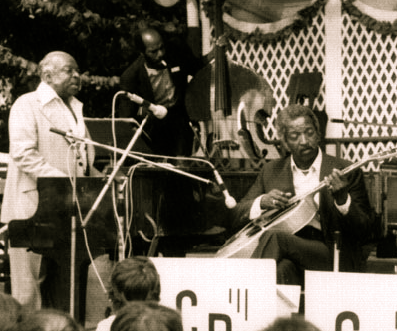
Count Basie, bassist John Duke and Freddie Green, 1975
In a recent interview, pianist Ethan Iverson says: ‘I don’t know what swing is’, a seemingly paradoxical statement for someone with as much experience playing jazz as he has. He says it in the context of a longer thought: ‘I don’t know what swing is, but I know everything [drummer] Billy Hart plays is always incredibly swinging. A universe of beat.’ As Iverson has a number of recordings that display a highly developed swing feel, such as a version of Milt Jackson’s ‘Bags’ Groove’ from a trio album led by drummer Albert ‘Tootie’ Heath, I take his quote to be a kind of hyperbole indicating that while swing is sometimes glibly explained, it defies simple explanation. It is easy to try to describe swing, and much harder to put into practice, and the effort to keep swing feel in one’s playing is a never-ending process. Another important takeaway from his quote is to listen to Hart’s drumming. One of my personal favorite examples is the tune The Fuzz which Hart plays with the Duke Jordan Trio. It features a drum solo in which Hart does all kinds of sophisticated subdivisions while Neils Henning Orsted Pedersen keeps steady time on the bass. Perhaps partly out of the sense of mutuality that comes from the deep connection between his solo and Pedersen’s constant quarter notes, Hart’s solo stays conversational throughout, rather than becoming a lone technical display.
There is a common understanding among jazz guitarists, derived from the playing of Count Basie Orchestra guitarist Freddie Green, that one important way to create swing feel when playing chords in consecutive quarter notes is to lightly accent beats two and four. Among the many tunes where Green can be heard playing with this approach is in this 1981 version of Satin Doll. His approach is demonstrated in recent videos by guitarists Ron Jackson and Zakk Jones among others. An interesting article on freddiegreen.org (a website edited by Vermont guitarist Carl Severance) characterizes the sound of his comping as ‘choo-chit-choo-chit’, which represents the longer, lighter first and third beats and the shorter and slightly accented second and fourth beats. Staff Sargeant Johnathan Epley of the U.S. Army Field Band also mentions this accent pattern in a video and visually demonstrates (but doesn’t verbally mention) a back-and-forth strumming pattern which is sometimes used to achieve this sound. One hears this accent elsewhere in the rhythm section of the Count Basie Orchestra as well, in the playing of bassist Walter Page and drummers Papa Jo Jones and Sonny Payne.
While playing constant quarter note chords is less common among jazz pianists, one notable and well-known exception is Erroll Garner. In his version of All Of Me, he can be heard accenting mostly beat four of his quarter note left hand chords at the ends of two-bar phrases. To accent a chord on the piano, lift the hand using the wrist (not the elbow or shoulder) as an axis. This way of increasingly the velocity of one’s fingers takes less work than simply pushing the fingers into the keys. However, the challenge on piano is most often to keep one’s chords lighter than one’s melodic line, so generally it is important to lift one’s chord hand less high than one’s melody fingers.
Perhaps one reason it can be challenging for musicians familiar with pop and rock music to play quarter notes with a swing feel is that there are a number of iconic hit pop/rock songs that begin with quarter notes which are strongly and evenly accented on all four beats of a 4/4 measure. The best known of these might be Andy Summers’ guitar intro to Roxanne by The Police. It is interesting to compare this to an isolated version of Freddie Green’s comping on How High The Moon, even though it is at a very different tempo and time feel, to hear how Green’s tone and articulation are more subtle than Summer’s intentionally forceful chord chops. (Summers demonstrated on his 2005 album Green Chimneys: The Music Of Thelonious Monk that he does also know how to employ the wider palette of articulation and dynamics that are needed for jazz guitar; his version of Monk’s Dream is a good example.)
Other iconic pop/rock songs with even-quarter-note intros include the 1966 single Good Vibrations by The Beach Boys and the 1967 single Penny Lane by The Beatles. Paul McCartney has spoken about the influence of the Beach Boys on the Beatles in this period, and I wonder whether one of the things the British group inherited from their jazz-influenced American counterparts was the combination of even rock quarter notes in the accompaniment with swing eighth notes in the melody which can be heard in both songs. In contrast to the relentlessly (and effective) even quarter notes of these songs, the Basie band’s rhythm section plays quarter notes which are lighter with a moderate accent on beats two and four. Another example of this can be heard on the Ray Charles tune From The Heart (from the 1961 album Genius + Soul = Jazz, where Charles is backed by a group drawn largely from the Basie band. It is also interesting to contrast the original version of Penny Lane with a jazz cover of the tune by pianist John diMartino and the Count Basie Orchestra’s cover of With A Little Help From My Friends (from ‘Basie On The Beatles’, the second of two albums by the CBO devoted to Beatles songs.) In both of these recordings, the accenting of beats two and four is clear, particularly in the intro to diMartino’s ‘Penny Lane’ and Basie’s brief piano solo in the middle of ‘Friends’.
An important way of creating swing feel with swing eighth notes is to accent most or all of the upbeats, as in the accented baritone sax part in the midsection of Frank Foster’s Blues In Hoss’ Flat performed by the Count Basie Orchestra, the fifth and sixth bars of Duke Ellington’s piano intro on the version of Take The A Train from the album Ellington Uptown and Emmet Cohen’s intro to his version of Everyday I Have The Blues with vocalist Tyreek McDole. Note that Cohen is lifting his right hand, which is accenting the upbeats in the constant swinging eighth notes of the intro, slightly further than his left hand which is playing the downbeats. A good way to practice this kind of accent is to lift the hand or finger that is accenting the upbeat all the way off the keys, so that it is even more visually pronounced than in the video of Cohen. Cohen’s technique is developed to the point that he can play with considerably different velocity in each hand without the difference being that visually perceptible. To build one’s muscle memory of the two velocities, it is important to visually exaggerate more than Cohen does the higher lift of the right hand that creates the faster velocity.
Just as there is a pop music tradition of even quarter notes that can make it difficult for pop-influenced players to accent beats two and four in a swing feel, there is a pop/rock tradition of accenting the downbeat of a swing eighth note pair that can make it difficult for pop-influenced players to accent upbeats. Swing eighth notes with accented downbeats are exemplified by Chuck Berry’s guitar part in the third bar of ‘No Particular Place To Go’ (i.e. the first bar of the twelve bar blues form, just after the two bar intro ending with the word ‘automobile’). While Berry’s accented downbeats give his music its characteristic swagger, in a jazz context this kind of accent can drain a swing groove of its bouyancy. Just imagine Emmet Cohen accenting his right and left hands evenly in the excerpt I linked to above.
Another way of swinging eighth notes is to accent specific upbeats, as Bud Powell does when he plays the opening bars of Benny Harris’s melody to Ornithology on his version of the tune from the album Bud Plays Bird (the melody begins at :11, following Powell’s eight bar intro). To accent a melody note, lift the finger higher so that it strikes the key with greater velocity than if you were to simply keep the finger on the key and push down. Practice scales and melodic lines in swing eighth notes, accenting all upbeats or specific upbeats while paying attention to the connection between key velocity and finger height.
Although the first two measures of the melody to Charlie Parker’s ‘Now’s The Time’ (as heard around the 14 second mark following the intro on the November 1945 recording ) and the first four measures of the Prologue to Fiddler On The Roof by Bock and Harnick are played at two different tempos and in two different duple meters (Parker’s tune is notated in 4/4 while the Prologue is notated in cut time or 2/2), these two passages have the same melodic rhythm – a pickup note on an upbeat followed by four more notes of the same duration on the following downbeat. The two different ways they are articulated illustrates the difference between swing and straight eighth notes, if one can imagine the ‘Fiddler’ excerpt being notated in 4/4 rather than 2/4. The opening of the ‘Fiddler’ prologue is borrowed from a Jewish folk tune which is intended to accompany dancing, so the second note is accented, to indicate to listeners who are also dancing where their steps should begin. ‘Now’s The Time’, by contrast, is one of the early recordings of the bebop movement, where players like Parker who had been primarily employed in dance bands began to be interested in creating music with more complex rhythm, harmony and melody and a faster tempo that was intended for the intellectual response of listening rather than the kinesthetic response of dancing. In this melody, the first note of the initial six-note phrase, the one on the upbeat, is given the same kind of light accent as beats two and four in the Freddie Green guitar parts mentioned above.