
‘Just Friends’, a jazz standard that was published in 1931, seems to be the best known tune by its German-born composer, John Klenner. Sam Lewis, who wrote the lyrics to ‘Just Friends’, also wrote lyrics to a number of other jazz standards, including ‘Dinah’, which was recorded by Thelonious Monk on his album Solo Monk, and ‘Street Of Dreams’, which is sung by Frank Sinatra with the Count Basie Orchestra on the album Sinatra At The Sands.
Two of my favorite recordings of the tune at the more common medium-up tempo are Chet Baker’s scat solo on a live version with Stan Getz, and Hank Jones’ typically elegant, ebullient and crystalline solo on his version from Hank Jones In Copenhagen.
Listening to Baker’s version, Sarah Vaughan’s 1981 version with the Count Basie Orchestra and Tony Bennett’s duo version with pianist Ralph Sharon are good ways for familiarize yourself with the lyrics. Bennett’s version features his trademark clear and colloquial enunciation of the lyrics and is a great example of piano-vocal duo collaboration. The versions I’ve mentioned here, along with great versions by Paul Chambers with Wynton Kelly on piano, Phil Woods, Mike Metheny and Grace Kelly can be found on this playlist. I’d love to hear your reflections on these versions, or links to other versions of the tune you like, in the comment section.
I have included three resources here to help singers, pianists and other instrumentalists familiarize themselves with comping and improvising on Just Friends. The first is my original tune on the chord changes, ‘Elmo, Koko, Donna and the Blue Rose (aka Deep Space Friends)’. Here is a link to a recording I made of the tune on ProTools using the DrumGenius app for drum patterns and adding an accordion solo following the piano solo.
The first part of the title is a series of clues about artists, solos and tunes that inspired this melody. ‘Elmo’ refers to the great bop pianist Elmo Hope, and several of the melodic patterns the title refers to are discussed elsewhere on this blog. The second part of the title refers to some lyrics I wrote to the original melody of ‘Just Friends’ to fit the theme of a recent summer jazz intensive my wife Amber and I taught, which was Interplanetary Jazz. (The last link in the previous paragraph leads to the playlist for the intensive.). The tune combines a bop-inspired right hand melodic line accompanied by left hand comping that uses three and four note voicings, conversational (aka dialogic) phrasing and crossless voice leading. (This is my own term for voice leading that avoids voice overlap, i.e., one voice of a multi-voice texture landing on or jumping above or below the note of a concurrent voice to reach its next note. Consecutive chord voicings with voice overlap are often more difficult to execute on the piano and when they are played or sung by wind, brass or vocal sections.) Here is a link to a folder containing PDFs in all transpositions of the tune as well as a Barry Harris-style scale outline demonstrating some basic scale vocabulary for the tune.
The third resource is a sheet of comping voicings using two-handed four-note voicings with crossless voice leading. These voicings alternate between what Phil Degreg in his indispensable text Jazz Keyboard Harmony calls ‘four voice shell extension’ voicings and ‘four note open position’ voicings. I hope you find some or all of these resources helpful in learning to solo and comp on ‘Just Friends’, and I’d be glad to hear in the comments section about what resources here you found particularly helpful and other steps in the process that you find helpful in learning this skill. (Please see below the comping sheet for one final thought.)
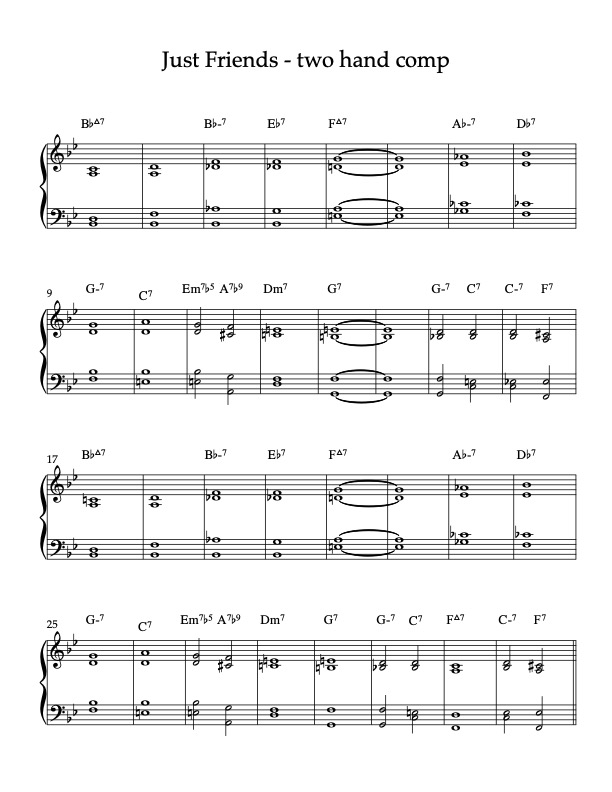
One final note is that although with some tunes I go through the steps shown here of writing out two-handed arrangements of an alternate melody, a scale outline and comping voicings, as I also did with my tune Birdfeeder Blues, based on Rashaan Roland Kirk’s Serenade To A Cuckoo, it is also an important skill for jazz players to be able to go through these steps without writing them down. For me, writing out these steps is an exercise like ‘showing your work’ in math. Just like writing out arithmetic, writing out scale outlines and voicings helps me build my ability to go through these processes working from a single-staff leadsheet and relying on my musical and muscle memory to apply the concepts and retain the patterns.