Feeds:
Posts
Comments

Another Thomas Berry quote worth spending a bit of time with:

“Acceptance of the challenging aspect of the natural world is a primary condition for creative intimacy with the natural world. Without this opaque or even threatening aspect of the universe we would lose our greatest source of creative energy. This opposing element is as necessary for us as is the weight of the atmosphere that surrounds us.” (The Great Work, p. 67)

Berry defines “the wild” as “the root of the authentic spontaneities of any being” (which sounds Deleuzian to me) and which is counterposed to a second constituent force in the universe, discipline or form. “The wild,” as my colleague Stephanie Kaza paraphrases in her review of The Great Work, “is the expansive force, the disciplined is the containing force, ‘bound into a single universe and expressed in every being in the universe’ (p. 52).”

I wonder how this dyadic understanding stacks up against the more monistic, Deleuzian-Spinozian (and Whiteheadian) views that see form-building, or morphogenesis, as part of the same process of spontaneous becoming (e.g. as developed by Manuel DeLanda in A New Philosophy of Society, Intensive Science and Virtual Philosophy, and A Thousand Years of Nonlinear History). This could probably be boiled down into the question: can the two (the expansive and the containing, the Yin and the Yang) also be one (the Dao)? Is Deleuze/Guattari’s ‘desiring-production’ (connection, becoming, subjectivation) analogous to the Dao, as Deleuzian acupuncture theorist Mark Seem has suggested, with any perceived differences being only differences of emphasis — Deleuze focusing more on the open-ended possibilities of becoming, and Daoism focusing on the patterns by which that process of becoming works itself out in time and in space, territorializing and deterritorializing as it goes?

These are rhetorical questions, of course. It’s time to go hear what wisdom my friend Cate Sandilands and British lit crit Greg Garrard can impart about “Our Critical Challenges: What’s Next for Ecocriticism?” (I’m at the ASLE conference in Victoria, British Columbia. More on it soon.)

ThomasBerry.jpg

The tributes are starting to come in for Thomas Berry, Catholic ecotheologian (or “geologian,” as he sometimes referred to himself), scholar, and spiritual/deep ecological visionary, who passed away at age 94 yesterday. Berry is best known for books including The Dream of the Earth, The Universe Story (with physicist Brian Swimme), and The Great Work, in which he articulated the idea that the universe is not a collection of objects but a communion of subjects. Berry wrote:

“If the dynamics of the Universe from the beginning shaped the course of the heavens, lighted the sun, and formed the Earth, if this same dynamism brought forth the continents and the seas and atmosphere, if it awakened life in the primordial cell and then brought into being the unnumbered variety of living beings, and finally brought us into being and guided us safely through the turbulent centuries, there is reason to believe that this same guiding process is precisely what has awakened in us our present understanding of ourselves and our relation to this stupendous process. Sensitized to such guidance from the very structure and functioning of the Universe, we can have confidence in the future that awaits the human venture.”

A few of the more interesting tributes are from the National Catholic Reporter and Drew Dellinger, whose tribute to Thomas is shared on Gus DiZerega’s blog. But I’m sure there will be much more about him in the coming days.

Berry’s vision is completely in synch with the views I’ve described on this blog under the terms “immanentism,” “immanent naturalism,” et al. His passion and writing will continue to nourish many.

Tree.jpg

Now that I’ve taken the time to read the growing list of responses to Lessig’s post, I have to say that I’m much more impressed with the collective hive mind — the network of respondents he’s grown around himself — than with the Queen Bee (Lessig himself) on this matter. (That metaphor is not very rhizomic, I know.) Several respondents play variations on the same themes I argued in my post yesterday, i.e. that Lessig’s use of the word “socialism” is inaccurate, somewhat irresponsible, a little alarmist, and very ethnocentric. Lessig writes in reply that

“We all need to recognize (speaking now to the cross cultural crowd) that different political systems internalize the concepts differently. So I am criticizing an American writing in an American publication about his use of a term — ‘socialism.’ I don’t pretend to understand how well the use fits other cultures, or traditions. I am speaking to one of my own about my own tradition.”

To which Kelly replies that he’s not writing as an American but is “at this point half Chinese, and, as much as possible, a citizen of the world.” He could have added that Wired magazine is read all over the world, especially on-line, and that Lessig is, too. To his credit, Kelly sticks to his guns.

An interesting side-discussion seems to be emerging from Kelly’s challenge to “Give me a better word to describe the type of governance that is emerging”, with the issue being whether what is emerging from Wikipedia, etc., qualifies as governance at all. Of course it isn’t, but it could be considered part of a larger, more diffuse network of governance mechanisms that are evolving in fits and starts at every scale from the local to the national to the global, from peer pressure and the institutionalization of accepted practice to enforceable regulations. These are neither purely capitalist nor purely socialist. They, ideally, should have something to do with nested systems of collective monitoring and adaptive governance, with mixtures of rights and obligations, checks and balances, individual and collective forms of behavior, etc. And if there isn’t an accepted word to describe them, Kevin Kelly’s attempt to test at least one of them (socialism) for its appropriateness seems laudable. At the very least, it’s nice to see this discussion happening in a public forum where political philosophers aren’t huddled together in their own, mutually exclusive camps.

See Lessig’s “On “socialism,” Round II” for continuing discussion of these issues.

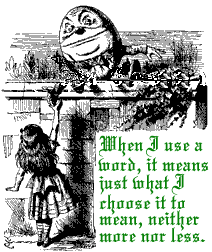
humpty%20dumpty.bmp

“When I use a word,” Humpty Dumpty said, in a rather scornful tone, “it means just what I choose it to mean – neither more nor less.”

“The question is,” said Alice, “whether you can make words mean so many different things.”

“The question is,” said Humpty Dumpty, “which is to be master – that’s all.”

— Through the Looking Glass

Lawrence Lessig has written a lengthy retort to Kevin Kelly’s article, which I just wrote about, describing the open-source movement as a form of socialism. Lessig, leading theorist of the open-source movement and a respectable legal scholar (whom I’ve blogged about here), says no way, but his argument, which he admits is a “rant,” is as sloppy as he accuses Kelly of being.

Lessig’s argument is essentially that one cannot redefine a word at will:

“Words have meaning. We don’t get to choose their meaning. If you call something “X” people will hear the equation. They won’t read the fine-print which says (“By X, I mean really not-X).”

and that the word “socialism” has a clear meaning and Kelly’s redefinition of it plays into the wrong hands. Kelly’s “sloppiness” here, as he calls it,

“has serious political consequences. When a founder of the movement which we all now celebrate calls this movement ‘socialist,’ that plays right in the hand of those would attack everything this movement has built. […] I do think that now is not the time to engage in a playful redefinition of a term that has such a distinctive and clear sense. Whatever ‘socialism’ could have become, had it not been hijacked by revolutions in the east, what it is in the minds of 95% of America is not what Wikipedia is.”

The irony here is that Lessig writes as if he hasn’t a clue of the historical meaning of the word “socialism” beyond its use as an epithet by American conservatives. He is, in effect, choosing the meaning of a word even as he diallows others from doing that. “At the core of socialism,” he writes, “is coercion”:

Continue Reading »

Responding to a post on this blog, Kvond, a little while ago, raised the question of the relationship between Arne Naess, originator of “deep ecology,” and Spinoza – which made me think of the interesting if sporadic/uneven/episodic relationships between the main traditions of continental philosophy and environmental thought. A glance at the changing editions of Environmental Philosophy, a reader originally edited by Michael Zimmerman but now collectively edited and in its fourth edition, shows us how the place of continental philosophy has grown from barely a mention in the first two editions (1993, 1998) to an entire six-chapter section in the fourth. How that came to be is a story that has yet to be written, though a few brief accounts exist, such as Michael Zimmerman’s chapter in Rethinking Nature , comments scattered through Zimmerman’s Contesting Earth’s Future, and Bruce Foltz’s brief but excellent piece in John Protevi’s Dictionary of Continental Philosophy, which I discovered as I was wrapping up this post.

What follows is a highly selective and episodic overview of key moments in that unfolding relationship. But I start with a few caveats.

Continue Reading »

byrne1.jpg

As many of us (academics) set off for various travels, a glance at David Byrne’s Journal can remind us of the value of the well-made observation. Byrne (yes, the Talking Head) has been posting his travel journals (to be published in the fall as Bicycle Diaries) alongside photographs, videos, and other observations on his blog for a few years now.

Thanks to Reese for reminding me of Byrne’s writing. I’ll be heading off to Vancouver Island for the ASLE conference next week, then to Amsterdam for the ISSRNC in July, and to Santa Fe in August for a seminar at the School for Advanced Research on the Human Experience, with a few other stops along the way, and time spent in Vermont in between. So my blog contributions may be spotty at times through the summer. But if I motivate myself, I may share some photos and observations from my travels. I will be posting other people’s stuff to the Shadow Blog regularly.

(On Kevin Kelly’s “The New Socialism,” Paul Ward’s Medea Hypothesis, Steven Shaviro’s “Against Self-Organization,” and more.)

Self-organizing adaptive systems and other networks are more than just the flavor of the philosophical month; they are a model increasingly used to make sense of the natural and cultural worlds. Generally it’s assumed that such distributed self-organization is a good thing and that our intelligence needs to mirror it as best as possible. This message is reiterated in books like Daniel Goleman’s Ecological Intelligence, a worthy recent entry onto the popular market by the psychologist who popularized the terms social intelligence and emotional intelligence. Summarizing the research of ecological economists and industrial ecologists, among others, Goleman argues that what we need is a “radical transparency” about the entire production and consumption cycle of the products we buy. I’ve only skimmed the book, but I imagine that this argument can be added to the social and emotional intelligence arguments he’s previously made, and perhaps to a “political intelligence” piece that may need to be better developed, so that what we’d get is a radical transparency about the ecological and social justice impacts of the things that make up our world.

Transparency and complexity would seem to go hand in hand, then: the more we are aware of the causal loops making up the increasingly complex systems of our uncertain world, the more capable we are of dealing with the results of those complex feedback loops. But there’s only so much knowing that can go around in a world that’s flooded with information, but in which that information comes primarily in the form of distraction. Both the distribution of knowledge and the economy of attention will be areas we’ll need to be concerned with more and more. On the latter, I highly recommend Sam Anderson’s New York Magazine piece “In Defense of Distraction,” an entertaining jaunt through the landscape of twenty-first century distraction, where attention is increasingly becoming a new currency, and attention aids, from neuroenhancement drugs to mindfulness training, will increasingly provide us with what we need to navigate the world (while remaining upwardly mobile).

To better map out the distributive politics of knowledge and of ecological (and other kinds of) intelligence, we may need to retrieve traditional ideological concepts like “socialism,” and also to examine our assumptions about the nature of the whole system (whether that be global capitalism, the biosphere, or the combination of the two). A couple of recent books and articles can help us think about the ethics and politics of globally distributed intelligence.

Continue Reading »

glen.jpg

I’m very sad to hear that a friend and colleague, geographer and Africanist Glen Elder, has passed away following a heart attack. Glen was a warmhearted, passionate scholar, former chair of Geography and current Associate Dean of Arts and Sciences at the University of Vermont. He had just given a captivating performance as master of ceremonies of the Arts and Sciences graduation ceremony this past Sunday.

My deepest condolences to all affected, especially Glen’s partner Mick. Our memories of Glen will continue to be inspired by his warmth, insight, passion, expansive worldview, and dedicated teaching and leadership.

Here’s Glen’s web site and UVM Provost John Hughes’ words about Glen’s death. Also, my friend Reese Hersey has kindly shared the following reflection about Glen, originally given at Glen’s UVM Dean’s Lecture on November 4, 2005:

Continue Reading »

Robert Brulle has kindly shared his reply to George Lakoff’s article “Why Environmental Understanding, or ‘Framing,’ Matters.” See below for further discussion of the article.

I found Dr. Lakoff’s comments quite interesting and revealing of the limitations of cognitive science in the analysis of social change processes. From a sociological perspective, attitudes and beliefs are the outcome of socialization processes. There are not just two different cultural models available for us to use in our interpretation of the world. Lakoff reduces the complexity and plurality of competing and/or contradictory world views into a highly simplified and individualistic approach. In essence, this is a form of psychological reductionism. For a competing view of value socialization and moral development, I suggest a review of “Moral Consciousness and Communicative Action” by Jurgen Habermas.

Continue Reading »

Descartes3.jpg

In Why Environmental Understanding, or “Framing,” Matters, published today on the Huffington Post (and on AlterNet), liberal framing guru George Lakoff provides a useful critique of a forthcoming EcoAmerica report on the framing of environmental and climate change issues. While his conclusions are perceptive and make the article a valuable read — I’ll get to those — I find the assumptions underlying his critique worthy of examination. Lakoff is a cognitive linguist, and he contrasts his use of the term “frames” with sociological work on “discursive frames,” rather unfairly biasing the comparison in his favor by suggesting that the sociological approach is “superficial” while his is rooted in the neurobiology of brain functioning.

We think,” he writes, “mostly unconsciously, in terms of systems of structures called ‘frames.’ Each frame is a neural circuit, physically in our brains [sic]. We use our systems of frame-circuitry to understand everything, and we reason using frame-internal logics. Frame systems are organized in terms of values, and how we reason reflects our values, and our values determine our sense of identity. In short, framing is a big-deal.

All of our language is defined in terms of our frame-circuitry. Words activate that circuitry, and the more we hear the words, the stronger their frames get. But if our language does not fit our frame circuitry, it will not be understood, or will be misunderstood.

In translating science for a popular audience, especially in a political context, one of course has to simplify. But I find Lakoff’s simplifications here a bit jarring. They remind me of those Cartesian diagrams of human mental circuitry by which a physical stimulus leads to a neurochemical response leads to a physical reaction (see illustration above), with no place for culture or for a feeling human agent in the middle of it. Lakoff reduces all of our understanding to words (“all of our language” works this way) activating distinct neural circuits called “frames,” which are “organized in terms of values,” with the latter in turn “determin[ing] our sense of identity.” It’s not clear where these “values” come from, or if values and identity have their own separate neural circuits or, if not, what exactly they are. According to Lakoff, “two competing value-based systems of frames,” and therefore two identities, are available “in our politics”: a conservative one and a progressive one. (See his Moral Politics for more on these.)

But my quibbles here are not so much with the simplification of our politics or of the “neural circuitry”; I’m content to acknowledge that a quick polemical Huffington Post article is not the place for articulating a thorough and coherent model of language, selfhood, and society. What’s more important to me, though, is that there seems little role in Lakoff’s model for affect, that is, for individual and collective emotional response, in people’s processing and use of language, concept, metaphor, and image.

Continue Reading »

Philosopher of religion and Derridean “atheologian” Mark Taylor’s recent NY Times op-ed End the University as We Know It has generated a lot of discussion in academic circles and blogs. Reading the article reminded me of a situation my institution, the University of Vermont, went through recently, after being approached by a foundation interested in dropping a truckload of money into curricular restructuring toward a more problem-based and “solutions-oriented” model of a “green university.” Our president had committed himself to making UVM “the environmental university,” and so the group that initiated this restructuring felt it was well positioned to make a case for some kind of wholesale restructuring. Much time was spent debating what this might entail and whether it should involve institution-wide restructuring or just a grafting-on of a new “meta-college” that would facilitate cross-institutional and extra-institutional collaboration, but wouldn’t essentially alter the existing structure of the university. But in the end, the initiators seem to have misjudged the extent of resistance to systemic change, and the foundation lost interest, for reasons external to the process itself.

But there’s something I think they missed in that “resistance” which Taylor’s critics have been quick to identify. Taylor’s op-ed succeeded in what it set out to accomplish, which was to generate discussion, and it did include some generally smart (if not original) ideas, like restructuring the curriculum so it’s more “like a web or complex adaptive network” (that sounds good, doesn’t it?), increasing collaboration among institutions, transforming the traditional doctoral dissertation, and expanding the range of professional options for grad students outside the “pyramid scheme” structure that exists now. Even the proposal to “impose mandatory retirement and abolish tenure,” substituting the latter with renewable (or terminable) seven-year contracts, has its virtues which those of us who defend tenure would willingly acknowledge.

Continue Reading »

Environmental pied piper Annie Leonard’s 20-minute teaching video The Story of Stuff got five minutes of frantic Fox News treatment a few days ago — which means it’s making an impact out there in the wilds of America. New York Times Education writer Leslie Kaufman, writing about it on Sunday, noted that six million people have viewed the film on the Story of Stuff web site, millions more have seen it on YouTube, over 7,000 schools, churches and others have ordered a DVD version, and Facing the Future, a sustainability and global issues curriculum developer for schools in all 50 states, is drafting lesson plans based on the video. Kaufman calls it “a sleeper hit in classrooms across the nation.” She also notes its critics, including a Montana school board that decided against showing the video “after a parent complained that its message was anticapitalist.”

Fox’s liberal media watchers apparently took the Times story as a cue to do a segment on it, so they invited Allegheny College environmental studies prof Michael Maniates and the American Enterprise Institute’s global warming skeptic Chris Horner to debate it for a full, well, not quite five minutes. (If the environmental studies field had its academic stars, Maniates would be one of them, alongside David Orr, Gus Speth, and a few others. That list alone makes me want to ask: where are ES’s Judith Butlers and Donna Haraways? But that’s a topic for another conversation.)

Horner describes the video as an “abysmal” marriage of Malthus and Marx — “community college Marxism in a ponytail” (sounds scary, doesn’t it?) — and claims that it “terrorizes children into rejecting the prosperity that will allow them to live into their 70s or likely 80s in America as opposed to their 40s if they’re lucky in Haiti or 50s in India — these poor societies that we idolize and romanticize through philosophies like this, which […] were disproven some time ago.”

It’s that very connection between us living into our 80s here and the Haitians and Indians living only to their 50s ‘there’ that the video is so good at thematizing. Despite its oversimplification of the details, Leonard’s video captures the systemic interconnections between ecology, industrial growth, human rights and social justice, and corporate globalization in ways that’s nearly impossible in twenty minutes. It’s not a marriage of Malthus and Marx — calling it that is just Horner’s attempt to make it seem both dated and dangerous, though he may be shooting himself in the foot, since most Fox viewers aren’t likely to know much about either of them. It’s really a simplified ‘for-kids’ version of a pretty current synthesis of ecological economics (and industrial ecology) with world systems theory and political economy — or, in a word, political ecology.

One of Maniates’s points (one of the few he’s allowed to make in such a short segment) is that the video is being greeted well not only by the environmental left but also by parts of the right. You can see a bit of that on the Christianity Today blog, for instance (though I’m not sure how ‘right’ they are). Some interesting critical discussion of the video can also be found on tech-geek Andy Brain’s blog.

Thanks to GreenMuseum.blog and SustainablePractice.org for alerting me to the Fox story.

« Newer Posts - Older Posts »

Skip to toolbar