Feeds:
Posts
Comments

Just by linking Carl Sagan’s eloquent little Pale Blue Dot to the teachings of Gautama Buddha, James Ure’s Buddhist Blog brings out the buddhism inherent both in Sagan’s words and in the imagery of the Earth from space. That imagery (as I’ve discussed before here and here) is multivalent, but Sagan’s spin on it — the pale blue dot as “the aggregate of our joy and suffering” on which “everyone you love, everyone you know, everyone you ever heard of, every human being who ever was, lived out their lives” — deepens its ability to carry useful meaning. That ability will one day exhaust itself, if not turn into its opposite, but for now I don’t think it has. “The Earth is a very small stage in a vast cosmic arena. Think of the rivers of blood spilled [. . .] the endless cruelties visited by the inhabitants of one corner of this pixel on the scarcely distinguishable inhabitants of some other corner [. . .] Our posturings, our imagined self-importance, the delusion that we have some privileged position in the Universe, are challenged by this point of pale light.”

Continue Reading »

prairiedog.jpg

Over the past several days I’ve gone from the cool wetness of Alaska’s southeast coast to the high dryness of north-central New Mexico. The first was pure holiday, accompanied by loved ones (including those who generously funded it) and featuring glaciers, salmon, a black bear (devouring one of the salmon), a ride on one of the most scenic train routes in the world, and the ambiguous eco-ethics of spending a week on a cruise ship (but I decided not to look such a gift horse too closely in the mouth). The second has been a kind of work vacation involving a week of conversations on the topic of science, nature, and religion, generously funded, hosted (and wined and dined — there’s even a book about their culinary tradition) by the School for Advanced Research in Santa Fe.

The SAR has been funding anthropological research, hosting seminars and residencies, publishing books, and working alongside Native American artists to collect and preserve art and material culture for over a hundred years now. Its campus, a former artist’s colony called El Delirio and cheekily referred to as an “anthropologists’ resort,” is just outside downtown Santa Fe, which, at 7000 feet, is a deceptively uncitylike state capital; buildings are restricted to three stories and a limited range of variations on deep-cream-colored adobe (or adobe-style) architecture. The late summer days here heat up, albeit sweatlessly, but the mornings, evenings, and nights swell up invitingly into the big starry sky, with sweet summer smells of lush semi-desert vegetation (pinyon pine and juniper, cottonwood, fruit trees, yucca, Russian olive blossoms, cholla cactus), layers of soft cricket chirpings, and the occasional coyote chorus or quite (but communicative) prairie dog (see above) scurrying around in the grasses. The city is greener than I remember it from a brief visit in 1994, and it seems to be dealing with its water issues reasonably well (water being the limiting factor in these parts). It feels good to be in the southwest again (having visited this part of the country only briefly a few times since my fieldwork in Arizona in the mid-1990s).

Continue Reading »

I recently worked my way through Charles Taylor’s A Secular Age, which, since its publication in 2007, has become one of the most widely reviewed and critically lauded books on religion and secularism — and which, in a tangential way, was one of the provocations that led me to start this blog in the first place. What follows are some thoughts on Taylor’s notions of immanence and transcendence, and on the “third way” of radical immanence, or immanent naturalism, that has become an important conversation partner in the debate that has arisen in the wake of Taylor’s book. (See The Immanent Frame for some of this debate, especially the contributions by William Connolly, Elizabeth Hurd, Lars Tonder, Patrick Lee Miller, and Taylor himself.) These thoughts are taken from a longer argument that I presented at last week’s ISSRNC conference in Amsterdam.

It’s rare that a nearly 900-page tome of dense and circuitous philosophical and historical prose gets the kind of attention A Secular Age has gotten, and the fact that Taylor is as brilliant, respectful, and nuanced a thinker as he is makes it a book well worth celebrating. Conferences have been held in its honor, and the Social Science Research Institute-supported blog The Immanent Frame, on “secularism, religion, and the public sphere” and named after one of the book’s central concepts, has attracted the contributions of dozens of high-profile thinkers to weigh in on the themes raised by Taylor. (The list includes Talal Asad, Arjun Appadurai, Robert Bellah, Barbara Herrnstein Smith, Martin Marty, Wendy Brown, Craig Calhoun, Jose Casanova, William Connolly, Saba Mahmoud, Donald S. Lopez, Jr., Roger Gottlieb, Timothy Fitzgerald, Todd Gitlin, Christina Lafont, and Taylor himself.)

Continue Reading »

3272263118_c6ff7e5b8c.jpg

Today, my last day in Amsterdam, I finally made it to the monument unveiled last year honoring Baruch de Spinoza. Since the talk I gave at the ISSRNC conference here was on immanence (specifically, Charles Taylor’s concept of the ‘immanent frame’ and William Connolly’s and others’ immanent naturalism), there was no way around visiting the eminent philosopher of immanence himself.

The bronze monument stands in front of the city hall and at the entrance to the old Jewish Quarter in which Spinoza grew up (he was born in Amsterdam to a family of Sephardic Jewish refugees from Spain). Spinoza’s back is to one the tree-lined canals floating to the Amstel, and a few feet away from him is an icosahedron, a 20-faced geometric form that refers to the geometrical method that informed his philosophy. The coat he is wearing features several birds — rose-ringed parakeets and sparrows, the former being bright green birds that are exotic to Amsterdam and that first settled in the nearby Vondelpark, the latter a diminishing native breed — and roses, which apparently symbolize Spinoza, whose name means “thorn” in Portuguese, but which to my mind also represent the love that infused his philosophical writings. A thorn in the side of authoritarians (the text on the base of the statue is a rather optimistic quote from Spinoza, “The purpose of the State is freedom”), Spinoza preached democracy, tolerance, freedom of thought and expression, a monism which he opposed to Cartesian mind-body dualism, and an immanent naturalism that equated nature with God, for which he was excommunicated from his synagogue and his books banned by the Catholic church. The Spinoza Monument Publication quotes his words in its dedication of the statue: “Gratitude or thankfulness is love’s desire or endeavor to do good to someone who has done us a service out of an equal love affect.”

Earlier this year, local artists along with the Amsterdam Spinoza Circle put on a series of events in his honor, including performances, installations, discussions, a series of posters exhibited around the city, and more, under the title My Name is Spinoza. I can’t think of a more appropriate place to do that than friendly, liberal, multicultural Amsterdam, which no matter how thoroughly humanized its nature may be, is a place that, with its famous tolerance for the virtues and vices of human nature, well reflects Spinoza’s sentiment that you can’t hate nature. That said, incidents of intolerance have marred the city’s and country’s reputation recently, but they seem, from my brief visit and the reading I’ve done while here, like exceptions to a general rule of getting along, parakeets and sparrows and all, infused by a love of knowledge and of life.

Spinoza has been rediscovered repeatedly, more recently by post-Marxist political theorists like Althusser, Deleuze, and Negri in the 1960s and 1870s, but also, as I’ve discussed here, by deep ecology founder Arne Naess and, a little later, by anti-Cartesian neuroscientist Antonio Damasio. While the world has caught up with him, to some degree, in its political liberalism, his non-Cartesianism represents, to many, the philosophical path not taken — until now, perhaps, as mind-body dualism winds its way down and is replaced by a more subtle understanding of how thinking, feeling, and bodily affects interact to produce the relations that constitute us.

More information about the monument can be found here. More detailed photographs can be seen here and here. And for eloquent Spinozist blogging, I recommend kvond’s Frames /sing.

Paul Ennis has posted an interview with me over at Another Heidegger Blog. It follows a few great interviews with distinguished company — philosophers Graham Harman, Levi Bryant, and Lee Braver — and I hope it and the rest of the series generate productive cross-currents and conversations between philosophers, greens, and others.

EveningCanal2-m.jpg

Meanwhile, I’m in Amsterdam for a meeting of the ISSRNC, an interdisciplinary association that’s been producing some very interesting conversations about the intersections of religion, nature, and culture — without taking any of those three terms for granted — since its inception just a few years ago. More on that soon.

But what a lovely city. Last night, as the sky was finally beginning to darken after 10 pm, the lanterns on the streets were aglow and the lights beneath the bridges reflected on the canals, all of it blanketed by the soft hum of people’s voices, and I could imagine myself enjoying the same scene in the fall, with red and orange leaves on the ground, and in the spring, with smells of blossoms in the air, and in a winter covered in snow, skaters lazily moving down the frozen canals. (I’m told, though, that the snow doesn’t stay around long any more when it does fall. Europe’s warming, too.)

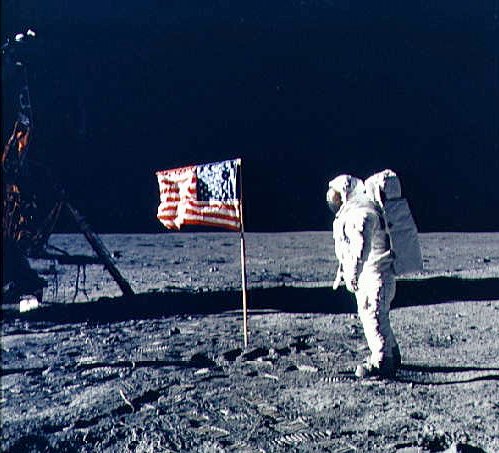
buzz-aldrin-moon-msfc-6900952-ga.jpg

This image of Buzz Aldrin on the moon, photographed forty years ago by his Apollo 11 spacemate Neil Armstrong, has haunted me for decades. Not so much because it’s taken on the moon, as because of the image on his helmet, a mirror image that suggests there’s nothing behind the mask, inside that cavernous helmet, except for a kind of deadly infinite blackness, a void beyond which is nothing. (Except that we are there, whatever the ‘we’ are, and not necessarily just us humans.) It’s one of those images that seeped in and triggered the growth of the budding Buddho-Lacanian in me, the one who suspects that within and between the myriad things of beauty and color and sound and joy and sadness and struggle and sorrow and loss, there is some kind of space that’s dark and calm and empty, a place of infinite rest, the Buddhists’ calm abiding and the Slavic Christian’s vichnyi spokij, but a place that’s also somehow bottomless, one of Pascal’s infinite spaces, where planting a flag will hardly make a home. Where Elton John’s rocket man burns up his fuel alone, and Ground Control’s call to Major Tom gets lost, his circuit dead for good.

As for Neil Armstrong’s walk itself, my memory of it is steeped in the hypnotic ambiance of the eerily blue screen and tinny sound of the black-and-white TV that filled up the summer cottage where we spent that part of the summer of ’69 with our extended Ukrainian family of siblings and cousins, aunts and uncles, against a background of crickets and rotting wood and septic tank smells. It’s all mixed together with the distinct memory I still carry around with me of walking down the country road outside that cottage with my dad and a friend of his talking about space and the future, the space between us and the moon filling up with the weirdly vertiginous understanding that someone was up there walking on that white orb, just as we were walking down here on this earth, in some sort of bizarre mirroring between earth and space. “We came in peace for all mankind”, they said, just as Jesus did, planting flags on a flagless, lifeless, inert, and in the end perhaps futile new world.

Conspiracists continue to deny it, but according to established consensus, twelve men have walked on the moon. All have been Americans. One of them golfed there. One, Edgar Mitchell, went on to found the Institute for Noetic Sciences, write a book on psychic phenomena, and claim that “we are being visited” by extraterrestrials and have been contacted by them several times, but that governments have hidden the truth from us for over sixty years. Another, James Irwin, went on to form the High Flight Foundation, a religious organization based in Colorado Springs (the epicenter of American evangelical Christianity) to encourage people to “the Highest Flight possible with God”; Irwin has led trips in search of Noah’s Ark on Turkey’s Mount Ararat, and has said that “Jesus walking on the earth is more important than man walking on the moon.” As for Buzz Aldrin, he reported Apollo 11’s apparent UFO encounter (later clarified to remove any suggestion of aliens), but didn’t get Ali G. (But would he get Bruno?)

If Apollo (alongside other missions) brought us the Earth as picture, a planet captured by technology, visualizable as an entity we (or our experts) can map, measure, quantify and manage — in all its boundaryless, post-nationalist glory (choose the interpretation you favor, the globalist or the planetarian), then the moonwalk — brought to us by Bill Bailey, Marcel Marceau, James Brown, David Bowie, Neil Armstrong, and most famously by Michael Jackson — gave us the Moon as dancefloor. (Both Theory Vortex and Moving Images compare the two most famous moonwalks, Neil Armstrong’s and Jackson’s.) Sun Ra, George Clinton, and other Black musicians have, of course, been traveling to outer space for decades, as John Akomfrah argues in the film The Last Angel of History. Just as Ray Bradbury displaced the American frontier to our neighboring red planet in his Martian Chronicles, lyrically evoking the disappearing native culture in the face of the incoming settlers, African Americans, whisked off and carried forcefully to new worlds, have been mapping out alien space for centuries.

How do we walk on the moon? How do we dance onto that surface that has never been danced on by one of us, and how do we shuffle forward on it, when there is neither forward nor back anymore (it’s too late for that), just a nervous tiptoeing into the blackness of a nowhere on the other side of the Cocteauian mirror of a “small step” taken, a “huge leap for mankind“? The Independent reported the other day that among the results of the Millennium Project’s 6700-page, 2700-expert, UN- and World Bank-supported State of the Future report is the recognition that climate change “will cause civilisation to collapse.” Where to, then? How do we step into that mirror? Benjamin knew what Klee’s Angel of History was saying, but we aren’t sure of anything anymore. (are we?) (take another step, slowly, feel the dirt, the sand between your toes; take off that boot, astronaut, and lift those rose-petals to your face, so soft, sweet smelling, delicate, red) (Tarkovsky’s Solaris is the antidote to Kubrick’s 2001, but even it is haunted and dark; the real antidote is life itself) (the planet I would cherish is the one that would turn our flags into roses, and it’s right here, where I’m sitting)

First%20Step%20Moon.jpg

The eco-arts blogosphere has kept simmering through the early summer. Greenmuseum.blog, connected to the excellent online environmental resource and exhibition space Green Museum, has taken on a new look. The blog had recently covered the Earth Matters on Stage EcoDrama Symposium, held at the University of Oregon. Mike Lawler’s EcoTheatre blog also provided coverage of EMOS. Ecoartspace has been blogging from the Seattle Public Arts Conference, the theme of which this year was Renewable Resources: Arts in Sustainable Communities.

Over at Sustainability and Contemporary Art, Maja and Ruben Fowkes have been blogging about the Hard Realities and New Materiality Symposium, which took place at Central European University recently. Antennae magazine has an interview with the Fowkes in which they discuss the sustainability of contemporary art, the ethics vs. the aesthetics of form, Felix Guattari’s ‘three ecologies,’ and other topics. Some of the Fowkes’ writings, including Unframed landscapes: Nature and Contemporary Art and Towards the Ecology of Freedom, can be found at Translocal.org. (Some of these overlap with issues I discussed in my piece Sustainable vision from the 2004 Natural Grace exhibition catalogue; you can find a brief overview of the environmental and eco-art movements there.)

Smudge has been blogging about the massive LAND/ART exhibition/project in New Mexico. In many ways, land art reflects an earlier moment in the evolution of ecological art, one premised on making statements in wild or open landscapes, but much of what’s presented in this exhibition goes well beyond that, for instance, to the documentation, questioning, and interrogation of land uses in their social, perceptual, and ecological contexts. Among the events is an Experimental Geography exhibition, featuring The Center for Land Use Interpretation, Trevor Paglen, and others. See the CLUI’s database of unusual and exemplary sites — which range from nuclear and industrial accident sites and weapons plants to tourist caves, ghost towns, and UFO sites across the U.S. — to get an idea of what this unusual ‘research organization’ does. Artist and “experimental geographer” Paglen‘s work on “black sites” — secret military landscapes and other “blank spots on the map” — has even gotten him onto the Colbert Report; see his media page for articles, reviews, and videos. Paglen writes about Experimental Geography over at Brooklyn Rail, while Rhizome provides a good list of reading materials on the topic. See also art:21’s interview with EG curator Nato Thompson.

Sustainable Practice is a good place to keep up to date with a lot of these types of things, while Critical Spatial Practice focuses more on the geographical interventions.

stalker7.png

As ecocriticism expands and deepens in scope (of subject matter & media examined), extent (internationally), and diversity (in approaches, connections with other schools of thought, etc.), its interactions with non-literary fields such as cinema studies, theatre/performance studies, and musicology (as I posted about recently) are starting to develop in healthy ways. The ASLE conference had several sessions devoted to film — four panels, several papers within other panels, and a pre-conference session on film and media — which, I believe, is more than the conference has ever had. Since then, an Ecomedia Studies Wiki has been started, as has an Ecomedia listserv (with very little activity yet, only because I started it and I’ve been too preoccupied to get any conversation going). Among related ventures, the Media Ecology Association‘s 2010 convention will be on “Media Ecology and Natural Environments” (e-mail Paul Grosswiler for further info on that). A group of us are hoping to make a little splash at the Society for Cinema & Media Studies conference next year. If you have any interest in such things, feel free to e-mail me directly, but expect a slow response during the summer, as I’m on the road through much of it (between the cabin where I’m blogging from in Vermont and Amsterdam the week after next, then the west coast of British Columbia & Alaska, then New Mexico in mid-August).

Continue Reading »

As chair of the awards committee for the International Society for the Study of Religion, Nature, and Culture, I’ve had to start thinking about the best scholarly books published in the last couple of years. Given the overlap between “the study of religion, nature, and culture” and this blog, I thought I’d throw out some names of books and other things I’ve been impressed with recently that make important contributions to the study of nature/culture in their many intersections and blurrings. The following are really just those closest to the top of my head right now. The list can certainly be expanded, and the exercise is even a little perverse, since there are many books I’ve been wanting to get to but haven’t yet (such as Tim Morton’s Ecology Without Nature, Steven Shaviro’s Without Criteria, and Graham Harman’s new book on Bruno Latour, The Prince of Networks). Other suggestions are welcome. (And if you have anything you’d like the Religion/Nature/Culture awards committee to know about, please feel free to send information, or even copies, to my institutional address.)

Best book in nature/culture (ecocultural) studies

Arturo Escobar, Territories of Difference: Place, Movements, Life, Redes (Duke University Press, 2008)

Stefan Helmreich, Alien Ocean: Anthropological Voyages in Microbial Seas (U. of California Press, 2009)

Joachim Radkau, Nature and Power: A Global History of the Environment, translated by Thomas Dunlap (Cambridge University Press, 2008; orig. 2002)

Nicole Shukin, Animal Capital: Rendering Life in Biopolitical Times (University of Minnesota Press, 2009)

Best (most inviting) collections in ecoculture studies

(books that understand the importance of allure for disseminating ecocultural thought/art/work)

David Carrasco and Scott Sessions, ed., Cave, City, and Eagle’s Nest: An Interpretive Journey through the Mapa de Cuahtinchan No. 2 (University of New Mexico Press, 2007). (This could be in the first category above as well.)

Paul Waldau and Kimberley Christine Patton, eds., A Communion of Subjects: Animals in Religion, Science, and Ethics

(Columbia University Press, 2007).

John O’Brian and Peter White, Beyond Wilderness: The Group of Seven, Canadian Identity, and Contemporary Art (McGill-Queen’s University Press, 2007).

Best environmental blog

Dot Earth

Runner-up: WorldChanging

Best philosophical blogs in nature/culture theory

Well, this one’s difficult because I wouldn’t want to offend those I don’t mention, but my favorites of late have been Frames /sing, Larval Subjects, and The Pinocchio Theory.

The philosophical movement increasingly known as Speculative Realism is starting to get attention in these parts of town (the town being Academe, or at least its digital suburbs, and these parts being its ecocritical/biocultural/animaphilic ghettoes). News about the forthcoming re.press anthology, The Speculative Turn: Continental Realism and Materialism, has been circulating for a few days now. The publisher’s blurb announces that

“Continental philosophy has entered a new period of ferment. The long deconstructionist era was followed with a period dominated by Deleuze, which has in turn evolved into a new situation still difficult to define. However, one common thread running through the new brand of continental positions is a renewed attention to materialist and realist options in philosophy. […] All of [the authors represented] elaborate a positive ontology […]. […] the new currents of continental philosophy depart from the text-centered hermeneutic models of the past and engage in daring speculations about the nature of reality itself.”

Scu at Critical Animal posted several beginners’ questions to the movement on Friday, and both Levi Bryant, a.k.a. Larval Subjects, and Graham Harman, a.k.a. Dr. Zamalek posted responses Saturday (Bryant’s providing the more detailed and, for Harman, “perfectly” agreeable replies). The speed of their responses shouldn’t surprise us; Scu aptly begins his post with the phrase “For an intellectual movement that has such a strong internet presence”… Indeed they do, as Paul Ennis at anotherheideggerblog points out, calling them “the first truly digital” philosophical movement, for the extent of online conversation and open access publication that goes on in the SR milieu.

Continue Reading »

The explicitly ecological piece on Marvin Gaye’s What’s Going On was Mercy Mercy Me (The Ecology), which, like a lot of his music at the time, fuses a clear-eyed realism with an optimistic, gospel-tinged sense of possibility. I’m not sure where this video comes from (or why David Bowie appears in it), but the shots of people (heads, notably) in thought underlines the sober message of “think, man” — something that was possible in cooler, more reflective times. Michael Franti’s “Everyday Life Has Become a Health Risk” (no video available) tries to do this as well, though less coolly than some of the Disposable Heroes of Hiphoprisy’s other songs, like “Music and Politics.”

Gaye and Jackson shared Motown, at the time at least, and with Motor City’s demise and potential eco-revival, there’s a story to be told about Detroit, black music, and ecology somewhere in there (cf. George Clinton and Parliament-Funkadelic, technoists Derrick May, Juan Atkins, Kevin Saunderson, et al.).

The death of Michael Jackson has prompted eco-bloggers to take another look at Jackson’s 1995 “Earth Song“, which some consider the most popular environmentally themed song ever produced. The song remains Jackson’s biggest seller in the U.K, having sold over a million copies there — more than either “Thriller” or “Billie Jean” — but it was never even released as a single in the U.S.

Alex Pasternack at TreeHugger.com describes the epic music video’s “scenes of environmental destruction and war […] cut with Jackson wandering across a landscape of drought and fire, before he does his yell-through-the-wind thing, undoing all of our ecological damage like magic.” Its messianic portrayal of Jackson staving off the eco-apocalypse apparently ticked off Pulp frontman Jarvis Cocker (now a climate change activist rocker) who stormed the stage at one of Jackson’s performances. Other blogs posting about it include the Guardian’s Environment Blog, Rock and Ecology, Moving Images Moving People, and Mark Meisner’s new environmental communication blog Indications, which also provides helpful links to sites examining environmental themes in popular music. One can find lists of such “earth songs” or “eco-tunes” at SierraClub.org, PlanetPatriot.net, and Rich Wallace’s Climate Change Songs site — and see the long list of links at the end of that document for others.

A focus on environmental messages in popular music, however, doesn’t tell us much about the ways music reshapes the material, social, and perceptual ‘ecologies’ within which it is produced, consumed, and lived. (I’ve been developing this idea of “three ecologies,” inspired originally by Felix Guattari’s book of that title, in my writing on film, but it applies just as well to music.) The focus on media messages tends toward an instrumentalist understanding of cultural artifacts — which is helpful enough within an environmental culture that seeks to ‘market’ the ‘right ideas’ and images to audiences, but if those ideas/images remain subject to the short memory spans and limited issue-attention cycles of popular media interest, any effort at social or environmental change remains an uphill struggle. Jackson’s “Earth Song” is a fascinating artifact, and I have no doubt that it got some of his youthful fans excited about environmental issues at the time it came out, but I would want to know to what extent it set this affective energy into motion — the ways it informed fans’ identities (or failed to), shaped the ways they felt and thought about things, and moved them to discussion and even action on environmental issues.

Another moment within the song’s and video’s cultural circulation that does get mentioned in some of this environmental commentary is its production. Pasternack writes, “It was named by MTV one of the top 40 most expensive music videos, and was also likely one of the most carbon-heavy, too: locations included the Amazon rainforest, Croatia, Tanzania, and Warwick, New York, where a safe forest fire was simulated in a corn field.” Ecocritical film scholars have been urging ‘greener’ forms of film production, and the same could be done (and is being done) with music. But ultimately an ecocritical approach to music would have to deal not only with the ways music and its related media forms (such as videos) are produced and the cultural meanings they convey, but also the ways in which they might broaden, or dampen, collective and institutional capacities for socio-ecological change. Popular music of the kind Michael Jackson excelled at did change people through the meanings and affects it conveyed about movement/dance and race (blurring the black-white divide in America perhaps more than any other artist to that time), but I doubt the same could be said of the environmental or eco-social imagery in this song, which isn’t particularly original (neither the video’s romanticization of indigenous people nor Jackson’s role as messianic agent leading a magical movement reversing “man’s” environmental sins were new ideas). What was new was that this was Michael Jackson doing it. But that has a history, too — Marvin Gaye’s What’s Going On preceded it by over two decades, and it’s interesting to compare the cool, heady optimism of Gaye’s video (just folks gettin’ together to change things, man) with the hot jeremiadic fervor of Jackson’s.

The message-focused instrumentalism — a focus on songs that would convey or encode new ecological meanings and sensibilities — reaches its apogee, perhaps, in A Singable Earth Charter, a project that relates this task to a broader set of cognitive-psychological and cultural contexts than found in most discussion of popular ecoculture. But there remains plenty of room for the development of a broader agenda within ecocritical studies of music, which would look at the connections between the production of music (including the ways its production enables or constrains the democratic capacity for music/culture-making) and music’s many meanings and uses, including in relation to popular and alternative cultures, dance and body cultures, communication and new media, soundscapes or ‘sound ecologies’, and so on. The work of musicologists like Steven Feld, Charles Keil, Philip Bohlman, and Tim Taylor provides some avenues for the kind of ethnographically informed cultural analysis of music that ecocritics could try to emulate. The Ecocriticism Study Group of the American Musicological Society has put out an impressive bibliography of resources that should be required reading for aspiring ‘ecomusicologists.’ The ESG leans toward the kind of eco-pastoral (rurality and wilderness favoring) normativity that has shaped the field of acoustic ecology since its inception, but there is clearly more brewing in this area than that. More cross-fertillization between the fields of environmental communication, cultural studies, musicology (including ecomusicology), and ecophilosophy could bear much interesting fruit.

A couple of other takes on Michael Jackson which are, in very different ways, attuned to a few of the broader ‘ecologies’ of music, are ANTHEM‘s brief but provocative actor-network account of the Michael Jackson “assemblage” and Steven Shaviro’s more freewheeling cultural analysis of Jackson.

« Newer Posts - Older Posts »

Skip to toolbar