September 13, 2013 by Adrian J Ivakhiv

When people say “the universe began 14 billion years ago,” do they realize that this is not true in the slightest?
It’s not true not because they aren’t measuring things accurately. Rather, it’s not true because the standards of measurement cannot have possibly remained unchanged over such a time period.
To put it crudely, this is because Continue Reading »
Posted in Philosophy, Process-relational thought | Tagged space, temporality, time | 7 Comments »
September 11, 2013 by Adrian J Ivakhiv
Cross-posting from e2mc:
I’ve begun teaching a course on film and ecology and using my book Ecologies of the Moving Image as the main text.
Since the topic is related to the theme of this blog, and since I’ll be creating reading guides and posting links to film clips and related materials for my students, I thought I might as well share those publicly here.
Continue Reading »
Posted in Cinema | Tagged ecocinema, Ecologies of the Moving Image, film | 1 Comment »
September 8, 2013 by Adrian J Ivakhiv
It’s the second day of the Digital Environmental Humanities Workshop at McGill University. Yesterday was devoted to the environmental humanities, today to the digital. One of the main goals is to bring the two together in new and productive ways.
Many exciting developments… Geoff Rockwell has been posting his notes from the conference. His list of links to digital humanities tools is particularly useful; scroll down to “Sunday Sept. 8th” on that page.
Continue Reading »
Posted in Academe, Uncategorized | Tagged digital humanities, environmental humanities | Comments Off on Digital environmental humanities
August 22, 2013 by Adrian J Ivakhiv

Bruno Latour fans will know that the French anthropologist’s long-awaited follow-up to 1991’s game-changing theoretical provocation We Have Never Been Modern was released in its English translation just a few weeks ago. The book is called An Inquiry Into Modes of Existence (and is becoming better known by its acronym “AIME”), and it provides a state-of-the-art summation of Latour’s project of producing an “anthropology of the moderns” — that is, of us.
Most interestingly, it does this as a multi-phase exercise in “interactive metaphysics,” which includes a participatory online web site intended to fill in the details and elicit commentary, debate, and refinement.
Hard-core fans will also likely have heard about Adam Robbert’s online AIME research group, which will be conducting a group reading beginning next week. The group currently involving several dozen participants (including myself — so you will be hearing about it here), but it is open to the public.
Continue Reading »
Posted in Philosophy | Tagged anthropology, Latour, metaphysics, nature-culture | 3 Comments »
August 6, 2013 by Adrian J Ivakhiv

Glandwr councillors, don’t do it. It’s a beautiful, sustainably designed home. Let them live there.
See Couple lose fight to save ‘hobbit house’ eco-home from demolition. And Charley and Meg’s Facebook page for updates.
Then sign the petition.
More pictures here.
Posted in Eco-culture | 2 Comments »
July 30, 2013 by Adrian J Ivakhiv

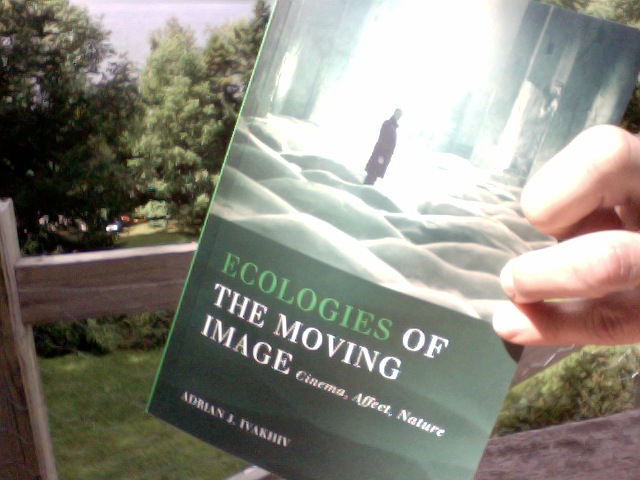
It arrived a few days ago. Feels good to grasp in the hand: thick, solid, “capacious” (as Steven Shaviro says in one of the cover blurbs). And Tarkovsky has rarely looked as green as on the cover.
But I’ve already found an indefensible oversight: Continue Reading »
Posted in Cinema, Philosophy, Visual culture | Tagged Ecologies of the Moving Image | 5 Comments »
July 19, 2013 by Adrian J Ivakhiv

I’m at the Vollmar Akademie by Lake Kochel in the Bavarian Alps, just a short train ride beyond the last S-Bahn station south of Munich, for “Studying the Environment – Working Across Disciplines.” The Rachel Carson Center has got a bunch of us together here to hammer out some ideas for inter/trans/disciplinarity in environmental research.
Continue Reading »
Posted in Uncategorized | Comments Off on Kochelsee
July 17, 2013 by Adrian J Ivakhiv

The above is
(a) beautiful,
(b) ugly,
(c) neither beautiful nor ugly in itself (nor anything else in particular), or
(d) _________ (fill in the blank)?
It’s a view (on a particularly hazy day) of the Sheffield wind power project in northeast Vermont, as seen from Crystal Lake State Park beach outside the town of Barton.
The view itself Continue Reading »
Posted in Eco-culture, Visual culture | Tagged Vermont, visuality, wind power | 4 Comments »
July 13, 2013 by Adrian J Ivakhiv
I’ve always been more of an improviser than a long-range planner, but my job requires that I occasionally dabble in long-range projections of my work. Here’s one.
While a number of concerns have framed my scholarship over the years — ethical, political, cultural, ecological, and theoretical concerns — the philosophical core of it has been solidifying around a certain conceptual machine, which I am setting to work in different contexts.
Continue Reading »
Posted in Philosophy, Process-relational thought | Tagged categories, Deleuze, ecosophy-G, Ontology, epistemology, Peirce, Whitehead | 1 Comment »
July 2, 2013 by Adrian J Ivakhiv
For anyone who thought “socially engaged Buddhism” (a.k.a. liberation Buddhism, Buddhist socialism, et al.) was a marginal movement within the Buddhist world, Bruce Smithers’s Tricycle article “Occupy Buddhism” shows it reaches high up the (sort of) hierarchy of publicly known Buddhists… to the Dalai Lama.
It’s a selective analysis (the DL is much more pragmatic than this suggests). But worth reading, as are the comments.
Hat tip to Brian McKenna of the E-ANTH listserv.
Posted in Spirit matter | Tagged Buddhism, Dalai Lama, Marxism | Comments Off on Half-Buddhist, half-Marxist
July 1, 2013 by Adrian J Ivakhiv
It will be quite an event for Peirce scholars.
My proposed paper will be on applications of Peirce to film theory, and in particular the two neo- (quasi-?) Peircian approaches that I present in Ecologies of the Moving Image. The first of these builds on Sean Cubitt’s three-part typology of the image (pixel–cut–vector, which I rework as spectacle–sequentiality–semiosis); I’ve written about it before on this blog and elsewhere. The second develops Peirce’s three normative sciences (aesthetics, ethics, logic) into a logo-ethico-aesthetics of viewership.
Here’s a quick encapsulation of the latter:
Continue Reading »
Posted in Cinema, Media ecology | Tagged aesthetics, ethics, logic, Peirce, Peirce Centennial Congress | Comments Off on Preparing my Peirce Centennial proposal
June 24, 2013 by Adrian J Ivakhiv

Ecologies of the Moving Image will be out next month. (Some seven years after I started working on it.) Here is a poster for it.
Many thanks to Steven Shaviro and Sean Cubitt for their generous endorsements, which I reproduce here:
“Ecologies of the Moving Image is an ambitious book, and a capacious and satisfying one. Continue Reading »
Posted in Media ecology | Tagged ecocinema studies, Ecologies of the Moving Image | Comments Off on EMI is imminent…
« Newer Posts - Older Posts »