In this post am going to focus on three recordings Fred Hersch has made of ‘Misterioso’, a blues in B flat by Thelonious Monk that could also be described as an etude1 in ascending melodic 6ths1. (Click on the tiny superscript ‘1’ next to the word ‘etude’ in the last sentence to see other examples of jazz compositions that could be considered etudes.). The earliest of the three recordings is Five Views Of Misterioso from the 1998 album Thelonious: Fred Hersch Plays Monk. In this version Hersch applies techniques including octave displacement, to the melody of Monk’s tune. The result has a texture and atmosphere that are somewhat comparable to Part’s Variations For The Healing Of Anoushka. In this version Hersch challenges the notion that improvisers need to leave the melody behind when they improvise and focus exclusively on creating entirely new melodic lines based on the chord progression. True to his title (a variation on the title of Wallace Stevens’s poem Thirteen Ways Of Looking At A Blackbird), Hersch stays with the melody, but creates five variations that move it gradually but firmly away from its original form. He opens with his clearest statement of theme, keeping the melody and harmony intact except for moving every other note of it two octaves higher. By the ‘fifth view’ of Misterioso, Hersch is playing a kind of altered mirror image of the melody, as though he were reading the score from a reflection in a funhouse mirror and adding a variety of other transformations as well.
Hersch also recorded a version of Misterioso on his 2007 album Night And The Music. He opens with a rubato statement of the melody (i.e. playing the notes Monk wrote but adding his own deliberate, expressive fluctuations in the tempo. When the rhythm section enters on the next chorus, Hersch keeps some of this rhythmic push and pull and adds the octave displacement heard at the beginning of the version on Thelonious, except that he moves the notes on upbeats only one octave higher rather than two. Starting in the fourth measure, he uses the additional space created by the octave displacement to introduce a middle voice. Contrapuntal improvising is one of Hersch’s great innovations as a player and a teacher, and here he increases the density of the texture from two voices to three. Hersch’s interaction with bassist Drew Gress and Nasheet Waits leads to a freewheeling solo over a loose swing groove, exploring different contrapuntal textures and an increasingly wide range of the piano but always maintaining a connection to the blues form. The performance winds up back where it started, with the piano alone, quietly tracing the original contours of Monk’s melody, its repetition relieved by variation so minimal that a less attentive ear could easily miss it. This progression of this version, from sparse to wild and busy and back to sparse, reminds me of the arc of a longer piece, Charles Mingus’s The Shoes Of The Fisherman’s Wife (one of the recordings that first got me interested in jazz) and Hersch’s own gorgeous Song Of The Universal, the opening to his Walt Whitman song cycle Leaves Of Grass.
In his version of Misterioso on the 2022 duo album The Song Is You with trumpeter Enrico Rava, Hersch synthesizes the approaches from the two earlier versions, creating a four-chorus solo that has some of the freewheeling nature of the 2007 version but also a link to the 1998 version with its strong connection to the melody. While ‘Five Views Of Misterioso’ rigorously reorganizes the melody, in this solo Hersch uses it freely as a recurring motive, transforming it each time it appears. Hersch improvises on the melody as much as he improvises on the changes. It is also a masterful example of his contrapuntal approach to improvising. This might also be called a ‘chorale approach’ to improvising. In a September 2012 Downbeat article titled ‘Back To Bach: Keys To Jazz Piano Prowess’, Hersch takes an approach to the first four measures of ‘Body And Soul’ which is based on the four-voice counterpoint found in the Bach 371 Chorales book. He begins with a long-note chorale of reharmonized chords for the passage which, through a number of examples, he gradually elaborates into more and more independent melodic lines. (Please see below the transcription for a conclusion to this post.)
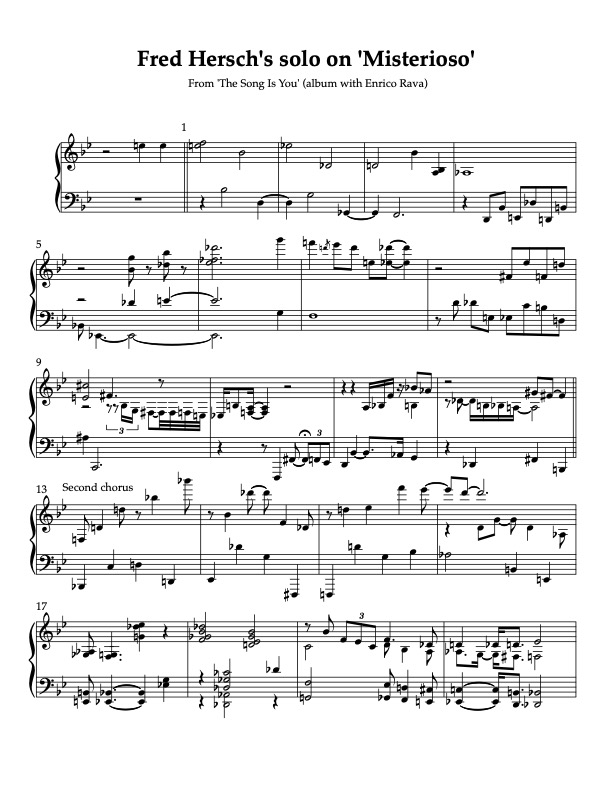
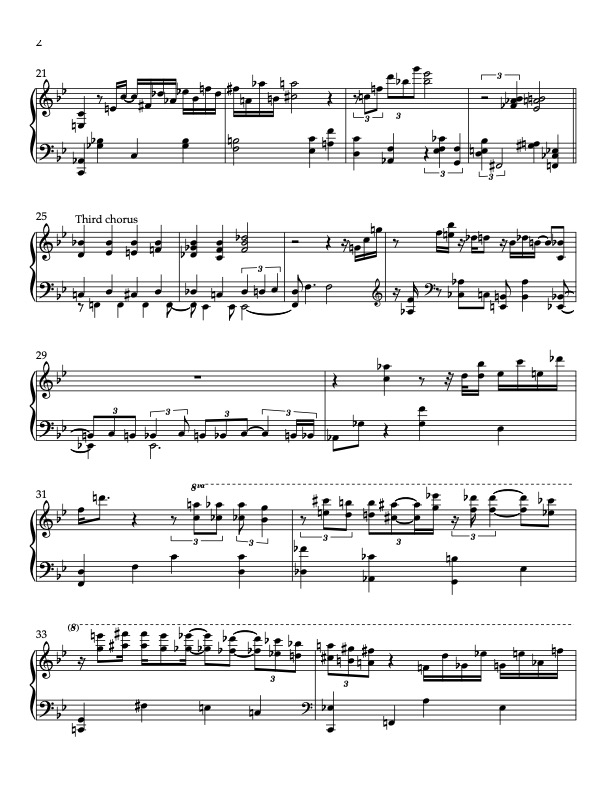
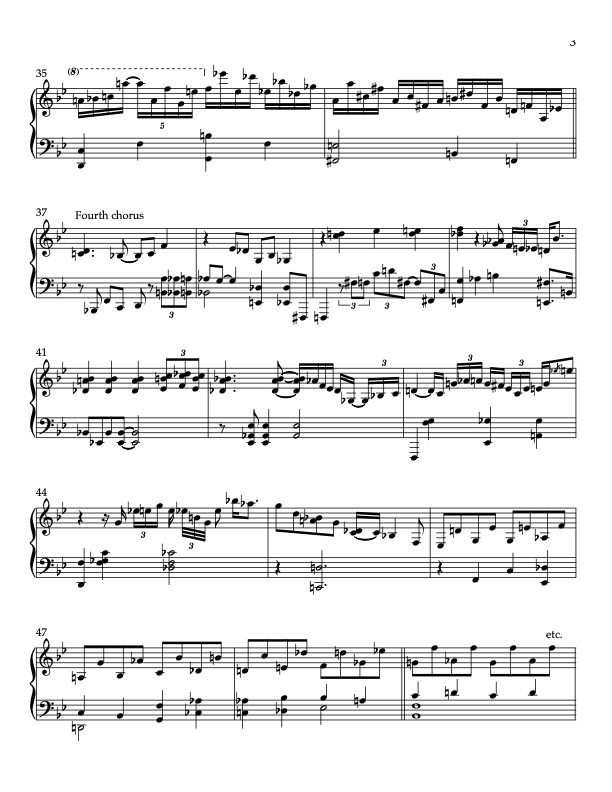
In a 2023 conversation I had with Fred, we discussed our shared admiration of Wynton Kelly’s playing. He has mentioned this in a number of other contexts. In an interview with Ethan Iverson, Hersch said ‘I always liked Wynton more [than Red Garland]. I mean, I think Wynton had what I call happy time, you know, just made me feel good. It had a little “pop” to it…there was a directness – not easy, but kind of an ease, a simplicity.’ He mentions having first discovered Kelly on the Miles Davis album Friday Night At The Blackhawk, which he also mention as one of two albums that he heard ‘the night I truly committed to being a jazz musician’. (My recent post The Quotable Bud Powell, Part Two mentions a passage in an early Herbie Hancock solo with Miles that I believe shows Hancock studied this record in some detail, in particular Kelly’s solo on ‘No Blues’ aka Pfrancing.). For me, a component of Kelly’s unique sense of time is the conversation between his left and right hands. The solo on Misterioso that I have transcribed here moves light years beyond Kelly’s eternally swinging two-sided conversation to a continuous, overlapping conversation of multiple voices that move in tandem, simultaneously leaving each other space and communicating their awareness of each other.
- Here is a short list of other jazz compositions and solos that could be described as being etudes or containing etudes:
– the bridge of Earle Hagen’s Harlem Nocturne features a series of descending perfect fifths that traverse the whole circle of descending fifths/ascending fourths (this also qualifies as a twelve tone row).
-Billy Strayhorn’s solo near the end of the Duke Ellington Orchestra’s original version of his composition ‘Rain Check’ features another twelve tone row, this one based on ascending and descending perfect fourths a half step apart. Wayne Shorter’s ‘E.S.P’ and ‘Witch Hunt’ and Eddie Harris’s ‘Freedom Jazz Dance’ also feature perfect fourths prominently.
-Fats Waller’s ‘Jitterbug Waltz’ prominently features ascending thirds. ↩︎