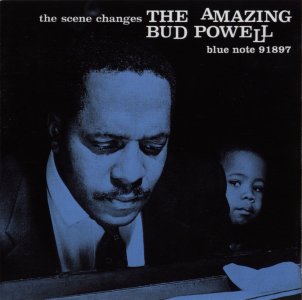

Top: The cover of The Amazing Bud Powell, Vol. 5 (Blue Note Records, 1959) featuring Powell’s son Earl John Powell / below: Earl John Powell and myself at a screeing of Haeyong Moon’s documentary ‘Bud Lives!’ in November 2025 (photo: Amber deLaurentis)
Please note: there are a number of footnotes throughout this post marked by very small numbers that I currently don’t know how to enlarge, so keep an eye out for them! Clicking on the number should take you to the footnote.
This is the second post I have written on improvised solos that quote Bud Powell. Since I wrote the first post, The Quotable Bud Powell Part 1, I’ve done some research on the study of quotation in literature and music. I think this research has been partly motivated by a need to put my own interest in researching Powell quotations in some context, to reassure myself that my interest in researching quotations is not an isolated phenomenon and to try to understand why people research quotations. I began by looking at a few examples from the fairly common genre of books that list quotable phrases by a specific author, like The Quotable Thoreau, or from a wide variety of sources, like Bartlett’s Familiar Quotations (originally published in 1855 and still in print today with a 2022 edition). The word ‘familiar’ in the title of Bartlett’s Familiar Quotations implies that the reader might have heard them someplace, but the lack of examples of where the quotes are used implies that the reader is supposed to trust that the editors have chosen quotations that are truly in common use, even though the book doesn’t cite examples of specific uses.
There are also studies of quotations used in a particular work, like T.S. Eliot’s footnotes on his own quotes in The Waste Land, my UVM colleagues Dennis Mahoney and Wolfgang Meider’s study of quotations or proverbs used in the novel Insect Dreams by the late, great Vermont writer and activist Marc Estrin, and my own study of the quotes Ella Fitzgerald uses in her solo on C Jam Blues with the Count Basie Orchestra from the 1972 album Jazz At The Santa Monica Civic. This can be found in my blog post Ellavolution, which was commissioned by musicologist Judith Tick and quoted in her recent critical biography Becoming Ella Fitzgerald. There are also lists of quotes used by a particular creator in multiple works, like this website that catalogs musical quotations in Charlie Parker’s solos.
Curiously, I found it more challenging to locate studies of where and how a particular creator or work is quoted. So far, other than my own posts on Powell and Fitzgerald cited above and the posts on Parker to which I link below, the only examples I have found of this kind of study are this article on Shakespeare quotes on the Merriam-Webster website that I linked to in Part One, this blog post and audio lecture on how Mozart, Beethoven and Mendelssohn all used quotations from Handel’s Messiah, and this article detailing two prominent quotes from the Messiah in the U.S. Christmas hymn Joy To The World1.
There are many collections of phrases Parker uses in his solos that appear to originate from him. These range in size from this list of 14 Charlie Parker licks at Jazz Guitar Online to the recent encyclopedic Pathways To Parker that runs to more than 900 pages of Parker licks. Like Barlett’s Quotations and The Quotable Thoreau, Pathways to Parker lists quotable phrases but not examples of where they are quoted. The only source I have found so far that lists examples of improvisers incorporating Parker phrases into their solos is this video on Parker’s ‘Cool Blues’ lick which I expand on in my blog post Taking The Fifth. My hope in compiling examples of great jazz soloists quoting Bud Powell is that they might form a ‘cloud of witnesses’ testifying to the ongoing relevance of Powell’s melodic language.
There are many recorded examples of great jazz players who are also Parker devotees exchanging quotes from the master in small congregations, like members of a faith community taking turns reading from holy texts. The 1949 recording of ‘Then You’ll Be Boppin Too’ by the vocalist Babs Gonzales features a young Sonny Rollins and Wynton Kelly quoting the same Parker phrase (which can be heard in the bridge of Parker’s ‘Koko’ solo) in their back-to-back solos (a link to this tune is in Part One of this post). (Rollins first quotes the phrase at :41 in the recording; leave a comment in the comment section if you can find the timing of his second quote of the phrase or Wynton Kelly’s quote of a fragment from the phrase. In all three quotes, the phrase is ‘rhythmically transposed’ to a different point in the 4/4 measure.) Eight years later, on the version of ‘Tune Up’ from Rollins’ album ‘Newk’s Time’, they can both be heard still using the same melodic gesture, but their rhythmic approach to it has evolved. (Rollins’ first use of the phrase can be heard at :54; leave a comment in the comment section if you can find the timing in the video of his doubletimed quote of the phrase or of Wynton Kelly’s differently doubletimed quote of it.) The opening to Charles Mingus’ original recording of his composition ‘Reincarnation of a Lovebird’ from the album ‘The Clown’, the opening is a kind of Parker séance, with all members of the quintet quoting Parker in quick succession. (The tunes quoted include Relaxin’ At Camarillo, Salt Peanuts and My Little Suede Shoes, as well as at least two other Parker phrases from tunes I can’t identify at the moment. Leave a comment in the comment section if you can identify the timings of any of these quotes. You will need to listen to the original Parker tunes to be able to identify them.). My blog posts on Ornithology and Erena Terakubo’s solo on Bird Lives analyze a composition and a solo that quote Parker frequently.
By contrast, my research suggests that quotes of Bud Powell in recorded solos tend to be less frequent, more isolated and sometimes more encoded. In the solos that I have found, the referencing of Powell tends to be more solitary than communal. The only story I have found that comes close to a physical meeting of a Powell fan club is Jackie McLean’s story, quoted in my earlier post, of meeting Sonny Rollins when Rollins was coming from a lesson with Powell and McLean was heading toward his. Another experience I had recently of a group brought together by common love for Powell’s work was a recent showing in New York City of Haeyong Moon’s remarkable documentary Bud Lives!, in which I make a short appearance. I watched the film, which I highly recommend, in the company of luminaries including jazz scholar David Berger, pianist Michael Kanan, and Powell’s son Earl John Powell. Experiencing Moon’s heartfelt, soulful and expertly researched film with these people was a rare moment of reassurance that I am not alone in my desire to work toward a greater understanding of Powell’s genius. The examples I have assembled here are of Powell quotes by great improvisers encapsulated on recordings and traveling like bottled messages to other Powell fans at the far corners of time and space.
Time flies, ‘Tempus Fugit’ remains – Solos that quote Tempus Fugit
Ethan Iverson counts Powell’s composition ‘Tempus Fugit’, recorded in early 1949 for Verve with Ray Brown and Max Roach, among a group of recordings that are ‘arguably Powell’s greatest studio trio tracks’, adding that ‘students should definitely learn these solos’. He also theorizes that ‘Tempus’ “might have [been] Powell’s answer to the minor key Gillespie tune, ‘Bebop’”, hinting: ‘compare the similar intros’. Indeed, where the intro to Gillespie’s tune, first recorded the year before ‘Tempus’ was copyrighted, begins with an minor triad arpeggio ascending over the range of an octave, Powell’s ‘Tempus’ intro decorates the same arpeggio by starting a half step below and approaching the top note from a whole step above, almost as though he were trying to ‘one-up’ Gillespie.
Iverson’s theory about ‘Tempus’ as a response to ‘Bebop’ is also supported by a passage in In ‘Wail: The Life Of Bud Powell’, where author Peter Pullman mentions that Powell originally wrote Tempus Fugit in 1946 for a small group led by Dizzy Gillespie. ‘Tempus’ is one of Powell’s most orchestral piano parts, and I think this is likely due to the influence of Gillespie and his arrangers such as Gil Fuller. While much of Powell’s work as a composer and a soloist is almost obsessively focused on the spinning out of long single-note melodic phrases, ‘Tempus’ features unusually short right hand melodic ‘calls’ and light, single note left hand ‘responses’ in its A sections as well as two-handed counterpoint in its bridge.
The other Gillespie composition that ‘Tempus’ resembles is the iconic ‘A Night In Tunisia’, first recorded as ‘Interlude’ by Sarah Vaughan with Gillespie in 1944, although Powell’s tempo is closer to that of Gillespie’s instrumental version, first recorded in 1946 but performed live the year before. While the ‘Tempus’ and ‘Bebop’ intros share three notes (the ascending minor triad), the ‘Tempus’ intro and the ‘Tunisia’ A section begin with the same seven-note melodic pattern, albeit in different keys, rhythms and harmonic contexts. The harmonic progression of the A section in Tempus Fugit also closely resembles the A section of ‘Tunisia’. In my post Musical Neighbors, I mention how both ‘Tunisia’ and original tunes based on its progression were in the repertoire played and recorded by all members of what I call ‘The Three Muskeeters collective’, which includes Powell, Mary Lou Williams, Thelonious Monk, Elmo Hope and Bertha Hope.
The ’Tempus’ solo was quoted in improvised solos by three great jazz pianists who were younger than Powell but close enough in age to have heard him live as well as on records. Rather than listing these quotations following the historical order in which the recordings appeared, I will list them following the order in which the quoted phrases appear in Powell’s solo.
Walter Davis was the pianist in Art Blakey and the Jazz Messengers during Wayne Shorter’s time with that band. On the band’s 1961 recording of Shorter’s composition ‘United’ from the album ‘Herbs and Roots’, near the beginning of Davis’ solo, he quotes the opening phrase of the ‘Tempus’ solo in its original key. This is followed by two transposed variants of the phrase. In all, Davis quotes Powell’s opening phrase or variants on it eight times during the course of his short solo.
At the opening of his second chorus of solo on ‘Tempus’, Powell plays a three-beat pattern starting on the third beat of the first bar of the form. He repeats this pattern six times, and the mathematics of a three-beat pattern repeated in 4/4 time leads the pattern to land on a different beat of the measure each time. In Horace Silver’s recording of his composition ‘Safari’ from the album Horace Silver Trio, near the beginning of his solo, he uses a variation on Powell’s phrase which he begins (as Powell does) with a triplet including the fifth of the minor scale, but rather than decorating the fifth degree with its chromatic upper neighbor (5-b6-5) as Powell does, Silver approaches it from its chromatic lower neighbor (b5-5-b5). Silver repeats the pattern four times, two less repetitions than Powell, but given that Silver told interviewer Len Lyons that he ‘used to play a lot of Bud Powell solos off the record’, the likelihood is high that Silver is directly referencing Powell here (as he does in a number of other places on the same record.).
At the beginning of the second A section of his second chorus on ‘Tempus’, Powell sequences another descending three-beat pattern over the 4/4 measure which uses the same melodic rhythm as the phrase in the first A but a different melodic shape. This shape is a variation on a phrase that, as I discuss in my post Emulate, Assimilate, Innovate Part 2, Powell used as a closing gesture in at least two solos and which Wynton Kelly quoted in a number of his solos. In these solos, the phrase ends with a descending whole step on scale steps 6 and 5, and is played only once. In the ‘Tempus’ solo, Powell alters the phrase so that it ends on the seventh degree of D melodic minor and takes it through the six repetitions that he introduced eight bars earlier. On a quartet version of ‘Walkin’ with John Coltrane recorded in a TV studio, Wynton Kelly quotes the version of the phrase from Powell’s earlier solos in the tenth chorus of his solo. He begins it on beat four of the last measure of the blues form and repeats it just three times so that it fits neatly into a phrase over the first four bars of the blues form. The phrase also includes Kelly’s unique and inspired blend of bop chromaticism and hand-to-hand conversation.
Still Un Poco Loco After All These Years (70 years of solos that quote ‘Un Poco Loco’)
According to the Bud Powell discography at jazzdisco.org, ‘Un Poco Loco’ was originally recorded and released by Blue Note records as a single in 1951. As we will see in this survey of quotations from the ‘Un Poco Loco’ solo, Powell’s recording had an immediate impact on the musicians who listened to it when it was released as a single in 1951, as four of the recordings I mention that quote Powell’s solo were recorded within four years of the session that produced ‘Un Poco Loco’.
Before I begin citing examples of other solos that quote Powell’s solo on the master take ‘Un Poco Loco’, it is worth mentioning that, to my ear, the solo itself includes at least three prominent quotations. Early in the solo, it sounds to me like Powell quotes the Vernon Duke/Ira Gershwin ballad ‘I Can’t Get Started’, although he conceals the quote by preceding the first six notes of the tune with a turn and by playing the pattern much faster than it appears in its original ballad context. A version of the tune from the 1963 album Bud Powell In Paris shows that it could well have been in Powell’s repertoire twelve years earlier when Un Poco Loco was recorded. Shortly after the ‘Started’ quote, whether intentionally or not, he plays a a phrase that is a transposed version of the second bar from Charlie Parker’s 1945 solo on Billie’s Bounce. (This phrase is a core component of Parker’s melodic vocabulary that includes the gesture I call ‘the Jumpin’ fragment’ in my my post on Erena Terakubo’s ‘Bird Lives’ solo.) Shortly before the end of the solo, Powell plays a pair of phrases that clearly quote the ‘clip-clop’ accompaniment figure from ‘On The Trail’, a movement from Ferde Grofe’s Grand Canyon Suite. (A condensed version of the main melody from this piece became a jazz standard, recorded by many jazz instrumentalists and vocalists, such as Wynton Kelly, who recorded a buoyant version.)
Of the solos quoting the UPL solo by other pianists that I have found, the one that quotes from the earliest point in Powell’s solo is by pianist Gene Rizzo, whose transcription of the UPL solo appears in The Bud Powell Collection published by Hal Leonard. A little online research reveals that Rizzo was a club date musician the Philadelphia and New Jersey areas who was born only 11 years before the recording of Un Poco Loco and died in 2021. In a recording of the tune ‘Avalon’ by the Midiri Brothers Orchestra (from a 1998 radio broadcast of an Atlantic City, NJ performance – a band in one Jersey Shore town playing a song about a town a few miles down the coast) Rizzo takes a fine piano solo which near the beginning (at :40) quotes the first seven notes of what I’ll call the first bebop section of the UPL solo2, followed quickly (at :42) by a seven-note quote from the tenth bar of that section. Rizzo also builds another phrase at :47 from the opening of Powell’s first bebop section.
In the first four bars of Walter Bishop Jr’s solo on the 1952 Charlie Parker version of ‘La Cucaracha’. Bishop begins by quoting three later phrases from the ‘first bebop section’ of the Un Poco Loco solo in the reverse of the order that Powell uses them. The first is the phrase I mentioned in the last paragraph where Powell appears to quote Parker’s ‘Billie’s Bounce’ solo. Bishop moves the phrase from beat 1 of a 4/4 bar, where Parker and Powell both place it, to beat 3 of a 4/4 measure. This might sound on the first hearing like a Parker quote because Bishop is playing with Parker and quoting the phrase in the same key where Parker uses it, however, Bishop follows this four beats later with a five note phrase that matches the bar in Powell’s solo that immediately precedes the phrase with which Bishop began. This phrase transposes ‘the Jumpin’ fragment’ down a perfect fourth. The third bar of Bishop’s solo could be described as the first full bar of the ‘first bebop section’ and the first note of the second full bar with one note removed and all of this transposed to the key of F. Bishop also ends with a quote from the end of the ‘Un Poco Loco’ solo, making his short solo a collection of quotes from Powell’s solo.
The next section of the Un Poco Loco’ solo that I’ve found quoted elsewhere is what I’ll call the ’b9-b5-triplet licks’3. They include a 7-note phrase (which I’ll call ‘b9-b5-triplet lick #1’), followed by a 6-note variant, followed by a different 7-note variant (which I’ll call ‘b9-b5-triplet lick #3’)4. (This is one of at least three places in the solo where Powell plays three similar phrases in quick succession. This is an example of what I call ‘live revision’ in an earlier post, where I discuss how Mozart, T.S. Eliot and Charlie Parker used this process.)
The ‘b9-b5-triplet lick #3’ appears in Benny Harris’s tune ‘Reets and I’, recorded by Powell in August 1953, the first half of the tune concludes with the ‘b9-b5-triplet lick #3’ from ‘Un Poco Loco’. While not all of Harris’ borrowed licks may have been consciously selected, given that his other tunes ‘Ornithology’ and ‘Crazeology’ (aka Bud’s Bubble, aka Little Benny) are both clearly a superfan’s melodic collage of favorite licks from the lexicons of Powell, Charlie Parker and Dizzy Gillespie, I would venture to posit that the Powell licks in ‘Reets and I’ are likely conscious borrowings5. The ‘b9-b5-triplet lick #1’ is also quoted by Walter Bishop, Jr. in his intro solo on ‘Stockholm Sweetin’ from The New Oscar Pettiford Sextet, recorded in December 1953. The minor third interval with which Powell begins the lick, moving from the flat seven to the flat nine of the C major scale, becomes a whole step in Bishop’s quotation. Like Davis in his ‘United’ solo, Bishop repeats the phrase and then transposes it.
Shortly after the ’b9-b5-triplet licks’ section of the ‘Un Poco Loco’ solo is a section that begins with what I’ll call the ‘expanded Charge! lick’, where Powell takes the six notes often played by ballpark organists to incite the response ‘Charge!’ from the crowd, changes the rhythm so that the triplet occurs one note later, and expands the lick by one note, bringing it into the realm of the jazz melodic line by adding the sixth degree of the C major scale, implying a C6 harmony. (Powell alternates throughout the solo between implying a C6 or Cmaj7 chord in his lines at some points and implying a C dominant 7th chord at other points through repeated use of Bb.).
The ‘expanded Charge! lick’ is quoted by Herbie Hancock in the fourth chorus of his astonishing solo on ‘Walkin’ from the Miles Davis album ‘Four and More’, recorded live in 1964. Although Hancock was only 25 years old at the time ‘Four And More’ was recorded, throughout this solo (and particularly in the chorus preceding his Powell quote) he shows a deep knowledge of the playing of Wynton Kelly, one of his predecessors in Davis’ band, through the use of what might be called ‘conversational bebop’ (see the section above on Kelly’s quote of ‘Tempus Fugit’), and through his quotation of a lick Kelly had previously used in his solo on Pfrancing, another F Blues, on the Davis album ‘In Person Friday and Saturday Nights At The Blackhawk’, recorded and released in 1961. Hancock’s quote from Powell shows that he also understood jazz piano lineage; my post Emulate, Assimilate, Innovate Part 2 gives just a few examples of how Kelly’s melodic language is clearly based on Powell’s. While Kelly’s quote from the ‘Tempus’ solo is one more example, an exhaustive compilation of Kelly’s Powell quotes could fill a sizeable book.
Powell closes his ‘Un Poco Loco’ solo with a final group of three phrases that begin with a gesture he had used in 1947 in bar 11 of his first chorus on Charlie Parker’s recording of ‘Buzzy’ (I go into more detail about this, including a transcription of Powell’s ‘Buzzy’ solo, in an earlier post). I have found two improvised solos and a composed melody that quote parts of this ending phrase. As I mentioned earlier, Walter Bishop, Jr. quotes an adapted version of Powell’s closing phrase near the end of his ‘La Cucaracha’ solo. (Bishop’s solo is preceded with one of Benny Harris’s rare recorded trumpet solos, in which he quotes ‘Reets and I’. Jazz composers quoting their own tunes during improvised solos, such as was a kind of mid-century jazz equivalent of the ubiquitous customer-targeted product suggestions one finds today while shopping online6.)
Pianist Terry Pollard starts her solo on vibraphonist Terry Gibbs’s 1955 recording of his tune Nutty Notes with a phrase beginning on beat two that starts with a lick which adapts the beginning of Powell’s closing gesture to a minor key, moves on to a lick adapting the motive from the ‘b9-b5-triplet licks’ section, and includes the end of Powell’s closing gesture before concluding with another adaptation of the beginning of Powell’s closing gesture. Pollard’s remarkable gift for melodic summarizing can also be heard in her solo on Yusef Lateef’s Oboe Blues, where she begins her solo with a brilliantly compressed version of the lick Bernard McKinney uses to end his euphonium solo. (McKinney would later change his name to Kiane Zawadi.)
Powell’s concluding phrase from the ‘Un Poco Loco’ solo is also quoted in the 2021 tune ‘Happy Hour’ by the Italian jazz pianist Yuri Storione. I discovered this tune, and Storione, on the 2021 album This Time The Dream’s On Us, where he plays in a trio with drummer Jorge Rossy. The album contains a number of Powell allusions, including a tune called ‘Viva Bud Powell!’. The melody ‘Happy Hour’, which is credited to Storione and bassist Dominik Schurmann, uses (:48) the same section of Powell’s closing phrase from ‘Un Poco Loco’ as Bishop, but quotes it with less alteration – beginning it on beat one instead of beat four and removing the last two notes of the first phrase. Storione quotes a number of bop and bop-adjacent motives in his solo, including ‘The Irish Washerwoman’ (I wrote a whole blog post on Ella Fitzgerald’s use of this motive), ‘Reets And I’ and ‘Confirmation’. If you can find the timing of these quotes, please leave them in a comment in the comments section.
As a coda to this collection of possible Powell quotes, I have a theory about another Horace Silver solo that may reference an alternate take of ‘Un Poco Loco’. Silver was quoted in a 1964 New York Times article about Powell’s return to Birdland as saying: ‘Bud is one of the great sources. He says more in five measures than most players say in five minutes’. This quote, combined with the one I mentioned earlier where Silver mentions playing Bud Powell solos ‘off the record’, as well as the Powell quotes in Silver solos that I mention earlier in this post and in my posts Bud Powell, Bard Of Bebop and Conversation Pieces, Part Two, establish Silver as an ardent enough superfan of Powell to pay attention to the alternate takes from his recording session. In April 1956, Blue Note followed its 1952 release of The Amazing Bud Powell, the first full-length album to include ‘Un Poco Loco’ (which followed the single release in 1951) with The Amazing Bud Powell Volume 1. The expanded playlist of this album included two alternate takes of ‘Un Poco Loco’. In Un Poco Loco alternate take 1, Powell plays a pair of phrases, the second longer than the first, which together imply the C whole-half diminished scale by traversing six of its eight notes. In his solo on Senor Blues, Silver plays a series of five phrases which use the exact same notes, although in the context of an E flat minor six-nine chord rather than Powell’s C drone. Silver plays two shorter phrases with a four-note span which lead to a longer phrase with the same six-note span of Powell’s phrase and a similar melodic shape. He then transposes the short phrase and the long phrase up a minor third, so that they cover the two missing notes of the scalethat Powell had left unplayed.
The way that Silver conjures this phrase first partially and then completely from his melodic imagination, steeped as it was in Powell’s language, reminds me of the way he gradually brings forth his quote of Powell’s Dance Of The Infidels in his solo on Silver’s Serenade (see my posts Conversation Pieces Part One and The Quotable Bud Powell Part One for more discussion of this). The way he transposes Powell’s idea is an example of the ‘Assimilate’ phase of Clark Terry’s ‘Emulate, Assimilate, Innovate’ process (which I discuss in Ellavolution among other places) and reminds me of how Benny Harris emulates and assimilates ideas from Parker in ‘Ornithology’ as I detail in my blog post on the tune), from Powell in ‘Reets and I’ and from Powell and Gillespie in ‘Crazeology’.
One form of a 19th century proverb that uses a term often associated with Powell is: ‘imitation is the highest compliment mediocrity pays to genius’7. While Powell may have appeared to be a somewhat isolated genius in his time, in the wider lens of jazz history, he has become an essential innovator who is genuinely loved by the generations of jazz players. One of the more touching sections of Haeyong Moon’s documentary is when she asks a series current jazz luminaries what they would say to Powell if they met him today, and more than one says they would start by giving him a hug. I hope the examples I have cited show how Powell enabled players who followed him to transcend mediocrity by introducing or passing on musical ideas that they were inspired to not just borrow (emulate), but also transpose to different musical settings (assimilate) and transform (innovate) so they could be integrated into newly imagined surroundings. In this way they were not just following Powell’s lead as a melodic innovator, but also emulating the ingenious ways (in his quotes of Duke, Parker and Grofe) that he adapted the ideas of others.
Footnotes
- As it turns out, this song is deeply American in its patchwork construction. Its author may or may not be the American banker, church musician and crusader against homegrown American sacred music Lowell Mason, but is definitely not Handel, although he is frequently cited as the composer. Whoever the author is, they brought a preexisiting text together with a new melody that quotes two movements of Handel’s masterwork in the space of twenty measures.) ↩︎
- In a series of essays about bebop called The Stuff Dreams Are Made Of, the erudite pianist and analyst Ethan Iverson includes ‘Un Poco Loco’ in a list of Powell compositions that he calls ‘not bebop’. in response to literary critic Harold Bloom’s assertion that UPL is a twentieth-century masterpiece, which to me is an evaluation worth considering. Iverson writes that ‘it’s wrong to cite a non-bebop example of Powell as the greatest Powell’. This led me to look for bebop language in Powell’s solo on the UPL master take. I found non-scale tones on upbeats, the kinds of melodic moves called enclosure or surrounding, a preponderance of eighth note and triplet motion, use phrases originated by bop players like ‘the Jumpin’ fragment’ and phrases frequently borrowed by bop players like ‘I Can’t Get Started’ (see Cannonball Adderley’s solo on Milestones), a tendency to begin and end phrases on upbeats or beats two and four and end phrases on rhythmically emphasized altered tone (F# or #11). For me, all these contradict Iverson’s assertion. ↩︎
- I initially thought of calling this series of licks the ‘vaguely Middle Eastern sounding licks’, as they sound similar to the attempts made to melodically evoke Middle Eastern music in jazz in tunes like Ellington and Tizol’s Caravan, Victor Young’s Delilah and Roger King Mozian’s Desert Dance, also recorded by Machito and His Orchestra as Cleopatra Rumba. All these tunes use the flatted ninth, ascending and/or descending minor thirds, and what Klezmer musicians call the ‘freygish mode’, or the fifth mode of the harmonic minor. I decided that the attempts by US composers to evoke Middle Eastern music in the absence of Middle Eastern musicians need to be addressed by someone with more knowledge of Middle Eastern music than I have.). ↩︎
- The opening interval of each of these licks is, to my ear, incorrectly shown in Gene Rizzo’s transcription from ‘The Bud Powell Collection’ published by Hal Leonard, one of very few errors in the transcription.). ↩︎
- Harris’ compositional process of creating melodies that are ingenious patchworks of borrowed licks is worth delving into briefly here. Harris’s first borrowing from Powell in ‘Reets and I’ is a phrase Bud plays in his solo on ‘All God’s Chillun Got Rhythm’, recorded in 1949 and originally released by Mercury records in 1951. In this phrase Powell interpolates a lick from his own tune ‘Strictly Confidential’, recorded immediately before ‘All God’s Chillun’ at the same session. In ‘Reets and I’, Harris kept the chord progression of ‘All God’s Chillun’, followed the phrase from Powell’s solo on the tune with an allusion to the melody of ‘I’ll Keep Loving You’ (an original Powell ballad also recorded at the same session as ‘All God’s Chillun’) and concluded the first half with the ‘b9-b5 triplet lick’. ↩︎
- These kinds of ‘product placement’ quotes include Duke Ellington’s quote of ‘I’m Beginning To See The Light’ at the end of his solo on ‘Take The A Train’ from Ellington Uptown and Thelonious Monk’s quote of ‘Misterioso’ at the end of his solo on the original version of ‘Straight No Chaser’. ↩︎
- Some forms of this aphorism have been attributed to spoken conversation by Oscar Wilde, but a synopsis of its use on quoteexplainer.com suggests it was viral and frequently mutating in printed media. ↩︎