
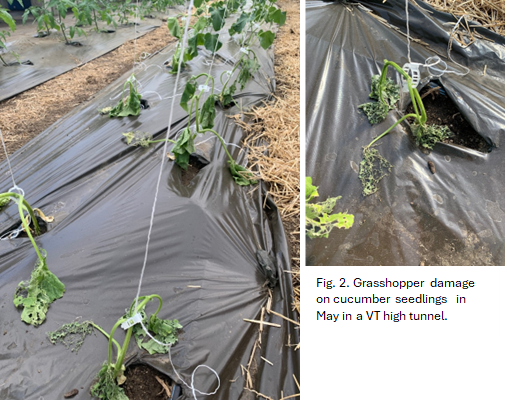
Usually, we think of grasshoppers as a summer or fall vegetable pest. That is why we were surprised to hear from a grower with a plague of them in his Vermont high tunnel in early May (Fig. 1). This grower had never noticed grasshoppers in the spring before but, this year the succulent new growth of his high tunnel cucumbers has been reduced to lacy shadows of their former selves (Fig. 2). Becky Maden has observed grasshoppers in her high tunnel for the past 3 years, and it seems they appear earlier every year and are doing more damage. There are at least 83 different species of grasshoppers in Vermont alone, and it is unknown what species was responsible for the damage these growers observed. However, it is likely the special microenvironment within a high tunnel can lead to unique pest issues not encountered in field production.
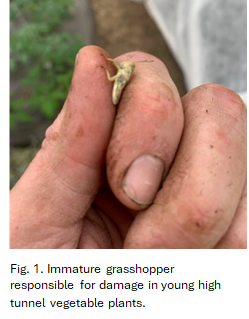
Grasshoppers are in the order Orthoptera, and include what we commonly call locusts, katydids, crickets and grasshoppers. There are over 20,000 known species of orthopterans worldwide. They have gradual or incomplete metamorphosis, with the immatures (nymphs) hatching from an egg looking similar to the adult stage. Over multiple molts they gradually grow wing pads that form wings when they reach adulthood. They have chewing mouthparts that can consume large amounts of foliage in a short amount of time. They continue feeding throughout all life stages except the egg. That makes them a persistent pest over an extended period. Most grasshopper species overwinter as eggs in the soil and emerge as nymphs when the temperature rises. The common signs of grasshopper damage are leaves that are skeletonized or with ragged or tattered edges and fruit with chewing pits.
It is impossible to know the life cycle of the damaging grasshopper, without a species determination. However, some general assumptions can be made. As the grower proposed, it is likely the grasshoppers overwintered as eggs in the high tunnel, in the egg stage. He saw a few grasshoppers last fall, but they didn’t ravage his crops the way they have this spring. An individual female grasshopper can lay an average of 10-400 eggs, and they don’t need a male grasshopper for reproduction. That means even one or two adults in the high tunnel in the fall can lead to hundreds of young ones in the spring.
Becky Maden noticed grasshoppers early in her high tunnels too. They decimated some of the more tender young plants like basil. In grasshopper-infested houses, it is essentially impossible to grow these particularly sensitive crops. This year she sprayed Pyganic®, a pyrethrin-based biological insecticide) known to provide a quick knockdown and kill for a broad array of pests, including grasshoppers. She advised applying it at a time of day when they are less active to make sure the spray contacts the pest to maximize on control. Targeting the early nymphal stage is best as they are more likely to be more sensitive to the treatment, and their exoskeleton is softer and more likely to be penetrated by the spray. Spraying along the edges of the tunnel is important as they may hide in these crevices when not feeding on plants. More than one application may be necessary because the overwintering eggs hatch over for several weeks. When the population isn’t too high, Becky also hand picks them off, dropping them in a container of soapy water and rubbing alcohol. If the population is reduced early, the plants can outgrow the damage. They don’t seem to cause so much damage on tomatoes. Once the cucumbers begin to gain some height, the problem seems to subside. Grasshoppers in her experience don’t climb high into the plant canopies. They also seem to stay off the benches.
What other options are there for this pariah?
Cultural control. Because the eggs overwinter in the soil, tilling the soil thoroughly in the fall before may destroy the eggs. Weeds around the high tunnel in the summer and fall also may serve as a food source for grasshoppers, so removing them could reduce the adult population that would lay eggs before winter. Theoretically particularly sensitive plants could be protected by careful screening, but grasshoppers are known to chew through cloth screening and once under the screen, they benefit from the protection and their damage may go unnoticed.
Insecticides. Several types of insecticides are labeled for use against grasshoppers, though their efficacy can’t be confirmed. Here are a few of them:
- Neem-based products (e.g., AzaGuard (active ingredient: azadirachitin)
- Insecticidal soaps
- Beauveria-based products, (e.g., Botaniguard® EC).
- Diatomaceous earth (e.g., Perma-Guard™)
Baits containing a protozoan, Nosema locustae, were developed several years ago, but are no longer available commercially. These baits, when available, take 2-4 weeks to be effective, and in the spring that is too slow for protecting young plants.
The Take Home Message.
Grasshoppers are yet another emerging pest invading the high tunnel environment. Growers are turning to high tunnel protection to reduce the impact of extreme weather events on their crops. Sadly, insects have also figured out that high tunnels are a perfect overwintering habitat. Thorough tilling of the soil between plantings may contribute to disrupting vulnerable pest stages without significantly impacting beneficials.
Other resources:
https://www.arbico-organics.com/category/pest-solver-guide-grasshoppers-crickets
https://www.planetnatural.com/product/semaspore-grasshopper-control