It’s difficult to briefly summarize Ukrainian history — the best books on the topic clock in at 432 pages (Plokhy’s) and 896 pages (Magocsi’s) respectively — but John-Paul Himka has done that in 10 “turning points” at Ukraine Solidarity Campaign, a web site that is in some ways very kindred to UKR-TAZ. HImka’s piece on Ukraine’s socialist heritage also fills in some of the blanks on that side of Ukrainian history (and shows how the worst thing that ever happened to socialism was Stalin).
Himka on Ukrainian history
20 04 2022Comments : Leave a Comment »
Categories : History, Uncategorized
Babij: “this is about ground”
17 04 2022For the next several weeks I will be on the road and likely not posting very much. But occasionally I’ll share bits and pieces that come to me that I don’t find being shared elsewhere. Like this one.
Writer and curator Larissa Babij‘s blog A Kind of Refugee has been providing a kind of refuge of poetic and inspired reflection on the reality of the Russian war on Ukraine. Most recently she writes about spring sunshine in Kyiv and how the “great energy to do something fully in the moment” provides the ground on which Ukrainians stand today.
The choice, she writes,
between subjugation to Russia or obedience to the West was never a particularly palatable one. and so Ukraine just plodded along ambiguously, neither here nor there, but “not dead yet.”
But “under increasing pressure and finding no safe path or protection” Ukrainians began to fight, not out of a rigorously theorized perspective — “Ukraine doesn’t have philosophy,” she provokes — but
Ukrainians have the audacity to do things. without asking. without thinking too far ahead. without mapping out in their imaginations how it will work or endure in the long run.
Comments : 1 Comment »
Categories : Uncategorized
UCSB talk: Causes & implications of the invasion (2 variants)
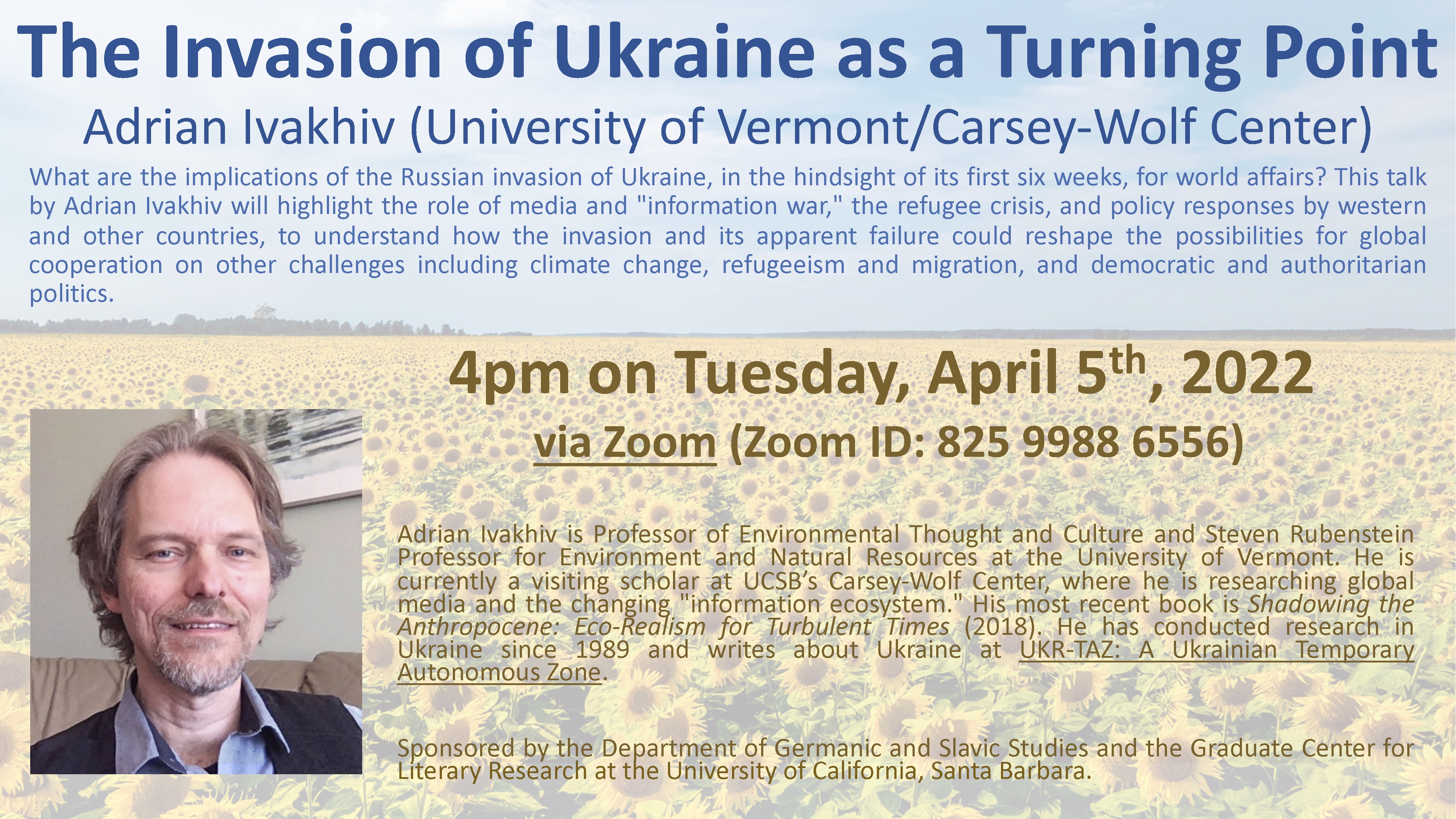
7 04 2022My talk “The Invasion of Ukraine as a Turning Point” tries to make sense of the causes of the Russian invasion and its potential effects on the future of global media, migration and refugeeism, democratic and authoritarian politics, and climate change. It can be viewed here.
For those who don’t have time to watch webinars, I’ve also created a summary in the form of two Twitter threads. The first part is here (or click on the first image below). It continues here (or second image below). Or you can read the continuation as a thread here.
In the intro to the talk, I mention two ways we can learn from (and partially “redeem”?) such events: (1) by understanding their causes so that they can be prevented from arising again, and redirected if they do arise, and (2) by seeing the effects as a range of possibilities, of which some are better (and to be followed) and some worse (to be avoided), with some of the better ones being new and not so easy to see. The third, which must accompany the others, is justice and reparations.
Thanks to Professor Sarah Weld, the Department of Germanic and Slavic Studies, and the Graduate Center for Literary Research at the University of California, Santa Barbara, for sponsoring and organizing the talk.
Part 1:

Part 2:
Comments : Leave a Comment »
Categories : Uncategorized
Koposov: on Russia’s national interests
6 04 2022One of the questions we will all have to struggle with, in the near term future, is how to reintegrate Russia back into the world community once all of this is over. (I say that in full recognition that “the world community” is very much a work in progress, and still needs a great deal of work before it feels like an integrated and inclusive place.)
Historian Nikolay Koposov’s “Nobody Knows What Russians Want, Not Even Russians Themselves” helps us think about that. It also raises basic questions about the importance of democracy — in the sense of some way of representing people’s real, legitimate, and considered interests — in any future that could possibly accommodate and include Russia. This is, of course, an issue that underlies the future of the world community, which is why it will require serious thinking about what democracy means and what forms it can take. But Koposov’s effort here is a starting point. He writes:
Having subjectivity here means being free to make rational and responsible decisions. The acquisition and possession of subjectivity entail several things. First, the group must have access to relatively reliable information. Second, it should be able to openly discuss its situation, formulate various action plans, and promote them in the public space. And thirdly, it must have agreed-upon decision-making mechanisms to determine which plan is the best.
None of these exists in Putin’s Russia.
[. . .]
Perhaps the time will come when Russia can take its subjectivity back from Putin and stop this shameful war. But until then, Russia has no subjectivity and no legitimate interests.
Comments : Leave a Comment »
Categories : Uncategorized
Musical interlude
5 04 2022I was interviewed yesterday by UCSB music professor and KCSB DJ David Novak. The hour-long interview offers a highly personal take on Ukrainian music since the 1980s. It features an adventurous mix of work by contemporary Ukrainian composers and bands from Kharkiv (The Moglass), Odesa (Kadaitcha), and Berlin (Zavoloka), as well as a piece of Polissian (Chernobyl area) traditional singing by the authentic folk ensemble Drevo, and a little from my own late 1980s-1990s Ukrainian-Canadian band Vapniaky, a.k.a. Stalagmites Under a Naked Sky.
The interview can be listened to in Soundcloud; click below or here. The playlist, which you can find here, includes links to further listening.

Related links:
Comments : Leave a Comment »
Categories : Uncategorized
Miller on #IStandWithPutin
5 04 2022As I’ve noted before, Russian information warriors may appear to be losing roundedly to their Ukrainian rivals, but this is only the case if we leave out the Global South. Writing today in The Atlantic, social media analyst Carl Miller confirms that Indian, South African, and other accounts in the Global South have been actively promoting support for Putin and Russia, framing the conflict in anti-colonial terms that equate colonialism with Western imperialism.
The memes pushed vivid anti-colonial and anti-Western imagery mixed with Putin strongman motifs and solidarity among the BRICS: Brazil, Russia, India, China, and South Africa. Some applauded Russia’s great friendship toward India or Putin’s apparent role in African liberation movements, but many were really about the West, its own seeming hypocrisy, and the alleged aggression of NATO expansion. [. . .
The blunt reality is that in many parts of the world, antipathy for the West is deep and sympathy for Russia is real.
This, in my estimation, is where a lot of the work in “information war” — or what I’ve called “information peace,” the effort to build a global information ecosystem that is reliable, trustworthy, and conducive to democracy — needs to take place if conflicts like these aren’t to completely unwind any capacity for the world community to take on common problems like climate change (which the IPCC just reminded us yesterday are massive and quickly worsening). That will be a theme of my talk/webinar later today, which will be recorded and shared online afterward.
Comments : 1 Comment »
Categories : Uncategorized
The invasion as an inflection point
31 03 2022I’ll be giving the following online talk for the University of California Santa Barbara next Tuesday at 4 pm Pacific Standard Time. It hinges on the idea that the invasion of Ukraine, like other unexpected “hyper-events” (such as the Covid-19 pandemic or the 1986 Chernobyl nuclear disaster), provides a historical “inflection point” at which rearrangements of agency — that is, rearrangement of the structural forces and capacities by which human potentials are shaped and constrained — might occur. There’s of course no guarantee that they will occur, or that the rearrangements will be for the better and not for the worse. The talk will provide some speculation on the kinds of rearrangements that might be possible.
Read the rest of this entry »The Invasion of Ukraine as a Turning Point
What are the implications of the Russian invasion of Ukraine, in the hindsight of its first six weeks, for world affairs? This talk by Adrian Ivakhiv will highlight the role of media and “information war,” the refugee crisis, and policy responses by western and other countries, to understand how the invasion and its apparent failure could reshape the possibilities for global cooperation on other challenges including climate change, refugeeism and migration, and democratic and authoritarian politics. 4:00 pm on Tuesday, April 5th, 2022 via Zoom (Zoom ID: 825 9988 6556).
Comments : Leave a Comment »
Categories : Uncategorized
NATO expansion: a hypothetical question
23 03 2022If I counted all the articles arguing that NATO expansion contributed to the current Russian invasion of Ukraine, I would be kept up all night. (All are variations on Mearsheimer.)
Can someone convince me that they aren’t all missing one fundamental point: that if NATO had not expanded, we have no idea if that would mean that Russia would not have attacked Ukraine in 2014, or Georgia in 2008 (from which it militarily carved out South Ossetia and Abkhazia), or supported separatists in Moldova (from which it carved out Transnistria in 1992)?
These are all non-NATO countries. Doesn’t the logic suggest that Russia would have, by now, also invaded the three Baltic states as well, if not others?
Since we don’t know that, we are all talking hypotheticals: on one side, the hypothetical that NATO expansion got Russia so mad that they attacked those non-NATO countries; on the other side, the hypothetical that they attacked them precisely because they could still do that without attacking NATO.
Which do you find more plausible?
Read the rest of this entry »Comments : 1 Comment »
Categories : Uncategorized
Call for collaborators
16 03 2022UKR-TAZ compiles materials helpful for understanding Ukraine, with an emphasis on radical democratic (left-libertarian) perspectives. (See here for more.) That makes it an unusual if not rare space on the English-language internet. To do this well requires help. We are not calling for donations — if you can provide any, please donate to the organizations listed here. Rather, we seek collaborators, who would be willing to collect articles and/or media to be shared here, and potentially contribute original work of an appropriately analytical (or inspirational) nature. If you are interested, please write to the editor, including “UKR-TAZ” in your Subject line. Thanks.
Comments : Comments Off on Call for collaborators
Categories : Uncategorized
UKL resource list revived
16 03 2022For those with time to educate themselves, the University of Ottawa’s Dominique Arel has compiled a lengthy list of recent and upcoming video webinars featuring scholars in Ukrainian studies, Russian studies, and related fields. (The list of several dozen is hardly exhaustive; the two university panels I’ve been on aren’t there, and I can think of others that could be added.) They are part of the revived Ukraine List “UKL,” which Arel has edited for many years now, with intermittent frequency but quite regularly during the last few Ukrainian “crises,” the Orange Revolution of 2004 and the Maidan of 2013-14.
This 504th issue of UKL also includes numerous full-length articles, some of them from pay-walled publications, covering analytical perspectives on the Russian invasion.
A PDF with active links to the entire issue of UKL is found here: https://www.chairukr.com/_files/ugd/ff1dca_a39f811f7a834cf0a7a8960e41b8bc77.pdf
The webinars feature close to the beginning of the document.
Comments : Leave a Comment »
Categories : Uncategorized