A Case Study: Rich and Connie Hourihan, Cabot Smith Farm
Background
Cabot Smith Farm in Cabot, Vermont has been owned and operated by Rich and Connie Hourihan since 2001. They grow 80 acres of wholesale vegetables and 4.5 acres of pick your own berries. Many of the farm’s crops are dependent on or enhanced by insect pollination, including honeyberries, blueberries, strawberries, high tunnel blackberries, winter and summer squashes, and cucumbers. The farm supports wild crop pollinators by growing 7 acres of perennial wildflower strips to provide pollen and nectar. Planting annual flowering cover crops is another practice the farm uses to support pollinators, improve soil health, and protect water quality.
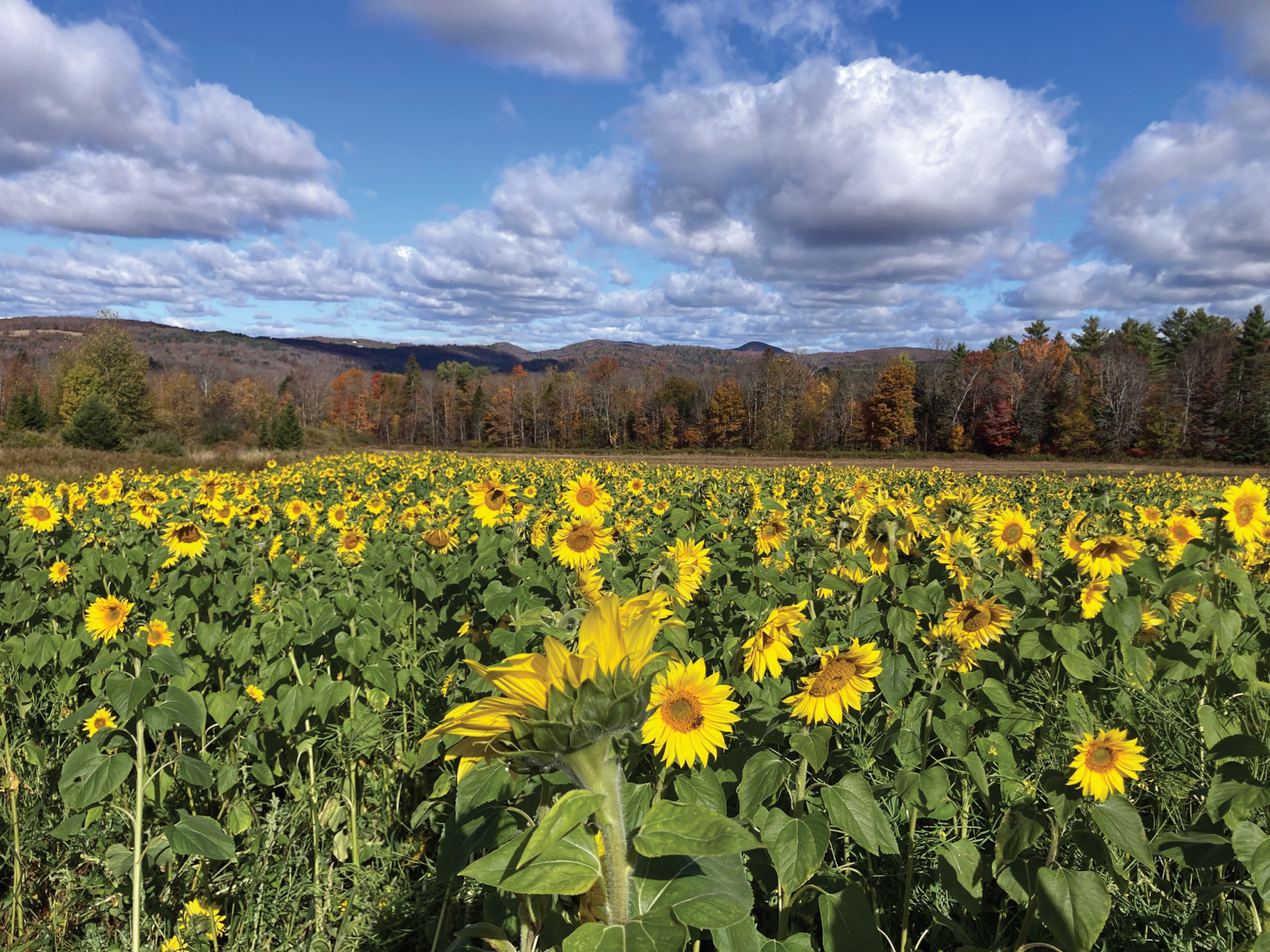
In 2025, five acres of strawberries failed due to a wet spring. Many plants died or declined, and in response to the crop failure, the Hourihans decided to implement an idea they had long wanted to try: planting a large field of sunflowers. They hoped to support pollinating insects late in the season, protect bare soil from erosion, suppress weeds, and create a fall visitor attraction.
Actions Taken
The farmers requested sunflower seed from their regular seed supplier. They were given a quote for pollenless sunflower seeds to plant 5 acres. These male-sterile sunflower varieties were developed for cut flower industry. Their lack of pollen prevents staining and extends vase life. Though they are pretty, and can provide soil protection, they do not supply abundant food resources for pollinating insects. After understanding the farm goal, the seed supplier suggested using black oil sunflower seed commonly sold as bird seed at local feed stores. The Hourihans purchased two different brand bags at 40 pounds each and $28 per bag. They were each purchased from two different vendors in case one bag failed.
The failed strawberry crop was incorporated using a tractor drawn 3 bottom plow followed by disc harrowing. A stone bucket was used to pick stones and then the field was finished with drag harrow on July 15. On July 17 sunflowers were planted at 40,000 seeds per acre using a 4-row Massey Ferguson corn planter that seeds at 20,000 seeds per acre. Two seeding passes were used to ensure a uniform stand, one in a north-south direction then another in an east-west direction. After planting, a cone disc spreader was used to apply 17-10-20 fertilizer at 200 pounds per acre. Then Dual Magnum (S-metolachlor), a pre-emergent herbicide for annual grasses and small-seeded broadleaf weeds, was sprayed on the soil using a boom sprayer.
Results
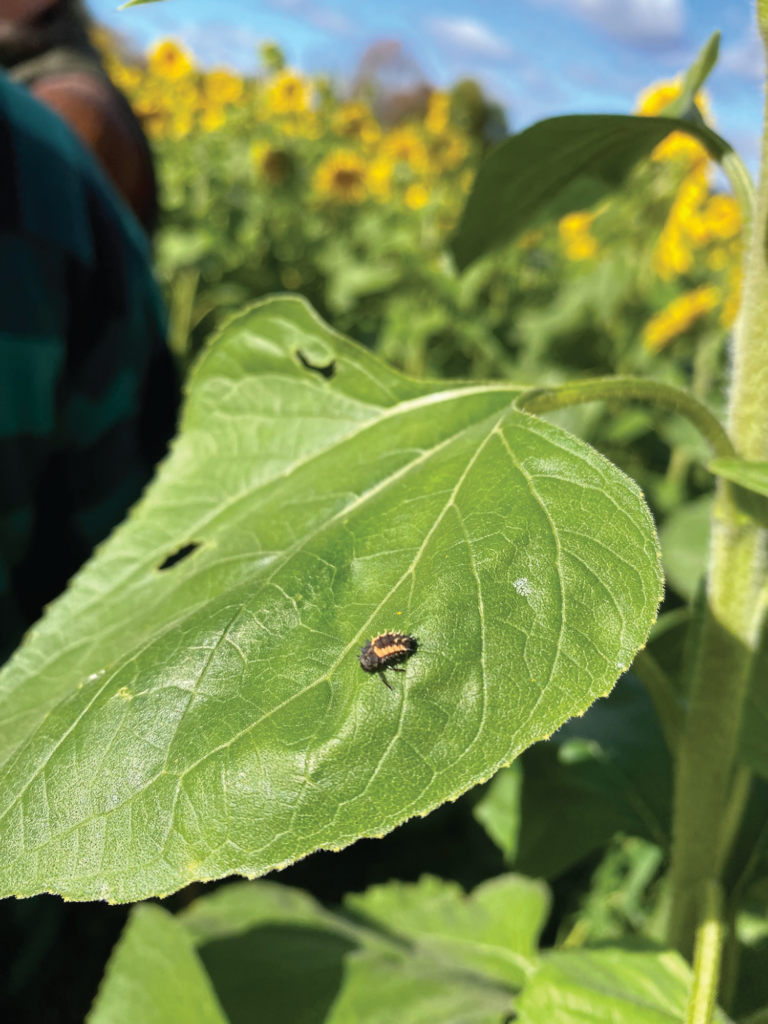
The seeding rate was effective. In combination with the herbicide applied at planting, enough sunflower biomass was produced to adequately suppress weeds and prevent soil erosion. The sunflowers began to bloom on October 4th, about 70 days after planting, and were at peak bloom on October 9. Despite the late season blooms when weather was cool, some insect pollinators like bumble bees were found foraging on blossoms. Non-bees, like lady beetle larvae, were observed on leaves of the plants.
The sunflower cover crop was managed to serve as an attraction for on-farm visitors. A walk-behind brush hog was used to cut a 41 inch wide path into the stand once it started to flower. By mowing a path at this stage of crop development, a thick mat of plant debris was left behind to cover the soil, protecting it from foot traffic and rainfall that could cause compaction or erosion.
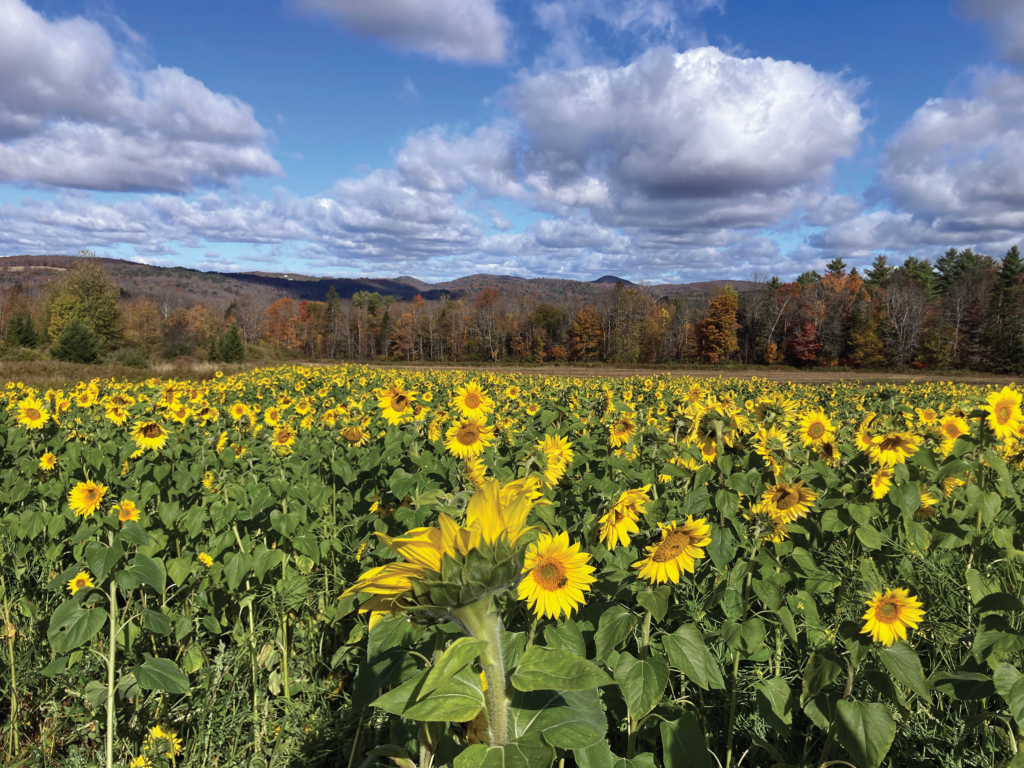
Fifty-one people “liked” the farm’s social media post advertising the availability of a sunflower walk, and visitors came to the farm to experience the sunflowers, especially during weekends in October. The Hourihans estimate that about 30 people visited the sunflowers. Many of these visitors to the farm also purchased fresh produce at the farm’s stand, which was an excellent value-added benefit of the cover crop!
Conclusions
The Hourihans are looking forward to refining this practice in the future. They feel that sunflowers are a good cover crop to plant in the unfortunate case of another failed spring cash crop (cucumbers, yellow squash or zucchini). Given the significant residues that will remain after the sunflower cover crop, it needs to be followed by a suitable crop; they plan to plant sweet corn in that field in 2026.
It was surprising to the Hourihans that the sunflowers bloomed so abundantly after being planted so late in the season. In the future, they will plant two weeks earlier. They will also mow the paths earlier, when plants are about a foot high. The high residue mowing left paths that were uneven, at times making footing difficult. Mowing when there is less biomass should make paths easier to walk on while still providing enough plant residue to protect the soil.
Future plans include an artistic design and map for the paths, more advertising to attract more visitors, and possibly offering wagon rides which could draw more guests and provide greater accessibility for people of different abilities and ages.
Download this Case Study as a PDF
For more information about pollinator supportive farm management practices, contact UVM Extension Pollinator Support Specialist, Laura Johnson, laura.o.johnson@uvm.edu