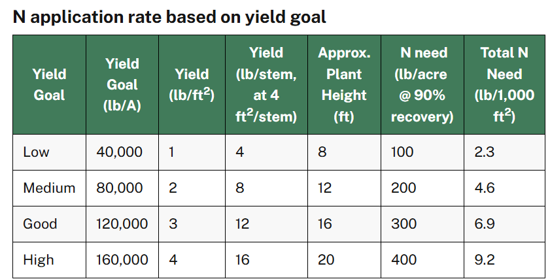
Providing the right amount of nitrogen (N) to high tunnel crops at the right time in the growing season is a common challenge, especially for organic growers who typically use fertilizers that require microbial activity to release the N they contain. Our previous work has shown that vigorous, indeterminate tunnel tomatoes need 2 to 3.5 times the N required for field tomatoes to meet their yield potential. That is up to 400 lbs. per acre equivalent for long-season, grafted tomatoes in heated tunnels with a yield potential of 4 lbs. per square foot. Shorter season tunnel tomatoes with a yield potential of 2 lbs. per square foot still need about 200 lbs. per acre of N (Figure 1.) And, although tomatoes need significant N prior to fruiting for plant establishment and vegetative growth, plants continue to utilize N throughout their productive life. Researchers at UC Davis found that field grown processing tomatoes continued to uptake N throughout their growth, beyond 120 days after transplanting. They also found that 70% of the total above ground N was allocated to the fruit, with the remaining 30% in the vines (Hartz and Bottoms, 2009). That may explain why we’ve observed that front loading all the crop’s N is an imperfect strategy for longer season tomatoes; adding all the N early, even with slow-release organic materials, can lead to overly vigorous, “bullish” plants and can delay fruit ripening.
A survey of 47 tunnel tomato growers we conducted in 2024 revealed that most growers (78%) use soluble fertilizer delivered through drip, known as “fertigating”, and the majority of them rely on sodium (“Chilean”) nitrate (15% N) (Grubinger and Maden, 2025). However, salt build up in tunnel soils can become a problem due to the lack of natural rainfall, and this problem is exacerbated by the use of high salt fertilizers like sodium nitrate. Furthermore, sodium nitrate is mined from ancient salt deposits in the Atacama desert of northern Chile, leaving many growers reluctant to use it.
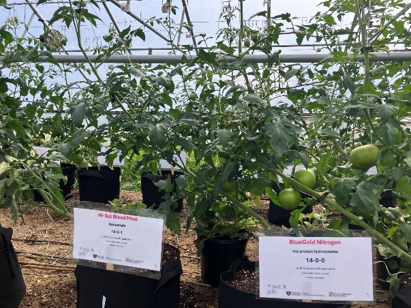
To better understand the options for providing N to organic high tunnel tomatoes during the growing season, we compared the performance of 6 OMRI-labeled soluble N fertilizers. The products were provided by Seven Springs Farm Supply, which we thank for supporting this project! While yield results are not in yet, this article details what has been learned so far.
Methods:
The experiment was conducted in a commercial high tunnel. There were 6 soluble fertilizer treatments and an unfertilized control, with four replications. Tomato plants (variety “Geronimo”) were seeded into 72 cell trays on June 14 into a sterile organic potting media (Pro Mix MP Mycorrhizae Organic). On June 30, the tomatoes transplanted into 3-gallon fabric bags filled with the same potting media amended with 0.25 lb. ProGro (5-4-3). That rate of fertilizer was intended to mimic typical background nutrient levels for high tunnel soils. The bags were placed in a randomized design on a greenhouse bench.
Each soluble fertilizer treatment was applied at a rate equivalent to 10 lbs. N per acre per week. A hand held pH meter was used to measure the fertilizer solutions and citric acid was added to acidify the solution to a pH of 5.5. The materials were mixed and applied by hand to avoid cross contamination through drip lines.
Preliminary findings:
Each fertilizer was evaluated for solubility, odor, cost, and plant growth using a rating scale of 1-5 , with 1 being “poor” and 5 being “excellent” (Table 1). Fruit yield and quality were also evaluated and the findings covered in a subsequent article.
Table 1
| Material | Solubility | Odor | Cost (per 0.25 lb. of N) | Growth |
| Liquid Fish Concentrate “aqua power” | 5 | 1 | $ 9.12 | 4 |
| Soluble blood meal | 2 | 1 | $ 3.06 | 4 |
| Biomin N | 5 | 3 | $ 7.54 | 5 |
| Ferti Nitro Plus | 4 | 4 | $ 15.60 | 5 |
| BlueGold Nitrogen | 4 | 3.5 | $ 8.02 | 5 |
| Ferti-Organic soluble humates | 2 | 5 | $ 2.05 | 4 |
| Allganic nitrogen plus | 4 | 5 | $ 5.18 | 5 |
| control | NA | NA | NA | 4 |
Solubility
The materials in this study are all marketed as “soluble” but there was a range of of actual dissolution. The Aqua Power Fish and Biomin N were both in a liquid form and very soluble when mixed with water. Both of these materials were also tested through drip lines and had no problems with clogging. In contrast, the Hi Sol blood meal was surprisingly difficult to dissolve and hold in suspension. The label instructs: “this fertilizer is intended to be mixed with water using moderate agitation” but it was difficult to achieve that level of agitation without the material clotting immediately upon contact with water. Once the material clotted, it was hard to put back into suspension. Some growers have noted that it can be problematic for drip lines.
The two flowable soy products tested, Ferti Nitro Plus and BlueGold, both dissolved easily. However, we did learn that in storage, these products need to stay completely dry or they can become chunky and then quite challenging to dissolve. The Allganic also dissolves well, especially when given a few minutes left on its own; like a salt, it will easily fall apart, particularly if the water is warm.
Odor
This wasn’t an attribute we planned to evaluate, but the varying level of odors made it apparent that this was an important factor to consider, especially for use in tunnels or greenhouses. The fish fertilizers have a strong odor during application that is difficult to wash off of hands or clothes, but the smell doesn’t linger in the greenhouse. All three of the soy-based products (liquid Biomin N, Ferti Nitro Plus, and BlueGold) had an odor that was mildly fermented but easy to handle. Blood meal was probably the most distasteful of the products in terms of odor and overall “ick” factor. It is made from “porcine blood meal” and smelled and acted like clotty blood.
Cost
In this study, there is an enormous range in cost per unit of N among the products tested (Table 2). Everything except the blood meal is dramatically more expensive than Allganic, which is a big reason we frequently recommend to growers. However, the price differences would be more impactful if applied on a field scale—spending up to $62 per pound of N to fertilize a field crop is a big investment. However, tunnel crops are grown in much smaller areas, have a higher value and yield per area, so the investment in quality fertilizer makes more sense than in the field.
The standard recommendation for fertigating N for high tunnel tomatoes 0.25 lb./ N per 1000 square feet (10 lb. N/ acre equivalent) for 6 to 8 weeks, beginning 4 to 6 weeks after transplanting. At that rate, the shaded column below in Table 3 shows the total cost of fertigating for the season in a 3,000 sq. ft. high tunnel. The most expensive product, Ferti Nitro Plus, would cost $280.84 for a season, 7.7 times more expensive than the least expensive product, Allganic N at $36.96.
| Product | Cost per lb. N | Cost of 0.25 lb./N per 1000 sq ft. | Season cost for 6 applications in a 30×100 tunnel |
| Liquid Fish Concentrate “aqua power” | $ 36.46 | $ 9.12 | $ 164.08 |
| Hi-Sol blood meal | $ 12.23 | $ 3.06 | $ 55.02 |
| Biomin N | $ 30.15 | $ 7.54 | $ 135.69 |
| Ferti Nitro Plus | $ 62.41 | $ 15.60 | $ 280.84 |
| BlueGold Nitrogen | $ 32.07 | $ 8.02 | $ 144.29 |
| Allganic nitrogen plus | $ 8.21 | $ 2.05 | $ 36.96 |
From a production point of view, the difference of ~$250 between the most and least expensive fertigation program could easily be recouped with a small bump in yield. At the average reported retail price of $4.50/lb. (from our 2024 survey) for slicer tomatoes , it would only take an increase of 55.5 pounds of marketable tomatoes (6 harvest flats) over the course of an entire season to pay for the costliest fertilizer.
Crop growth
Plant growth was assessed on a weekly basis with evaluations of height, stem diamater, and plant vigor. After some initial differences in seedling growth, all treatments show no significant differences, with good overall growth and plant balance. Seedlings treated with Aqua Power, which is very acidic, showed damage to stems after the first fertigation. One plant died and all plants in that treatment suffered, but within 2 weeks the survivors recovered fully.
This is very short term study to assess short term outcomes from organic amendments, but there are longer term soil health implications that are important to consider with soluble fertilizer choices. For example, what are the soil health benefits from using materials that enhance soil micorbial activity such as the FertiNitro Plus or Aqua Power? On the other hand, what are the impacts on tunnel soil from using high salt fertilizers like sodium nitrate? These differences may not be apparent from a short study like this one, but over time we may begin to understand what products have favorable impacts on soil health characteristics and lead to successful tunnel crops for many years.
Stay tuned for the next article, with quantitative data on plant growth and yield!
By Becky Maden and Vern Grubinger, UVM Extension
* Mention of products is for information only, no endorsement or discrimination is intended.
References:
- Hartz, T.K., Bottoms, T.G., 2009. Nitrogen Requirements of Drip-irrigated Processing Tomatoes. HortScience 44, 1988-1993.
- McKeag et al., 2025. New England Vegetable Management Guide https://nevegetable.org/crops/tomato-greenhouse-and-high-tunnel.
- Grubinger, V. P. & Maden, R. R., 2025. A Current View of High Tunnel Tomato Production in New England. HortTechnology, 35(6), 992–1002. https://doi.org/10.21273/HORTTECH05779-25