
Sustainable Innovation MBA Students Support “Old Spokes Home”
Fundraiser Aids Mission To Provide Mobility and Job Skills To Low Income Vermonters
This post was written by Shari Siegel, ’18
Students from The Sustainable Innovation MBA Class of 2018 — Arielle Tatar, Madeline Brumberg, Ian Dechow, and Shari Siegel — donned their tights and jerseys and saddled up for a recent fundraiser for the Old Spokes Home in Burlington.
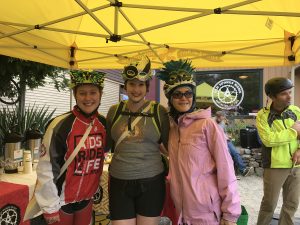 The unique bike shop is a not-for-profit organization that, in addition to selling and servicing new and used bicycles, helps get bikes into the hands of low income Vermonters who need them for mobility, health and freedom. In addition to providing bikes, the Old Spokes Home offers job training, classes, social programs and guided rides. As its leadership says, “we believe bikes are a simple solution to complex problems. We believe there is a bike for every person and every purpose. We believe bikes aid in positive personal and cultural transformation. Bikes connect people to their community, to their own bodies, to their physical environments. Bikes heal. Bikes empower. Bikes mobilize. We believe everyone should have access to bikes. We believe everyone deserves to feel the joy that a bicycle provides. That’s why we’re here.”
Such a mission is embraced by the students who came out for the event. The event exceeded its fundraising goal, and a good time was had by all.
This Week in Sustainable Innovation

Scotland Just Set a World Record for Producing Energy From Tidal Power
China’s Painful Energy Transition
Business That Works For Everyone: A Declaration Of Interdependence
The Impact Intrapraneurs: How Interface and ZSL Collaborated to Create Net-Works
Puerto Rico Is Considering Bringing Power Back Through Renewable Microgrids
Getting to Know the Class of 2018: Camille Fordy
Meet Camille Fordy ’18, (LinkedIn) who came to The Sustainable Innovation MBA from the Washington, D.C. law firm of Brownstein Hyatt Farber Schreck where she worked in their government relations division. Prior to working at Brownstein, Camille worked on Capitol Hill as a legislative staff assistant to Sen. Patrick Leahy and the Senate Judiciary Committee. This interview was conducted by Peyton White (LinkedIn), an undergraduate Business Administration major in UVM’s Grossman School of Business.
Why did you choose The Sustainable Innovation MBA?

 I was MBA-bound for a while. I took the GMAT once and was exploring future options for MBA programs. I did lots of research on two-year programs, which I liked. I was going to push the application process out a year to continue studying for the GMAT, but instead I applied to The Sustainable Innovation MBA. I liked that the opportunity cost of attending The Sustainable Innovation MBA program was only one year and offered me a great change of network, too, away from my primary one in D.C.
“I liked that the opportunity cost of attending The Sustainable Innovation MBA program was only one year.”
What do you like about The Sustainable Innovation MBA?
I know a few individuals who were in previous cohorts. Their growth and experience in The Sustainable Innovation MBA program is inspiring and I really like the uniqueness of the program. I have heard before that “if you don’t go to a Top 10 school, an MBA isn’t worth it.” But after one month, I can say I disagree for many reasons. The program offers many interesting perspectives, classes are intellectually challenging, and we are provided with many opportunities to work in teams. I have found that the teamwork projects have been a great tool to self-assess how I work with others and improve upon my communication, project management, and problem solving skills for use in my future workplace. I have had the opportunity to develop relationships with new people and new personality types that I may never have met in my former workplace. Working in these diverse teams in a low-stakes atmosphere has given me the space to take risks and grow.
Continue reading “Getting to Know the Class of 2018: Camille Fordy”
Watch It Live: The Transformation of the Grossman School of Business
Autumn may be leaf-peeping season in Vermont, but it’s also construction season at the University of Vermont, and the Grossman School of Business. Among the many, many projects at UVM over the last twenty-four months is a significant addition to Kalkin Hall, the School’s home. When completed in 2018, Ifshin Hall will add a significant amount of classroom, office, and multi-purpose space to UVM’s growing and nationally recognized business programs, including The Sustainable Innovation MBA.

Click the video to follow a live feed of the construction.
Considering Leadership Stereotypes in Sustainable Business
This post was written by Julia Lyon ’18 (LinkedIn), a student in The Sustainable Innovation MBA, and a co-editor of the Review.
Picture this: You are employed at a company, in a role that you love, and the CEO is none other than George Costanza. Thinking about his character, do you believe George will be a good leader?
 For those of us who are Seinfeld fans, we know that George will likely not be the most effective business leader. But what qualities, assumptions and observations bring us to this conclusion? This question was the opening to the recent Leadership Stereotypes workshop for The Sustainable Innovation MBA students, where the class discussed gender and leadership, implicit biases, and how to apply these insights in leadership and life.
Continue reading “Considering Leadership Stereotypes in Sustainable Business”
Diane Abruzzini ’17 Named Business Advisor at Vermont Commodity Program
Diane Abruzzini ’17 will be joining Salvation Farms as a business advisor, helping the non-profit strengthen its Vermont Commodity Program by revising and expanding its business plan.  The Vermont Commodity Program operates Vermont’s first surplus-crop food hub through a workforce development program. The food hub cleans, quality assesses, processes, and packs surplus crops.
Diane, whose work will be made possible through Salvation Farms’ partnership with the Cabot Creamery cooperative, will be working on financial modeling, business strategy, and stakeholder relations for the program.
In addition to her education in The Sustainable Innovation MBA, Diane comes to Salvation Farms with experience working with sustainable agricultural business models. She has started multiple small businesses, including an edible landscaping firm and a farm to table bakery.
“I have spent most of my career focusing on innovative ways to increase population access to local food, both the supply and demand side of the equation,” Diane said. “Salvation Farms is creating a unique opportunity to assist both sides at once: increase farmer revenue and facilitate new markets.”
Read the news release announcing Diane’s appointment. Learn more about Salvation Farms.
Vermont Business Accelerator Launched for Climate Change-Focused Entrepreneurs
A new business accelerator program, aimed at supporting entrepreneurs and startups focused on technology, services, and products addressing climate change challenges — particularly in the area of energy — has been launched in Vermont following the recent national Catalysts of the Climate Economy Summit held here in early September.

Accel-VT is inviting startup or seed stage ventures from across North America interested in solving one of the most pressing electric grid issues facing the U.S.—integration of distributed renewable energy, efficiency, and storage technologies with the grid — to apply. Participants will be selected based on their ability to help solve the challenges related to the monitoring and control of distributed energy (e.g., storage, electric vehicles, solar, community scale wind, combined heat and power) to improve their value while providing safe, reliable, and affordable electric service to all customers.
“We’re building a cluster of climate innovation companies and we offer an entrepreneurial support system that includes access to business planning services, networks, and growth capital—in a state known for its high quality of life in an idyllic and recreational setting in the Green Mountains,” says Geoff Robertson of Accel-VT.
Read the full press release. Or, learn more about Accel-VT.
Innovator in Residence: Laura Asiala
This post was written by Keil Corey, Sustainable Innovation MBA ’18
Recently Laura Asiala, Senior Fellow at PYXERA Global and a Sustainable Innovation MBA Advisory Board member, joined this year’s cohort for an in-class discussion on the role that business can play in addressing some of the world’s most intractable challenges.
 Before joining the PYXERA team, Asiala had been the Director of Corporate Citizenship at Dow Corning Company. Over three decades in the corporate sector taught her that environmental and social sustainability are not hindrances to business; rather, they can ensure long-term success and profitability. She carries that vision forward in her current role at PYXERA, where she works to leverage the strengths of corporations, governments, social sector organizations, educational institutions, and individuals to solve complex problems in inclusive and sustainable ways.
Of particular interest to Asiala is how corporations can and must play a role in achieving the United Nation’s Sustainable Development Goals (SDGs), also known as the Global Goals. Adopted in 2015, the Global Goals identify specific targets and timelines that aim to end poverty, protect the planet, and ensure prosperity for all. At PYXERA, she is working on aligning multi-sector stakeholders toward those ends.
UVM Rated A Top Green University by Princeton Review
From the Editors
The University of Vermont is one of only 24 universities nationwide to make the Princeton Review’s “Green Rating Honor Roll” in recognition of sustainability-related practices, policies and academic offerings. From the University’s press release:
“The schools on our Green Rating Honor Roll demonstrated a truly exceptional commitment to sustainability across critical areas we looked at — from course offerings and recycling programs to plans for reducing greenhouse gas emissions,” said Robert Franek, the Princeton Review’s editor-in-chief. “We salute their administrators, faculty and students for their collective efforts to protect and preserve our environment.”
Franek noted the increasing interest among students in attending “green” colleges. Among nearly 10,500 college applicants the Princeton Review surveyed in 2017 for its College Hopes & Worries Survey, 64 percent said having information about a college’s commitment to the environment would impact their decision to apply to or attend a school.
“UVM’s Green Rating scores show the results of our individual and collective decisions to live more sustainably,” Gioia Thompson, UVM’s director of the office of sustainability, said. “The interviews of students show how strongly students identify UVM as a place where people act in support of sustainability locally and globally.”
“UVM’s status as a green school is a core part of our identity and definitely contributes to our appeal for prospective students,” said Stacey Kostell, vice president for enrollment management. “The Princeton Review Honor Roll designation is a confirmation of what those of us who are part of the university see every day.”
Continue reading “UVM Rated A Top Green University by Princeton Review”