323 Stearns St, Carlisle, Massachusetts 01741
Weather:
On Wednesday at 3:00PM, the temperature was 71˚F. It was sunny with very few clouds in the sky. Within the woods, the ground was shaded by the trees. There was little to no wind and it did not feel very humid.
Site Description:
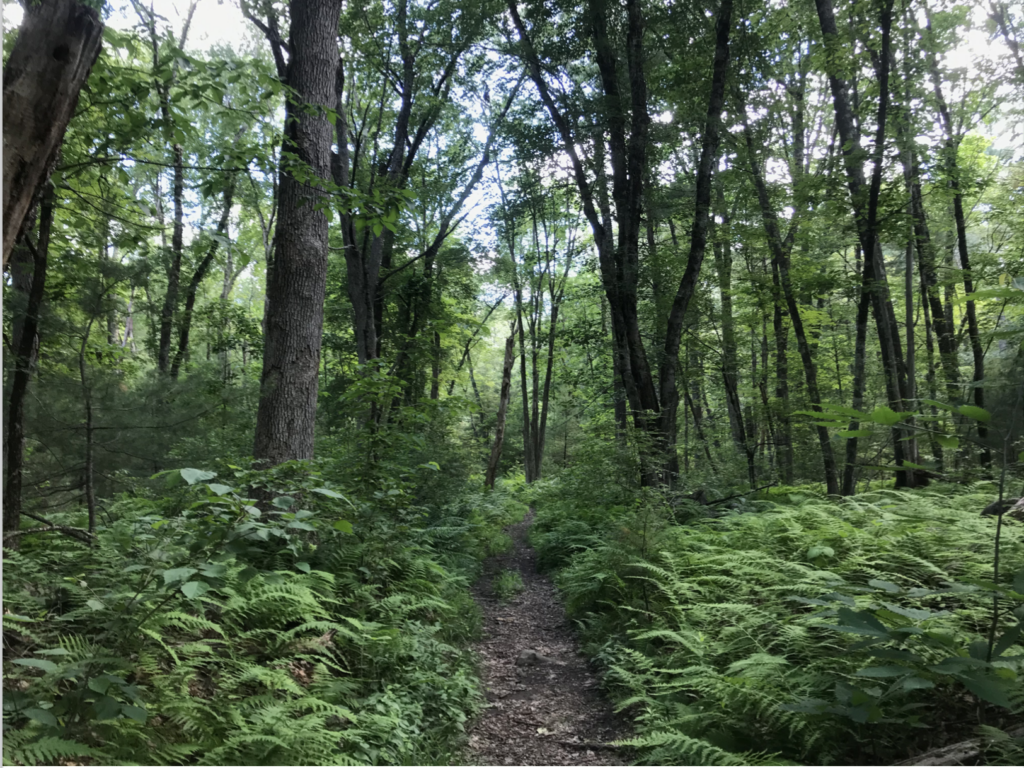
At the entrance of the Malcolm Preserve trail, the air smelt very strongly of flowers. There was a large shrub with small white flowers that had recently dropped to the ground. Past the flowers, it smelt slightly damp. It rained the night before and this caused the path to be muddy in some areas. Along with the mud, the trail was covered in old leaves that had fallen off of the trees in the fall. Throughout the rest of the trail, the air smelt of earth, grass, and pine trees. The trail was very lush with ferns and other small plants lining the edge of the path. Mixed in with the ferns, there were saplings of oak, birch, and maples trees as well as ivy plants and grasses. Behind the ferns, there were larger trees. Some were conifers while others were deciduous. There were a few very large, and old trees as well as younger ones throughout the forest. Along the ground there were also fallen logs. These logs had polypore mushrooms growing upon them and were decaying. Many of the living trees had lichens and polypores growing on them as well.
This land was formerly used for farming. There is evidence of this along the trail as there are stone boarders lining both sides of the path. Within these stone fences, there are holes in which chipmunks were running through and hiding within. Within the mud upon the ground, I could see deer tracks heading in the direction of the pond at the end of the trail. As I walked along, I could hear several species of birds chirping and could see them flying between trees. I could also hear flying insects buzzing by my ears. Low to the ground, there were wasps pollinating the plants along the edge of the trail. There was also a garter snake slithering off the trail, attempting to get away from me. It moved quickly to hide beneath some leaves. As I continued to walk, I lifted up a few rocks. Beneath one, the fungal mycelium was visible. It appears white and stringy, similar to the string of a spiders web. Another rock had a colony of ants living beneath it. The ant larva were wrapped in a while pouch or sac. Further along the trail, there was a bog area that was filled with water. There I heard frogs bellowing and I could see ripples along the water of organisms swimming away. There were a lot of water plants in that area submerged in the bog and along the edges of it.
Question Marathon:
- What species of shrub is producing this flower at the entrance?
- Why did it drop its flowers at this time?
- How did these large boulders appear here?
- Were the boulders deposited here by a glacier? Where did the originate from?
- This used to be farmland, how has the farming affected the land and the species that grow/live here now?
- When was the land converted from farmland to woodland?
- How long have these trees been here?
- Why are there so many ferns along the side of the trail and not further within the woods?
- Why are some of the leaves of the ferns curled inward?
- There are a single deer’s tracks along the trail, what species of deer is it?
- Why is this deer alone?
- Why are all the small insects flying towards and around me?
- What species of birds are in the area?
- Why do they chirp continuously?
- What species of lichen in present on many of the rocks and trees?
- How does lichen propagate and spread throughout the forest?
- Why do some healthy appearing trees have a couple dead limbs?
- Do these dead limbs indicate that the tree is sick or dying?
- Why do mushrooms tend to appear only on larger, older trees?
- Does mushroom presence always indicate decay of the tree?
- Why do polypore, or shelf mushrooms, mushrooms appear to be more common than mushrooms that grow on the ground?
- Along the path, there are small holes/burrows in the ground, what species of animals live within them?
- Beneath a rock, the mycelium was visible, why is the mycelium exposed here above ground but usually beneath ground elsewhere?
- Does the mycelium need constant moisture to survive?
- What species of beetles and other insects live in the holes beneath the rock?
- I saw a garter snake slithering away from me, how do they sense predators are near by?
- Where do garter snakes inhabit? Do they have a burrow?
- Beneath another rock, there was a colony of ants with their larva. Why are the larva individually covered in a white pod or sac?
- What species of ant was this?
- What species of frog or toad was bellowing in the bog area?
- How do the plants in the wetland bog area survive with constant changing levels of water?
- How does current human activity affect Malcolm Preserve and its species?
- How does treading on trees roots damage or change them over time?
Research:
Question: How has the previous farming activity of this area affected the present day woodland?
Many modern day forests throughout New England were previously used as farmland. The disturbance history of these lands affected how and what species of plants grow in the area today. David R. Foster et al.1 discuss how human activity has affected these lands and shaped them, “the modern distribution of vascular plant species, levels of forest biomass, and soil structure, chemistry, and fertility are strongly conditioned by legacies of a varied land-use history” (p. 44). During the 18th and 19th century, American forests were decimated due to deforestation for agriculture and to fuel the industrial revolution. The wood was needed for industry and farmers were growing crops. In some areas, the land was stripped of its nutrients and fertilizers were applied as nitrogen fixers, permanently altering the soil composition. All of this activity was harmful and the forests have changed greatly since before European contact. Compared to the past, trees in New England have been homogenized. There are fewer species and biodiversity has dropped. The modern forests have a weaker ability to deal with climate and soil variability due to the past land usage. With a loss of tree species, several woodland organisms have also been depleted from the area. The present day woodland, while slowly improving with conservation efforts, will never return to the same state as the pre-European contact forests of the past.
Final Paragraph:
In future visits, I would like to focus more on the wetland areas of Malcolm Preserve. It would be interesting to see the toad or frog activity within the bog. I would love to be able see what other species inhabit the area as well. Another thing I would like to observe is a pond at the end of the trail. I think it would be interesting to see how the pond differs from the forest trails. I wonder if the tree species nearest to the water are different from those on dryer land. I would also like to observe how the area looks when it is dryer. It had rained the night before I visited, so it would be interesting to see how things change without recent precipitation.
References:
- Foster, David R.; Donahue, Brian; Kittredge, David; Motzkin, Glenn; Hall, Brian; Turner, Billie; and Chilton, Elizabeth S., “New England’s Forest Landscape: Ecological Legacies and Conservation Patterns Shaped by Agrarian History” (2008). Agrarian Landscapes in Transition: Comparisons of Long-Term Ecological and Cultural Change. 344.