Recent Acquisitions: Artists’ Books

Silver Special Collections continues to add new artists’ books for use by students, faculty and community members. In this post, we highlight a sample of our recent acquisitions.

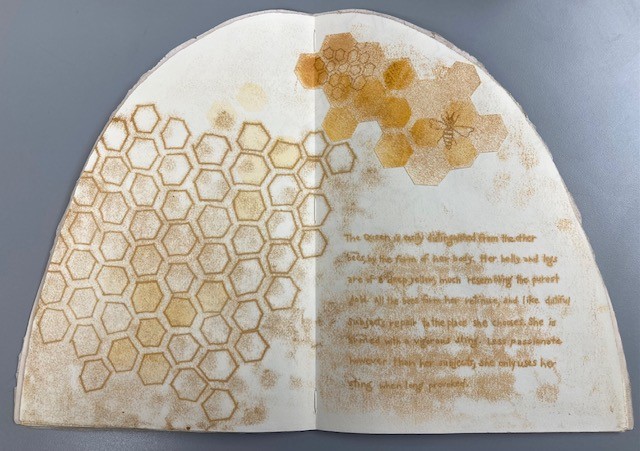
Photograph of a page spread in a hive-shaped book showing gold honey comb patterns and text about bees.

A page spread in Bees, by Stephanie Wolff.

Our current exhibit, “Along the Banks of My River,” displays books and textile pieces by Vermont artist Stephanie Wolff that are connected to weather, history and language and based on a series of journals kept by Anna Blackwood Howell during the nineteenth century. We purchased three of the pieces in the exhibit, including Bees (pictured above), Fishing Time at Fancy Hill and The River 1833.

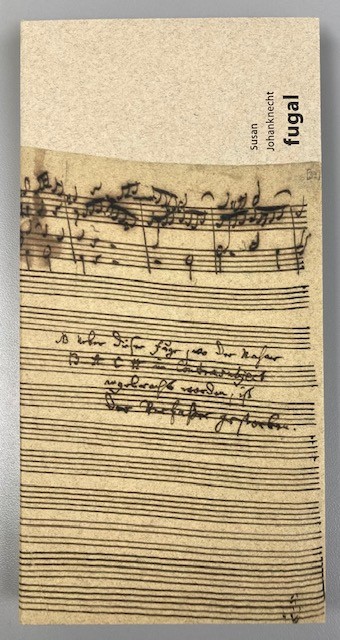
Cover of a tall, thin book with a handwritten musical score below the author's name, Susan Johanknecht, and the title, Fugal.We expanded our collection of books from  Susan Johanknecht’s Gefn Press with nine works made between 2014 and 2025. Johanknecht established Gefn Press in 1977, the same year that she graduated from the University of Vermont. The additions include her latest book, Fugal, produced in collaboration with Claire Van Vliet at the Janus Press and Andrew Miller-Brown at Plowboy Press. The artist explains the creation process,  “Fugal was written in response to descriptions and listenings to Bach fugues. Procedures used in the composition of the fugue were applied to build a poem which speaks to its musical source yet becomes an autonomous text.” The cover presents an image of Bach’s last known musical score.

We also acquired the production archives for a number of Gefn Press books.


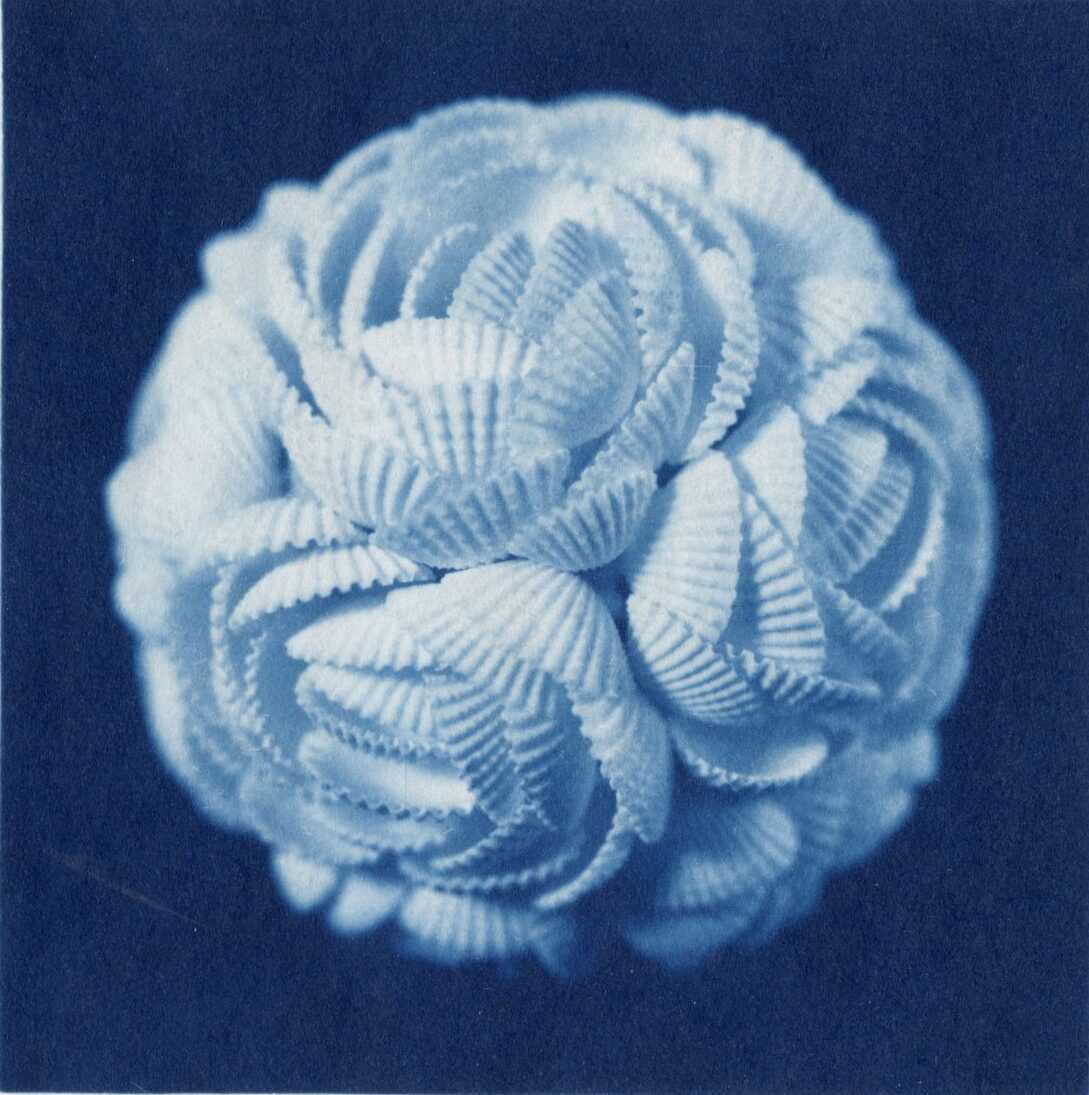
Blue-toned photograph of a round ball made of white shells.Two of the recent acquisitions use photographs in very different ways. David Sokosh’s Things That Look Like the Moon (but are not the moon) explores perception versus reality. He presents 16 photographs of round objects that look like the moon, but are not, such as a ball of string, a melon and the modern version of a nineteenth-century valentine made from shells shown at right. A short explanation accompanies each photograph. The book is cyanotype-printed, creating a unique set of blue moons.

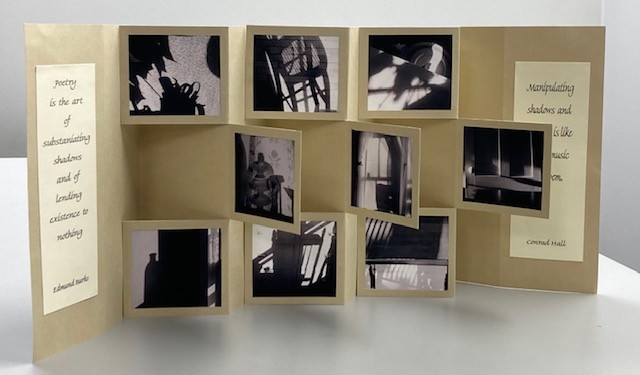
In Found Shadows (shown below), Vermont artist Rebecca Boardman incorporates black and white photographs of shadows that she collected in her home. She puts them on display in a gallery-like structure. Text on the panel on the left side of the structure reads, “Poetry is the art of substantiating shadows and of lending existence to nothing. Edmund Burke.” Text on the right panel reads: “Manipulating shadows and tonality is like writing music or a poem. Conrad Hall.”

Photograph of a book with a gallery-like structure displaying three rows of black and white photos of shadows. Two panels at either side of the gallery contain thoughts connecting poetry with capturing shadows.

Found Shadows, by Rebecca Boardman

Visit Silver Special Collections in Billings 201 to explore the artists’ book collection.

Submitted by Prudence Doherty, Public Services Librarian
 

Posted in Artists' Books, Rare Books | Tagged , , , , , , , | Comments Off on Recent Acquisitions: Artists’ Books

Learning to Ski, Simply and Quickly

Silver Special Collections holds a significant number of books and other resources related to the history of skiing and ski instruction. Many of the learn-to-ski manuals were written by instructors with connections to the Vermont ski industry of the 1950s and 1960s, including the five shared below. Profusely illustrated with photographs, the books assured beginners that they could become proficient if they followed the simple step-by-step methods laid out by experienced instructors–in conjunction, of course, with lessons and practice on the slopes.

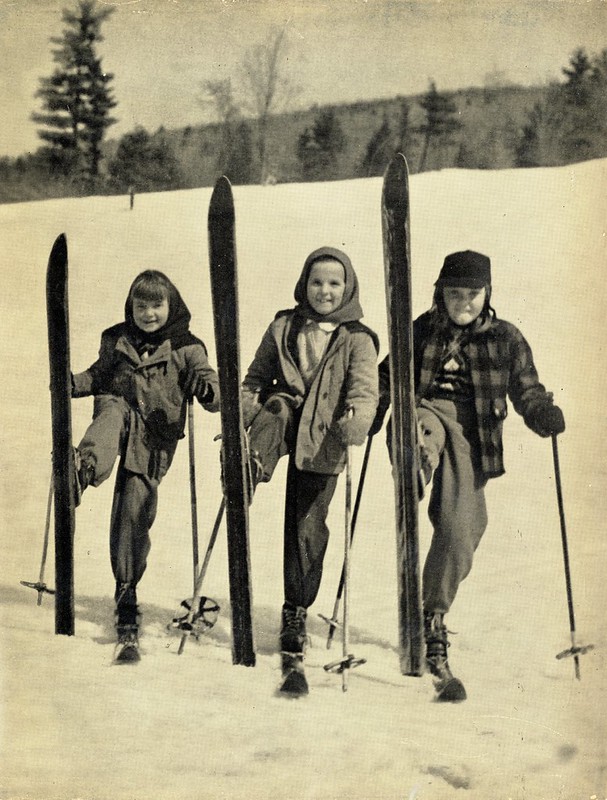
Back cover of the book, showing two girls and a boy standing in snow on one ski and lifting the other perpendicular to the ground.


Brown, an instructor at Mad River Glen in Fayston, published Skiing for Beginners in 1951. The manual for children and parents is illustrated with photos taken on New Hampshire’s Mount Washington, all featuring a Vermont student, Spike Mignault, who demonstrates the snowplow position on the front cover.

Cover of the book "The New Way to Ski," showing a photograph of author Bob Bourdan and a photograph of a man skiing down a snowy slope.

Vermonter Robert Bourdon published his first book about skiing, Modern Skiing, in 1953. Bourdon’s New Way to Ski appeared in 1962, when Bourdon was an instructor at the Sepp Ruschp Ski School in Stowe, where the “new method” was taught.

Cover of the book, "If You can Walk You Can Ski by Frank Day," showing an image of a red skier on snow against a blue background.


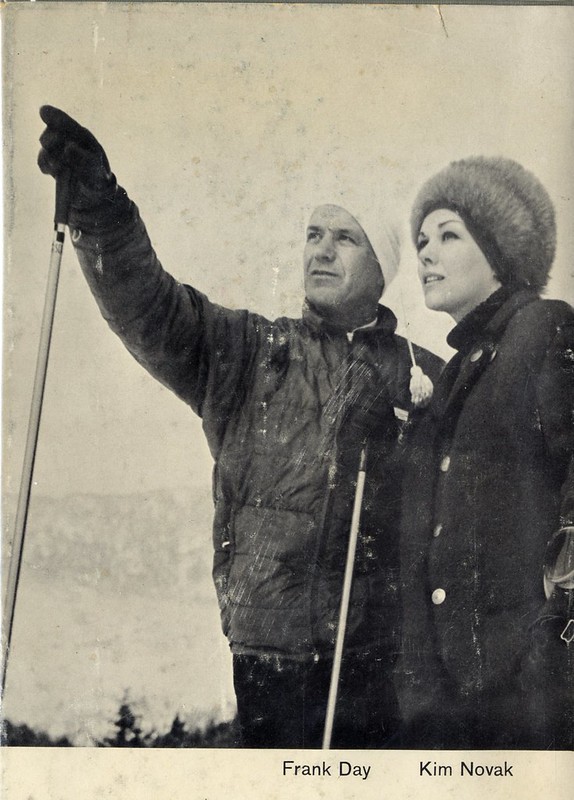
Instructor Frank Day from Waitsfield, Vermont enlisted actress Kim Novak to help promote his 1962 book, If You Can Walk, You Can Ski. Day inscribed our copy, wishing the book’s owner “simpler and safer skiing.”

Cover of a book called "Instant Skiing on Short, Short Skis," showing a man kneeling on snow and holding a pair of short skis and a sign about their advantages.

Clif Taylor, who was affiliated with Mad River Glen and Hogback Mountain, published Instant Skiing on Short, Short Skis in 1961. Taylor promised that the 2.5-foot long “short-ees” he designed would start a revolution in skiing. One sportswriter noted that the short skis Taylor promoted were the greatest boon to skiing since stretch pants.

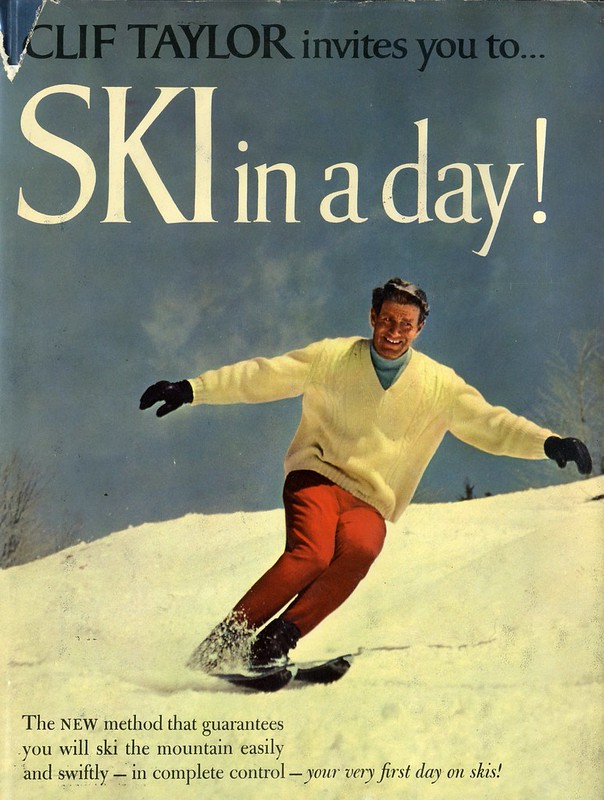
Cover of the book "Ski in a Day," showing a man in a white sweater and brown pants skiing across a snowy sloe with short skis.

Three years later, with Ski in a Day!, Taylor shared the method that would have novices skiing easily, swiftly and in control on their first day on skis. The back cover proclaims that “The TAYLOR method wins the acclaim of famous personalities,” such as Jack Parr and Lowell Thomas.

Come to Silver Special Collections in Room 201 Billings to look at books in the skiing history collection.

Submitted by Prudence Doherty, Public Services Librarian
 

Posted in Rare Books, Vermontiana | Tagged , , | Comments Off on Learning to Ski, Simply and Quickly

The Harlan Paige Papers: Letters, Photographs, Certificates — and a Powder Horn

In this post, Special Collections staff member Alyssa Bonaro shares an account of a unique internship experience.

During Spring 2025, I was completing my Master’s in Library and Information Science (MLIS) while working at Silver Special Collections. For my program’s final project, I did an internship at the Library Research Annex (LRA). This experience led to an exciting discovery.

Under the guidance of archivist Erin Doyle, I processed manuscript collections, including the Harlan Paige Papers. Harlan Paige was a Civil War veteran from Vermont and the papers document his life and Paige family genealogy. The collection contains a variety of materials–Civil War era letters, correspondence between family members about genealogy, photographs, a handmade dress, and a number of objects.

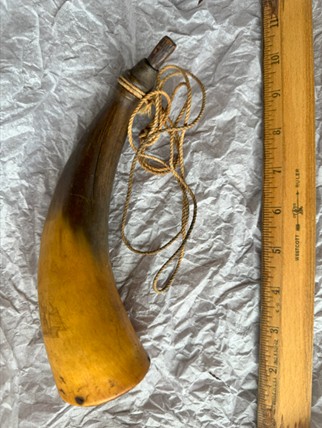
A powder horn sits on a piece or crumpled tissue paper next to a ruler, showing that the horn is about 9.5 inches long.

The Paige powder horn is about 9.5 inches long.

One of those objects was a brown horn-shaped item wrapped in white tissue paper. It was tucked inside a small box on a shelf in the Special Collections processing room in Billings. Some research suggested that the item was likely a powder horn, a container used to carry gunpowder. Upon my initial inspection, there wasn’t anything about the object that made me think gunpowder could still be inside.

However, after the horn was sent from Billings to the LRA, I opened the box to find that the previously clean tissue paper now had gray smudges.  A small amount of dark powder was nestled into the paper’s creases. There was also a distinctive smell. It seemed that the powder horn did still contain gunpowder.

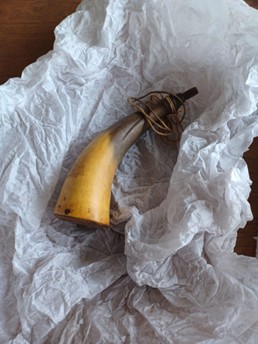
A powder horn sites on a piece of gray-stained tissue paper.

The horn inside the powder-stained tissue paper.

I told Erin about the discovery, and she reached out to our colleague Erica Donnis, who is president of the Collections Care and Conservation Alliance. Erica contacted the armorer at West Point for guidance on identifying whether the horn and powder were authentic. They told us that the horn likely dated back to the Revolutionary War. Since most horns in that period were made from the horn of an ox, ours likely was too. We do not know how the horn ended up in Harlan and/or his family’s possession.

For the gunpowder, the West Point armorer recommended a water solubility test to determine if the powder would smear when exposed to water. If so, then the powder was likely real.  Erica performed the test and found that the powder did smear.

Since we had confirmation that the horn likely contained actual gunpowder, we needed to dispose of it safely. Erica reached out to UVM Environmental Services and scheduled a time for us to meet with them to remove the powder.

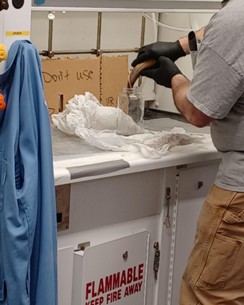
The most exciting part of this discovery was watching UVM Environmental Services carry out the removal. They were able to pour the majority of the powder from the horn, although a lead shot stuck inside prevented complete removal. We took photos of the process.

A person in a laboratory is wearing gloves and pouring dark gray powder out the small end of the horn into a glass jar.

An Environmental Services staff member poured the powder into a glass jar.

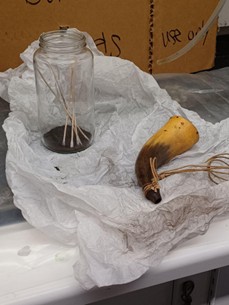
A powder horn sits on gray-stained tissue paper beside a glass jar with power at the bottom. The also contains several long cotton swabs.

The final results. The Environmental Services technician used cotton swabs to help remove the powder, which he deposited in the glass jar.

To learn more about Paige and the collection, visit the Harlan Paige Papers finding aid.

Posted in Manuscript Collection, Vermontiana | Tagged , , | Comments Off on The Harlan Paige Papers: Letters, Photographs, Certificates — and a Powder Horn

Views of the World: Stereographs in Silver Special Collections

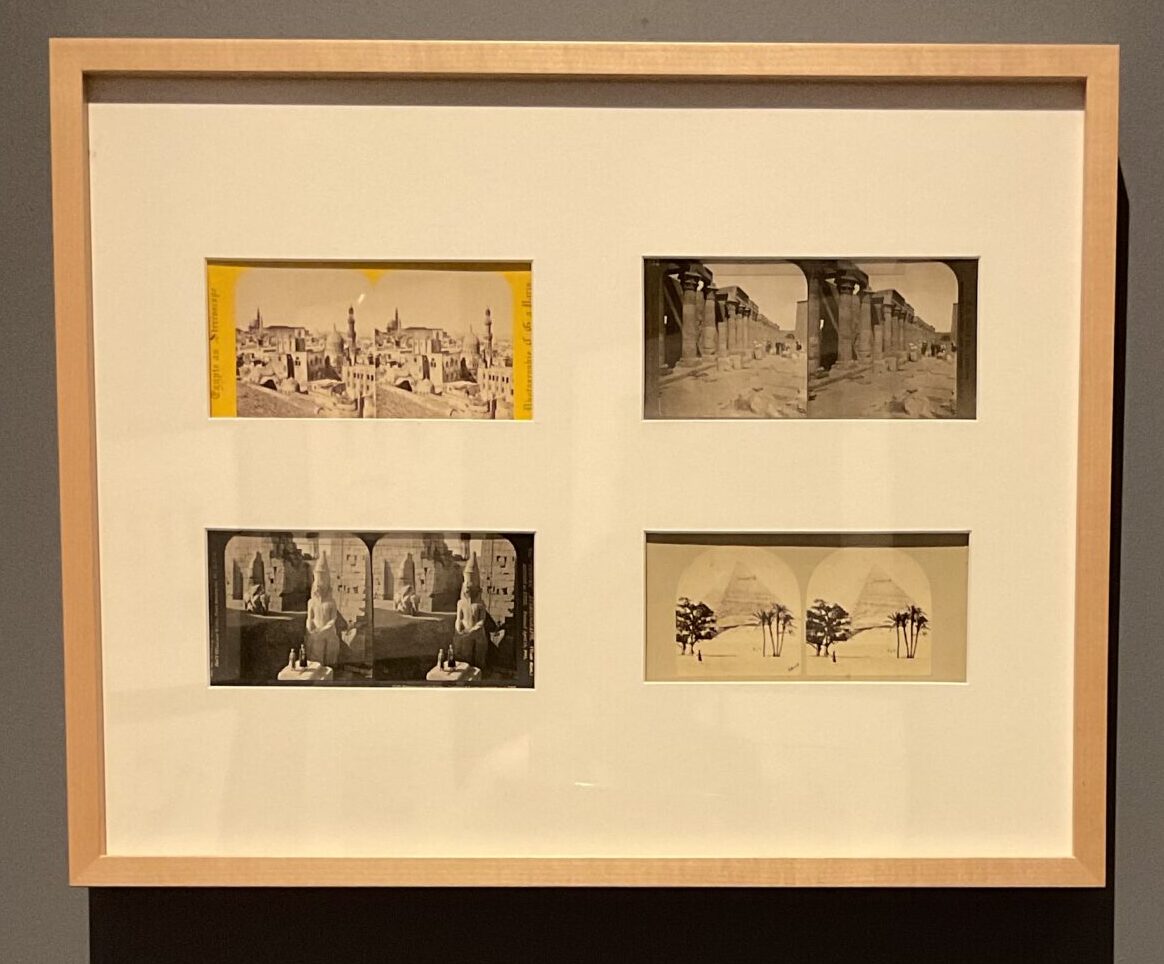
Four stereographs mounted in a wooden frame hanging on a wall.The “Art for Everyone” exhibition at the Fleming Museum of Art includes four stereographs of Egyptian scenes on loan from Silver Special Collections. The stereographs are displayed next to objects and prints selected and described by two of the museum’s collections and curatorial interns, including six prints from the monumental Description de l’Égypte published in the early nineteenth century. Fleming curators selected stereographic views of Cairo, the Temple of Luxor, ruins of an unidentified monumental building, and the pyramid at Giza to accompany the prints.

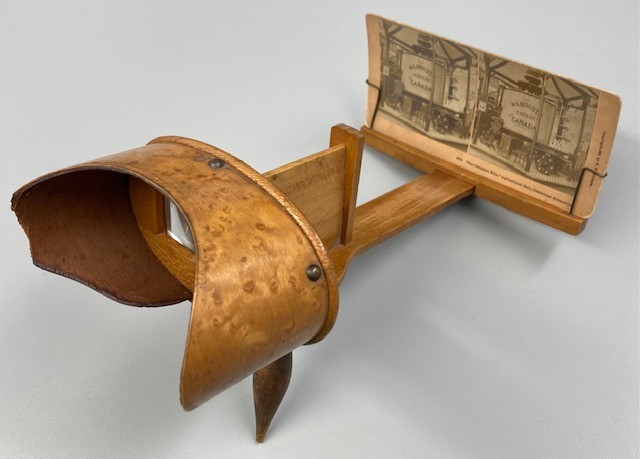
A stereograph is a pair of photographs or printed images mounted side by side on a rectangular card. Viewed through a stereoscope, the photographs appear as a 3-D image. Stereographs were extremely popular from the 1850s through the first decades of the twentieth century. They were produced by local photography studios and by large firms. Covering a wide range of content, stereographs provided entertainment and served as educational tools. While travelers might purchase stereographs as souvenirs, others viewed them to see distant places they might never visit.

Special Collections is fortunate to have an impressive collection of stereographs produced between 1860 and 1930. Librarian Jeffrey Marshall reported in 1990 that the collection consists of 3,000 Vermont views, 5,500 views of other states, and 6,000 views of foreign countries (Vermont History 1990: 37). The Vermont Stereograph Collection is heavily used and is indexed by place and subject. Many of the Vermont views are included in the Vermont Landscape Change image database. The views of other states and foreign countries are organized by country, subject, and in a few cases, by photographer. Some examples of the stereographic images taken by American and European photographers in other states and countries are presented below.

Wooden viewing device with a stereograph inserted into the wire frame for viewing.

A hand-held stereoscope.

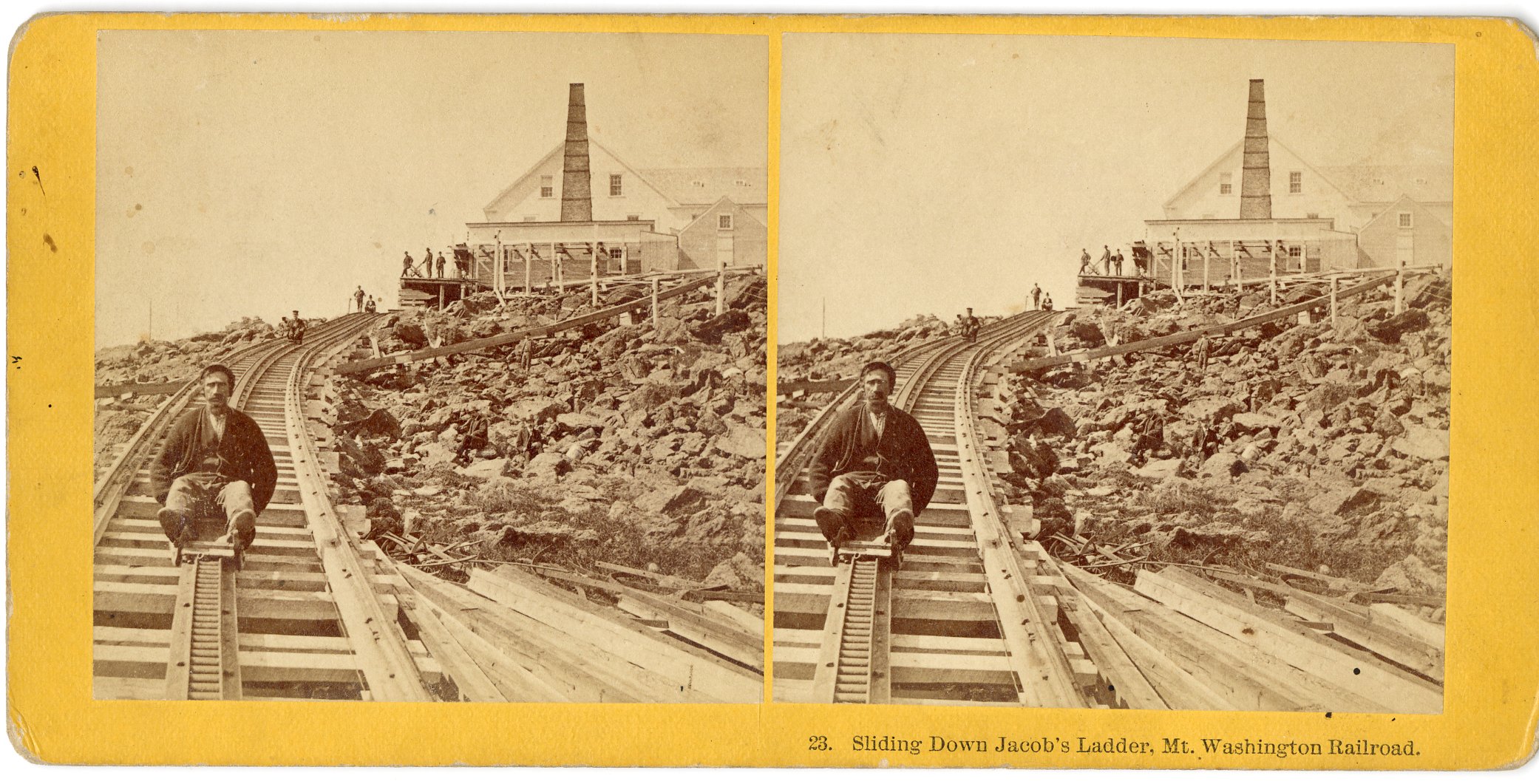
Two photographs mounted side by side on a yellow card showing a man seated on a board sliding down a cog railroad track.Photographed and published by the Kilburn Brothers of Littleton, New Hampshire, “Sliding Down Jacob’s Ladder” is one of many views featuring the Mount Washington cog railroad that took tourists to the summit of New Hampshire’s tallest mountain. Railroad workers are riding homemade slideboards through a particularly steep area on their way home at the end of a work day.

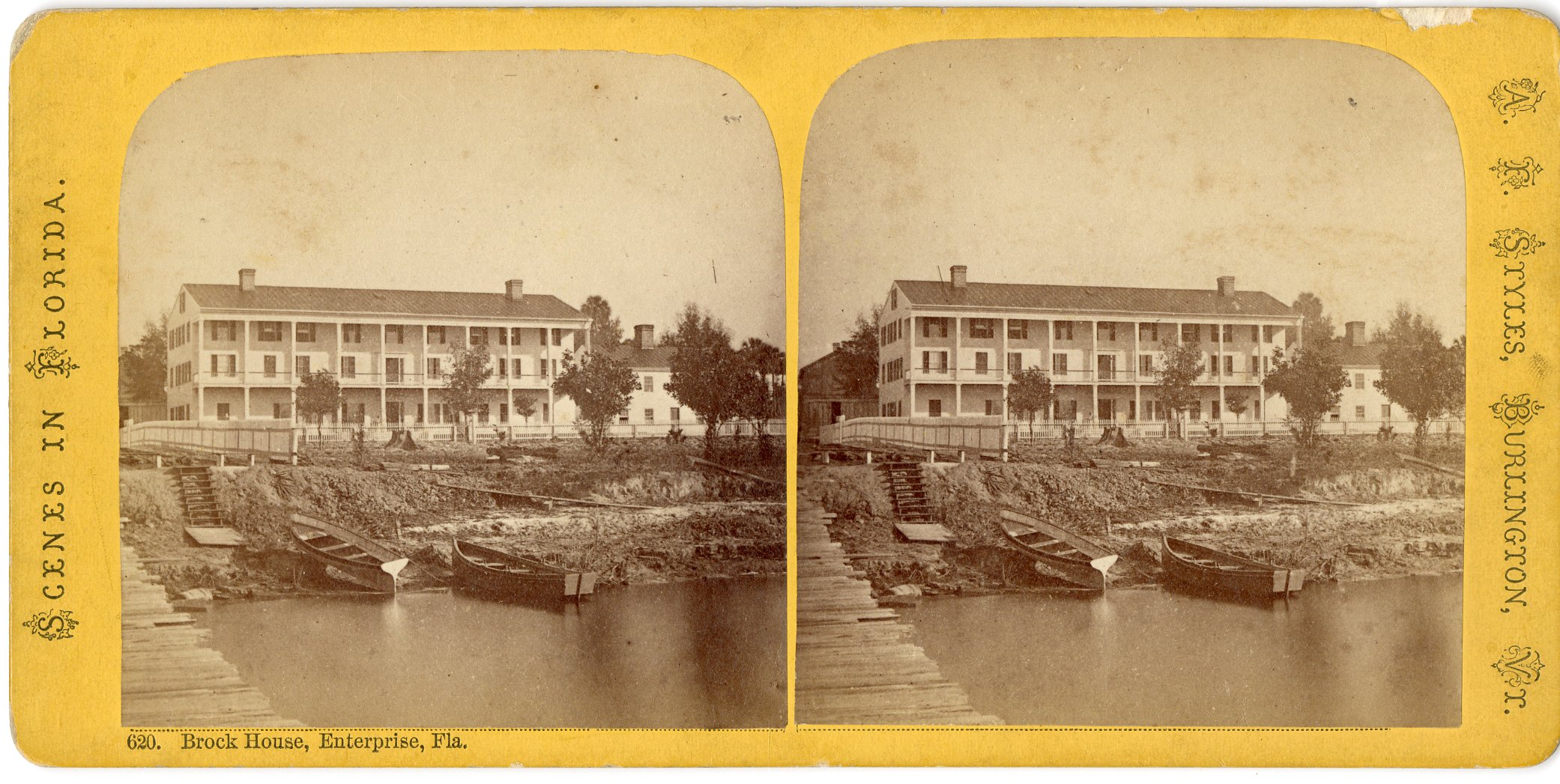
Two photographs mounted side by side on a yellow card showing a l3-story white hotel on a shoreline with small boats in the water.

Burlington, Vermont photographer A. F. Styles published the popular Green Mountain Scenery stereographic series, but he also traveled to Florida to gather images for another series, Scenes in Florida. This hotel was located in the town of Enterprise, on Lake Monroe in central Florida.

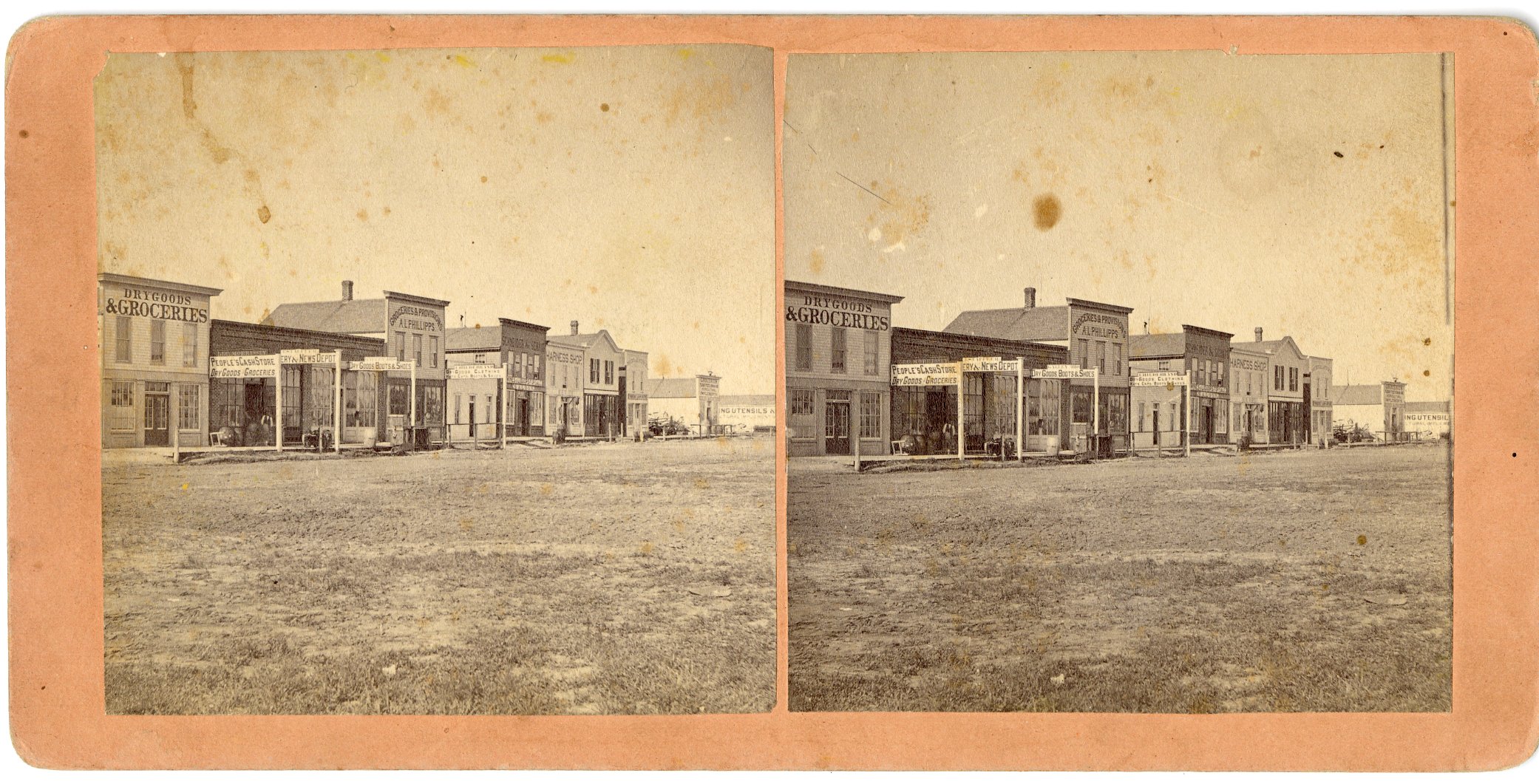
Two photographs mounted side by side on a pink card showing commercial buildings facing a dirt street.

Photographer and dentist Dr J. S. McAllister created this stereographic view of Columbus, Nebraska after he went west from Bristol, Vermont, where he also had a photography studio and a dental practice.

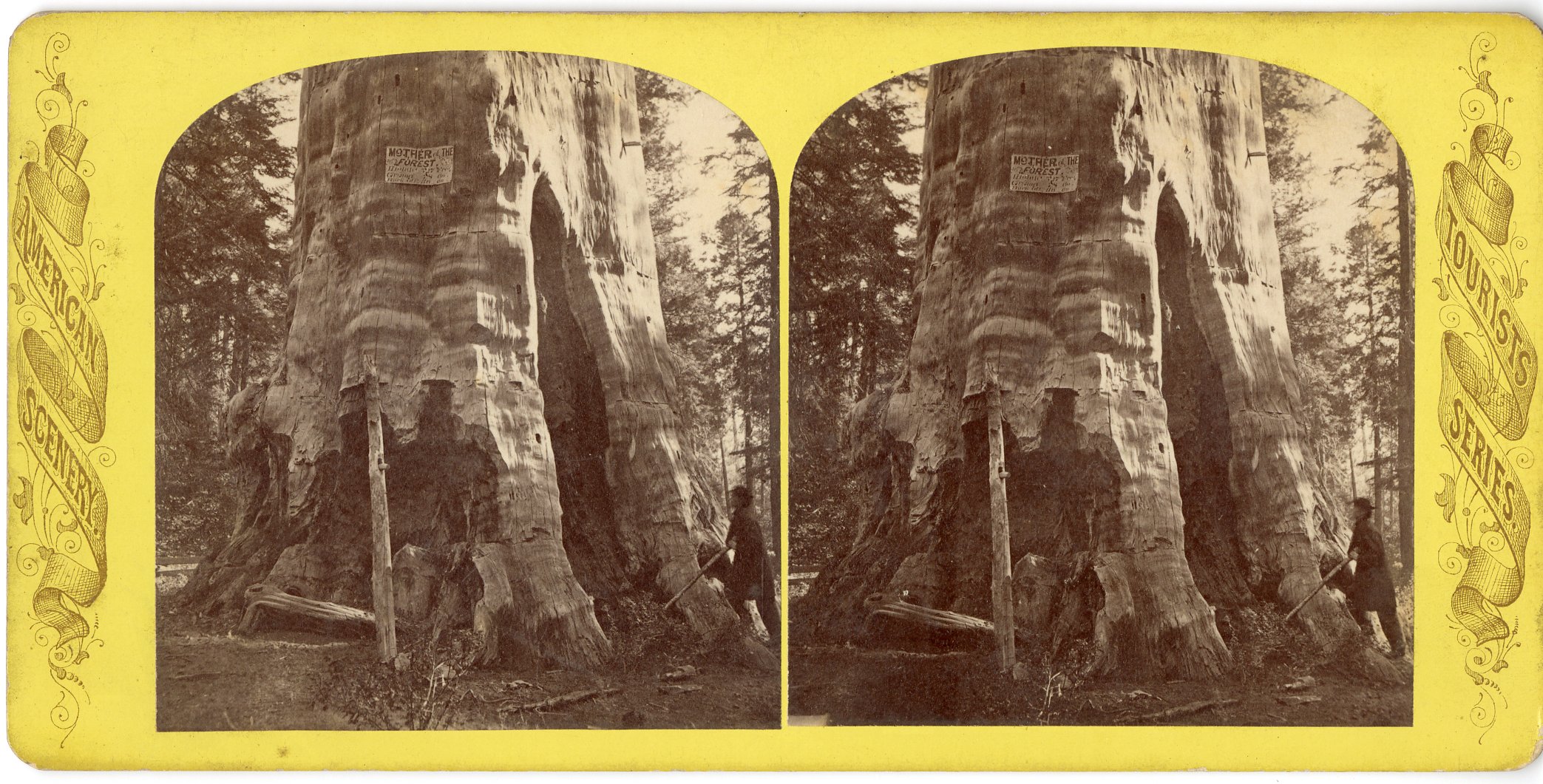
Two photographs mounted side by side on a yellow card showing a giant tree with a man at the bottom for scale.

This stereograph was included in an American Scenery Tourist Series, From the Atlantic Ocean to the Pacific Ocean. The list of stereographs in the series on the back of the card lists this one as number 59, “Mother of The Forest–Big Trees, California.”

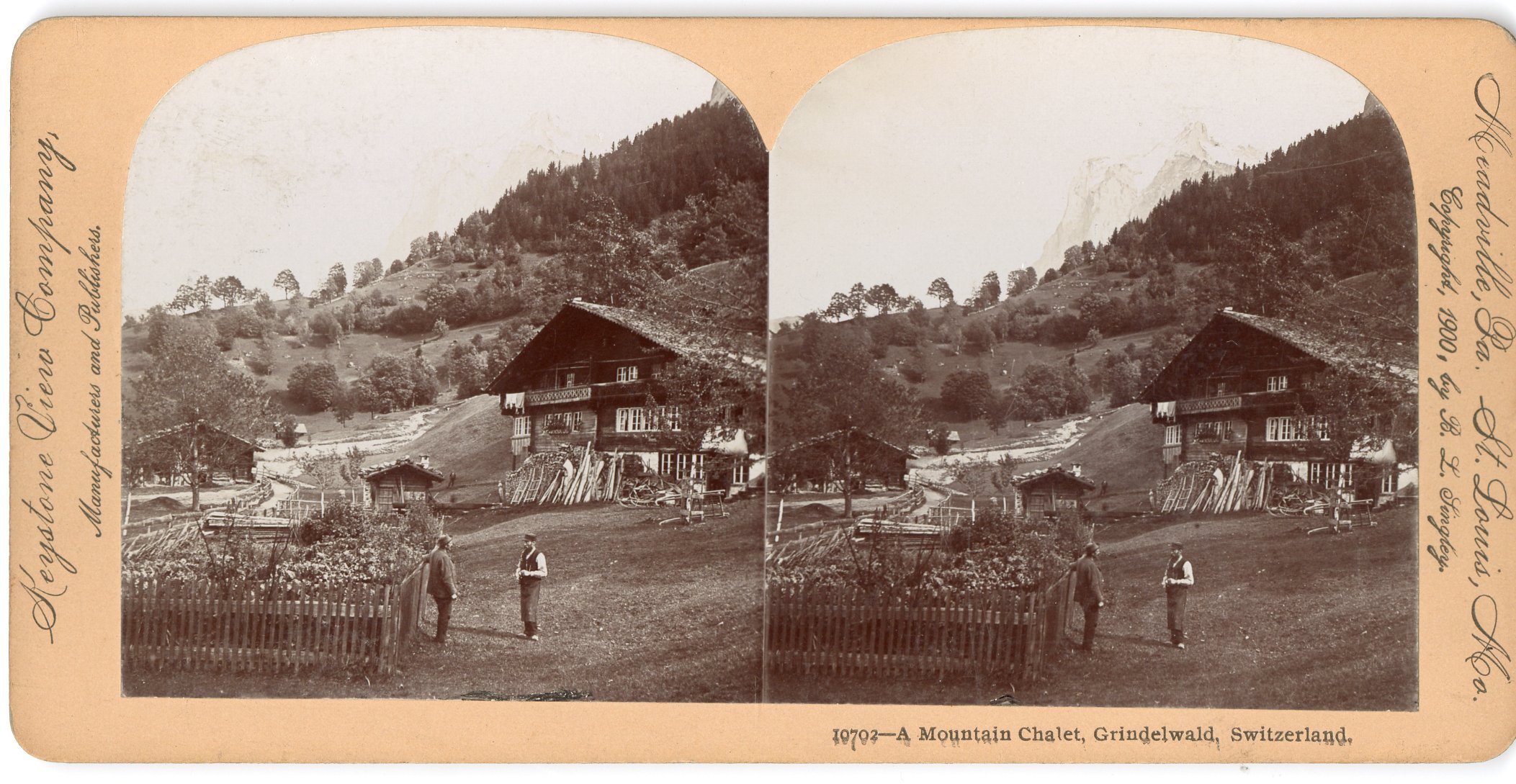
Two photographs mounted side by side on a tan card showing two men in front of an inn on the side of a hill.

Published by the Keystone View Company, this is one of many stereographs that introduced armchair travelers to distant places, in this case, a mountain chalet in Grindelwald, Switzerland.

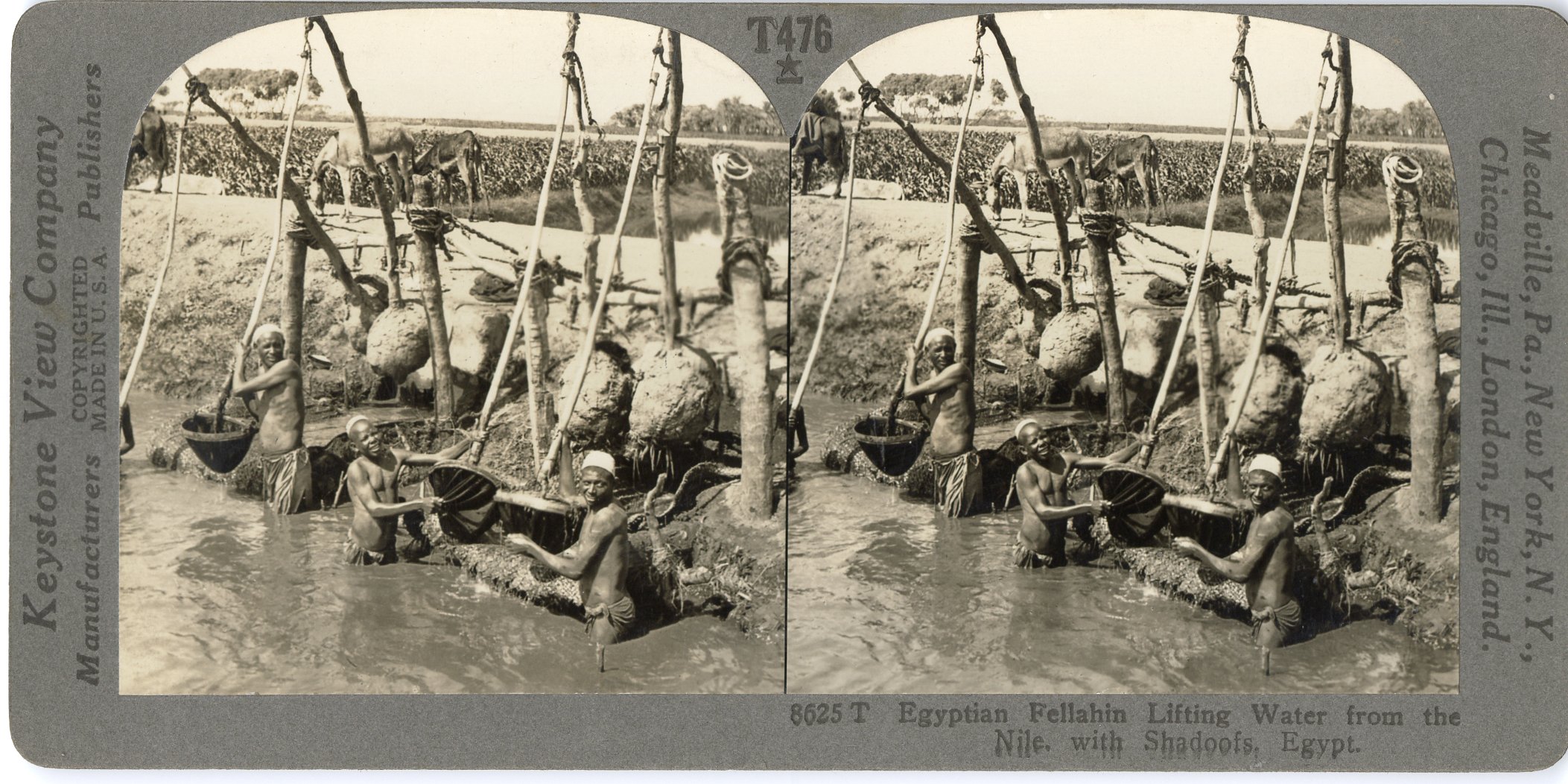
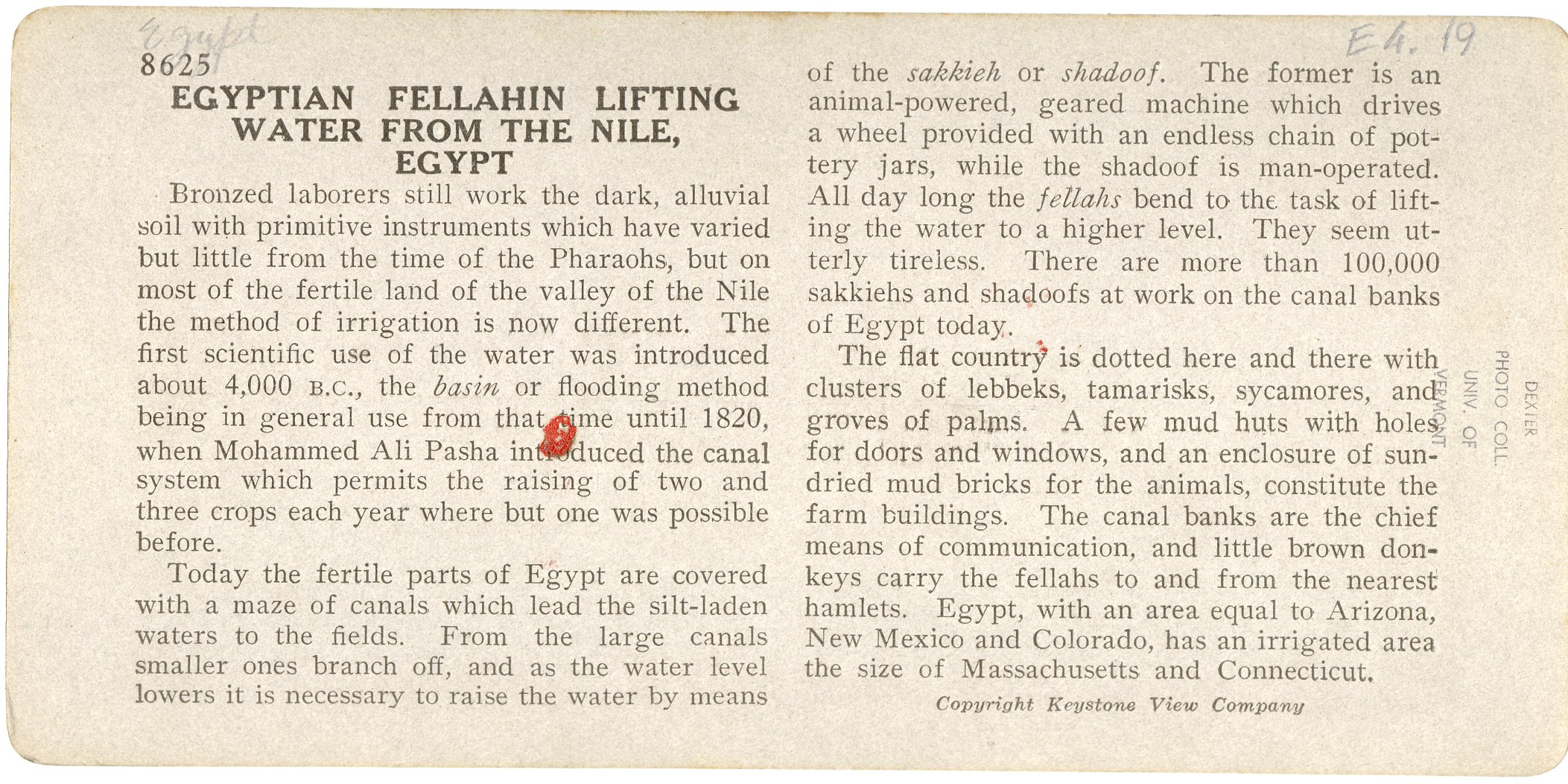
Two photographs mounted side by side on a gray card showing rural Egyptian farmers using well sweeps to lift water from the Nile River.

This  Keystone View Company stereograph shows rural Egyptian farmers using well sweeps to lift water from the Nile River for irrigating fields. Keystone specialized in stereograph sets for educators. The company provided extensive descriptions on the back of their thick cards and published curriculum units to help teachers use stereographs in their classrooms.

Two columns oft text on the back of a stereograph card describing the image on the front, titled Egyptian fellahin lifting water from the Nile, Egypt.

Stereographs were sold individually and in boxed sets. We have several complete and partial boxed sets, including these two published by the Keystone Viewing Company.

Two boxed sets of stereographs designed to look like the spines of leatherbound books. One is titled Tour of the World, the other is labeled Palestine.
Visit the Fleming Museum to see the “Art for Everyone” exhibition and visit Special Collections to browse the stereograph collections.

-Submitted by Prudence Doherty, Public Services Librarian
Posted in Photographs | Tagged , | Comments Off on Views of the World: Stereographs in Silver Special Collections

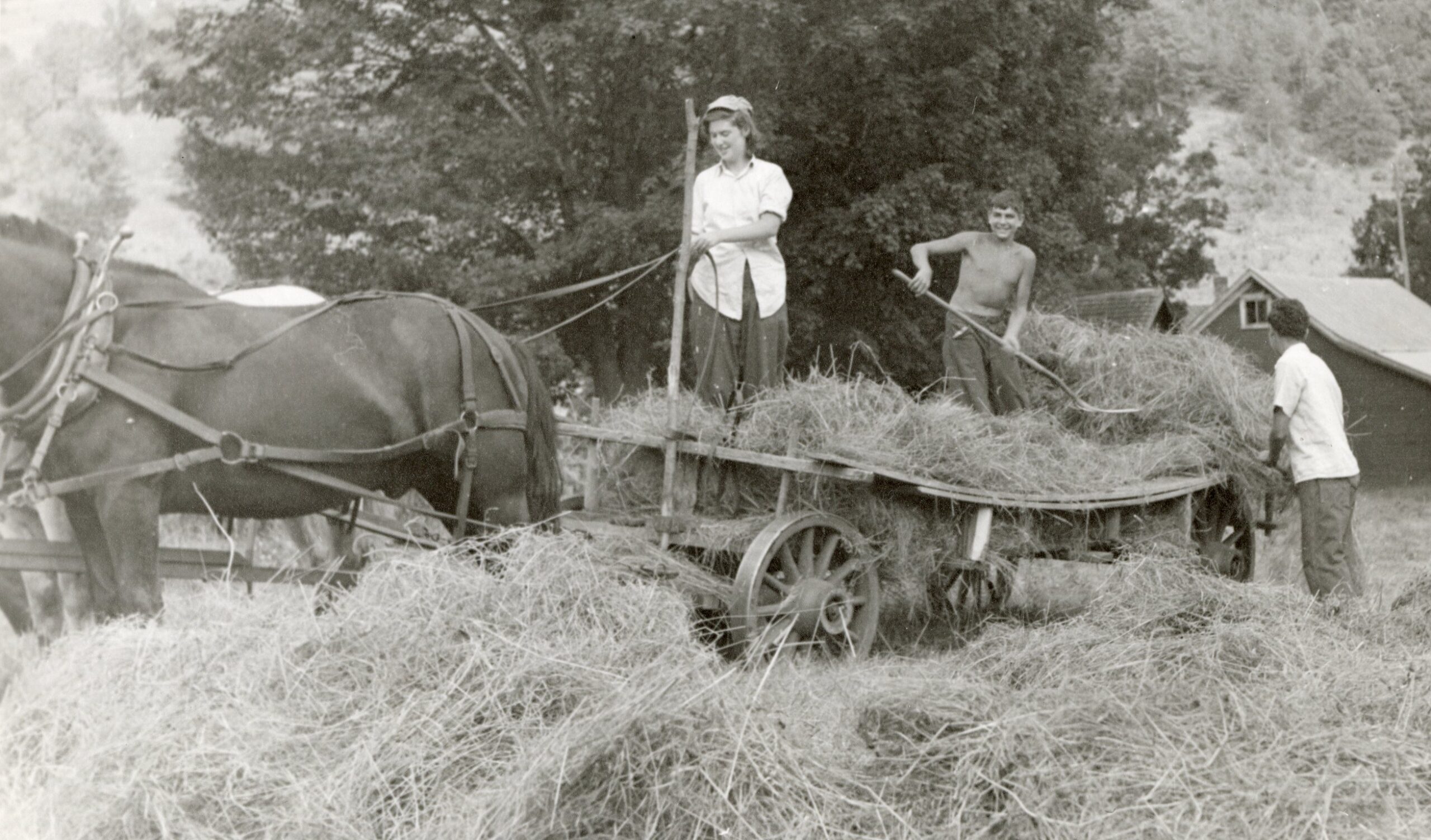
Harvesting Hay in the 1940s

Three youngsters loading a hay wagon drawn by horses.

Youngsters loading a hay wagon. Undated photograph by Mack Derick of Orleans, Vermont.

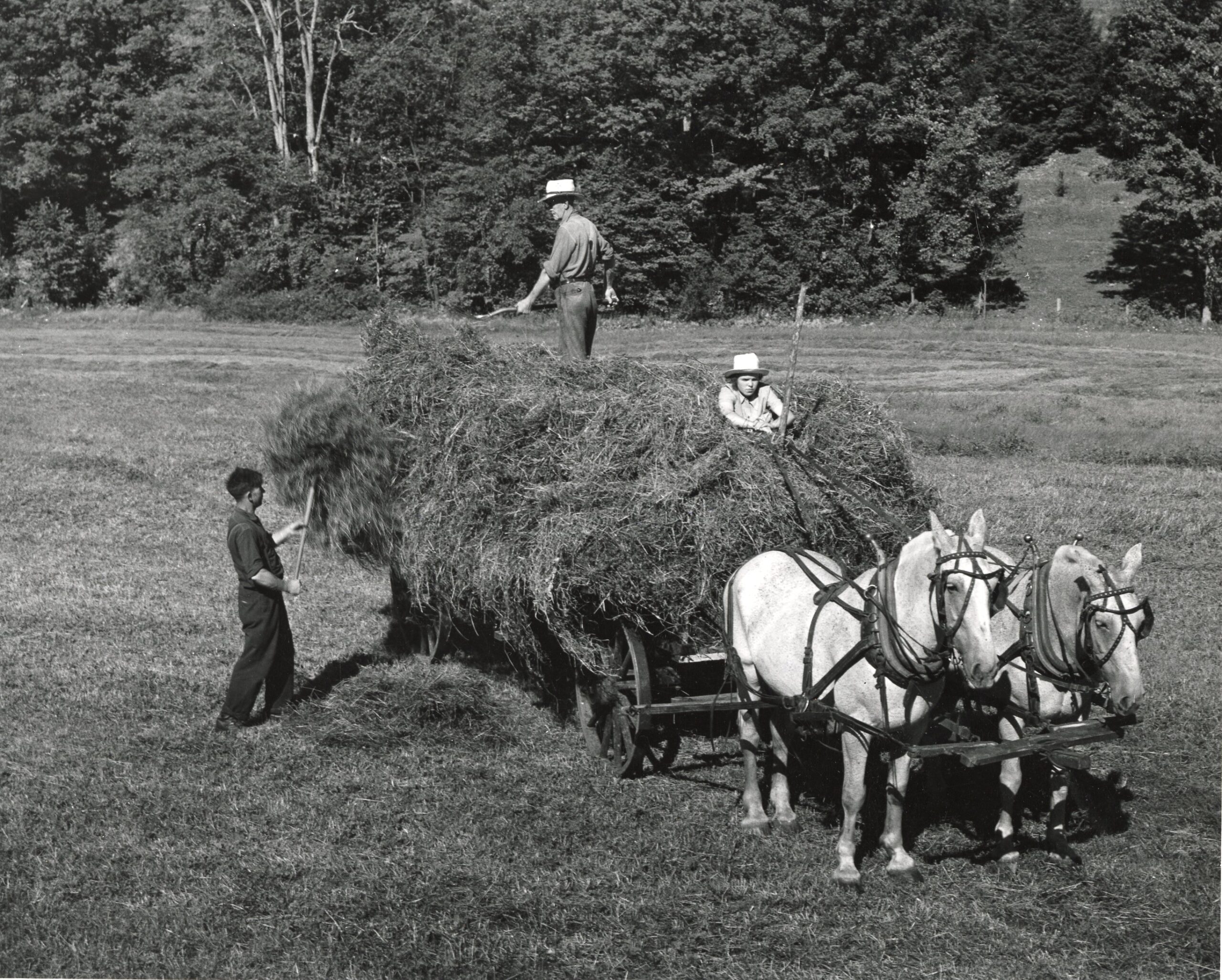
Hay has long been an important agricultural crop in Vermont. Our collection of University of Vermont Extension publicity photographs contains numerous images documenting hay harvesting practices during the middle of the twentieth century. We have little information about most of the photos, like the example above that only has a note recording the identity of the photographer. However, notes on the back of two sets that we included in a recent exhibit, “Working in Vermont,” provided clues that helped us track the stories behind the photographs.

Haying on the Nelson Farm

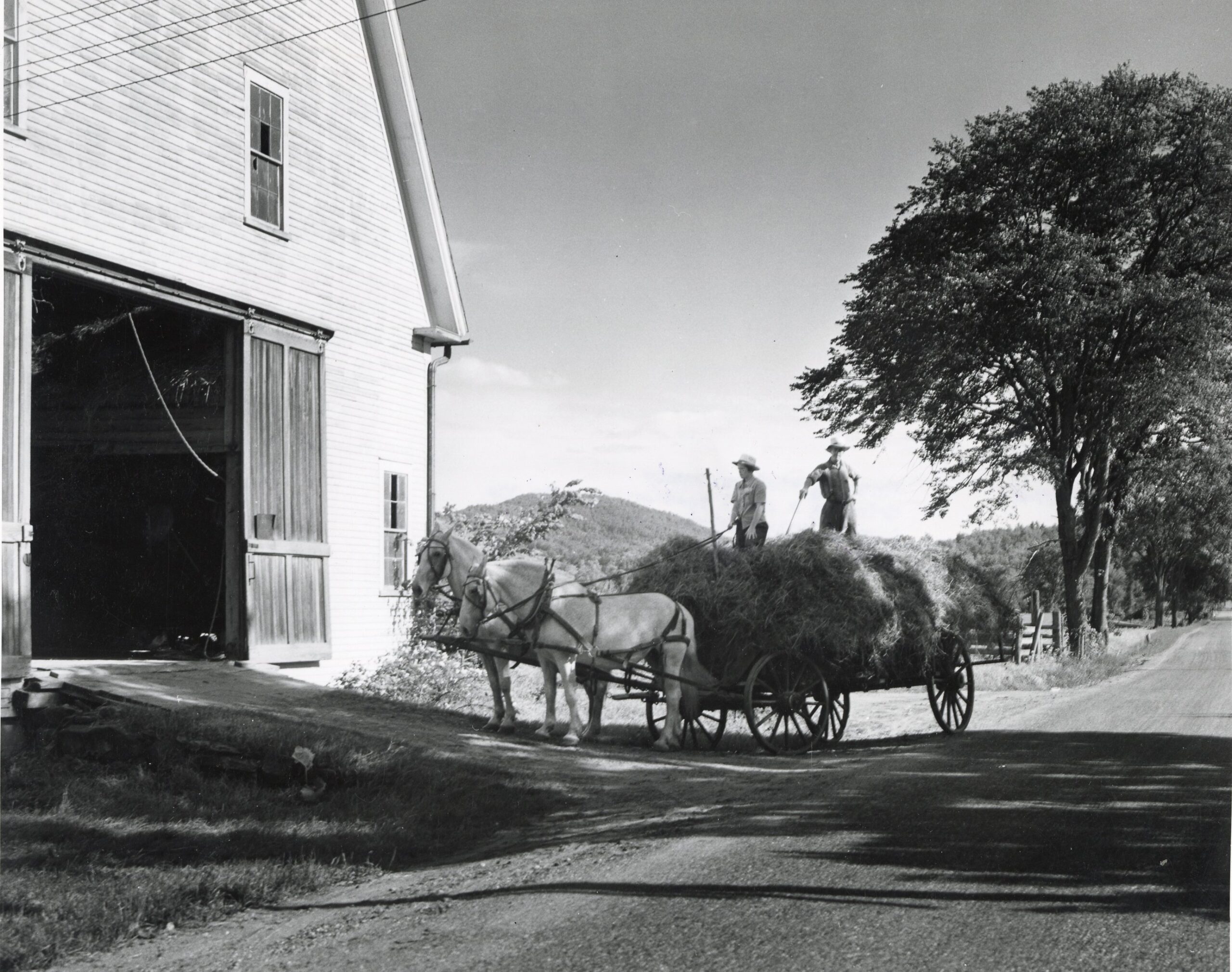
In August 1941, a photographer from the United States Department of Agriculture documented a hay harvest on the Miles Nelson farm in Woodstock. Three of these photos are in the UVM Extension collection. According to the Peace Field Farm website, the USDA conducted a photo study called “Vanishing Vermont” on the Nelson farm from 1941 to 1943. The photographer followed the farm crew as they harvested hay with horses at a time when many farmers were seeking to improve efficiency with tractors and other machinery. Nelson served as UVM Extension’s Windsor County agricultural agent from 1942-1947.

In a field, two men load hay on to a horse-drawn wagon driven by a young woman.

Farm workers, including hired man J. Hewitt on the wagon and Marjorie as teamster, load hay on the Miles Nelson farm in Woodstock, Vermont, August 1941.


A horse-drawn wagon carries hay into a barn.

Hewitt and Marjorie bring a small load of hay into the barn on the Nelson farm.

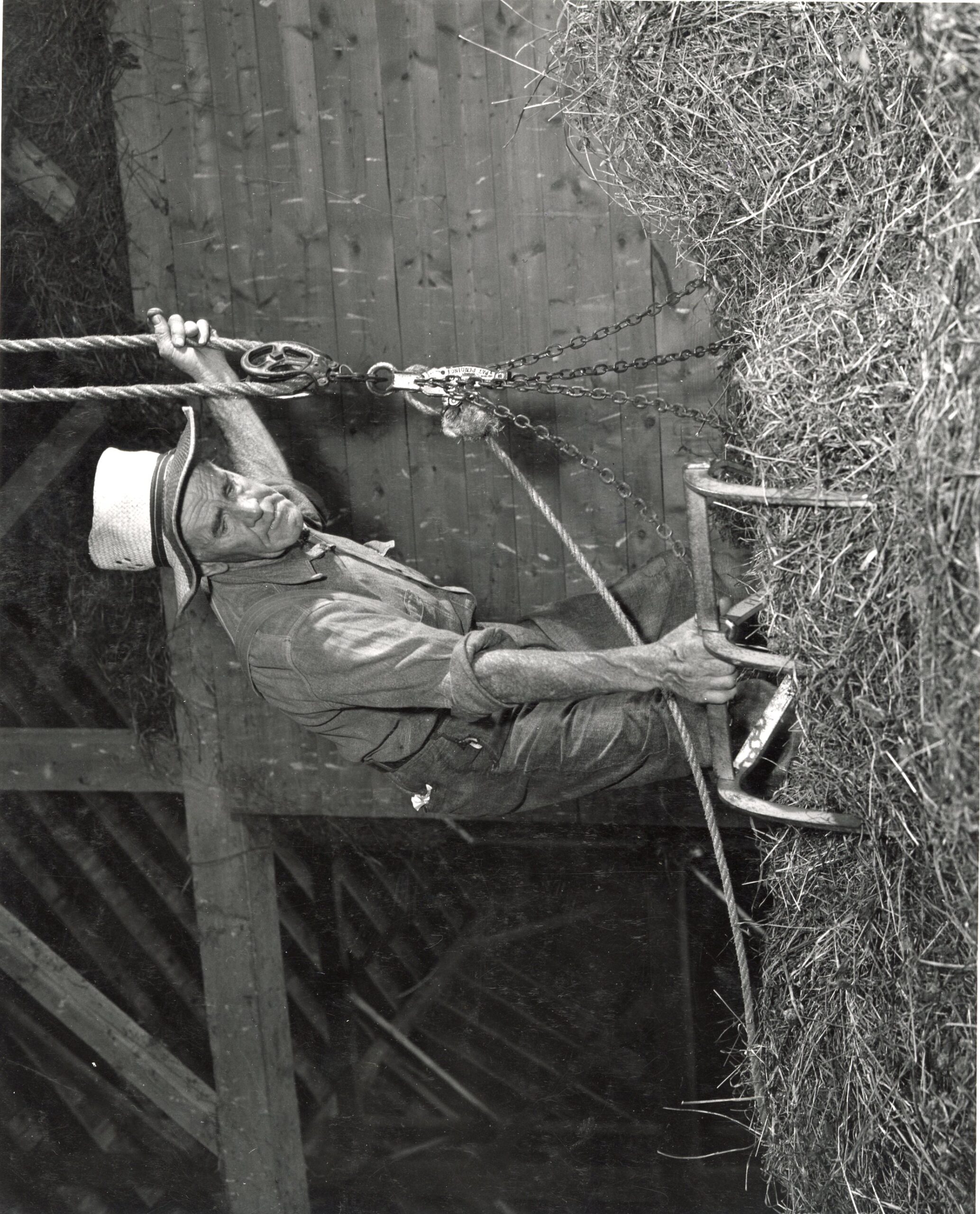
In a barn loft, a man with his hand on a rope pulley grabs hay with a horse fork.

Hewitt grabs hay with a horse fork, an innovation that allowed the farm to get more hay into the barn without adding more workers.

Volunteers on Vermont Farms

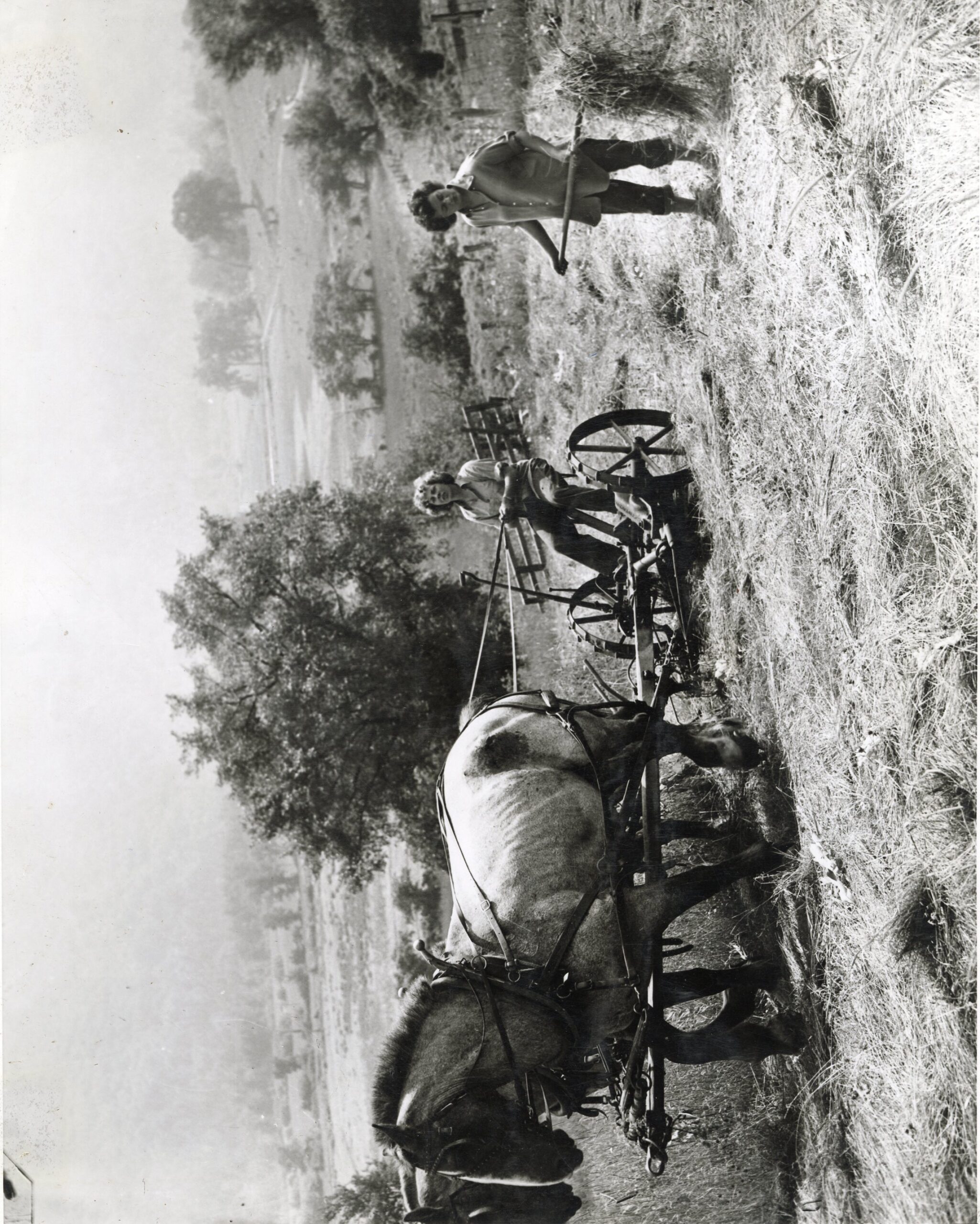
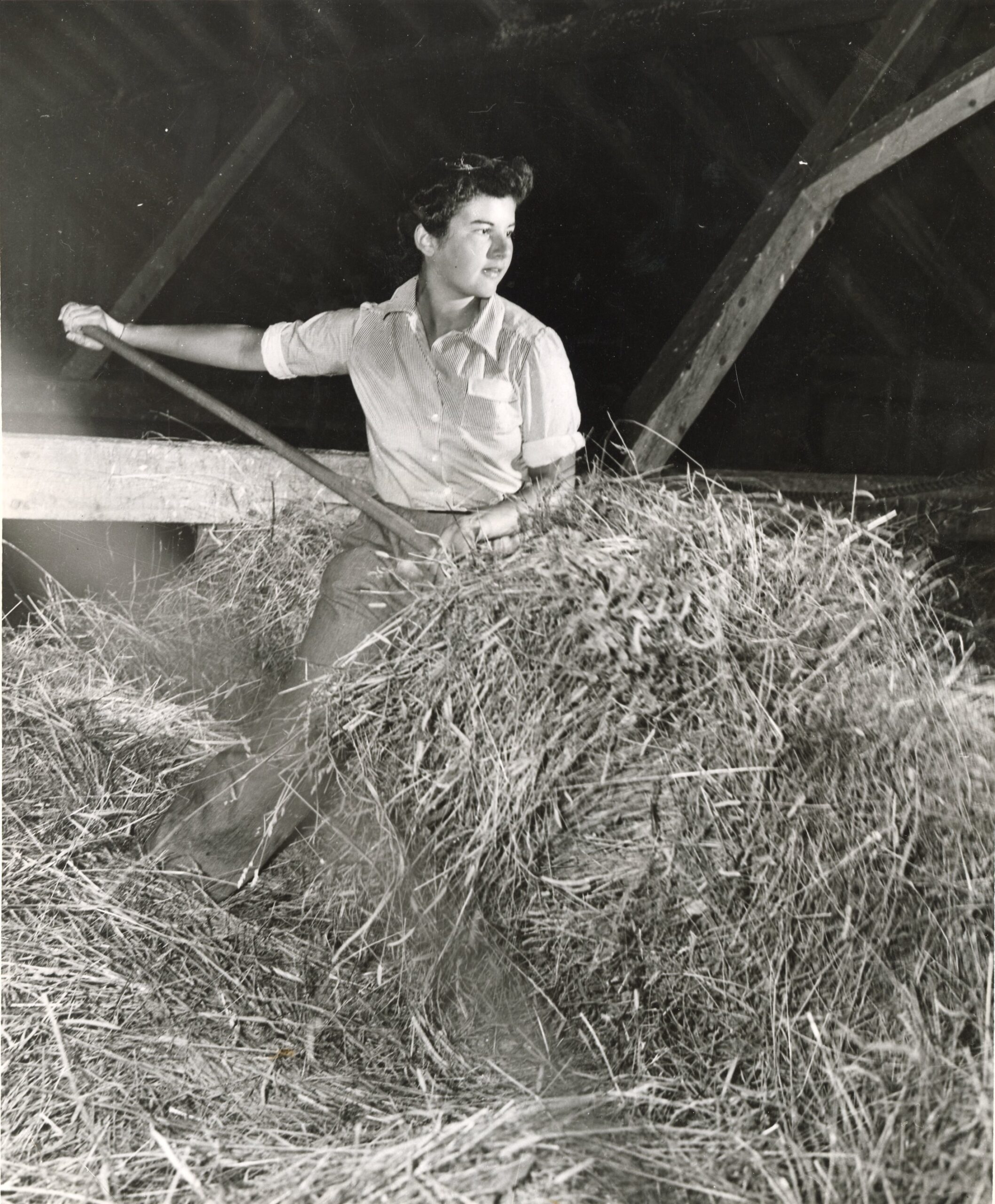
During World War II, when there was a serious shortage of farmhands in Vermont, members of the Volunteer Lands Corps (VLC) stepped up to help Vermont farmers. Two photos from the Extension collection that show women haying are credited to the New York Times. The photos were used to illustrate Vermont author Dorothy Canfield Fisher’s article about the first year of Vermont’s VLC program (“Youth at the Plow,” July 26, 1942). She wrote, “Hot, heavy and dusty work, in the barn and in the fields, that has to be done by somebody if cattle and horses are to be fed, falls to the lot of farm recruits.” These 1942 recruits included college students from urban areas. The volunteers received room, board and $21 per month to work for the summer.

In a field, a woman sits on a farm vehicle drawn by two horses, while another woman lifts cut hay.

Volunteer Land Corps members working in a recently cut hay field.

A woman lifts hay in a barn loft.

A Volunteer Land Corps member works with hay in a barn loft.

Learn more

Yale, Alan. While the Sun Shines: Making Hay in Vermont, 1789-1990. Montpelier, Vt.: Vermont Historical Society, 1991.

Root, Arthur. Report on the Volunteer Land Corps, summer 1942.

Hay Harvesting in the 1940s. Three films produced by the Vermont Agricultural Experiment Station show different hay harvesting techniques.

Submitted by Prudence Doherty, Public Services Librarian
Posted in Vermontiana | Tagged , , , , | Comments Off on Harvesting Hay in the 1940s

Burlington’s Women Ordnance Workers

For Women’s History Month, we are sharing photographs of women who worked at Bell Aircraft Corporation’s ordnance division in Burlington. To encourage women to join the industrial workforce during World War II, the War Department created a publicity campaign featuring a WOW, a woman ordnance worker. Newspapers from 1943 mention some Vermont women who traveled to work in ordnance plants in other parts of the country, but later that year, a munitions plant opened in Burlington and provided many women a chance to serve as WOWs near home.

In 1943, the Bell Aircraft Corporation of Buffalo, New York began negotiations to use Burlington’s old Queen City Cotton Mill on Lakeside Avenue as a new facility for their ordnance division. The Burlington Free Press reported in a May 3, 1943 article that it was one of the few factories of an appropriate size with a sufficient labor supply and that Bell anticipated hiring many women and planned to provide training for metal working.

Members of the local Chamber of Commerce, and especially William Loeb, the publisher of the Burlington Daily News, actively campaigned to bring Bell’s ordinance division to Burlington. On July 16, 1943, the Daily News proclaimed,  “This will give many of us an opportunity to make with our own hands and brains the weapons which we are defeating the Axis. The machinery which Burlington mothers and fathers will make here at Bell in many cases will be used by their Vermont sons in the smoke-filled turret of some Flying Fortress in mortal combat.”

Newspaper advertisement for jobs at Bell Aircraft, including a list of available positions.

Bell published this advertisement in newspapers around the state. Barre Daily Times, June 14, 1944.

Bell’s ordnance division started producing gun mounts at the Burlington facility quickly. The company finished installing equipment by the end of September 1943 and placed ads in newspapers around the state to solicit workers. By June 1944, they employed 2,400 men and women from 25 surrounding towns. Bell’s photograph division documented work at the Burlington plant. The photographs in our Bell Aircraft Ordnance Division Photographs collection demonstrate that women performed a range of jobs in offices and on the factory floor. We selected the photos below to create a mini album of Burlington’s women ordnance workers.  Except in one case, we used the descriptive labels recorded on the back of the photos.

In the Office

Woman dressed in a suit sits at a key punch machine.

Florence Roscoe at the key punch machine, 1944.

Woman in office attire is inserting cards into a machine.

Sue King working at the alphabetical accounting machine, 1944.

A woman holding large scissors stands at a machine ready to cut rolls of printed paper.

An unidentified woman is ready to cut copies of design plans.

In the Assembly Department

Men and women sitting at a work bench soldering.

Soldering on the electrical assembly bench, 1944.

A man and four women work on gum mounts on a long work bench.

Men and women workers prepare gun mounts in the assembly department, 1944.

Two women at an assembly bench work on machines.

Women preparing power mounts for shipment in the assembly department, 1944.

Men and women standing at long benches assemble gun mounts.

Men and women in the assembly department putting finishing touches on the gun mounts before shipping, 1944.

If you would like to see the Bell Aircraft Ordnance Division Photograph Collection, contact Special Collections by email at uvmsc@uvm.edu or call 802-656-2138 to make an appointment.

Submitted by Prudence Doherty, Public Services Librarian

Posted in Vermontiana | Tagged , , , , | Comments Off on Burlington’s Women Ordnance Workers

A Family Reunion: Correcting the Record, Expanding the Story

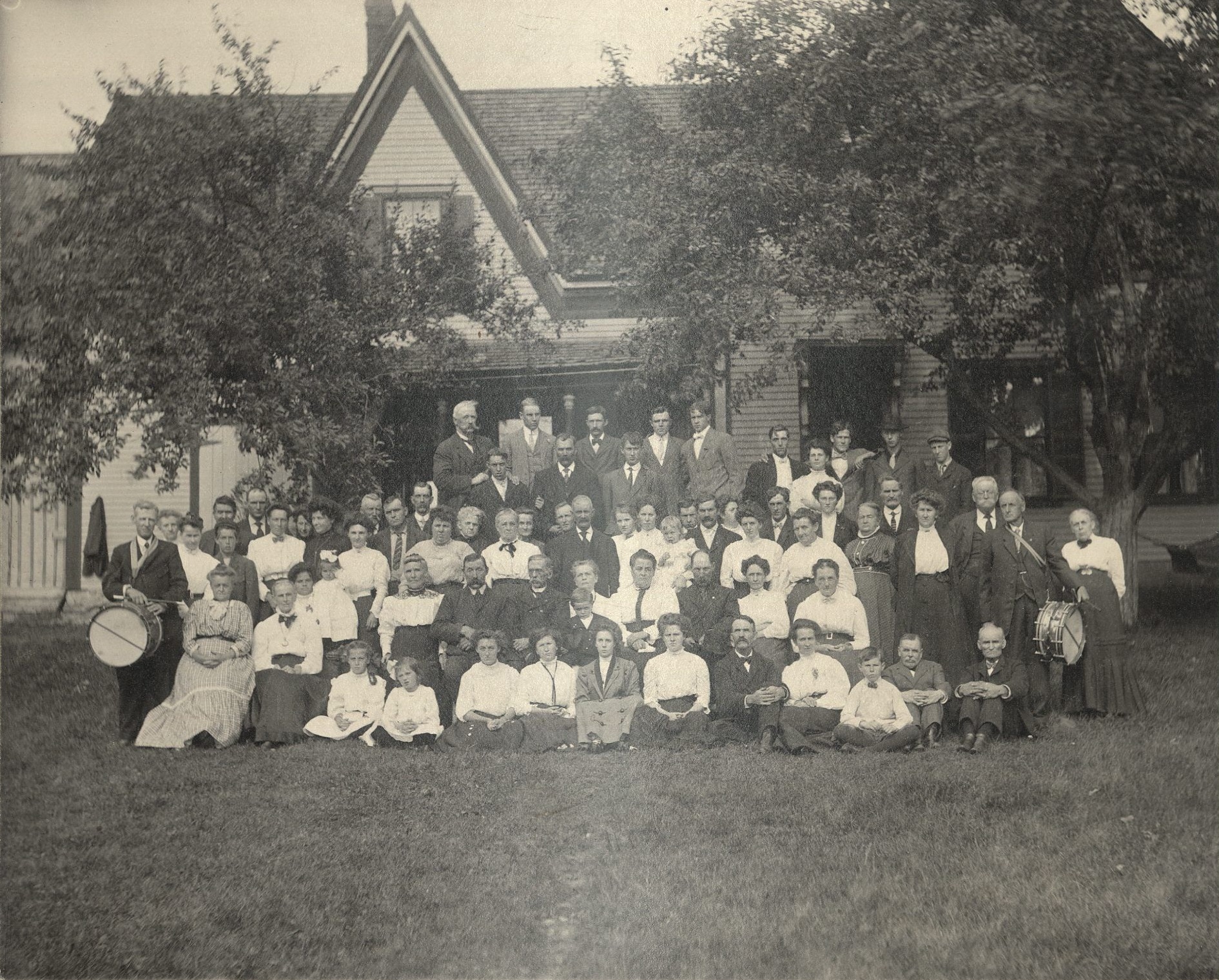
Large group of people of all ages seated and standing in the yard in front of a frame house.

The 1909 Grant Family Reunion, East Concord, Vermont.

Jeffrey M. Ranney recently contacted Special Collections to offer us a copy of his book, An American Journey: The Ranney Family of the Connecticut River Valley & Virginia, 1616-2022. The family, he wrote, had deep roots in Vermont. Checking our collection to see if we already had any resources related to the Ranney family, I found an oversize photo listed as “Ranney Family Reunion, Kirby, Vermont.”

I wrote Mr. Ranney to say we would be glad to accept his family history and attached a digital copy of the photograph. In response, Mr. Ranney generously sent us the 2-volume set. Just as important, he shared information that tells the story behind the photograph and allowed us to correct the description in our finding aid. 

Special Collections archivists based our description on information written on the photo’s cardboard mount. In the upper right front corner, a note in pencil reads, “Ranney Kirby VT.” On the back, Minnie E. Ranney’s name appears on the top left and in the center, possibly written by the same person. A note at the top, probably written at a different time, explains “this was taken at John McDonalds.” A third note, added more recently by a seller, includes the location (Kirby, VT) and a price (4.00).

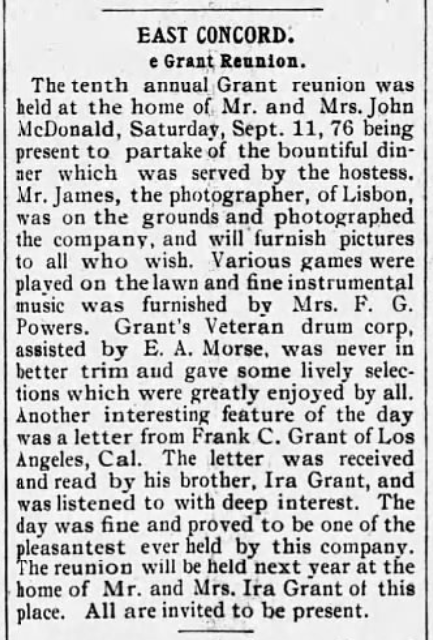
Mr. Ranney’s research revealed that the photograph was actually taken at the 10th Annual Grant Family reunion, held on September 11, 1909 at the John McDonald home in East Concord, Vermont. On Sept. 15, 1909, the St. Johnsbury Caledonian reported that 76 people attended the event, which included a bountiful dinner, lawn games and music. The Grant Family reunion was held for at least 67 years, from 1899-1966.

Minnie E. Ranney was likely the owner of the reunion photograph now in Special Collections. Minnie was born to Robert and Eliza Isham in 1866 and became a member of the Grant family when her mother married John W. Grant in 1876. John McDonald, the host of the 1909 reunion, married John Grant’s niece, Lillian Powers. Mr. Ranney found numerous articles in local papers reporting that Minnie and her husband Pliny Ranney, who lived in Kirby, Vermont, frequently attended Grant family gatherings and visited members of the extended Grant family. Mr. Ranney was unable to spot either Minnie or Pliny in our 1909 photo.

When I sent the photo to Mr. Ranney, I pointed out the drummers sitting on each side of the group. He replied that drumming was a Grant family tradition. Brothers John and Ira Grant had been drummers in the 11th Vermont Regiment during the Civil War. Ira was recognized as one of the best drummers in Vermont, and John passed on his passion for drum music to seven sons. Mr. Ranney reports that the Grant Drum Corps formed around 1900 and performed at local fairs, carnivals, parades, football games and family celebrations at least until 1962. He was not able to identify the snare drummer (left) or the bass drummer (right).

Newspaper clipping describing the Grant family reunion in 1909.

According to the report about the reunion in the St. Johnsbury Caledonian, “Grant’s veteran drum corp … was never in better trim and gave some lively selections which were greatly enjoyed by all.”

Thanks to Mr. Ranney for allowing us to share the results of his research.

Submitted by Prudence Doherty, Public Services Librarian
Posted in Vermontiana | Tagged , , , , | Comments Off on A Family Reunion: Correcting the Record, Expanding the Story

The Poor Farm Garden 1947-1953

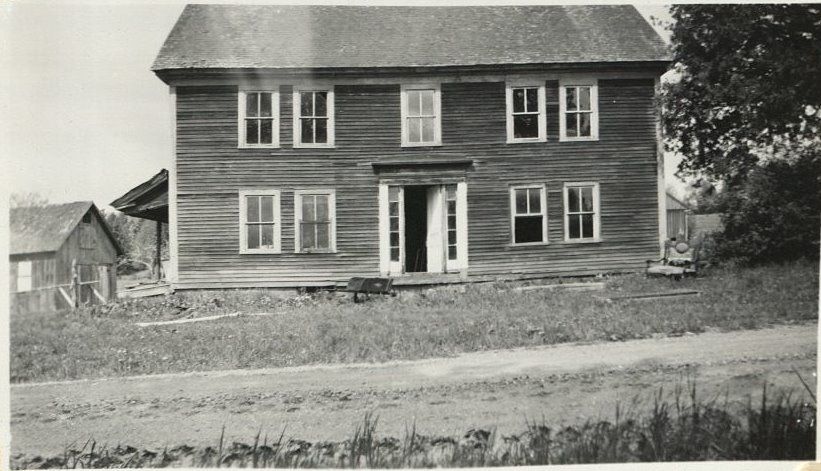
In the fall of 1946, Robert F. Stoel (who later changed his last name to Stowell) joined the University of Vermont English department as an instructor. In June 1947, Stowell purchased 18 tillable acres with buildings and a spring on Old West Road near Kent’s Corners in Calais, Vermont. The property had once been part of the Calais Town Farm, also known as the Calais Poor Farm. Stowell used a blank notebook to record work and life on his Poor Farm from 1947 to 1953. The notebook is one of the many diaries and journals in our small bound manuscript collection.

Two-story unpainted farmhouse on a dirt road with outbuildings visible in the background.

Stowell’s Poor Farm house in June 1947.

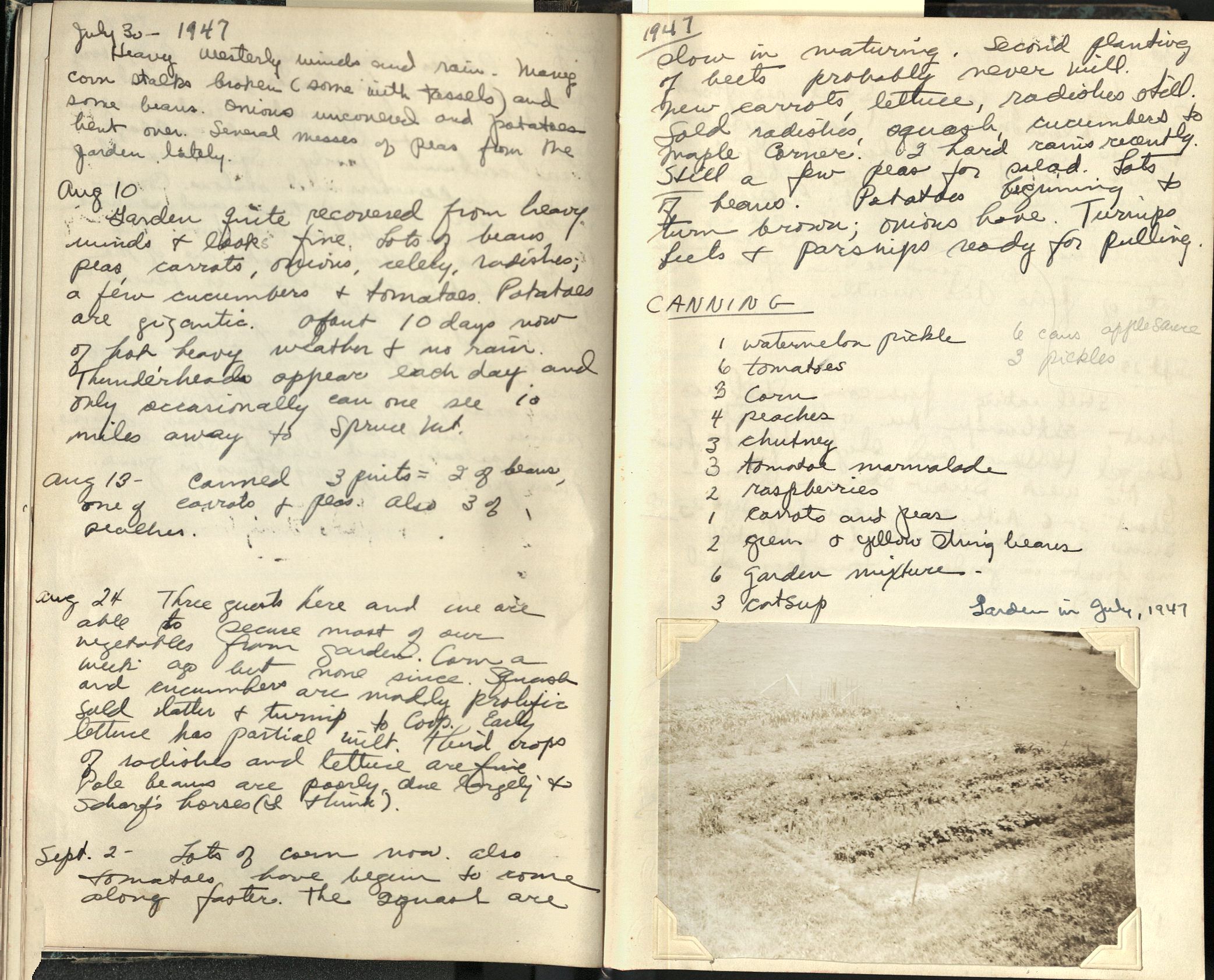
Stowell and his wife Ann were committed to simple living and voluntary poverty, and in Calais, that meant growing as much of their own food as possible. Most of the journal is devoted to records of planting successes and failures, garden meals, and harvesting and putting food by for the winter, as the entries on the two pages below demonstrate.

Two handwritten journal pages with July and August entries about garden progress, a list of vegetables and fruits canned, and a photo of the garden.

Summer 1947 journal entries. Click on the image to enlarge.

On July 30, 1947, Stowell recorded that wind and rain broke the corn stalks and some beans, and on August 10, that there had been ten days of hot heavy weather and no rain. The garden flourished nonetheless, with lots of beans, peas, carrots, onions, celery, radishes, cucumbers, tomatoes and gigantic potatoes. The bounty provided dinner for visitors, root crops and canned fruits and vegetables for the winter months, and surplus squash, cucumbers and turnips to sell.

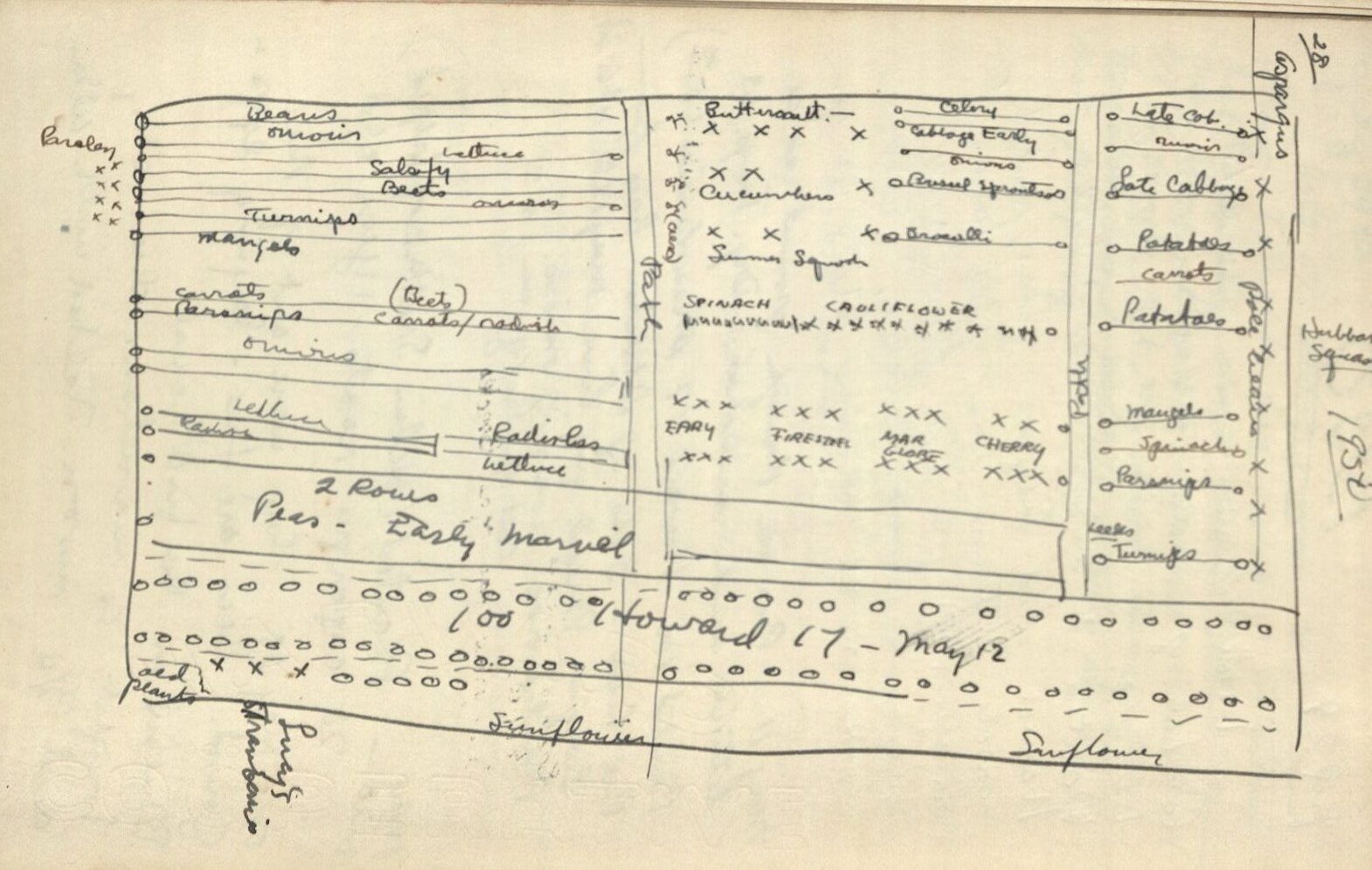
Each season, Stowell drew plans recording what crops were planted in the garden. The plan for the 1950 garden includes some information about specific varieties. A large area was devoted to Early Marvel peas, and the tomato section included Firestone, Marglobe (disease resistant and good for canning) and cherry tomatoes.

Hand-drawn plan of a vegetable garden, showing where different vegetables were planted.

Plan of the 1950 garden. Click on the image to enlarge.

A handwritten journal entry dated April 1953 with a list of crops remaining in storage bins, and notes about digging leeks and parsnips and planting horseradish.Stowell planted Red Delicious and Yellow Transparent apple trees during his second gardening season in Calais, suggesting a long-term commitment to the property. However, the garden records end abruptly with an entry in April 1953. The Stowells sold the Poor Farm in July 1953, and by 1954 the family was farming land in the nearby town of Cabot.

A brief article in the October 1948 issue of American Notes & Queries announced that Robert Stowell, operator of the Poor Farm Press in Calais, Vermont had plans to print “a number of booklets on country living and cooperative communities. Some of these are to be concerned with subsistence farming, combining both philosophy and practical advice.”

Although Stowell did not print the booklets as planned, the Calais Poor Farm garden and journal  contributed to his book Toward Simple Living: A Theory and Practice of Voluntary Poverty (first published by the Solitarian Press in Hartland, Vermont in 1953 and reprinted in 1955), where he wrote about the potential benefits of vegetable gardens.

A garden in good soil measuring one hundred by one hundred feet will supply a family of four with all their vegetables for a year. A farm of from five to twenty acres of fairly good land can, with hard work and intelligent husbandry, supply simple living to a small family. A man growing food, concerned that his life be in good heart, is participating in the life process itself.

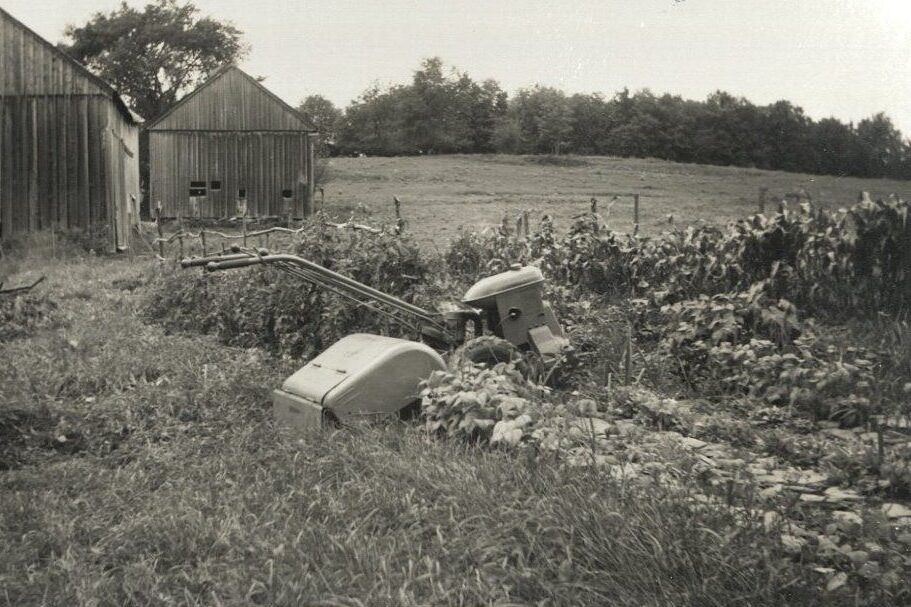
An undated garden photo tucked into the journal features a garden tractor. In Toward Simple Living, Stowell shared his thoughts about the tractor, writing “A garden tractor once seemed necessary to my happiness. Within days I was its slave, hauled about by it, harassed by its constant demands for attention (gas, oil, air, parts).”

Stowell, Ann and their two children moved to New Zealand in 1961. Writing from New Zealand, Stowell told readers of the October 1967 issue of Green Revolution, an Ohio newsletter for homesteaders, on-to-the-landers and do-it yourselfers, “We are writing a book, Green Mountain Homestead … about finding and developing a self-sufficient homestead on an abandoned farm in Vermont” and shared one of the chapters, A Lady Named Jess.

Submitted by Prudence Doherty, Public Services Librarian

Posted in Manuscript Collection | Tagged , , , , , , , | Comments Off on The Poor Farm Garden 1947-1953

Ovid and the Istrian Skies

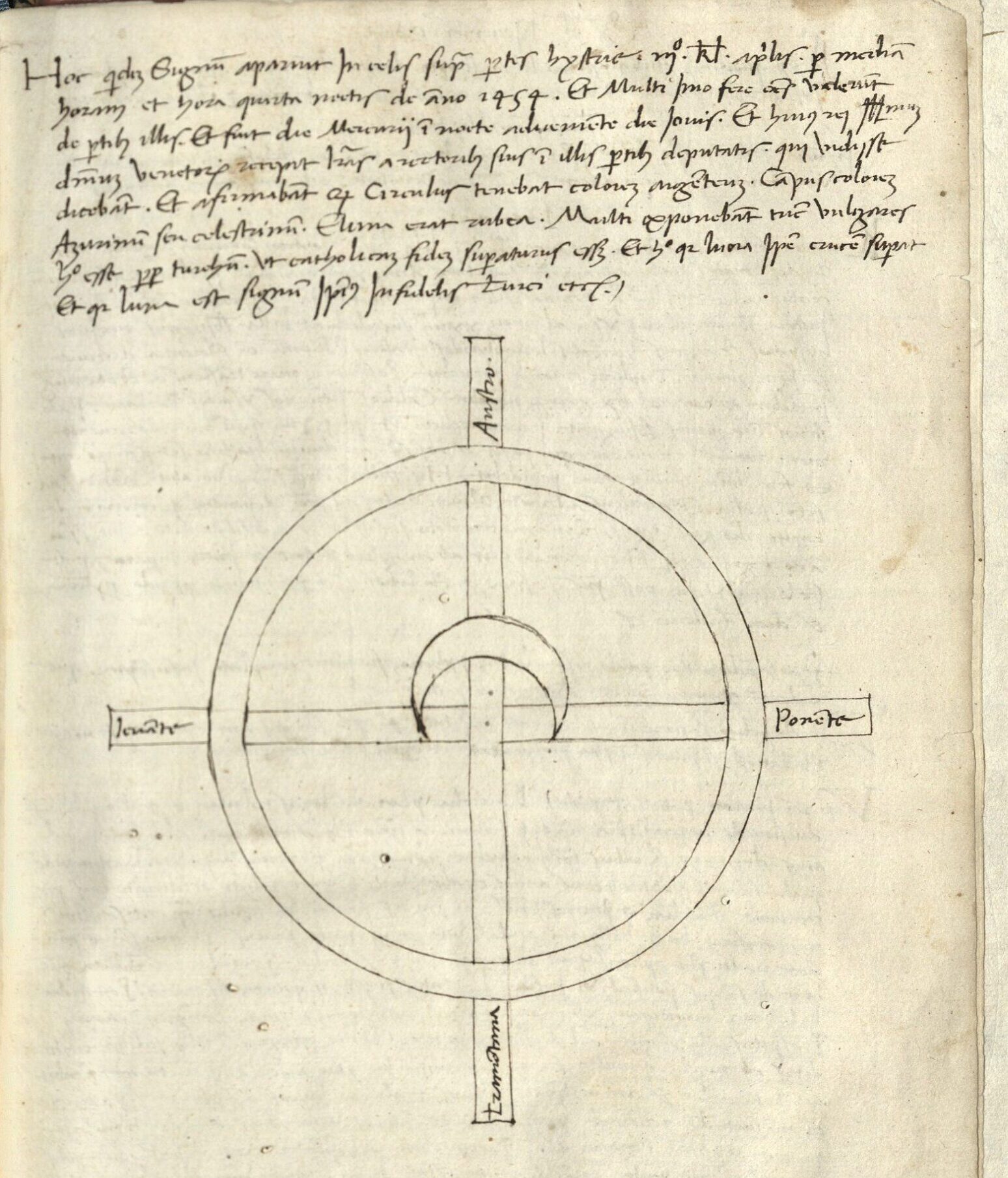
Bound into the back of our 1497/98 printed edition of the works of Ovid is a four-page manuscript that offers an intriguing sidelight to our current focus on eclipses. The dense Latin script is difficult to read, so we asked our friends Daniel Williman and Karen Corsano if they could translate it for us. Their initial results—to be updated in this blog when completed—indicate that at least part of the manuscript, including a hand-drawn illustration, concerns an unusual pattern of light that was observed in the sky above Istria on the night of March 30, 1454. (Istria lies directly across the Adriatic Sea from Venice and was part of the Venetian Republic in the 15th century.)

The illustration accompanying the text on the first page of the manuscript shows a circle spanned by two bars that form a cross, with a crescent moon near the middle. At the ends of the arms of the cross are written the four cardinal directions as they were referred to when viewing the heavens, or to the directions of the wind: Austro (south), Ponente (west), Tramontana (north), and Levante (east). A great many people, “indeed almost all in those parts” according to the text, observed this circle and cross of silver against an azure sky with a red quarter-moon near its middle at about 11 p.m. that night.

Eight lines of handwritten Latin text above a drawing of a circle imposed on a cross with a crescent shape in the middle.To many, the text continues, the unexplained appearance of a cross dominated by a red crescent moon was a foreboding sign of the threat posed by the Islamic empire of the Ottoman Turks, to whom the moon was an important symbol. Less than a year before, the Turks had captured Constantinople, the last vestige of the Byzantine Empire and the most significant Christian capital in the East. In fact, a week before the fall of Constantinople on May 30, 1453, a similar red crescent moon had appeared above the doomed city—the coincidental result of a partial lunar eclipse.

Could the celestial phenomenon observed in Istria have been a lunar eclipse? Scientists can determine with great precision when eclipses occurred in the past, and none was visible in this part of Europe on March 30, 1454. However, a lunar eclipse did occur on May 12 of that year. Perhaps the writer of the manuscript was mistaken about the date of the phenomenon.

The manuscript itself was likely written no later than the early 16th century. Whether it was originally bound with the book is unclear: its red Morocco binding was probably made in England sometime in the 18th century, so the manuscript could have been added at that time. It seems more likely, though, that the book and manuscript had been together for much longer. The only tentatively-identified owner of the Ovid prior to its appearance in England was Battista Peretti (1536?-1611), a Veronese church official, historian, and book collector.

Please check back for updates as we learn more about this mysterious manuscript. Many thanks to Daniel Williman and Karen Corsano for their translation help!

Contributed by Jeffrey Marshall, Professor Emeritus, Silver Special Collections

Posted in Rare Books | Tagged , , , , , | Comments Off on Ovid and the Istrian Skies

College Memory Books, for Keepers of Keepsakes

On October 22, 1921, UVM student Dorothy Mayo Harvey typed a long letter to “family adorable, and adored.” She reported on her campus activities and included a paragraph about her search for a college memory book.

I have a new desire—for a college memory book. They are very attractive, and the kind such as Hazel has have good stout covers, and will stand a good deal of wear. I saw some beauties at McCauliffe’s (never can spell that name, ‘scuse please?) this morning, but the one which I liked the best was bound in tan ooze leather, was much smaller than Hazel’s, and Mabel told me this noon that Linda Clark had one of that kind and it didn’t wear very well, not hold enough. Beside—it cost almost twice as much as Hazel’s, seven-fifty as compared to four dollars. Florence Farr, a nice Pi Phi Senior, is agent for “Hazel’s kind” here, and I should like to get one of her anyway, so that is one extravagance which you may be prepared to hear that I have committed.

Like many of her classmates, Dorothy purchased a memory book similar to those advertised in the Burlington Free Press and the Vermont Cynic. The UVM Archives holds a good collection of the dark green alumni memory books. This fall, students and staff worked with four memory books from the 1920s, including Mayo’s “extravagance.” The covers sport the UVM seal in gold and are customized with the student’s name and year and in some cases, their fraternity or sorority.

Dark green cover of Mollie Newton's memory book bearing a gold UVM seal and laced with a yellow cord.Title page of a memory book. "The National Memory and Fellowship Book" printed against a background of stars with images of an eagle, a ship and the Statue of Liberty in the corners, and a name plate for Dorothy May Harvey at bottom right.The books were published by the College Memory Book Co. As advertised, they included features to help the “keepers of keepsakes” organize their memory books. Students could fill pages with preprinted headings and spaces for notes and memorabilia, including lists of friends, songs and yells, notable students, campus athletic records, clubs and societies, professors, school and social functions, trips and more. Lois Burbank (class of 1927) filled the “Student Hall of Fame” page in her book with photos of men’s athletic teams, while Fannie Peirce (class of 1924) selected photos of women students.

Memory book page titled "Student Hall of Fame" with photographs of University of Vermont athletes.

Page from Lois Burbank’s memory book.

Students attached a wide variety of memorabilia to blank pages as they created records of their time at UVM, capturing both personal experiences and experiences they shared with the members of the campus community. Recording friends to remember was important. In addition to gathering information on one of the preprinted pages, students attached photos of friends to blank pages, like the page below from Fannie Peirce’s book. Fannie labeled the photos with names, dates and captions. “On a picnic-1921” is straightforward, but we can only wonder at the circumstances that prompted “Oh my curlers.”

Top section of a handwritten list of friends, with dates, addresses, personal information and some handdrawn portraits.

Friends list from Dorothy Mayo Harvey’s memory book.

Photographs of friends, mostly young women, pasted on a memory book page with descriptive notes about events, names and dates.

Page from Fannie Peirce’s scrapbook. To read the captions, click on the photo to see a larger version.

Students saved all sorts of ephemeral items and arranged them on the blank pages. Molly Newton (class of 1924) pasted items she collected during her first year on a page near the front of her book, including a football schedule, the constitution and bylaws of the Women’s Student Union, a season ticket for athletic events, and her certificate of membership in the Young Women’s Christian Association.

Printed ephemera pasted on a memory book page.

Page from Mollie Newton’s memory book.

Students seemed to have filled the pages as they accumulated memorabilia. The page below, from Lois Burbank’s book, includes a wide variety of items, including a dance ticket, a Valentine card, a list of prayer meeting topics, and the results of a room inspection (“your room is neat but the floor needs a bit of sweeping”). Some items would benefit from explanation, especially the poison label and the bull’s-eye dated Nov. 5, 1923.

Memorabilia and ephemera pasted to a page from a memory book, including a dance tocket, a valentine, a candy label, a bull's eye, and a list of prayer topics.

Page from Lois Burbank’s memory book.

Although memory books and scrapbooks are challenging to preserve and challenging to read–the brittle loose leaf pages are difficult to turn, mementos often are no longer stuck to the pages, and letters and cards carefully attached in envelopes are hard to extract–they provide a unique and personal record of a student’s UVM experience. Student memory books and other scrapbooks are part of the Alumni Papers (Record Group 81). Dorothy Mayo Harvey’s letter is included in the Alumni Relations Files (Record Group 75). Email Special Collections at uvmsc@uvm.edu if you would like a closer look.

Submitted by Prudence Doherty, Public Services Librarian
Posted in Archives, University Archives, Vermontiana | Tagged , , , | Comments Off on College Memory Books, for Keepers of Keepsakes