Entry #1
Thursday June 22nd, 2023
Lake Quannapowitt
It is Tuesday, June 22nd, at 16:30 and the weather is sunny, warm, and breezy at 70 degrees F.
Description:
This site is a shoreline location on Lake Quannapowitt in Wakefield, Massachusetts. The area is defined by flat grassy open area/field until you come to the shoreline where there is a variety of plant life growing along the water’s edge. The water itself is a murky, brownish-green color is undulates with small waves from the wind. The plant life along the shore is mostly composed of what looks to be various ferns, trees (lots of birch), tall grasses, and other brush. On the surface of the water is many hundreds of lily pads, some with bloomed water lilies and many with buds that have not yet blossomed. These occupy large amounts of area on the surface of the lake. There is a large tree that shades much of the green space around this area of the shoreline. A bench is beneath the tre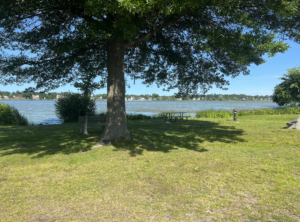 e and there is also a small picnic table close to the shoreline. The area beneath the tree, where it is shady, is significantly cooler than the sunny places in this area and there is a subtly strong breeze coming off of the water which makes being in the shade chilly. The ground beneath the bench is worn away from being grassy to being a pile of muddy dirt, most likely from the frequent rainfall in the area. Different species of bird are seen frequently here as well, I could identify Robins, Geese, as well as House Sparrows but there were also other species I did not know. In the flat grassy areas, there are also many places on the ground where rock is visible. It could likely be large rocks that are stuck underneath the ground and only the top is showing.
Questions:
What species of tree shades the area? What brush species exist along the shoreline? What species of insects exist here? What species of bird exist here? How did this lake come to be? How old is this lake? Are there people that come here to maintain the grass? What species of fish live in this lake? Are any of these plant species invasive? Which of these plant species are native to the area? Where have the sediments under my feet come from? Has there ever been a glacier in this area? Is there any glacial till underneath the ground? What sediments could be found at the bottom of the lake? Was this area ever underwater in its history? What geological processes shaped this area? Are there any currents in the water? How deep is the deepest point of the lake? What is the elevation of this area in regards to sea level? Why are there so many geese at this lake/area? Do the geese migrate here every year? Why are there buoys in the lake? Is this are fertile for growing plants/crops? How was this lake created? Is there any type of conservation going on in this area?
How Was This Lake Created?
Lake Quannapowitt was created as a result of a large ice sheet, the Laurentide, that covered New England about 22,000 to 14,000 years ago[1]. As this glacial ice sheet retreated, it left a depression which then became Lake Quannapowitt. It is also thought that that around 8,000 years ago, after the retreat of the ice sheet, that Lake Quannapowitt was a part of a much larger lake system. This is also indicated by the presence of present day marsh lands in surrounding areas which were likely large, shallow lakes 8,000 years ago[2]. Depressions created by the retreat of the Laurentide ice sheet, which is how Lake Quannapowitt came to be, are known as kettle ponds[3]. These depressions were formed as a result of ice blocks detaching from the glacier creating a depression and then melting which fills the depression with water, often forming a lake or other body of water[4].
Sources:
[1]“Our Icy Past.” Mass Audubon – Your Great Outdoors, 7 Jan. 2014, blogs.massaudubon.org/yourgreatoutdoors/our-icy-past/#:~:text=The%20Time%20of%20the%20Glaciers&text=Continent%2Dwide%20glaciers%20are%20called,right%20down%20to%20the%20bedrock.
[2]Wakefieldhistory. “The First Settlers.” Wakefield Historical Society, 22 Sept. 2020, wakefieldhistory.org/2020/09/22/the-first-settlers/.
[3]Admin. “Glacial History of the North Shore / Northeastern Massachusetts.” North Shore Nature, 18 Apr. 2022, northshorenature.com/north-shore-shoreline-13000-to-12000-years-ago/#:~:text=Glacial%20Retreat&text=By%2016%2C000%20or%2017%2C000%20years,of%20Massachusetts%20was%20ice%2Dfree.
[4]“Kettles (U.S. National Park Service).” National Parks Service, 28 Feb. 2018, www.nps.gov/articles/kettles.htm#:~:text=Kettles%20form%20when%20a%20block,pond%20or%20lake%E2%80%94a%20kettle.
Conclusion:
Prior to visiting this shoreline spot on Lake Quannapowitt, I had been here before. However, before today, and writing this entry, I had never really thought about the area too much. Nor did I ever really look into specific questions in regards to the area, history, and surrounding wildlife. Doing this entry has definitely piqued my curiosity for this place and I hope I can continue to ask question and learn more with future entries. The variety of wildlife, specifically plant species, caught my attention while visiting today and I definitely look forward to follow up with this next time during future visits.
Posted by UVM Enterprise Technology Services on June 22, 2023 at 7:49 pm
Hi, this is a comment.
To get started with moderating, editing, and deleting comments, please visit the Comments screen in the dashboard.
Commenter avatars come from Gravatar.