Part 1:
Tuesday, June 25th 2024 at 11:28 pm. The weather is 84 degrees Fahrenheit and sunny at the moment. It is fairly humid with a very light, occasional breeze.
Part 2:
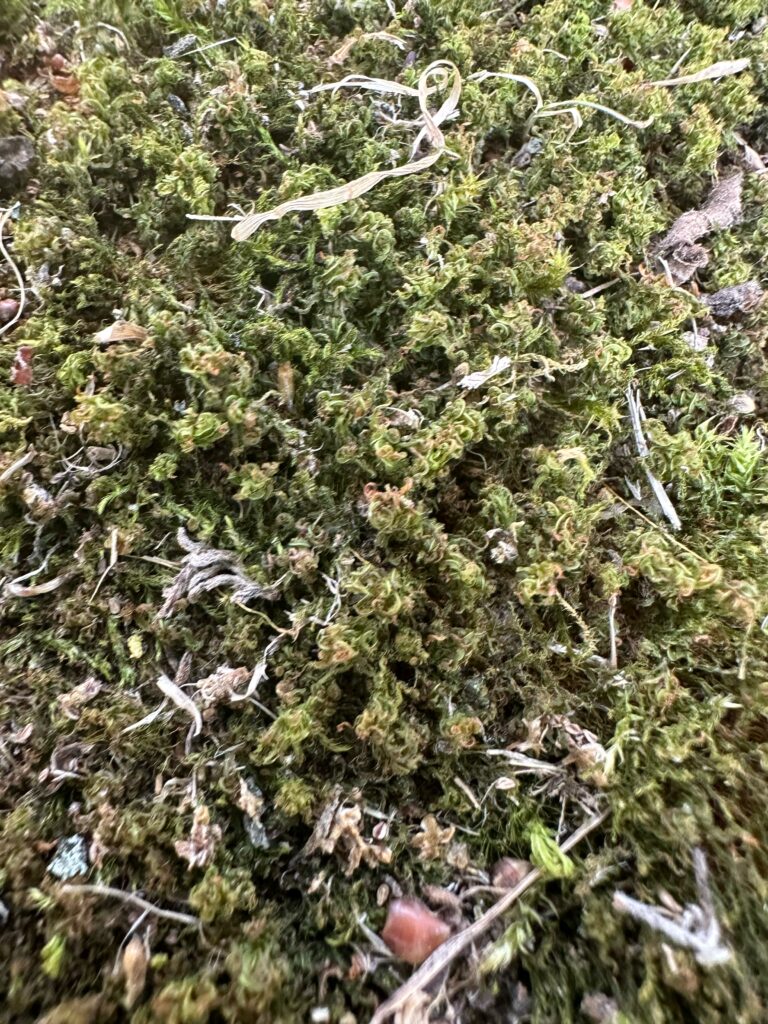
For this portion, I identified a patch of moss which I believe to be Smoothcap dry moss (naturalist.org, 2024), looking at inaturalist.org’s “NJ Moss notes”. This moss patch was growing underneath a tree, and must’ve been about less than a foot long. The moss was a dark shade of green with some bits of yellow in it as well. It was very dry to the touch, almost resembling the texture of artificial turf grass on a sports field. It also appeared to grow in small twisted strands that seemed to cluster together at their base. Some parts grew in more straight and it made me wonder why that could be. As I studied the area longer, I thought it was interesting that the grass nearby was growing in at full force and very thick up until where the base of the tree was emerging from the ground. Where the tree base started, the grass became sparse, and in this thin, dead patch of limp grass right by the tree base, the moss patch sat. The moss seemed to be a sort of barrier between the fuller grass and the dead grass by the tree base. I noticed small black insects occasionally flying or crawling over the patch of moss. A part of this moss cluster was growing over a rock fragment, which I found fascinating.
Part 3:
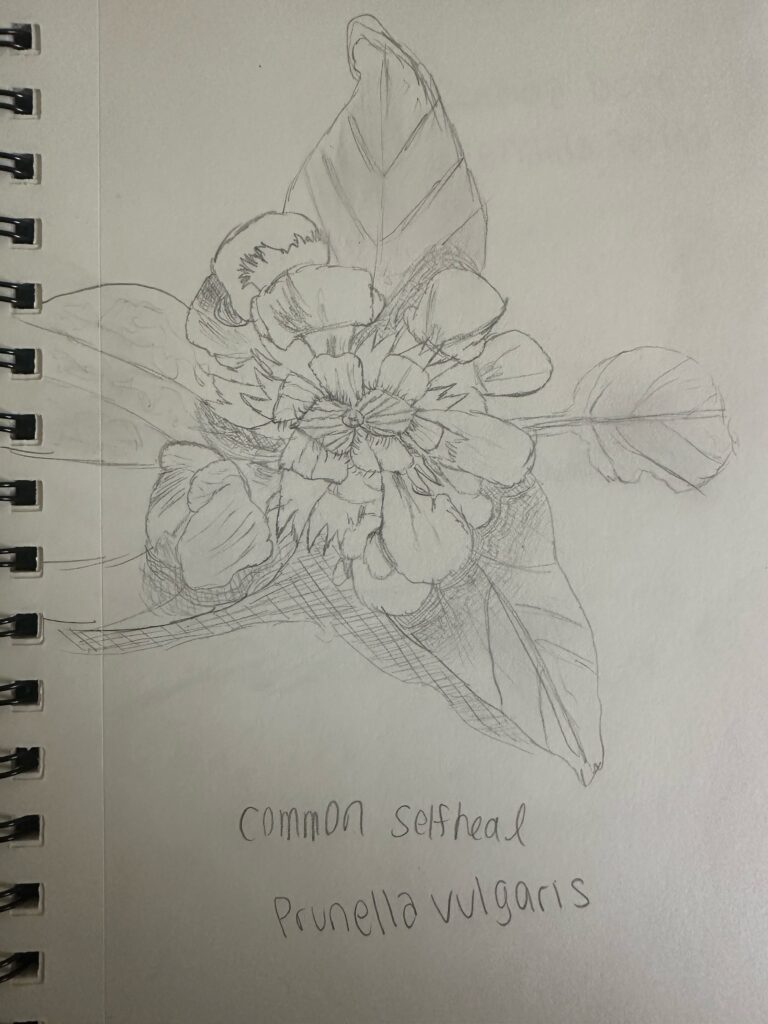
One species I identified that I had not otherwise been familiar with was the Common Selfheal. I noticed a small purple flower in the grass that I had not seen during my previous trip, so I decided to check it out more closely. I used the Seek app to identify the plant, which turned out to be a Common Selfheal, or Prunella vulgaris. I took a close-up picture to help me see the details better, and I sketched it. This was a very intricate flower with several different colored layers. It had a green inner layer, a maroon middle layer, and purple outer petals. A fascinating fact that I researched about the Common Selfheal was that it is a medicinal herb, and has the ability to lower blood pressure and combat tumors (USDA, 2011).
Part 4: Sketches
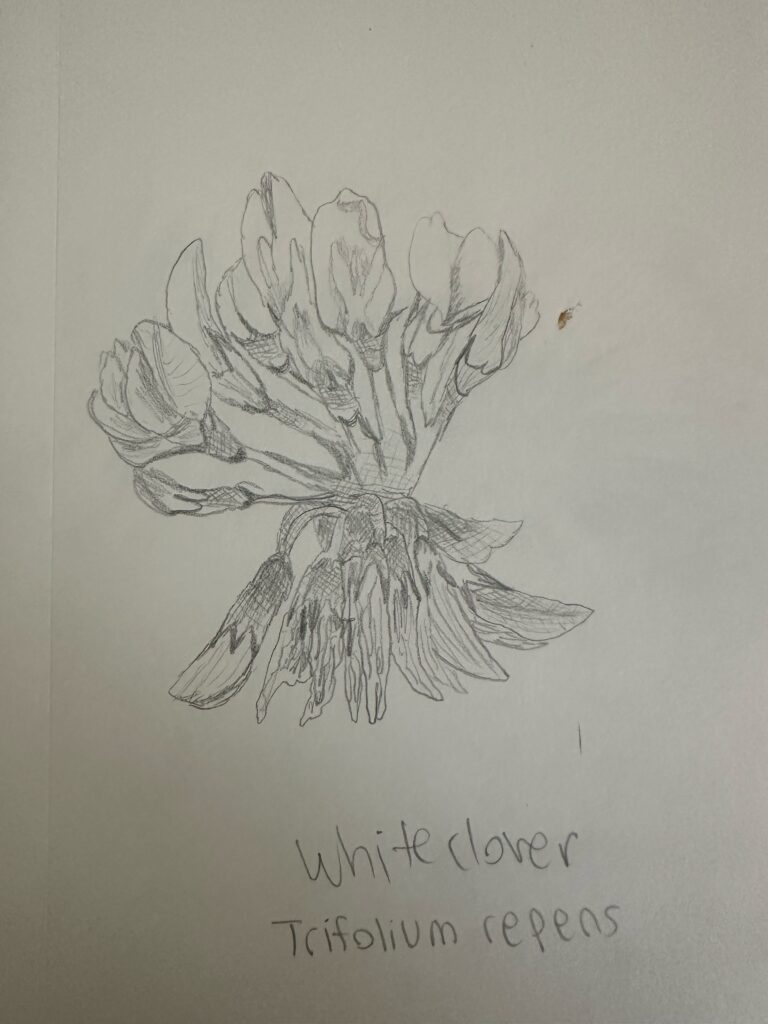
White Clover (Trifolium Repens): I chose to sketch this plant because it is very common at Anderson Park, and always attracts bees, which I enjoyed. While I sketched this object I got to watch pollination, so that was part of the reason I chose it. It is also one of the first plants that I learned about in Herbalism club, so it is special to me in that way.
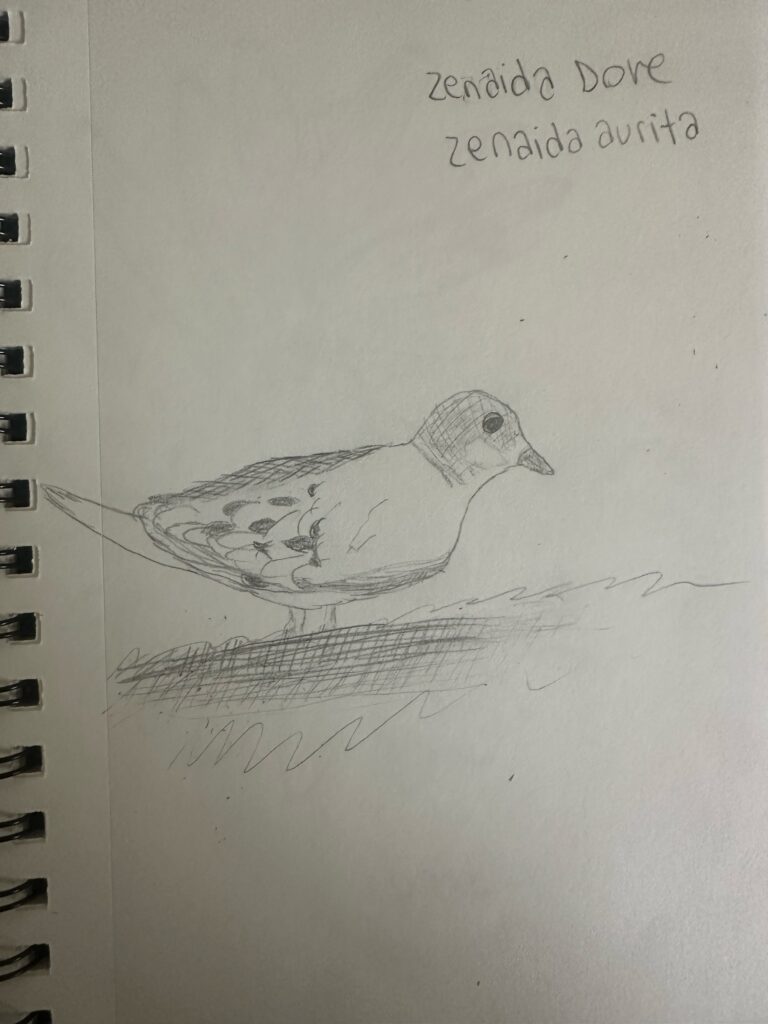
Zenaida Dove (Zenaida aurita): I chose to sketch this bird, because I thought it was a mourning dove and I was very excited since I love their song. I also wanted to sketch a variety of wildlife, and thought it would be nice to include an animal in my sketches as well as plant species.
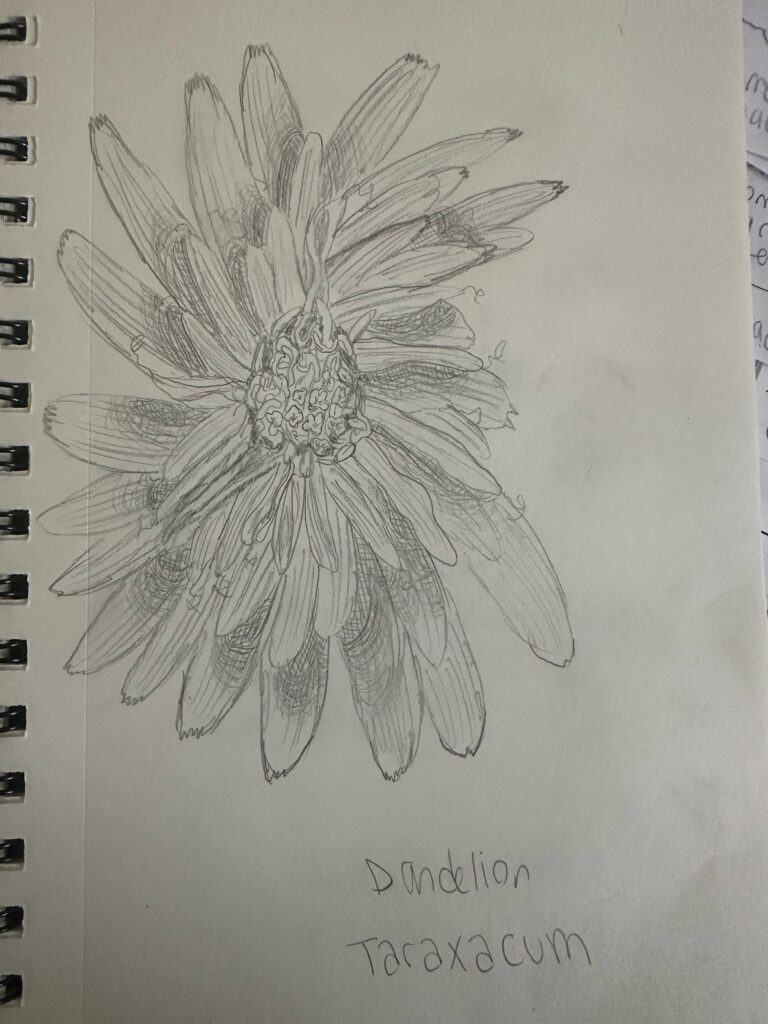
Dandelion (Taraxacum): I chose to sketch this plant because when I see dandelions, I always think of how they are seen as weeds and pests, but they are medicinal and so useful to pollinators. I think that dandelions should be more appreciated so I wanted to choose a dandelion that I found to sketch.
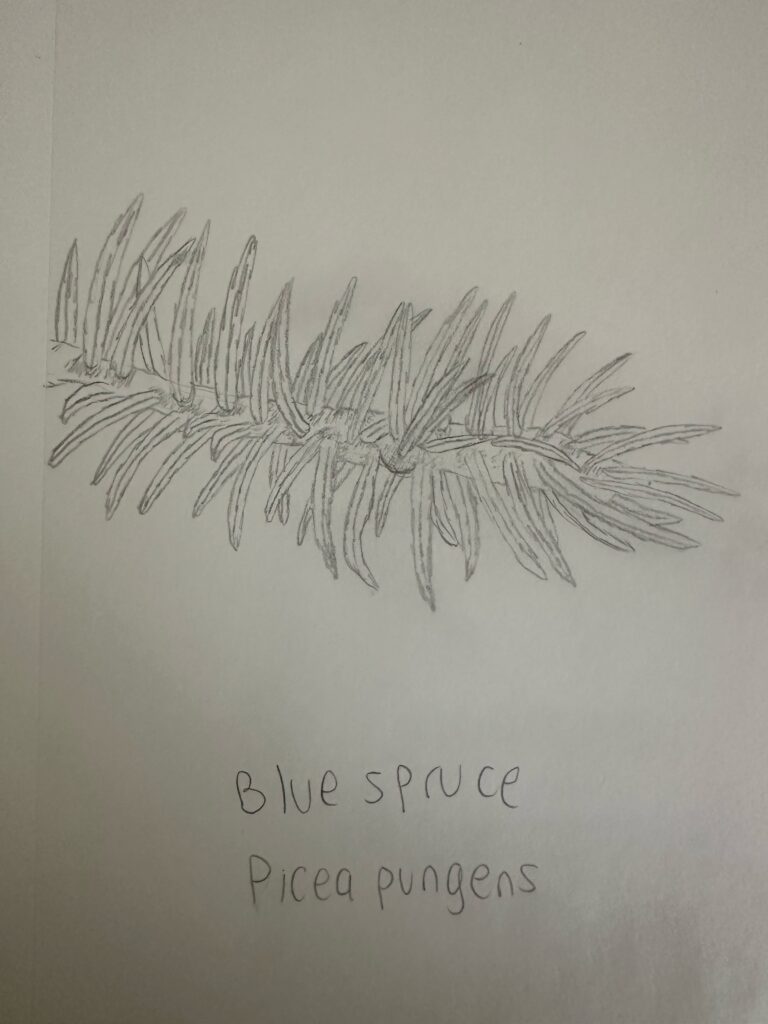
Blue Spruce (Picea pungens): I chose to sketch a part of this tree, because Blue Spruce is a plant that has always fascinated me, due to it’s color (which ironically is not shown here). I think the concept of a blue tree is extremely cool and I thought it would be fun to try and sketch all of it’s needles in detail.
Part 5: Conclusion
Sketching for my blog entry was a really fun experience. I very much enjoy science and also art, so this was the perfect activity for me, and I was so fascinated at how much detail all species have when you look up close. I took art classes when I was younger, so the sketching wasn’t too hard. I did find it a bit challenging to mark where the light hit plants, and it was a tad difficult to make shadows look like shadows instead of just awkward patches of darkness. Once I began a sketch I was super focused, and devoted all of my attention to that sketch. This being said, I definitely had to take breaks between each sketch so that I wouldn’t get burnt out too fast, since I put so much time and energy into each one. During my next visit I will be in Long Beach Island, but I am curious to see if there are any of the same species there that reside in Anderson Park.
Works cited:
Young-Mathews, A. 2012. Plant fact sheet for lance selfheal (Prunella vulgaris ssp. lanceolata). USDA- Natural Resources Conservation Service, Corvallis Plant Materials Center, Corvallis, OR. https://plants.usda.gov/DocumentLibrary/factsheet/pdf/fs_prvul2.pdf
Rall, Sara. (2024). NJ Moss Notes. New Jersey. inaturalist.org. https://www.inaturalist.org/posts/88688-nj-moss-notes