Part 1: The temperature outside in Anderson Park, Montclair New Jersey is 85 degrees Fahrenheit, and the weather is sunny, with some light winds. I am currently in the shade underneath a tree canopy.
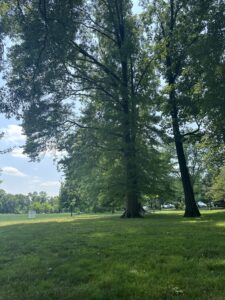
Part 2: I am in Anderson Park, a large park a block from my home in Montclair, New Jersey. This park is in a suburban area, and contains a large stretch of grassy field as well as trees interspersed along the perimeter, and an asphalt walking path with benches situated beyond those trees. I see grass that is shaded, and some that is in the sun. I also see trees of many different species, including Red Oak, Eastern White Pine, Kentucky Coffeetree, Blackhead, American Holly, and Maple. I also noticed flower such as China Rose and White Clover, as well as insects like a Wilke’s Mining Bee. I identified these species using the Seek app. I was also able to see an elderly man sitting on a bench, a couple walking their dog on the path, a spiderweb on the railing of my bench, pesticide signs, sticks and acorns scattered around by the trees, and a few squirrels. I heard bird calls from different species, such as the American Robin, House Sparrow, and Northern Cardinal, which were identified using the Merlin Bird apps sound ID. I also heard the leaves on trees rustling as the wind cam, people chatting as they waked by, bugs buzzing past my head, and cars driving on the adjacent road. I smelled the sweet, thick, humid air, which was so fresh compared to the cold and filtered air my home produces. I smelled the sunscreen I was wearing and breathed in the same natural, sun-touched air that everyone around me was breathing. I went around investigating, and took the time to look at different individual species that I had never observed with such intent before.
Part 3: Photo of Anderson Park which I took:
Part 4: Question Marathon:
1.) When was the area that is now Anderson park clear cut?
2.) Was there native people living on this land historically who had to deal with the consequences of the creation of Anderson Park?
3.) How do the pesticides that are administered in parts of this park affect the parks wildlife?
4.) How many native verses nonnative species planted in this park?
5.) What person or organization decides what trees and flowers are added into the park?
6.) How does the noise pollution from people talking and going on phone calls on speaker mode affect the species in the park?
7.) How would this area be different if there were more native pollinator plants and wildflowers incorporated?
8.) Where does the trash thrown onto the ground of this park end up in the environment as time goes on?
9.) Why do some of the trees here have pink bands tied around them?
10.) How many types of Oak trees are in this park?
11.) What does the food chain look like in this area?
12.) Are animals in this vicinity getting as much nutrients as animals living in a more secluded forest area, since the park is likely less biodiverse?
13.) How does the CO2 pollution of nearby roads affect the species of Anderson park?
14.) How have spotted lantern flies affected the health of Anderson Parks ecosystem?
15.) What aspects of nearby residential areas have the biggest effect on Anderson Parks species?
16.) How many bird species reside in Anderson Park?
17.) Where does the domestic animal waste in Anderson park go, and does it cause detriment to any local species?
18.) What effect, if any, does walking on the grass have on the microorganisms that reside there?
19.) What invasive species cause the biggest problem to Anderson park, and what are the issues?
20.) How many species deaths occur near Anderson Park per year, and is this correlated to the surrounding roads?
21.) Are the decorative flowers planted here helpful to pollinators? (And if not, why isn’t there any that pollinators would benefit from?)
22.) Do pet dogs frequently walked here ever contribute to deaths of Anderson Parks wildlife?
23.) What human-built appliance in the park most affects the species wellbeing?
24.) How greatly does the light from the lampposts in the park affect the animals circadian rhythm?
25.) What has been the biggest environmental change to Anderson park historically?
26.) What effect has the train adjacent to the park had on species health?
27.) Does tree climbing here harm trees?
28.) Why were some of the trees cut down, and why are there tree stumps here?
29.) How have the sewers in the middle of the grass on the slim strip of grass and trees affected animals species?
30.) Why are there 2 huge boulders placed by the parks entrance?
31.) Where the recycling in the park actually go? Does it get recycled, or do too many people throw trash in it?
32.) Why is there a small revine in between the park trail and the train tracks on one end of the park?
33.) Why do some trees have bubble-like growths on them?
34.) How are some trees covered in lichens here and some are not?
35.) How did the paving of the parks trail affect the wildlife here?
36.) What species resided in Anderson Park before it became a public park?
37.) Do the team sports player here such as soccer and volleyball affect the species wellbeing’s?
38.) Where is the most frequently visited area of Anderson Park?
39.) What plant species in Anderson Park would be considered safe for medicinal consumption?
40.) How have the global changes in weather and temperature affected the species in Anderson park?
Part 5: Question and research paragraph:
A big question that I had while in Anderson Park was “How would this area be different if there were more native pollinator plants and wildflowers incorporated?”. This question arose due to my observation that there seemed to be much more open grass area than area covered by flowers, aside from white clover which is prominent in the grass. However, one of the only planted flower species I found in the park were a few bushes of China Rose, which are not native to this area, but native to South West China (Yale Nature Walk). The National Park Service states, “By creating a pollinator-friendly garden full of native plants, you can help pollinators in your area” (National Park Service). This goes to show that adding more pollinator plants to the park would cause the area to have higher levels of biodiversity (USDA) which adds to an ecosystems resilience, and therefore helps to protect these areas. Anderson Park would be different with the incorporation of more native plants and flowers in its landscape, as local pollinators would greatly benefit from these actions, and the protection of the area is important in today’s current climate catastrophe.
Works cited:
National Park Service. (2023). I Didn’t Know That!: Planting for Pollinators. National Park Service U.S. Department of the Interior. https://www.nps.gov/articles/000/idkt-planting-for-pollinators.htm
Yale University. (2024). China Rose. Yale Nature Walk. https://naturewalk.yale.edu/trees/rosaceae/rosa-chinensis/china-rose-146#:~:text=Rosa%20Chinensis%20is%20native%20to,in%20hedges%20or%20form%20thickets.
US Department of Agriculture. (2024). The Importance of Pollinators. US Department of Agriculture. https://www.usda.gov/peoples-garden/pollinators#:~:text=Pollinator%20habitat%20can%20beautify%20your,community%20engagement%20and%20learning%20opportunities.
Part 6:
To sum up my first Wonder Blog, I would like to recap that I found so many different tree species, and had no idea that Anderson Park was so biodiverse. I would also like to reiterate the importance of native pollinator plant species. Though Anderson Park is a beautiful place with many species, the area could be improved by adding more of these beneficial pollinating native species, which would help to increase the parks resilience, and support the biodiversity of the area and its local pollinators. Something I found special that caught my attention was the plants growing up out of cracks in the pavement trail, such as plantain. I was puzzled by how they managed to survive in those areas, and would like to research this phenomenon further. This assignment allowed me to take a closer look into a space that I am in frequently, and has made me more appreciative of the beings who live in that space.
Posted by UVM Enterprise Technology Services on June 17, 2024 at 7:09 pm
Hi, this is a comment.
To get started with moderating, editing, and deleting comments, please visit the Comments screen in the dashboard.
Commenter avatars come from Gravatar.