Posts

Final Entry: Intervale Center July 8

July 8th, 10:37am: Hot and humid day, temperature sitting around 84ºF, sunny and slight breeze. A couple of clouds, but sunny and bright.

I found throughout these blog assignments that sketching and drawing made me feel the most connected to my site. I really enjoyed the sketching exercise we did, so for my final entry I thought I would try and add more detail and texture to sketches using watercolor! I wanted to combine the methods that we used in live class as well as some techniques that I use in my day-to-day art. I’m not very experienced with realism, so this was definitely a challenge for me.
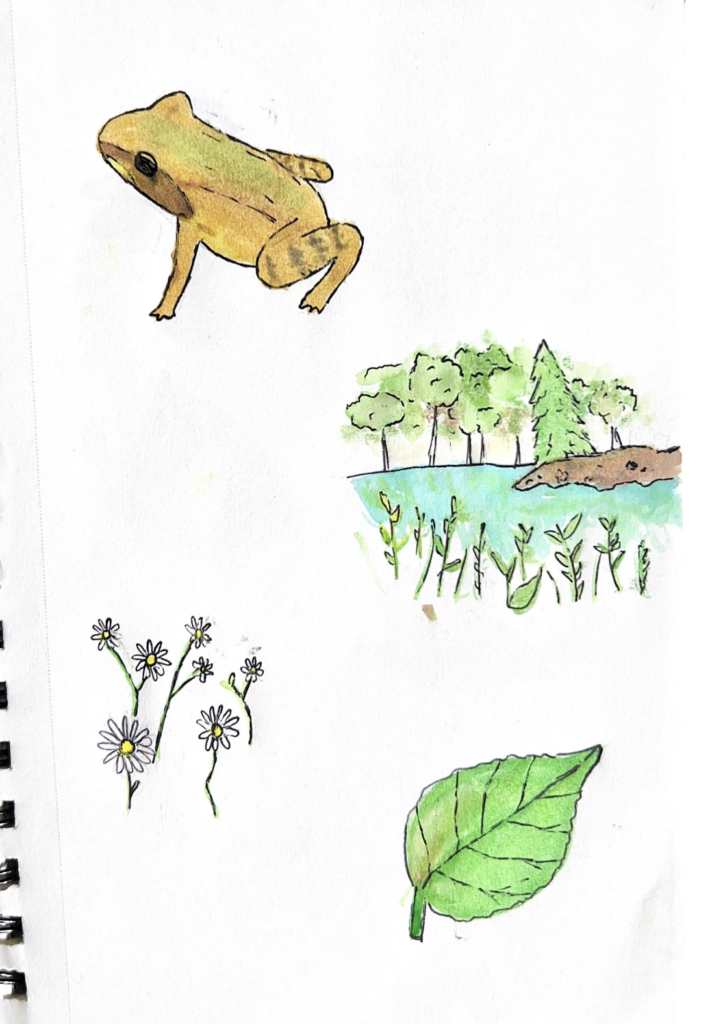
This page was a scene from the riverside, a wood frog, oxeye daisies, and an elm leaf I found on the trail.
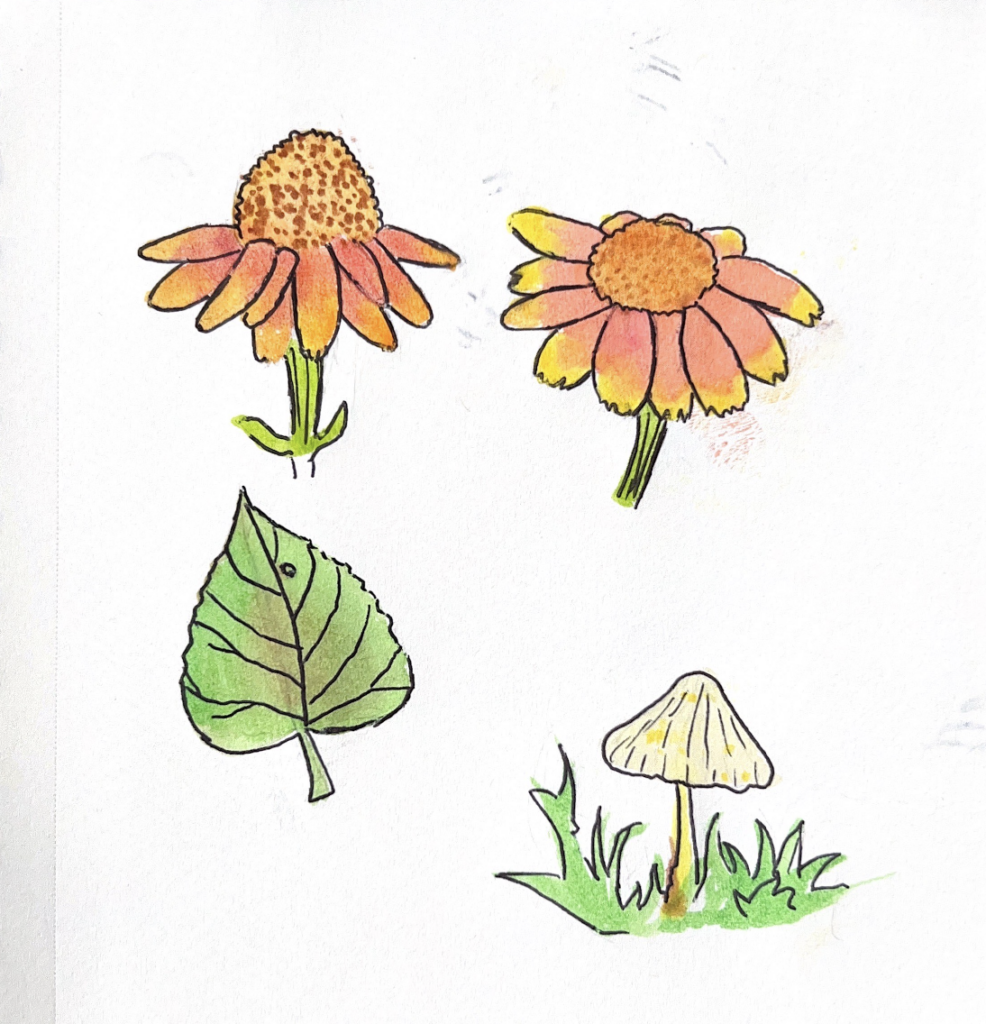
This page has orange coneflowers, a poplar leaf, and some sort of common white mushroom- I couldn’t figure out a specific species for this one. Here are some quick facts about a few of these species:

Red Coneflower (Tuxedo Lawn Care, 2023)
They’re easy to maintain, making them popular with gardeners
– non-invasive plants that stick in tight spots
– purple coneflowers can help improve soil quality!
Wood Frog (Tuxedo Lawn Care, 2023)
– first recognized in 1825
– this species developed an adaptation that allows it to survive the winter being partially frozen!
– they can alter their coloring within a range of possible colors
Oxeye Daisy (Tuxedo Lawn Care, 2023)
– this is an invasive species
– smells similar to sage
– a single plant can produce 1-40 flowering stems

I enjoyed this process because I’m more inclined to research what species are around me instead of just looking them over as I normally would. This last time I visited, I noticed there were a lot more millipedes and snails on the trail than the other times I had gone. I believe this might be because of the humidity. I spent a bit of time looking for insects before starting my sketches simply because I was a little curious. I’m not very used to working with paint, and watercolor itself is something that takes a bit of getting used to. I think it was a really interesting task to try and create texture by mixing colors instead of just using crosshatch shading. Overall, I think the finished product isn’t perfect, but it definitely pushed me to look more closely at the subjects that I chose.

Sources

Gupta, A. (2019). Oxeye daisy. https://extension.umn.edu/identify-invasive-species/oxeye-daisy

Sain, T., Sr. (2024, May 10). Wood frog. Our Breathing Planet. https://www.ourbreathingplanet.com/wood-frog/?gad_source=1&gclid=Cj0KCQjwv7O0BhDwARIsAC0sjWNsf5oP8PPnuufVjpG28W1wK9qy7uUmG-BTKmUZ-pK0rFMIiYLjs5AaAvUQEALw_wcB

Tuxedo Lawn Care. (2023, April 20). All about coneflowers! – Tuxedo yard care. Tuxedo Yard Care. https://tuxedoyardcare.com/all-about-coneflowers/#:~:text=They%20all%20typically%20grow%20between,the%20stem%20of%20the%20plant.

Entry #3: Intervale Center, July 2nd

June 2nd, 11:49am

The weather at the site was warmer than the last time I went- a really sunny day about 78ºF with a light breeze. It being earlier in the afternoon, the sun came through the trees pretty strongly.

Today, I tried to venture off the trail a little further. I walked a trail loop, looking into the brush on either side and stopping to turn over the occasional log or stone to look for interesting critters. There were a ton of centipedes and even quite a few orange-banded arions, the species of slug that I identified at my last visit. This time around, I spotted a large patch of wild blackberries! Most of them weren’t ripe yet, but I was lucky enough to grab a few. It seemed that most insects were taking cover in the shade just as I was on the trail. There were a couple more people this time around, I saw three folks in the field. One had a vivid-colored skirt and a cream-colored blouse.
On the way out of the trail, a small garter snake crossed the path in front of me. I tried to catch a picture, but he didn’t seem to want to say hello. I noticed as the trail got closer to the water, the ground was covered in sand. The rest of the area was dark, moist soil and the contrast was a bit confusing. I took a look at the data from last summer’s floods, as I remember talking about sediment deposits in a lab at the center a while back. It seems that the flooding from the river lifted sand and deposited it over the area lining the shores. This was surprising, as the trail was roughly 15ft above the water’s surface.

An ornate metal fence with a butterfly back, overgrown with weeds. I loved the way the plants filled in the gaps of the butterfly wing on one side.
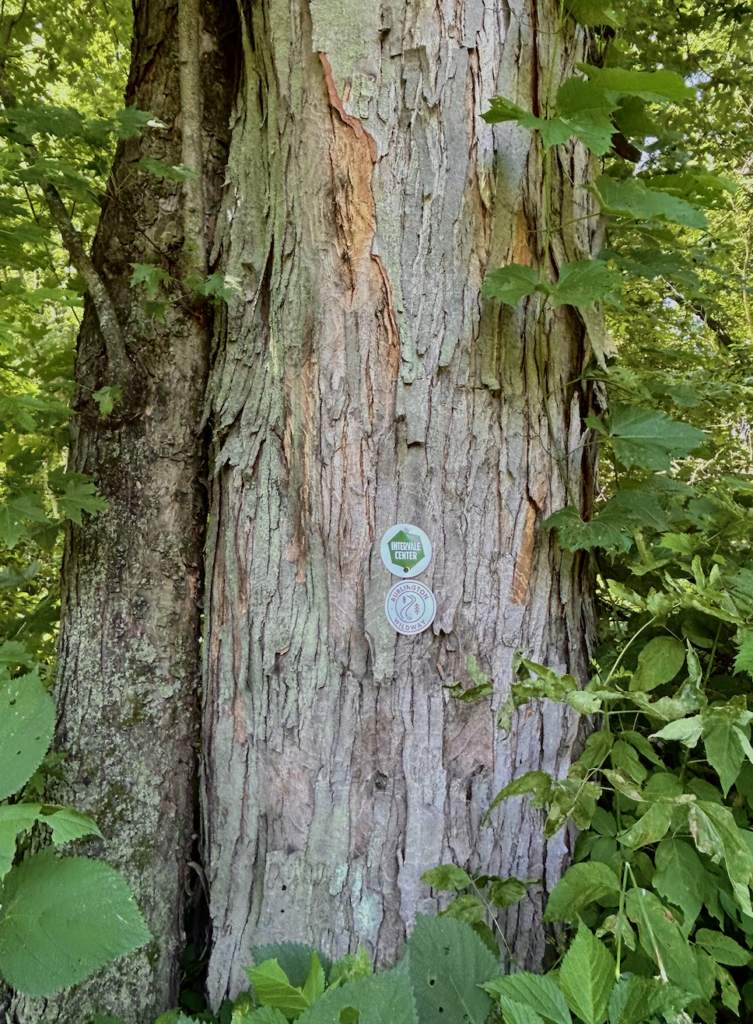
The Intervale Center’s logo and trail name on a red maple- I thought the two trees of different types growing so close together was interesting.
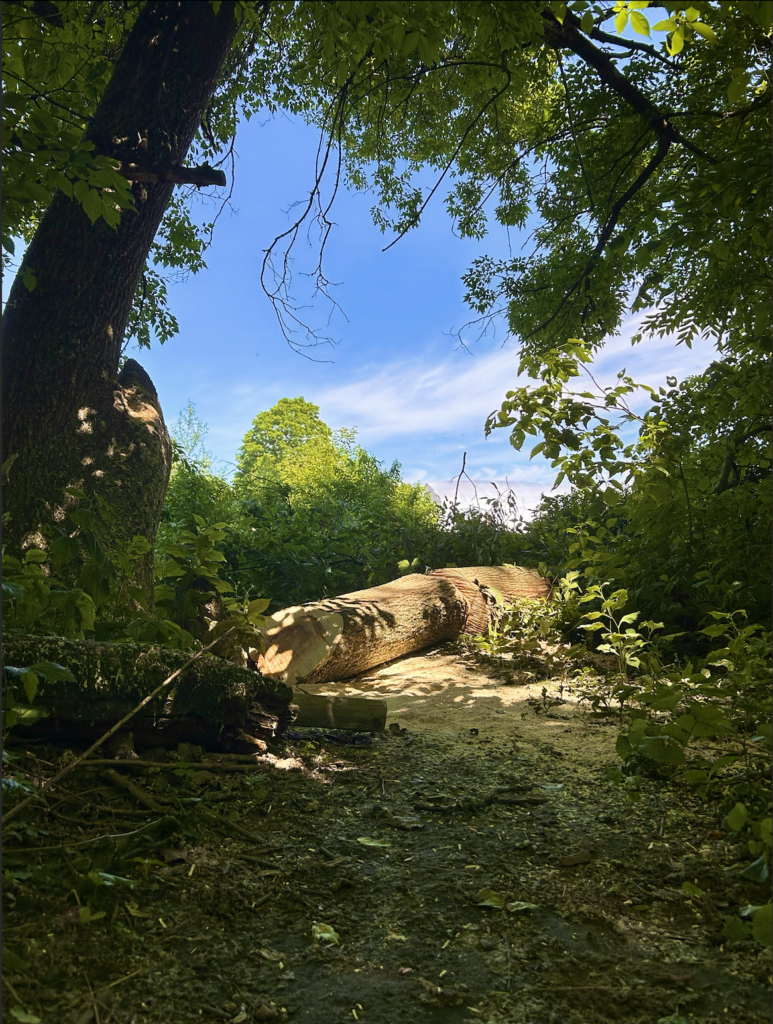
A sawed log blocking an employee path to the greenhouses. The area was covered in saw dust. I thought the light highlighted the color really well in contrast to the green shadows around it.
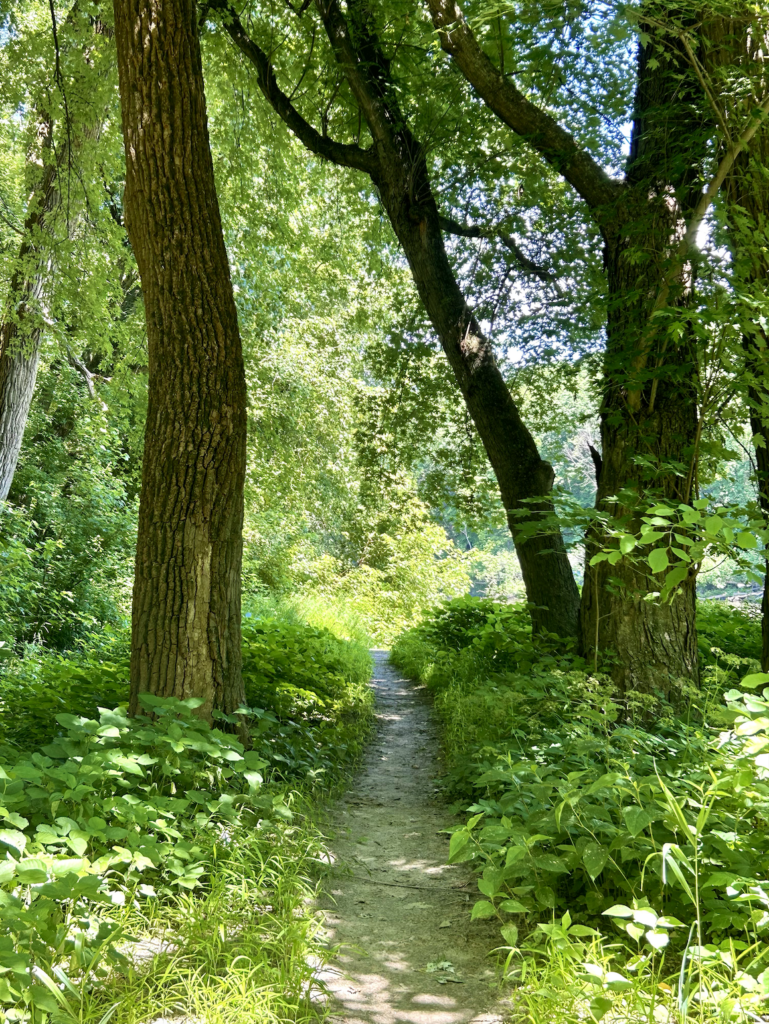
A small section of the trail by the river, I thought the angles from the trees were really visually interesting. You can see the sandy sediment deposits I was talking about above!
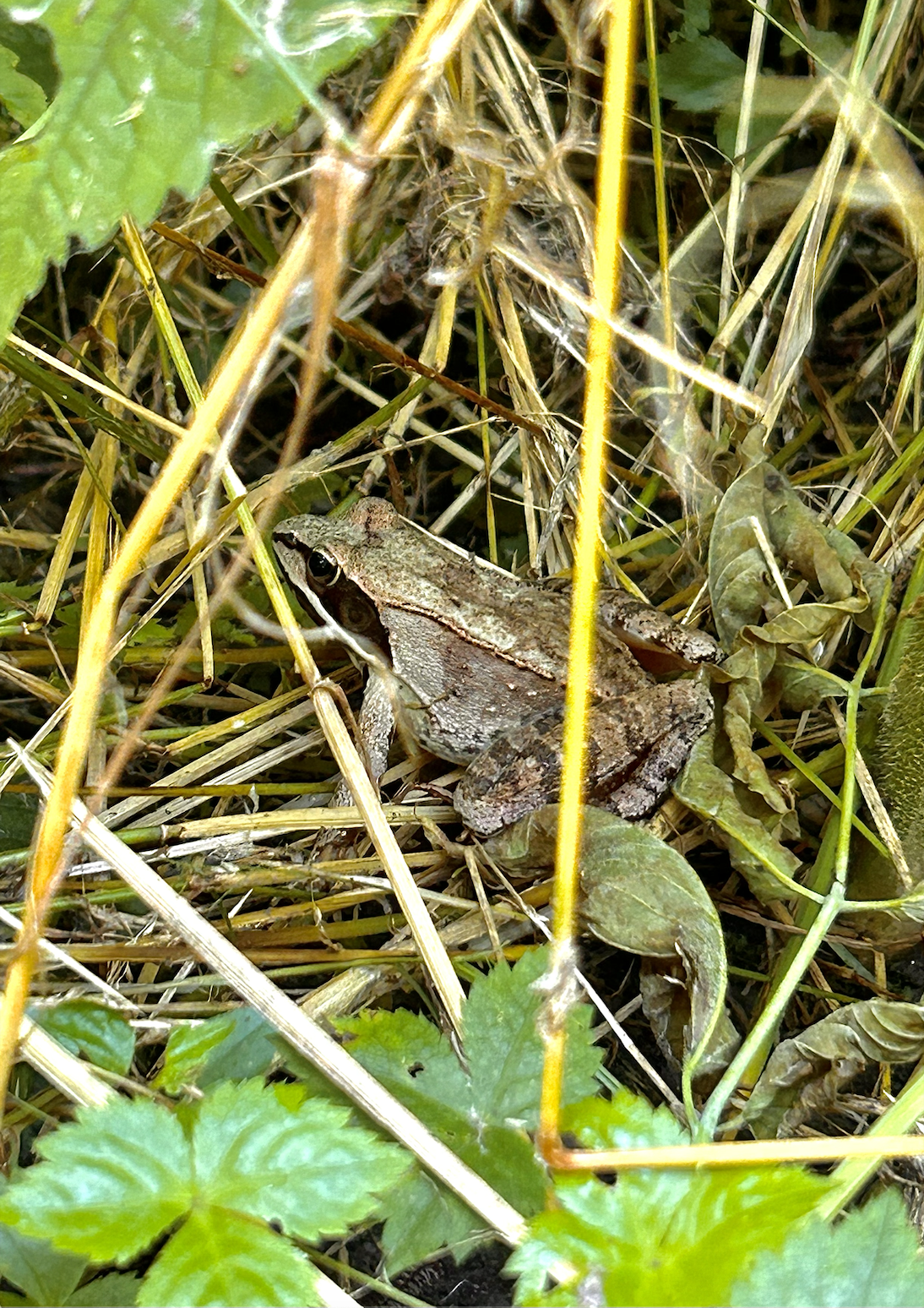
A wood frog hidden in the brush off the path. He let me get just close enough to take a picture, and then left pretty quickly. I hadn’t seen this kind of frog before, and had to identify him when I got home!

I really liked taking pictures in the field, it was nice to just be able to capture things with a camera without worrying if they would be easy enough to draw. I think that the sketching exercise was a little more detail oriented, and this assignment had me take a lens that was zoomed out, in a way. I really enjoyed going through and adjusting/editing the photos afterwards!

Entry #2: Intervale Center- Friday, June 28

Friday, June 28- 11:32AM

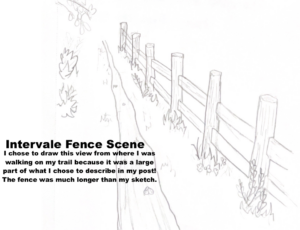
I chose to move my location to the Intervale Center because I was hoping to get a better variety of plant and animal species. The weather was nice, about 72ºF and sunny with a light breeze. The trails were quiet aside from some passing cars and rustling in the woods. I stayed and watched birds for a little while, I saw a robin come onto the trail and leave with an insect it found. The trail I walked began in the front lot and passed the “People’s Garden,” a small garden with a few types of brightly colored flowers but mostly empty plots- I assume crops that are now out of season. The trail led to a fork, and I followed it along a simple wooden fence for a little while. There were wildflowers growing at the base of the fence, attracting a couple of subtly yellow butterflies.

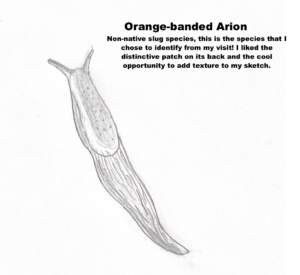
I found a couple interesting things hanging around: some nice flowers growing to the side of the trail, birds, as well as a slug that was tucked into the bushes that I found as I relocated an earth worm into the shade. The slug had a distinct sort of pattern on its back, one that I wasn’t familiar with. This was the species that I chose to identify. I found that it was an orange-banded arion, or Arion fasciatus (Living World of Molluscs, 2024). I found the species by looking up keywords to do with the distinctive band on the slug’s back. One interesting thing I found while researching was that they are not a native species! They originate from Northern Europe but was brought across the Atlantic during the colonial era.

Conclusion: I really enjoyed sketching in the field, I think it made me more attentive to details at my site because I was actively looking for interesting small subjects that might be a good opportunity to capture. It was a little challenging because I felt that I had to find the “best” parts of the landscape, but I knew that I would be back again and have another opportunity to capture other aspects! I’d like to go a little further off the trail next time to look at some cool critters deeper in the woods.

Sources:

https://en.wikipedia.org/wiki/Arion_fasciatus

https://www.molluscs.at/gastropoda/terrestrial.html?/gastropoda/terrestrial/arionidae2.html

Sketches:

Entry #1 Champlain Park- Burlington, VT (June 20)

Champlain Park, June 20- 11:35am

Weather: warm, humid, sunny, windy

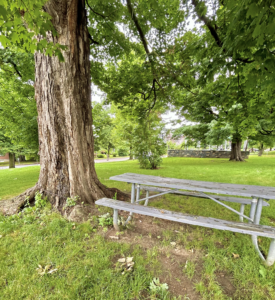
The area I chose for my first entry is a park overlooking the lake and downtown at Champlain College. The area has a walking path and picnic table but is almost completely empty all of the time. There are small purple and white wildflowers that seem to follow a more vividly colored patch of grass along the sidewalk. It’s relatively quiet aside from passing cars on the road. There is a tree that hangs over the picnic table, it’s angled sort of sideways and has a thick metal chain looped around its base but left on the ground. It’s been there since I moved in my apartment across the street. I wonder why it was left there- it seems to me that someone tried to pry it out of the ground. The chain looks old and might have been left there a long time ago. The lawn here has a gentle sort of slope that drops off in the direction of a playground. There aren’t kids there very often, but when there are it’s wonderful to watch. A simple brick walkway lines the edge of the area, with a few trees growing against a black metal fence blocking off a small soccer/play field.

Questions:

  1. What wildflowers are native to Vermont?
  2. Why is the grass growing by the path a different color?
  3. What makes trees grow sideways?
  4. What is the elevation from my spot to the waterfront?
  5. How long has the large tree been there?
  6. What bird species are most common in Burlington?
  7. What type of trees make the best bird habitats?
  8. What kind of maple trees can make maple products?
  9.  What seasons have the most mosquitos?
  10.  What mountains are right across the lake? 
  11. How far are the mountains across the lake as the crow flies?
  12. How much rainfall is too much for grass?
  13. How much rainfall is optimal for plant growth?
  14. How far down do tree roots go?
  15. Why is the tree’s bark so frayed and broken?
  16. What was the chain used for?
  17. What causes different types of grass to grow?
  18. What types of grass are best for insect habitats?
  19. What grass naturally occurs vs. being planted?
  20. What role do small wildflowers play in an ecosystem?
  21. How long do maple trees take to mature?
  22. What causes large increases in rainfall?
  23. What causes grass to change color?
  24. How long do trees live for?
  25. Why are some patches of grass more dense than others?

Q: What makes trees grow sideways?

A: Trees often grow at an angle due to phototropism, or the tendency of plants to grow towards available sunlight. It seems like a nearby building was casting a shadow onto the tree as it grew, causing it to bend at an angle to better photosynthesize (Trees Charlotte, 2021).

Source: https://treescharlotte.org/tree-education/my-tree-has-a-lean-what-does-that-mean/#:~:text=Leans%20like%20this%20are%20often,in%20the%20direction%20of%20sunlight.

I’d like to look a little more into the patch of trees growing to the side of the fence around the perimeter of the area. I want to see what species of trees are there as well as find any critters that might be hiding away from the path.

Welcome to UVM Blogs. This is your first post. Edit or delete it, then start blogging!

Skip to toolbar