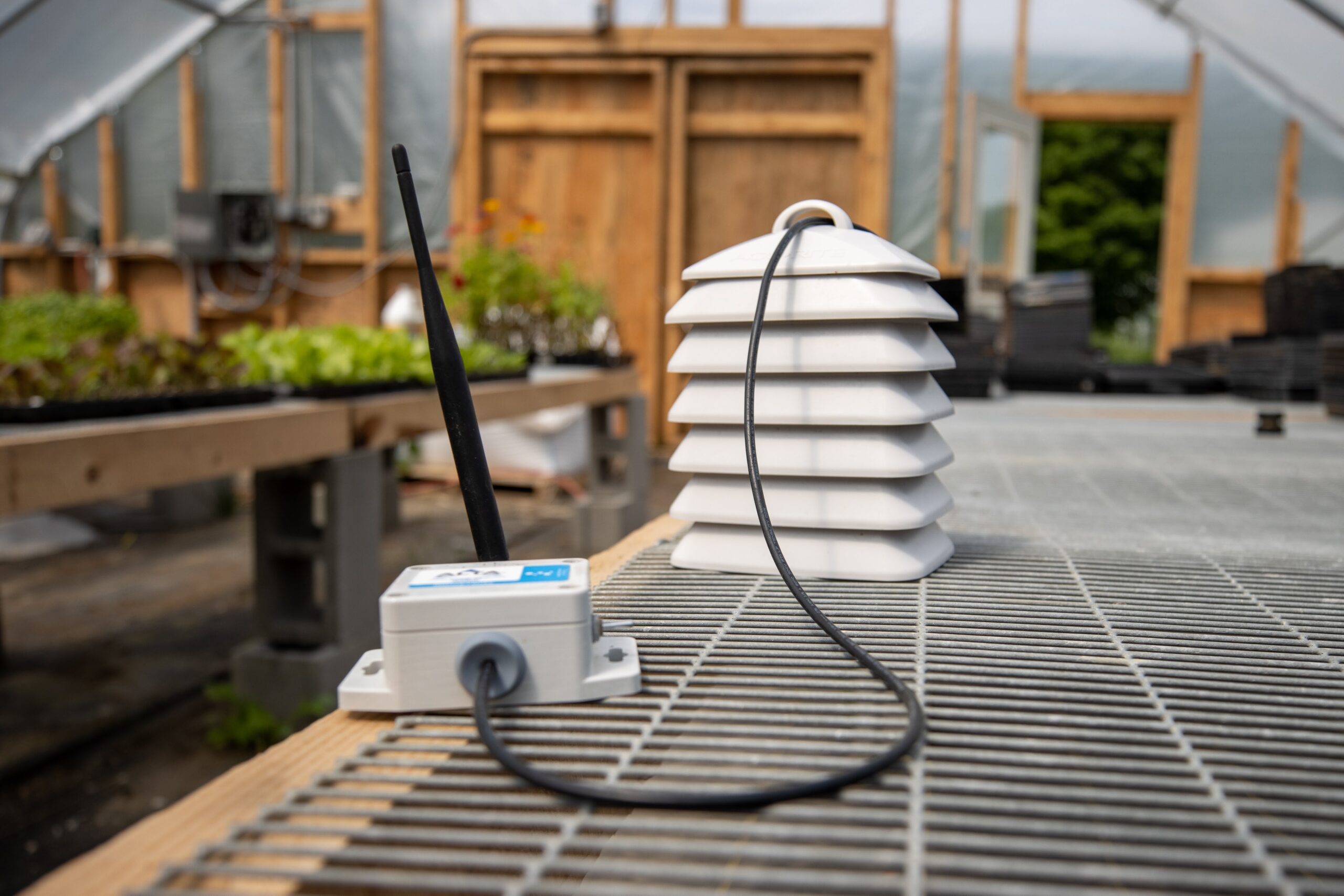
Environmental controllers are used to automate the management of growing conditions in greenhouses and high tunnels. They are most used to manage heating and ventilation systems, but can also be used to regulate CO2, humidity, irrigation, and light. Controllers are connected to sensors, monitors, and/or timers that provide the data for adjusting the high tunnel environment with the goal of optimizing plant growth. Automation can provide a more precise reaction to changes in growing conditions as outdoor conditions fluctuate, greatly improving the indoor growing environment.
Using controllers to automate the management of high tunnel environmental conditions can significantly reduce labor costs and improve yield and quality of crops. Automatic features easily allow far away or off farm activities, such as making deliveries or going to farmers’ markets, and will even monitor outside weather and close vents during storms.
Secondary monitor systems connected to alarms (audible, visual, email, text or phone) are a critical complement to automated environmental controls, notifying growers of systems failures, preventing suboptimal growing conditions or even catastrophic events such as freezing plants. If you already have basic automation, you may need to add temperature monitoring and alarms, as a way of constantly verifying everything is working as it should.
Controllers
Equipment like fans, vents and heaters can be controlled with a basic thermostat. However, high tunnels often have a need to manage multiple environmental conditions, so a more sophisticated controller can be helpful. Controllers can be adjusted to attain different sets of environmental conditions as activities and needs in a multi-purpose tunnel change over the growing season from propagation, to growing out, to pre-storage curing of harvested crops. Additionally, controllers can use more precisely placed temperature/humidity probes (or an average of multiple) giving an advantage over traditional thermostat use.
Many controllers have an intuitive user interface, and most are fairly “plug and play” for ease of installation.
Use of controllers for automation may not be ideal if:
- A tunnel is in a flood prone area
- A tunnel is far away from a source of electricity (solar powered systems can still be viable options, especially if travel distance to the tunnels increases the ROI)
- Your farm is prone to power outages and you lack a backup power system (note that most systems can easily plug into a camping battery system and the motors can run on drill batteries in emergency situation)
- You are satisfied with your tunnel’s level of production and labor requirements
- You enjoy manually managing your tunnel environment in response to internal fluctuations and outdoor weather conditions.
Where to purchase greenhouse controllers
You can often order this technology directly from your greenhouse/high tunnel supplier or through a specialized farm supply vendor, for example:
- CT Greenhouse
- Griffin Greenhouse Supplies
- Harnois Greenhouses
- Nolts Greenhouse Supplies
- Rimol Greenhoue Systems
- Smart Farm Innovations
It may also be possible to purchase controllers directly from the manufacturer, for example:
- Advancing Alternatives
- Bartlett Instrument Company
- Monnit
- Orisha
- Priva
- Wadsworth Controls
- TrolMaster
Examples of controller systems used by growers
Below are examples of common brands of controllers that high tunnel growers in the Northeast have adopted. Each brand mentioned comes in several models that offer different levels of sophistication in terms of what is controlled and how many settings are available.
Advancing Alternatives
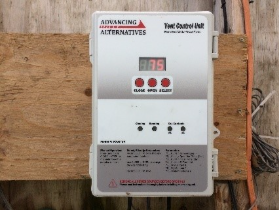
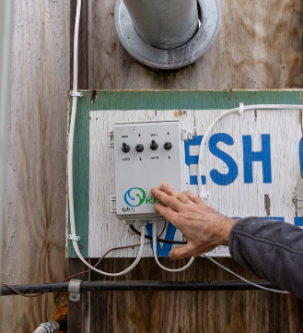
This basic controller, model VCU2-24 from Advancing Alternatives, is used to automate roll-up sides. It has a target temperature set point, and it modulates the roll-up side position to maintain a consistent temperature. At Chamberlin’s Farm in Underhill VT, they often have the system to open at 75oF. A temperature reading is taken every three minutes from the thermocouple in the middle of the house, and then the sides roll partially up or down as needed to maintain the set temperature.
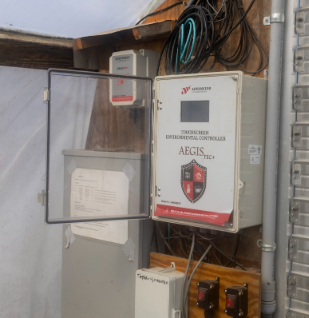
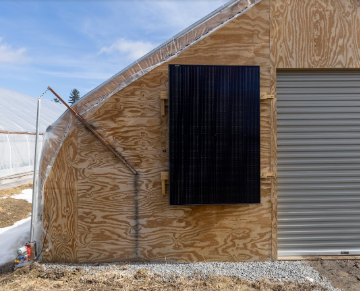
Greg Berger at Spring Ledge Farm in New London NH utilizes several few different controller systems in their high tunnels, including Advancing Alternatives, Wadsworth Controls, and a custom-built solar-powered system.
Th Aegis Tec+ controller from Advancing Alternative has features such as Single or dual-zone control, Call phone/tablet/pc access and alert capability and rain, wind and humidity sensors. These weather sensors, will trigger the controller to automatically close up as storm comes through.
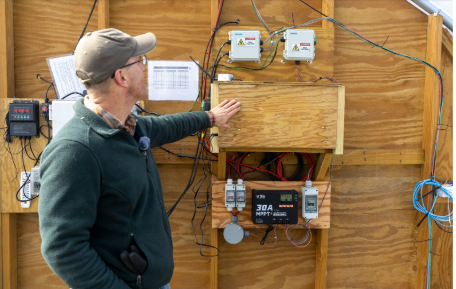
The custom-built comptroller required extensive research and troubleshooting to piece together the inverters, batteries, timers etc., but it allows one Greg’s tunnel to operate off-grid. You can hear Greg discuss these systems in Episode 44 of The Farmer’s Share podcast.
Bartlett Instruments
Andrew Knafel of Clearbrook Farm in Shaftsbury, VT uses a Bartlett ClimateBoss controller to run the heater, peak vents, and roll ups for his winter greens high tunnels. This system is Wi-Fi connected, so he can get notified if temperatures go out of the desired range. To learn more, watch this video of Andrew.
Orisha
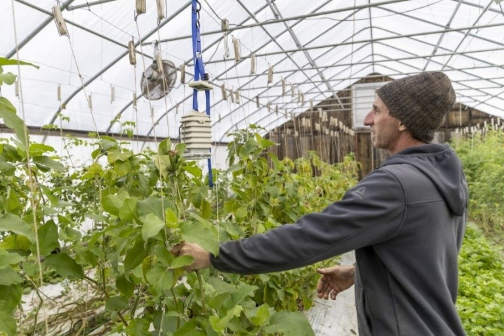
Tony Lehouillier of Foote Brook Farm in Johnson VT has installed an Orisha automation system. One of the benefits of this system is that it can be set to regulate tunnel temperature and humidity. It turns the heater off and on, and/or opens vents at the right times of day to vent humid air and to prevent condensation from forming, thus reducing foliar disease pressure on crops in the tunnel.
Monitors
Some controllers have the ability to notify you when the tunnel temperature, or another parameter, is out of the specified range. Some basic controllers do not have that capability, so adding a separate monitoring system can save a lot of money by preventing crop loss if there has been a mistake operating the system or a mechanical or electrical failure. Also, most controllers do not have the ability to text or call or even handle multiple recipients. Even if your controller has a monitoring system, having a separate system provides redundancy in case the controller system goes down. In addition to monitoring tunnels for over-heating or low temperatures, these systems can also be used to monitor temperatures in other areas of the farm, like walk-in coolers, refrigerators, freezers, shops, or in the field (for frost protection).
Sources for Monitor and Alarm Only Systems
- Monnit Sensors
- SensorPush
- Smart Farm Innovations
- QA Supplies
- Thermalarm
- Vermont Energy Control Systems
Options for Tunnels Without Wi-Fi
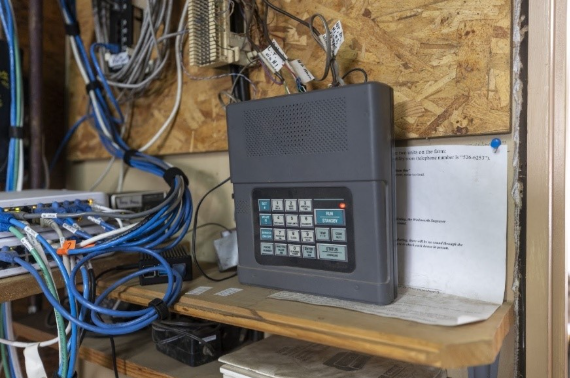
For farms that don’t have internet connectivity, using a phone-based system is often a good alternative. Sensaphone is one system that is phone line based. Spring Ledge Farm has the set-up shown below, so the farmer gets a phone call when environmental conditions are out of range.
Monnit systems (which can be purchased direct or through specialized resellers) have full cellular solutions allowing for easy setup at farms with no internet, Wi-Fi or phone connections. Alternatively, the cellular hub can act as a failover if a regular internet connection fails. The sensors are completely wireless and battery powered (5+ year life, replaceable) allowing for 1000’+ range from the cell or internet connected gateway/hub (which needs power but has a 24hr backup battery). The wireless signal uses a frequency that punches through objects better than Wi-Fi based systems allowing for much easier deployment on farm properties. The website/app allows for unlimited users to be notified via an inexpensive yearly subscription and simple text/call credit system. Additionally, all the monitored data is logged for reporting and research purposes.
Environmental Controller Experiences Shared by High Tunnel Growers on the Vermont Vegetable and Berry Grower Listserv (October 2026)
In our poly tunnel, we use a Honeywell G-Stat 4-relay controller for heating (hot water heating pipes under the tables and overhead hot-air Modine) and cooling control (low stage exhaust fan speed and high stage fan speed with evaporation system pad water). 3 thermostats (one for the boiler, one for the Modine, and a two-stage for the exhaust fans) in an 8″ aspirated tube control the G-Stat. This greenhouse is only used for propagation, so we’re not concerned about humidity. In fact, it’s usually too low in the beginning and I’m spraying water on the ground under the tables until we build humidity from watering the seedlings. In addition, we use HPS lights on a manual timer, usually running 6am to 8pm during propagation. The heat from the lights helps offset fuel use in the colder months. I suppose this system would work for many high tunnel growing situations that don’t require humidity control.
——————————————————————————————————————
We have a simple temperature gauge in our 28 x 96 tomato greenhouse. It opens a louver on one end and a fan on the other end, both on the top of the gable ends. It is perfect for keeping things from overheating in the morning and helps with keeping the air flow going on hot sunny days. I think it also helps a lot with cloudy days where you don’t need the heat, but you want there to be air flow. We also have rollups on both sides, which I operate manually, based on my own senses of when they need to be opened and closed. I am sure an automatic system would be much better.
—————————————————————————————————————–
We use the iMonnit monitoring system throughout our greenhouses, seed storage facility, pump houses, and walk-in coolers. It is separate from our greenhouse controllers, which handle automation such as roll-up sides, heating, and fans. One of the biggest benefits of iMonnit is the ability to monitor conditions remotely. We have temperature and humidity alerts set up, and the system can call, text, or email me when an alert occurs. You do need to purchase credits for the calling feature, and each call uses a credit. There is a bit of a learning curve when first navigating the system, but once I became familiar with it, I found it pretty easy to work with. We switched to iMonnit from our older Sensaphone system.
Another feature I really like is being able to set up multiple users on the account. This allows other staff to log in and access the environmental data it collects. That has been especially useful for our trial technicians here at JSS, particularly for monitoring conditions associated with our overwinter trials. Overall, I’ve been happy with the system and would recommend it.
—————————————————————————————————————-
I did the Orisha 40-hour farmer’s course/group this summer and it was super helpful but also made me realize that to really dial in we need a way to have heat come up from below the plants. We installed automatic roll ups as a way to dip a toe into automation and they’re amazing, BUT we have a ton of power outages and no backup generator out at the tunnels so the sides got stuck in the down position a few times. It was incredibly stressful, and enough to have us pause upgrading further.
Additional High Tunnel Information Resources
Share This Post
https://go.uvm.edu/controllers
Disclaimer
Mention of brand names is for example and information purposes only; no endorsement of products mentioned, or discrimination against products not mentioned, is intended. If you have a system that you like, please share it with us!
Acknowledgements
This work is supported by the Northeast Extension Risk Management project award no. 2025-70027-45395, from the U.S. Department of Agriculture’s National Institute of Food and Agriculture.