
Anyone who grows perennials in the Northeast has probably experienced the frustration of “winter kill” when a plant that is perfectly healthy going into winter does not make it out alive. There are many reasons a plant might die, or be seriously injured, during the winter. Some are biological, such as rodent damage, others are anthropogenic, like salt injury, but most reasons are likely weather related. These include drought stress prior to winter, desiccating winds, extreme temperature fluctuations, and just plain cold.
That last factor is of particular interest to growers because knowing how cold a location typically gets is a pretty good predictor of whether a plant species will thrive there. That’s why horticulturists at the Arnold Arboretum in Massachusetts put together the first maps of hardiness zones in the U.S, beginning in 1927. In 1960, the USDA got into the act, using a different approach, and by 1990 they became the go-to source of this information.
The USDA plant hardiness zone map was updated in 2012 based on new data, and again in 2023. It’s available at https://planthardiness.ars.usda.gov/
Plant hardiness zones represent the coldest temperature to be expected, based on the average minimum temperature measured during the past 30 years. In some years, the coldest temperature recorded was lower than the average, and in other years, it was higher. The same will be true going forward.
Stated another way, the zones are predictions of minimum temperatures for a location based on historical data. For the 2023 map, that data was from 1991 to 2020, provided by 13,412 weather stations nationwide.
So, what does this all mean in Vermont? In a nutshell, it doesn’t get as cold as it used to. Almost all areas of the State moved into a warmer minimum temperature zone on the 2023 map compared to 2012.
In the Northeast Kingdom, the coldest part of Vermont, the small patch of zone 3b, minimum temperature -35 F to -30 F has disappeared, and zone 4a, minimum temperature -30 to -25 F, has shrunk considerably, receding to northern Essex County and eastern Orleans County. The majority of the Kingdom is now zone 4b, -25 F to -20 F.
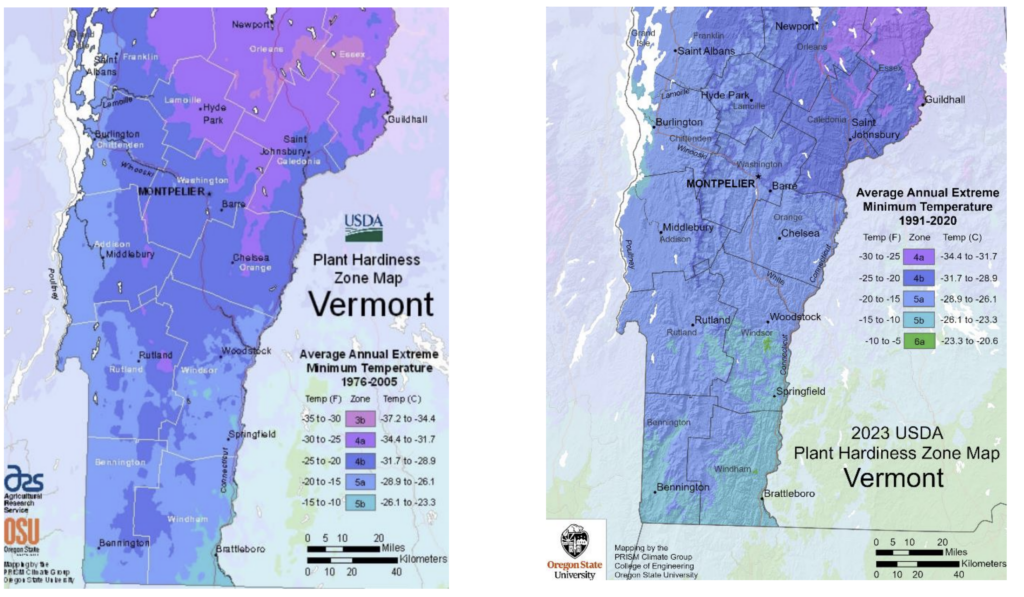
minimum temperatures recorded over 30 years have increased, statewide. The coldest zone (3b)
in 2012 no longer appears on the 2023 map. Most of Vermont is now zone 5a, with an average
annual minimum temperature of -20 to -15 Fahrenheit (F).
Bennington and Windham Counties, with Vermont’s warmest minimum winter temperatures, got a bit warmer, as zone 5b (-15 to -10 F), replaced much of what was zone 5a (-20 to -15 F). Windsor County also warmed up to mostly zone 5b, as did a small area of Chittenden County along Lake Champlain.
The only area of Vermont that did not change hardiness zones from 2012 to 2023 appears to be southeast Caledonia County, which held on to zone 4b.
Whatever zone you grow in, there are ways to help perennial plants survive the winter. Select protected areas for plants at risk of cold temperature damage. Avoid drought or nutrient stress by optimizing irrigation and fertilization during the growing season. Protect plant roots with mulches and protect foliage from cold dry wind with burlap or snow fence. And if you need to replace winter-killed plants, select species or cultivars with plant hardiness ratings at least one zone lower than the plants that died!
Published 1/8/2024 by Dr. Vern Grubinger, Vegetable and Berry Specialist, University of Vermont Extension