Leading up to the end of the semester, the UVM Career Center presents Seniors and soon-to-be-graduates with an assortment of focused topics to start your career chapter off right. This week: Getting started in your job search. So, let’s start at the beginning – knowing what you want in a job.
Know What Is Possible
The first step in beginning your job search is understanding what career paths are possible based on your major, skills and experience. You might be surprised by the number of options you have.
A Note On Stress We know all of this can be stressful. Some level of stress is actually a good thing – it motivates us and helps us grow – check out this article on Job-search-anxiety. That said, if you’re finding stress is getting the better of you – do reach out to CAPS for help.
Refer to the Occupational Outlook Handbook for career ideas that appeal to you. This site also provides salary information and educational requirements.
Use UVMConnect as a research tool. You could start searching by major and noting what jobs other alums have pursued. Remember, most people have labeled themselves as “Willing to help”, so you should have no hesitation sending them a short message with questions. See example messages.
To find more UVM alums, do some more research with the LinkedIn Alumni tool. Like UVMConnect, you can look at their profiles to see their unique career journey. You can also message them with a question, and don’t forget to mention your common Catamount bond!
Know What Is Important
By now you probably have a good sense of what is important to you for your career. If you are still deciding, try using some of these tools.
Remember: Not everyone approaches their career journey the same way, and that’s okay! It’s important to remember you’re not embarking on this new journey alone. We’re here to help you along your path. Here’s a handy checklist which we will explain more in future posts.
If you have any questions, don’t be afraid to drop in at Davis Center Room 204 and talk with our peer leaders. We’re available Monday to Thursday 10 am to 2 pm, we’d love to connect with you!
Don’t lose touch with valuable career tools you have access to for life! Your @uvm.edu email won’t last forever so be sure to:
Create or Update your UVMConnect account with a personal email to engage with a robust network of alums.
Smart Job Search Strategies
As you search for jobs, keep in mind that the process will probably take longer than you think. Devote a few hours each week to searching and applying to positions.
Adjust your search terms to get different results. Ex: “medical laboratory scientist” and “medical laboratory science” will yield different results and think broadly – not just “teacher” but also “educator” and “instructor.”
Use filters and save searches so that you will be notified when your criteria are met.
This video will help you reflect on your values and interests to determine the kind of job / workplace you seek. Search strategies to quickly sift through job postings are also discussed. Learn how to decode a job description and how to leverage LinkedIn to find jobs.
Decoding a Job Description
Typically, the most important requirements are written first.
Education level or certifications are typically not flexible.
Years of experience might be flexible.
Don’t get hung up on titles – a coordinator at one company might be a manager at another.
Second: Read between the lines – phrases like “self-starter” may mean you will be working alone a lot so be sure to highlight your ability to work independently; jobs seeking a “team player” may want to hear more about your experience collaboration.
Stay tuned for our next installments every Monday morning in your inbox! And remember the Career Center is available to alums for life!
ALSO: Don’t lose touch with valuable career tools you have access to for life! Your @uvm.edu email won’t last forever so be sure to:
Add your personal email to Handshake to maintain access to all the opportunities there.
Congratulations, you’ve successfully submitted your application to a recent job posting and have been invited to interview! What can you do to prepare? Consider the power of stories when answering interview questions. Continue reading “Interviews: Leaving Space for Stories”
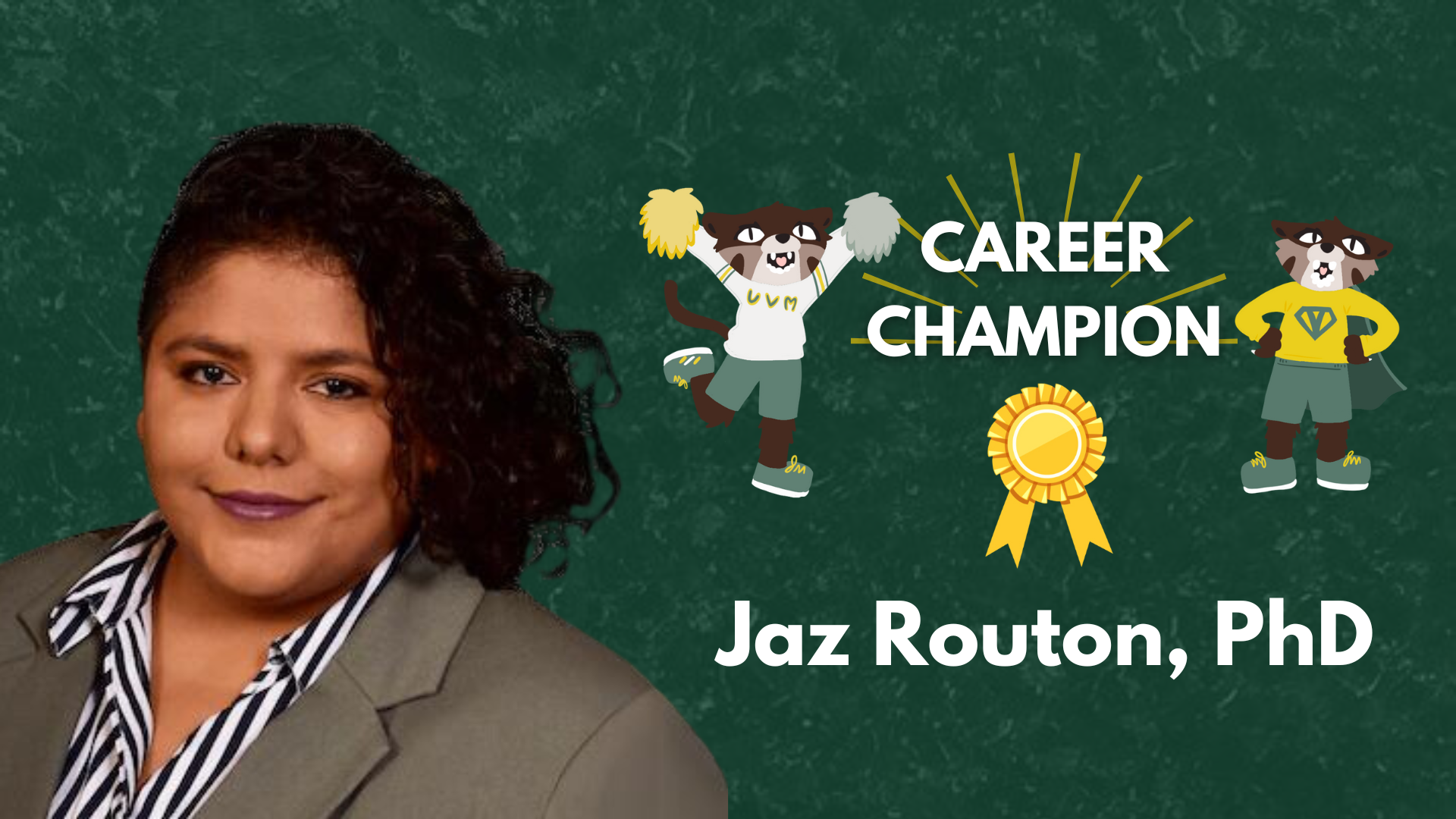
An interview with Jaz Routon, the Career Center’s 2024 Faculty Career Champion Award Recipient
Jaz Routon, PhD, a lecturer in Human Development and Family Services in the College of Education and Social Services, has been awarded the Career Center’s Career Champion Award for her outstanding dedication to supporting students in their career paths. In our interview, Routon shares their approach to empowering students and some of the best career advice they’ve been given in their career path. “Change is scary, even when you know you are making a good decision,” says Routon. “Do not let the fear of change stop you from making positive moves in your life.”
How does it feel to win the Career Champion Award?
I am honored to be selected for the Career Champion Award but could not have done this work alone. I must credit my teaching assistant, Arima Minard, many guest speakers, and our UVM and community partners who supervised our HDFS interns throughout this academic year.
What is your approach to supporting students in their career path?
My primary approach was demonstrating to the graduating seniors that their career trajectories did not need to be linear. I wanted to ease the stress and anxiety associated with graduating and figuring out the next steps. I invited helping professionals (such as counselors, mental health professionals, social workers, and clinical psychologists) to elaborate on their career paths and the twists and turns leading them to their current roles. I wanted the students to understand that what success looks like is diverse. I wanted the seniors to know there are no wrong turns because each step will give them experience and insight to inform and benefit their next step. It’s never too late to follow a dream.
What motivates you to go above and beyond to support a student’s career development?
In my first year leading the HDFS internship capstone course for our seniors, I realized that students were unsure what to do with Human Development and Family Science after graduation. Although the majors learn about numerous helping professions early in the program, they are not given explicit directions on exploring these options. I also remembered how hopeless I felt at the end of my undergraduate years and how much I could have benefited from this type of guidance. To help them better prepare, I asked what information the students wanted or needed, and I worked to meet those requests. We covered resume building, cover letters, recommendation letters, types of graduate degrees, job readiness, and career exploration, to name a few. I provided the students with various links for career and graduate school exploration. The students even learned about budgeting and received a crash course in Excel.
How do you foster a sense of confidence, courage, and curiosity in students regarding their career goals?
When the students first start at their internship sites, they think they know with certain which population they want to work with in the future and have a good idea of what they may want to do. However, the internship experience can sometimes change their perception altogether. For instance, I’ve had interns who thought they wanted to work with children only to find that they did not enjoy doing so or have the patience needed. Or, I’ve had an intern who was interested in working with the aging population but found they could not deal with the grief and loss when a client passes. When their original perception changes, the interns feel a sense of loss, confusion, and concern about what to do next – especially if they had spent their undergraduate years expecting to go into a specific helping field. However, I reiterate how critical it is to gain this insight and grow from it. I hope this has built courage and curiosity to keep seeking a path that feels right to them. I also teach the students to stand in their privileged social locations to push for change in the helping field. I think this has helped build confidence in their ability to make positive change and impact on individuals, families, and communities.
What’s the best career advice you were ever given?
That change is scary, even when you know you are making a good decision. Do not let the fear of change stop you from making positive moves in your life.
What’s the most important piece(s) of career advice you give to students?
To retrain your brain about “failure” because no matter what, you have gained experience that can serve you.
How can other staff support students in their career pursuits?
Making efforts to engage with campus and community partners deliberately and consciously in a way that does not only serve the University. As a land grant University, faculty and staff must be critical and consider how their teaching techniques and assignments can serve the community. Doing so builds trust and social capital that is highly integral to career development.
Chris Offensend graduated UVM in 2010 with a degree in mechanical engineering. He went on to pursue graduate studies in aerospace engineering at Georgia Tech before launching his career at Boeing. Throughout these experiences, Chris paid attention to what he wanted. And that desire led him to business school and entrepreneurship. In this interview, Chris talks about his journey and the early indications he felt leading him to start his own business. He offers students a helpful framework for how to approach their internships, as well as the different stages of their career, thinking of each experience as an experiment to test a hypothesis.
Sam: Chris, could you tell me about your story and how your path set you up for a successful start-up?
Chris: My story is a winding one. I started out at as a mechanical engineer major at UVM. But even by my junior and senior year, I still lacked a clear sense of where I wanted to go. My classes were good, and I really enjoyed the advanced courses. That uncertainty led me to go to graduate school.
Graduate school helped me in a couple of ways. It involved a lot of system design, which would serve me later. It also helped me to land an internship in aerospace that led to my job at Boeing.
My work at Boeing put me in a context that I was not used to; I was involved in manufacturing, research, and development – subjects that my UVM courses only provided a generic understanding. But it did involve a great deal of problem solving, which I enjoyed.
I encountered a personal problem when the Boeing corporation made the decision to move away from Seattle. I was not willing to relocate. This challenge led me to think more broadly. As a result, I enrolled in a Startup Weekend program, where participants would quickly move from ideating, pitching, and then launching a project all in the course of a weekend. It led to a lot of failure, but the experience was highly formative.
As a result, I became more curious about starting my own venture and decided to enroll in business school. As I learned about business theory, I wondered about if I still had what it takes to launch a start up. When it came time to secure an internship, I ran the experiment by joining an early-generation startup. I learned a lot, but the whole time I was asking myself, ‘is this a fit for me?’ The whole internship experience was transformative. It taught me a lot about scale, and I was empowered after that to go back and revisit my vision.
Sam: What immediate experiences led you to the idea for your startup?
Chris: There are people who are shoe-horned into entrepreneurship. These are the people who solve a problem, whose idea itself holds tremendous value. The process then becomes a matter of commercializing that existing idea. For people like this, entrepreneurship is kind of forced on them.
And then there are people like myself, who op in to become entrepreneurs. The reasons can be different, and for me it was a desire to be impactful, to address social concerns through a double bottom line. When entrepreneurship is your decision, then you have to decide what is the problem area that you want to tackle. The key is to find a problem that holds enough energy for you that it can sustain your efforts for five to ten years.
I found that problem area with a former UVM roommate who was telling me about the problems local governments face in procurement. The problem is costly since it involves steep overhead that can overtax local municipalities. And through our startup, Qwally, we are able to help local governments address that procurement issue.
Sam: What is some advice that you would give to students who are now studying at UVM and may have entrepreneurship aspirations?
Chris: I think internships are a big one. For me, this was a transformative experience. Every internship is like a career experiment. You get to run a test on a career hypothesis. Even if the internship is a bad fit, you can ask, why was this a bad experience? What went wrong? What did I learn – not just about an industry, but about yourself?
I remember one internship I had at UVM. It was not a good fit for me. It did not match my expectations. But I learned from that experience by asking myself: do I like this? Do I want to do this? The reaction is either hot or cold. In that case, it was cold, and I moved forward.
Sam: You had a couple of experiences in graduate school. Could you talk about the differences in those settings and how they shaped your journey?
Chris: It is important to understand that in graduate school you can’t always get what you want, but you do need to know what you are looking for. In my first setting, I gained a lot of exposure to a subject area that was a good fit. I even thought about a PhD for a minute; but that was another experiment that didn’t play out. The experiment as a whole did play out, though, because it increased my overall career options.
From there, I continued to follow my gut. This was certainly true by the time I went to business school. From the first setting to the second, I moved from a focus on one particular industry to a general, or broad range of possibilities. This range offered me more flexibility; it opened more options. It allowed me to diverge from my current trajectory. In business school, everyone was doing something totally different; and I suddenly became aware of options that I had never considered. It was really inspiring. Again, this allowed me to run lots of career experiments, helping me to refine what I wanted to do, so that I graduated feeling much more confident about where I wanted to go.
Sam: I can tell this was transformative. Could you tell me more about what you felt in that space?
Chris: It was definitely overwhelming at first, but then it was inspiring. I go back to the startup weekends. That experience was completely overwhelming. I left that not exactly feeling confident, but I knew I needed more experience. I think experiences of overwhelm can teach us about those gaps in knowledge or skills. It is an opportunity for us to develop ourselves. The startup weekends gave me a basic framework to work on those gaps, when I got to business school, it clicked and everything suddenly made sense.
As an entrepreneur, you are going to experience overwhelm. There is always a gap between theory and practice. And the bridge between those two is curiosity. Entrepreneurs have to be inherently curious to succeed. It is my biggest driving force. That curiosity pushes me to keep seeking out new experiences. If I encounter something new, I can join in, learn from it, and test more hypotheses. It doesn’t hurt to have a good fall back. In business school, I thought, I can always pivot and take on a job. I knew lots of classmates whose experiments failed, and they took a job somewhere. But in either case, the day to day is the same: positioning yourself in a new place where you can learn and operate to position yourself for the next experiment.
We spoke with Rosario Arias (‘87), a seasoned professional in the tech industry, to discuss her remarkable journey from pioneering online banking in the ’80s to navigating today’s rapidly evolving AI landscape. With a background in computer science from UVM, Rosario reflects on the invaluable lessons she learned as an international student and the collaborative spirit that defined her early career. As a woman of color in a field historically lacking diversity, she shares her strategies for overcoming imposter syndrome and emphasizes the importance of seeking out opportunities for growth and mentorship.
Could you give me some background about yourself: name, pronouns, what you studied at UVM? My name is Rosario Arias, and I’m she/her pronouns. I studied computer science with a minor in, what was called, Information Management from the Business School back in the ‘80s at UVM. Through the years, there’s been a decline in women participating in this career; however, my cohort had a lot of women in it back then.
After graduation I worked as a programmer for a bank in Miami, FL and developing sort of what you would say is an online banking system for them without the internet existing yet. It was more of a snapshot where the customer would dial into their account and be able to see an image of their current transactions and balance every morning. The thought existed as a concept for people to be able to do online banking, so it was pretty innovative in a sense and pretty exciting to be part of that!
And at the same time, I was part of a small group working on that and many of the engineers were much older than I was so that was my training ground and intro into the business world the first three years after graduating from college. I decided I wanted to move back to the Northeast and again, there’s no Internet, so it was very hard to figure out what companies were hiring so I went back to UVM and I asked for help.
Back then, there was a Career Center, so through the Career Center, they were able to connect me with different companies that were hiring, and one of them happened to be a company that was headquartered in Vermont. I went through the interview process and got hired, so I ended up moving back to Vermont. That was not the plan that I had originally, but that’s where life took me. In a sense, that was great because I already knew the area but, I was coming back in a different mode, now as a person living in the community, not as a student.
I got hired by this small company whose focus was in software development for products that were used by hospitals, clinics and radiology groups. They were homegrown but became really big so, when the owners decided that they wanted to retire they sold the company to General Electric healthcare; therefore, I became GE employee. We worked as part of the healthcare for 12 years, I believe, and then GE decided to break apart. I ended up now working for a different company called Athena Health, still working on the development side and still in the same area which is healthcare and revenue cycle management. I’ve been in my latest role for 10 years now.
What is difference between me and the other person that might go for [an opportunity]? Why not me? If you feel you have the qualifications to do something and the ability to do it, why not you?
Rosario Arias (‘87)
We are all working on new technologies and new languages in modernizing our software.
So that’s been the latest stuff that we’ve been doing is we’ve been taking this legacy code that we brought from the old GE/IDX and now modernizing it all.
In your experience at UVM, was there certain clubs, courses, professors, any specific things that you feel helped guide you in your career pathway and prepare you for the workforce? I came to UVM as an international student and back then, I was part of this cohort, and they were very supportive in providing me with ways of feeling comfortable in this new country and new environment. That’s what’s excellent – that UVM provided that back then. In terms of computer science, it was very focused on electrical engineering – something that I don’t see nowadays as part of the current curriculum. It was very math intensive as well, which is one aspect of the major that was very different then. Also, the fact that there was no internet made my cohort work together a lot. It taught us a lot about teamwork and helping each other because we would work in these computer labs and we would be there for hours.
During your time at UVM you said there was a lot of women in your cohort and in your classes; has the same remained true for your jobs/project teams? Yeah, there were a lot of women in information science back then. Comparing that for example to where I work right now, we have QA engineers on top of the development engineers and they have documenters, but the development engineers, we’re only three women. So that’s the scenario that you are facing most likely, you might be the only female engineer in your group.
That’s something to keep in mind when you go out there and are looking at employers and jobs.
As both a woman and person of color in a field that has historically excluded women of color, how do you navigate imposter syndrome and building confidence within your profession? Since my days at UVM I have always been involved in some group or leading some kind of group doing activities that provided me not just with something more to do, but a feeling of satisfaction and contentment, and that allowed me to build my network of support outside of just my working group. I feel that has always played a very strong role in making me feel confident at work and that I was just not there doing stuff with my working group.
One of the things that helped me to deal with the imposter syndrome too is I took a leadership course and one of the lessons that I learned there was about imposter syndrome. It’s, you know, how most of us feel, especially women. Some of the questions they said may come up are: who am I to volunteer? or who am I to say this/that? Who am I to lead that group or who am I to go for the promotion?
And that was the lesson: why not me? What is difference between me and the other person that might go for [an opportunity]? Why not me? If you feel you have the qualifications to do something and the ability to do it, why not you? Why can it not be you; and I always say that to myself.
Either way it will provide you a lesson. Either yes, you’re a good fit or you’re not, and it might just lead you to something better. This doesn’t mean you’re always gonna get it right or get what you want, but why not try for it and just be involved in different things?
What is your take on A.I advancements/changes your field of work since you’ve graduated? How has it been impacting your line of work? AI is such a big thing right now, and workers are asking how we use chat GPT. That’s the new thing we’re being pushed to figure out – how we can take advantage of that technology to make our software even more attractive to customers or to provide new features. So it always keeps improving, innovating and changing. Even though I’ve been working for so many years, my knowledge and career keeps shifting. And just so you know, to give you an incentive, wherever you start, it’s not going to stay the same. Hopefully students will be working on something that will keep innovating, challenging and pushing them to learn new stuff.”
Have you been learning how to use AI at your company and integrate it into your work for your benefit?
I’m not learning any of it yet, it was more: let’s explore what it means and how it could be used.
Like where it would be the right place for us to apply that technology in our software. So it’s very, very new for us. I don’t know where that’s going to lead us, but you know, here it is!”
How do you feel about this new shift of everyone in this sort of AI craze? Everything must be coded, right? So, you know, like the way my group saw it, if we have other things that were precursors to this AI idea, that’s what we could use AI for. I’m very open minded; it could be applied to different areas, but we still are trying to figure out exactly where to use it and, at the same time, you have to always be careful about security and privacy because we deal with a lot of private healthcare information from individuals, so that also comes into play.
It just keeps you challenged, and it is exciting because you don’t feel like you’re just stuck and not learning; well, it also depends on employer.
So, do you feel the reason why you’ve been able to stick with one employer for so long is because you’ve never felt stationary or unchallenged by your job? Correct, exactly that. That has been the main reason, the challenge was always there.
I never felt that I was stuck in something, that there was no going upward movement or experiencing/learning something new.. Had that been the case, I would have been looking for a different job.
What do you recommend students do to build skill and confidence outside of just courses? You just gotta keep trying different things, dipping your feet in different projects or initiatives.
Ask yourself, in any new involvement, where is this going to lead you? Is it going to open up a door for you? There’s nothing you do that will not be useful for you to use in your future. You know, another female in engineer called me ‘the real deal’ the other day and I said, what do you mean that I’m the real deal?
She said, well, you’ve had so many years of working in the field as a software engineer.
There are so few people like that, women like that. And then she started asking me questions like how did I do it? How did I raise a family while working and stay in the industry?
When I was working for GE I was able to maintain my full employee status and keep working about 25 hours a week, and that allowed me time to be able to also have, raise and be involved with my kids. One huge benefit from the pandemic was the open-mindedness of companies to allow for remote work. However, if you end up in a position where you are working remotely most of the time, I would encourage you to find ways of connecting with people somehow.
There are many ways of connecting online and breaking barriers and just being able to connect with people as if you had some interaction in the office, face to face.
As a seasoned professional in a STEM career; what advice do you have for students who may be questioning their abilities being new to their field of study? You know, that feeling doesn’t go away. I mean, even after all these years, like this week, I was working on a project that involved new stuff that I wasn’t familiar with or very knowledgeable about. I felt so stupid. But then a coworker who knows more about it kind of guided me and, at the end, and it was not that hard to learn!
Would you be OK for like mentoring or speaking with students after this? Sure, sure, of course! Remember you can do whatever you want!