
4:00 pm Feb, 26, 2020 30 degrees Fahrenheit.
More wildlife was active during this visit to my phenology site than last time I visited.
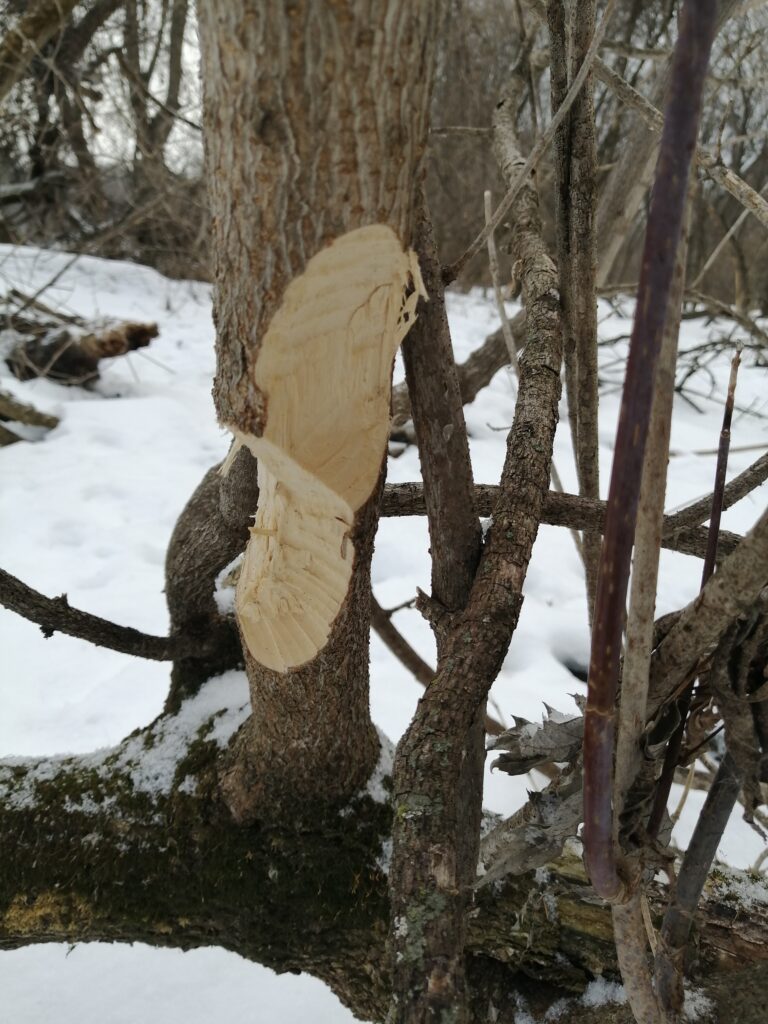
There was even more beaver cuts in the area of my site that appeared to be fresh, additionally there was tracks coming up from the water which indicating that the beaver may have come up from this area. The Winooski River at the time of my visit was broken up with large stretches of water open and some areas retaining full ice cover across. The beaver could swim through these open waters. Beaver do show activity during the winter, to repair structures and dams are never completely frozen. Lancia, R. A., Dodge, W. E., & Larson, J. S. (1982).
Additionally, there was lots of action among birds, there was wood peckers active. A large group of passing black birds, I speculate that it was a group of wintering crows. Crows are known to gather in large groups during the winter. (“Common Crow”, Vermont Fish and Wildlife).
https://drive.google.com/open?id=1yvX9b8GwWQuYy1yfqqQ4nXBZMrdk49Lk
Download to view video of crow movement.
Colby Fong (2020, February 28). Crow Video. Google Drive.
Wood Ducks were also returning from migration and three individuals were spotted swimming in the open parts of the river.
Wood ducks return to Vermont in early march. Ellis, E. & Elison W. (2015).

The beaver is the specific animal I would like to investigate. Beavers during winter spend most of their time in their lodge. Beavers are generally nocturnal so they are often only spotted at dawn or dusk. Lancia, R. A., Dodge, W. E., & Larson, J. S. (1982). They are known in the winter to be generally less active especially when winters are cold. Beavers will stock food near their den and also will repair their lodge. Lancia, R. A., Dodge, W. E., & Larson, J. S. (1982). Black bears, fishers, lynx, and coyotes are known to hunt beavers, Dewey, T. & Anderson, R. (n.d). Beavers eat wood cambium and other plant substances. Dewey, T. & Anderson, R. (n.d). The individual that was active near my site had tracks that led up from the shore that then disappeared. There was chewing on green ash which is a species interaction. The individual also chewed on box elder in my site.

Some phenological changes I have not mentioned yet is the lack of mammalian life when I returned to my site. The conditions for track where not great but not much mammalian life was able to be found. Not even squirrel tracks where able to be found. This may indicate that mammalian life is either not present here at this time of year or it is generally more inactive right now.
The return of the wood duck indicates that some aquatic or insect life must be available for the food duck to eat. Some life must be returning from it winter hiatus.
References:
Lancia, R. A., Dodge, W. E., & Larson, J. S. (1982). Winter activity patterns of two radio-marked beaver colonies. Journal of Mammalogy, 63(4), 598-606.
Wood Duck. (2015). VT Ecostudies.
Common Crow. (n.d.). Vermont Fish and Wildlife Department.
Dewey, T., & Anderson, R. (n.d.). American Beaver. University of Michigan.