In general, the trees on the phenology walk were still in their dormancy phenophase from winter. This also means all of the trees did not yet have any breaking buds, flowers, leaves, or pollen. The Red Oak and the White Oak both still had colored leaves that had not yet fallen, but the rest of the trees had no leaves. The White Oak had significantly more leaves than the Red Oak, however this may have been due to the location of it being shielded from the wind by the building.
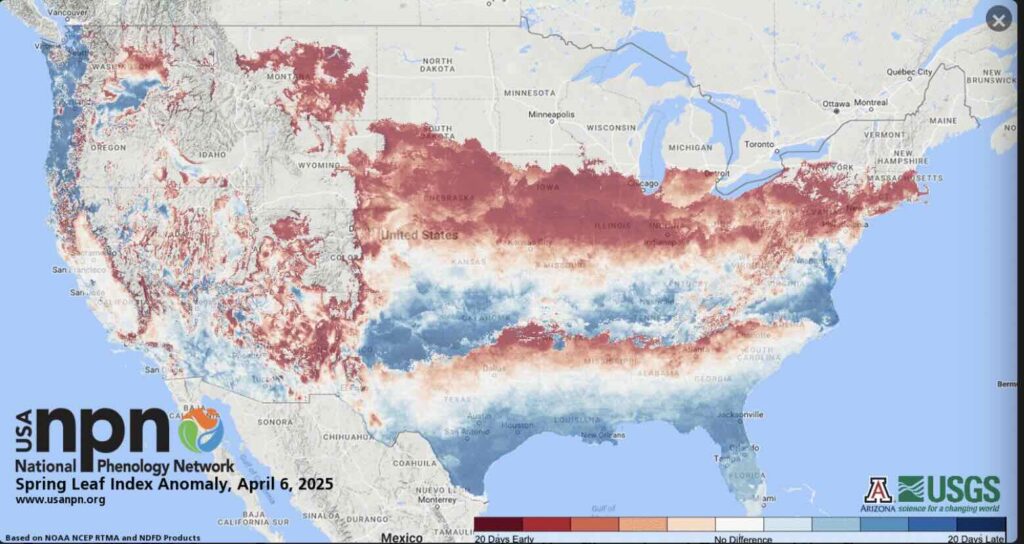
On the “Status of Spring” page I learned that depending on the region, the spring has come early in some locations and later in others around the country. The leaf arrival seemed to have a wave pattern of late, on time, early, and back to late, on time, and early (pictured below). The map also shows that spring (in terms of leaf arrival) has not yet happened in Vermont which matches what I observed on the phenology walk. This could also be relevant to broader discussions about climate change as we can see visible changes in the timing of spring arrival. People often anticipate the season, so having such physical and visual cues may bring more attention and awareness to climate change.