Posts

Final Phenology Blog Post

I think that my site in a bend in centennial brook has changed in the 8 months i’ve been regularly visiting it. Maybe how it has changed is consistent as to how it has changed several years into the past yet these seasonal changes were new to me and will continue to be. As the land changes subtly in ways only a more dedicated steward than I could notice each year, the phenology of the place is never the same.

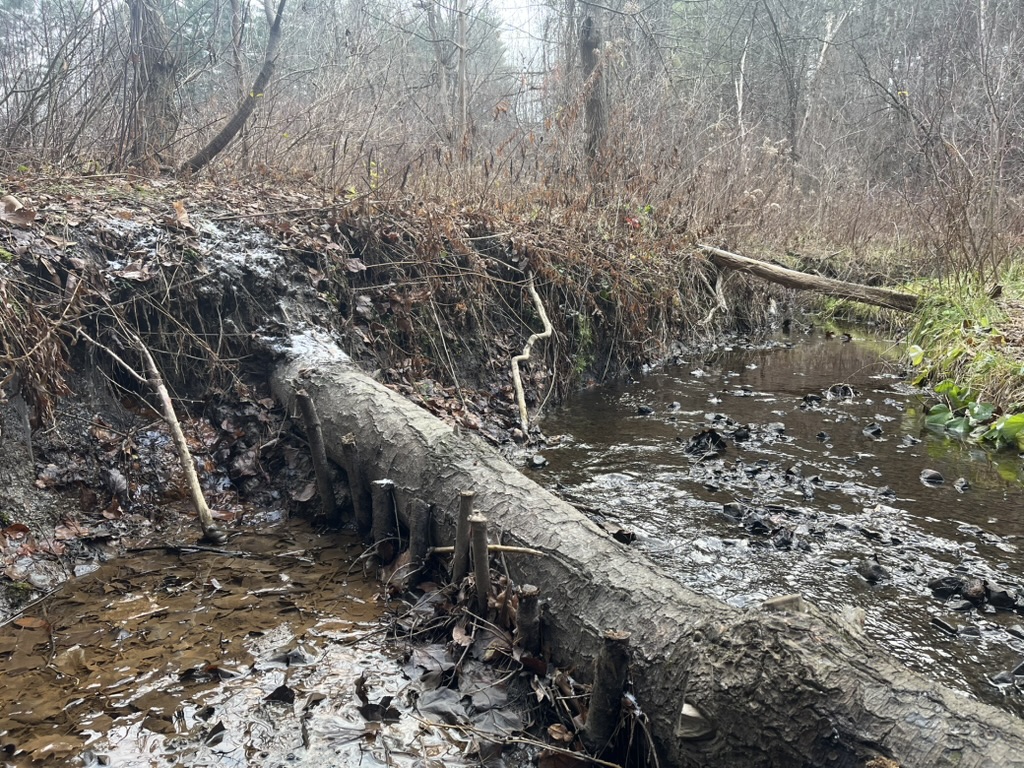
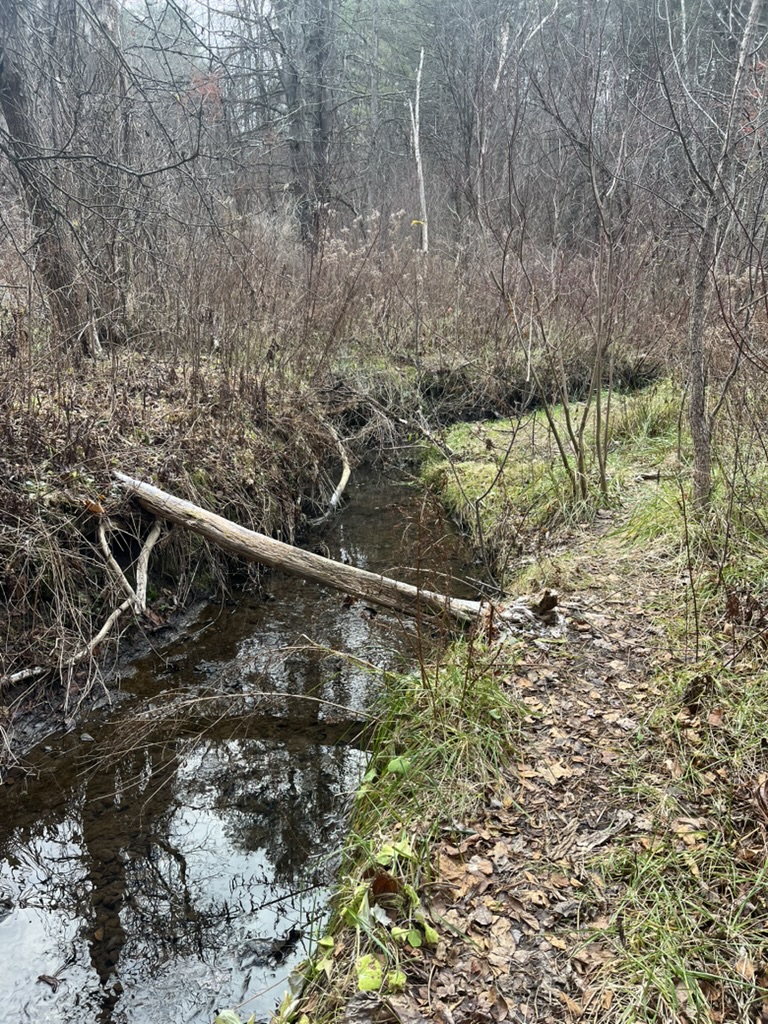
Many landmarks on my site have become known to me, especially the big downed log in the bend of Centennial Brook. This log has been important to me as it allows me to walk across it to the over side of the bank which is more sloped leading to me being able to get a more aerial view of my little bend. This log is important in more ways than just my crossing. The underside harbords various herps. Its unwavering position slows the brooks flow around the bend leading to a patch of still water developing which acts as good insect habitat. The downed log traps nutrients which feed the various plants that live in its wake yet this quality harms when human impact leads to excess nutrients leaching into our waters.

I think that there is a large connection between my site and centennial woods as a hood and the greater burlington area especially the culture at UVM. Centennial Woods is very ingrained in the first year rubenstein student experience since the first lab the first week of school. I think this introduction led me to choose this spot for my phenology spot as I was already familiar with it and it holds a rapidly developing nostalgia for the beginning of when Vermont and everything in it was new to me. Now I just have the illusion that I know even the rounding error of a percentage of what there is to know about my phenology spot and the world.

I would consider myself a part of my place. For no other reason than that I do tread through my spot possibly leading to the crushing of sprouting stems, or crushing leaves that hold eggs of butterflies, or that my walking compacts the soil contributing to the runoff of the area. I think that the spot is certainly a part of me as it has acted as a  place I can go and the brook will still be moving the same direction when everything else is seemingly going awry. 

April 2025 Phenology

I was out of town for a timbersports competition during the bio-blitz so I was not able to see many species and count them towards the burlington team as I was in New Hampshire and Maine. So for this assignment, I am going to share some of the species I saw while I was away and during a birding expedition I took on wednesday (4/23) with a friend of mine and Walter Poleman.

We went to Saint Michaels Natural Area Woodside to see some migratory birds which are at their peaks of migration currently. The trails Woodside brought us along the Winooski River and through a silver maple floodplain forest. In addition to silver maples, the predominant trees were cottonwoods which were the largest trees in this ecosystem. The most interesting species we saw was the spotted sandpiper which was on the bank directly across from us. I am surprised that there weren’t more pines where we were searching as the soil was quite sandy which is common in pine barrens of new england. It is likely that the flooding which is becoming more and more common in Vermont is too much for the pines to handle.

We saw some mammal tracks in the sands on the very edge of the river, they didn’t seem to be beaver so it was potentially muskrat.

Overall, we saw 28 species of birds which are listed below and were logged on Ebird.org

  1. Wood Duck Number Observed: 2
  2. Mallard Number observed: 2
  3. Mourning Dove Number observed: 3
  4. Spotted Sandpiper Number observed: 1
  5. Belted Kingfisher Number observed: 1
  6. Red-bellied Woodpecker Number observed: 3
  7. Downy Woodpecker Number observed: 2
  8. Hairy Woodpecker Number observed: 1
  9. Pileated Woodpecker Number observed: 1
  10. Northern Flicker Number observed: 2
  11. Blue Jay Number observed: 1
  12. Black-capped Chickadee Number observed: 10
  13. Tufted Titmouse Number observed: 2
  14. Ruby-crowned Kinglet Number observed: 2
  15. Golden-crowned Kinglet Number observed: 1
  16. White-breasted Nuthatch Number observed: 6
  17. Carolina Wren Number observed: 2
  18. European Starling Number observed: 1Exotic: Naturalized
  19. American Robin Number observed: 9
  20. American Goldfinch Number observed: 3
  21. White-throated Sparrow Number observed: 2
  22. Song Sparrow Number observed: 13
  23. Eastern Towhee Number observed: 1
  24. Red-winged Blackbird Number observed: 3
  25. Brown-headed Cowbird Number observed: 2
  26. Rusty Blackbird Number observed: 1
  27. Common Grackle Number observed: 3
  28. Northern Cardinal Number observed: 6

WordPress is not allowing me to upload the photos directly to the blog so I have created a google photos folder that should give access to all of the photos from this adventure.

https://photos.app.goo.gl/afAZ3B7992VqTkG2A

4/16 Phenology Walk

I was originally supposed to take this walk on monday (4/14) but something came up leading to me having to do it today. Unfortunately, today was a crisp 40° and snowing while monday would have been 60° and sunny. Odd weather patterns like this can lead to disruptions in the phenophases of plant as if there is an unnaturally hot day, there may be enough environmental indicators for the plant to break its buds only for a cold spell in future days to kill the bud reducing the amount that that plant would be able to reproduce.

The infrequent warm spells didn’t seem to warp the phenophases of the trees I looked at which included Red Oak, Sugar Maple, White Oak, Red Maple, and Norway Maple. With spring still being in its youth, most of the trees I looked at weren’t very far in their phenological cycles yet what part of the cycle they were in was different among the trees.

The Red Maple was the plant furthest along in its phenological cycle as its leaf buds had broken to reveal the flower bud. The White Oak and the Sugar Maple had buds that were in the process of breaking while the Red Oak and the Norway Maple’s buds had yet to break.

These differences in the timing of phenophases is in part due to filling ecological niches in which by flowering at different times, the trees are not all competing with one another and don’t have to compete for the same animal pollinators. This difference in phenophase timing leads to more tree biodiversity as well as supports the pollinator biodiversity as they no longer have to compete over the nectar or other resources from the same plants.

NR1020 2/24 Phenology Assignment 2

Over the past couple of weeks, i’ve been recording signs of life all across burlington.

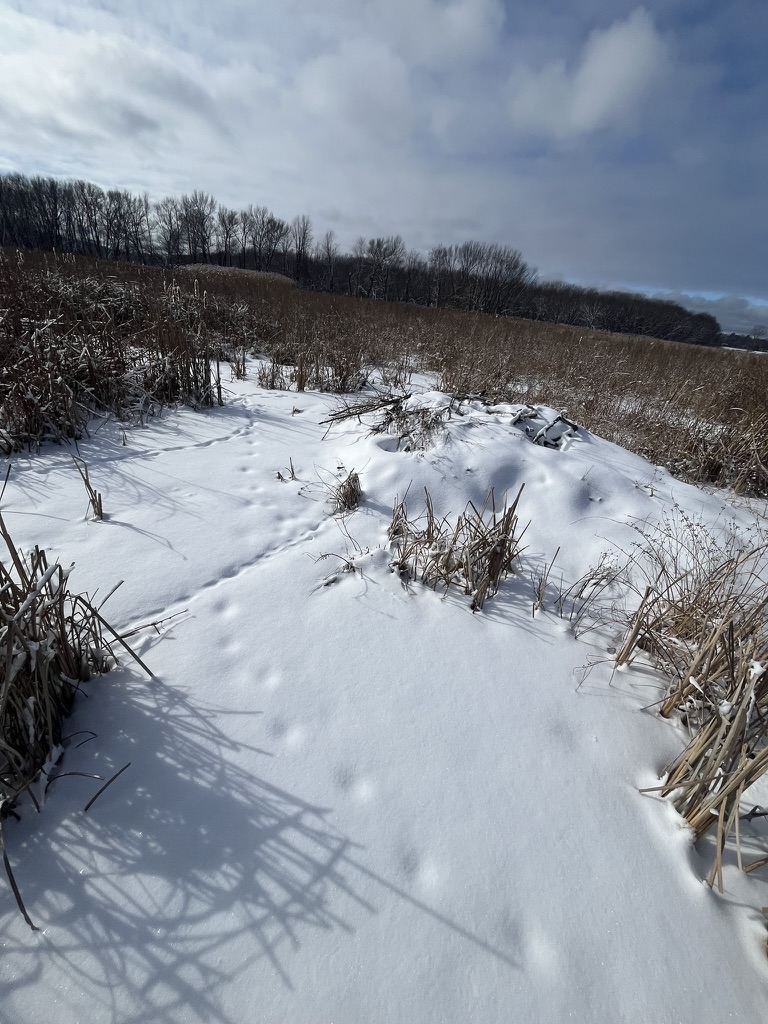
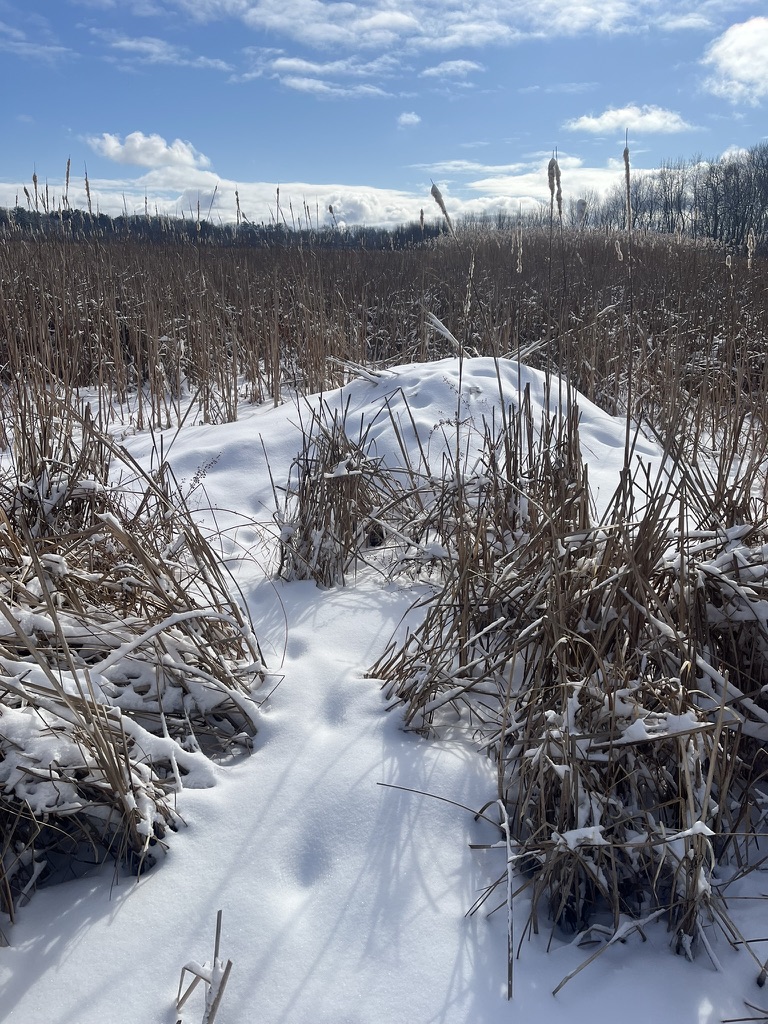
The most significant to me was going to delta park and walking across the frozen Winooski River to reach Halfmoon Cove. This area was rich with wetland plant as well as beaver lodges. There was a similar structure to a beaver lodge that had more reeds than wood in it which I think may have been the result of beavers abandoning the structure and some other animals such as a muskrat moved in and is inhabiting it. There were tracks around and on top of the structures which supported my idea that these structures are in active use.

On a sunday morning in which Burlington was expected to get a foot of snow that day, I went with my friend to Centennial Woods to go birding. This was my first time birding and it was certainly a memorable one. Over the course of a very snowy trek through the woods, we saw one bird. That bird however was the majestic pileated woodpecker which we find identified by hearing its pecking on tree and waited until it eventually it flew to a tree in view.

In addition to these very natural environments, I identified a variety of trees that I came across Burlington. An easy to identify one was American Beech as they are one of the few deciduous trees that keep their leaves over winter rather than dropping them. This gives them a similar advantage that many evergreens have in conserving energy by not needing to regrow leaves which is especially beneficial in areas that are low in nutrients. I also saw a tree that was definitely in the Birch family and what I think was a Yellow Birch due to the coloring of the bark.

Link to INaturalist profile

https://www.inaturalist.org/people/thomas_chamberlain

Thomas Chamberlain NR1020 Phenology Assignment 1

1/19/2025

This was the first time i’d been back to my spot since the last assignment for NR1010 last semester. In my absence a lot had changed at my bend in Centennial Brook. When I had left, there had been snow on the ground but now much of the top of the stream was frozen especially in the shallower areas.

The snow wasn’t new as it hasn’t been warm enough recently for a thaw. The snow seemed to have frozen to have a granular texture. There were tracks from some mammal that was larger than a squirrel but smaller than the average dog. The tracks were old though so much of the detail of them had disappeared and all that remained was the patterned depression in the snow.

Intersecting the larger set of tracks was a smaller set of tracks probably a vermin of some sort. The area was much more exposed than previous times as there were no leaves on the trees around and this area wasn’t inhabited by conifers. This led to more sunlight reaching the area which may lead to the snow melting faster once the temperatures increase above freezing. At the end of winter, this increase in sunlight may lead to an increase in the productivity of the plants as they begin to bloom for spring.

Phenology Assignment 5

12/3/2024

It was refreshing to return to my phenology place as it acts as a familiar place even when it is relentlessly in its seasonal ebb and flow. As I enter Centennial Woods, there is a blanketing stillness. A lack of movement defines every part of the landscape from the trees not shaking with the wind and an understory seemingly abandoned. Besides the tall pines that hold onto their majesty year round, all of the other trees are devoid of their flare and now their crooked branches on full display.

The only deciduous tree I see that holds its leaves is the Norway Maple but the leaves are more shriveled up as if the tree is embarrassed of its leaves which were once golden but are now the color of brass thats been exposed long enough to develop a patina.

As if fighting back from the stillness that is almost universal, the bend of Centennial Brook i’ve been observing for this project has a rippled texture of movement on its surface that looks like the rolling hills that cover much of Vermont. Not all parts of Centennial Brook are equal in their movement, some unbending lengths one has to look very closely to find the current that makes Centennial Brook closer to a stream than a pond. Where there was the humming of frogs, there is only the sound of the current. In deeper holes by my bend Minnows can be seen as they always have been.

Many of the leaves that used to be one of Centennial Woods prime attractions now compile in Centennial Brook steering the flow of the water. The leaves in the water are devoid of their color as they all seem to take on a uniform shade of grayish brown.

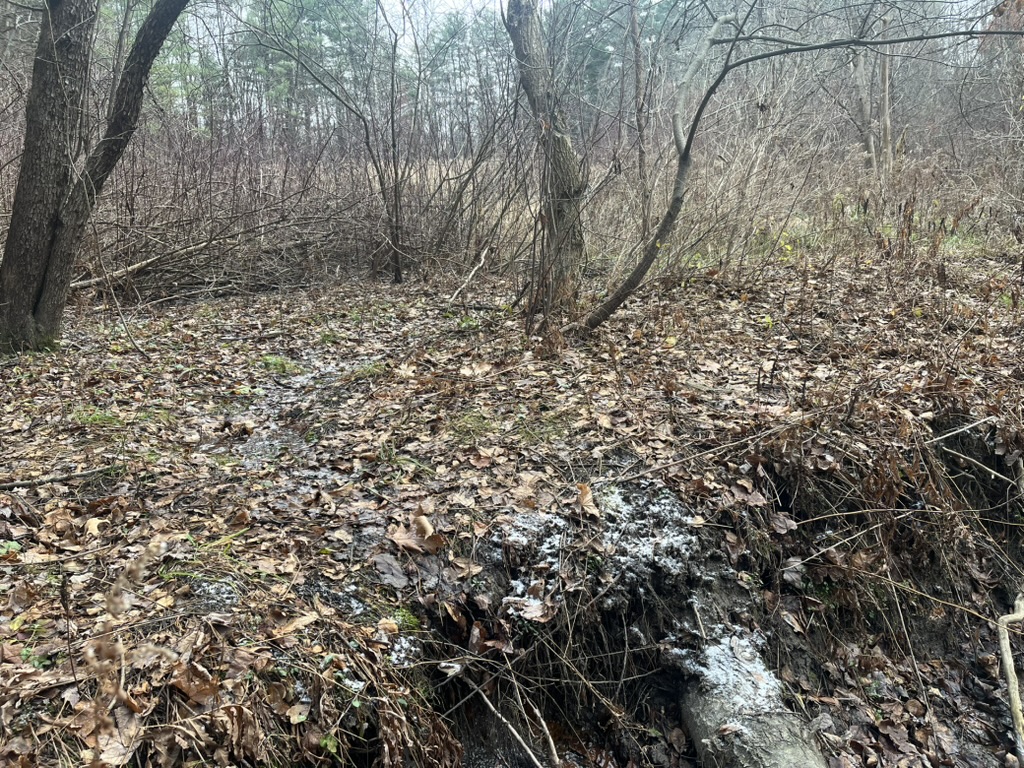
The most surprising change I noticed was by the downed log that aids in the waters bend west there are 2 new sources of water into Centennial Brook. One of them is above the ground and very shallows and the second seems to spring out from the side of the bank. The dirt around the new spout in the side of the bank is dyed a copper brown color as if the water is carrying either clay or iron with it.

I think the part of my phenology place that I enjoy is how the water has carved through the banks leading to its current path. It is interesting thinking of how the path the water takes will change in the future with clues hinting to this answer being found in differences in depths, obstructions changing flow of water, and where the drowned leaves can be found in abundance. This phenology project in general has been very rewarding as in reducing the scope of the area I am analyzing to just one section of a far greater environment, I am able to fluently understand the slow changes that occur to this area with the passing of time. I can not make any promises that I may not be able to deliver upon in the future but I do hope to continue the ritualistic observance of this small bend in a much larger stream.

Phenology Assignment 4

Rather than my typical phenology spot, for this assignment my location was in my backyard. More specifically than that, my backyard which is in northeastern Virginia. Identifying the environmental features here was different than my typical phenology spot as even though I had grown up here, I am much more adept at the composition of the environment in Vermont than Virginia.

This led to some challenges in identifying the species of trees but with the help of INaturalist, I was able to identify most of them.

Some of the most notable species I found in my backyard were

  • River Birch
  • Eastern Red Cedar
  • Chinese Holly

There were a few others that I wasn’t able to identify but there is an almost even split to the amount of conifers and deciduous trees in my backyard. The leaves from the deciduous trees blanket the grass in the backyard in the winter which can serve as the shelter for small critters especially butterflies that plant their eggs on the bottom of these leaves. They also return nutrients to the soil which otherwise would just be raked away.

With being in town for not a very long time I wasn’t able to get a gift to leave in my backyard. Although I wasn’t able to prepare a physical gift for my backyard, in the spring and summer I like to work in my backyard growing some plants and hope to do some big changes to the composition of the grasses that will be more beneficial to pollinators and other animals that sometimes pass through my backyard.

Link to INaturalist Profile

https://www.inaturalist.org/people/thomas_chamberlain

Phenology Assignment 3

This assignment began with spending 15 minutes experiencing my spot in centennial woods.

During this time I heard a variety of things. Faintly in the background I heard the hum of cars driving up and down the roads outside of the woods. Much closer to where I was though, I heard the the flow of the water and the croaking and splashing of frogs going about their business. I could also hear the crumpling of leaves from nearby walkers and tree limbs scraping one another when the wind blew through.

I saw a lot more in this 15 minutes than previous assignments as with trees shedding their leaves, the area has become much more exposed. This increase in sunlight may have impacts on the productivity of the centennial brook. In Centennial Brook, there were a lot of leaves that had fallen due to the change in seasons. This influx of leaves in the water can impair the water quality as the leaves contain nutrients such as phosphorus.

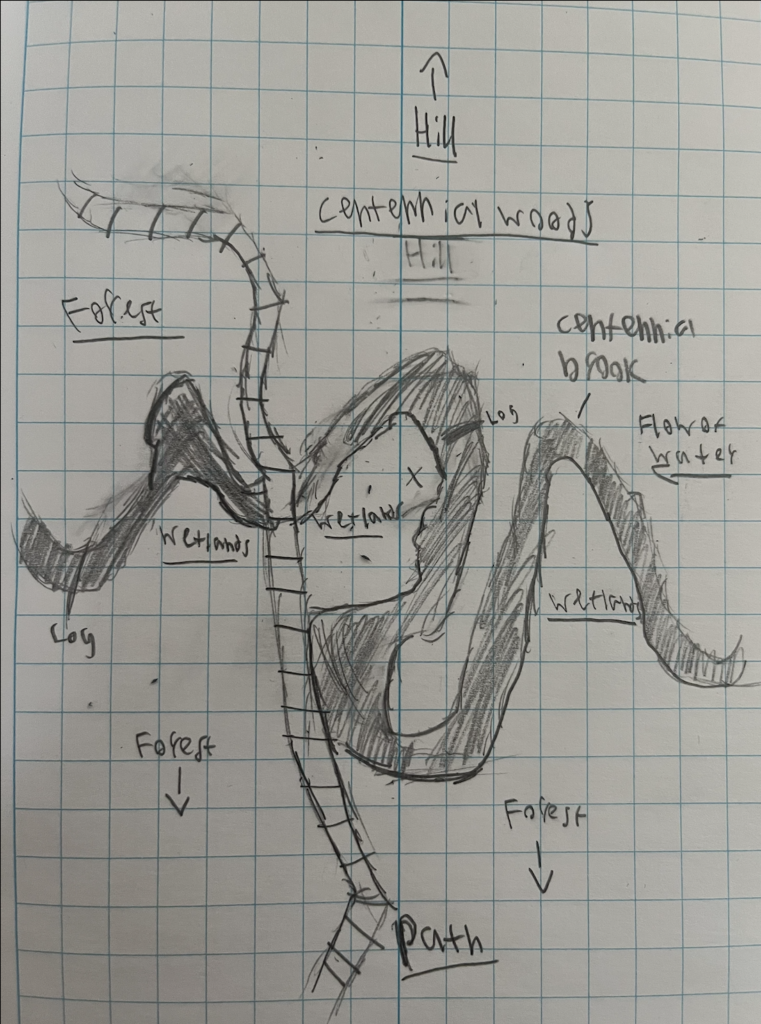
The second section of this assignment was to draw a map with a top down view of your area.

The final section of this assignment is to describe the changes in the area since i’ve last been there. The first thing I noticed was that the area was much more exposed as a lot of the cover from leaves was gone. This led to a larger organic layer on the ground as well as more leaves in Centennial Brook which I mentioned previously. The crabapple trees nearby were not as ripe with fruits which dominated the area when I went on previous visits. Perhaps the most noticeable change was how yellow the area seemed. This was due to the Norway Maples leaves turning a bright yellow in the fall. The Norway Maples in my area are the last deciduous tree with a substantial amount of leaves still on the tree leading to this dominant yellow in the color of the under and overstory in the area.

(10/9/24) Blog Post

My Location for this phenology project is a small bend in a stream in Centennial Woods. I chose this spot because of an interest I have in river morphology as in this bend there are various features such as rock and logs that change the speed and direction of flow leading to different micro environments existing.

To get to my location, you need to follow the trail until you reach an area in which there is a stream on both sides of the walkway. You should now be able to see an unofficial trail leading to the right. Follow that trail until you go around the bend where you should be able to see the fallen log in the water with the Mountain Holly tree looming over.

Along the bank of this stream the most common organisms you’ll find are Mountain Holly, Wood Ferns, and various maple trees. Ferns are various woody plants are found closest to the bank of the stream with larger woody plants and trees such as Sugar Maples being found further away from the stream bank. Inside the stream, minnows swim and frogs lay their eggs. The Mountain Holly dropping its berries leads to this being a popular spot for squirrels and birds to come forage for food.

The X in the bottom left corner is an entrance into Centennial Woods. The X closer to the middle is where I believe my bend in my stream to be although a lack a street-view data within Centennial Woods makes it difficult to identify on a map

These are two pictures that I took at my location.

Skip to toolbar