
Directions:
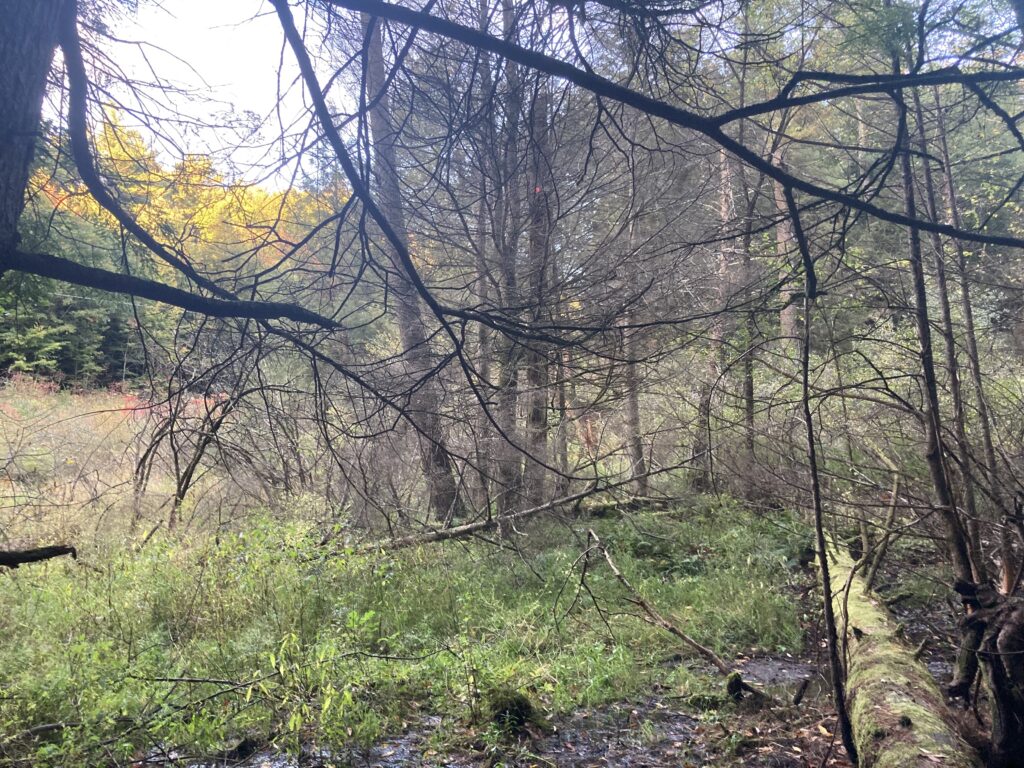
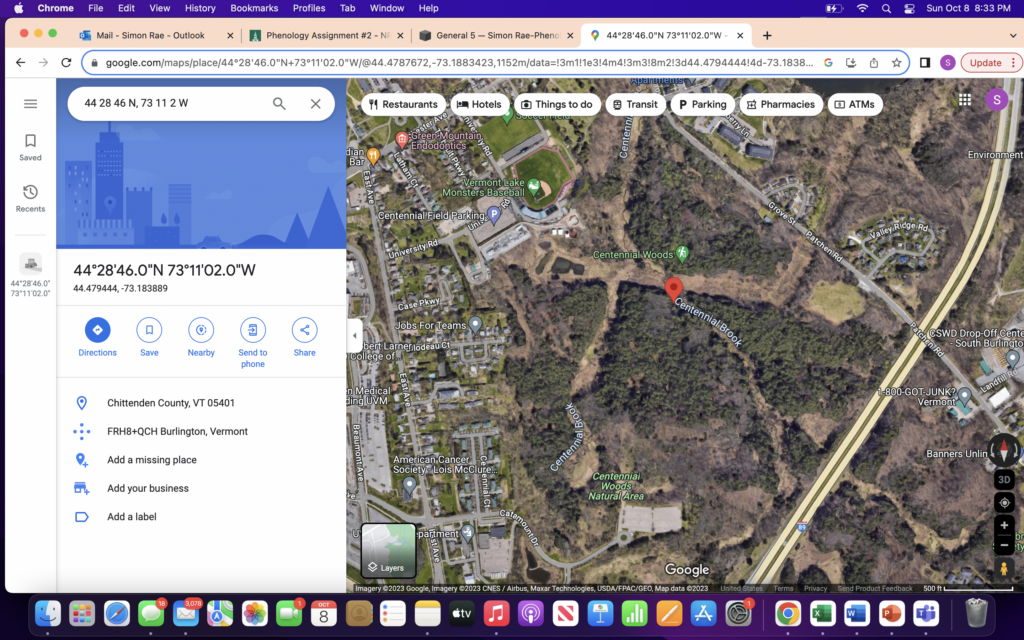
Enter at the trail head on Catamount Drive. Continue down the main path, which crosses over several raised wooden platforms. Take a right when you arrive at the junction near the floodplain, and cross the first branch of Centennial Brook. Continue to the next junction, and take the path that follows the brook downstream. Just before you get to the clearing with the power lines, take a right up and over the hill. When you arrive on the other side, this is what you will see.
Description:
The wetland that makes up about 50% of my site’s area extends all along the length of Centennial Brook. The soils are constantly moist, and most of the trees are dead. Up on the hill which makes up the other 50%, the trees are more stable and older. There are several large Hemlocks, and one enormous Ash tree.
I chose this place because I happened to sit down in the area one morning to observe the bird activity. I watched a flock of chickadees raid the hemlock cones above my head, and listened to a noisy blue jay perched in one of the dead trees. Many of the chickadees came quite close to me, and I saw a bird that I believed to be a Brown Creeper on one of the dead hemlocks. I also developed an appreciation for many of the individual trees, and so I decided I wanted to get to know the place.
Since I first visited the site, the Ash tree has been dropping more and more of its leaflets, which often separate from the stem that connects them when they fall. The birches have been yellowing, but so far have not been dropping their leaves as of October 8th.
Vegetation:
Woody Plants identified thus far include Yellow Birch, one species of ash, red oak, red maple, sugar maple, glossy buckthorn, burning bush, and Eastern Hemlock. Yellow birch and Eastern hemlock are most prevalent.
Herbaceous plants include Sensitive Fern, Christmas Fern, at least one unknown type of fern, Ground Bean, Jewel weed, mosses and wetland grasses.
Hi, this is a comment.
To get started with moderating, editing, and deleting comments, please visit the Comments screen in the dashboard.
Commenter avatars come from Gravatar.