
October 2020 Vegetation Changes and Wildlife sightings
Thank god we’re back! I bet you’ve been absolutely losing your mind wondering why I haven’t posted a blog(obviously). This is because we’ve been tracking temporal data and recording wildlife sightings in order to provide a more comprehensive and accurate description of Red Rocks Park’s unique ecosystem.
As fall in Vermont treads on, the leafs of deciduous trees and some Northern Hardwoods(Maples, Birches, Beech) in the area begin to fall off as a result of cold weather and high winds coming off of the lake. We can see many squirrels using this as a golden opportunity to collect the last of the tree’s acorns before winter hits.
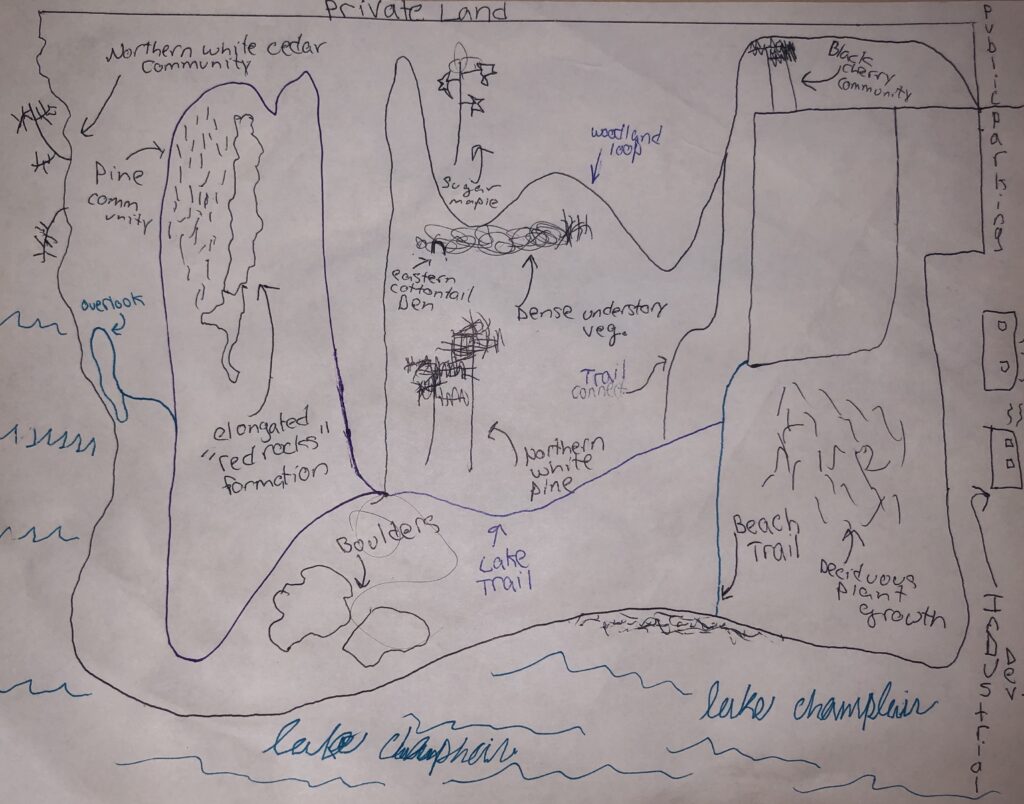
After a brief trip today, I also was able to see a fairly large Eastern Cottontail off the trial not too far from me. The Cottontail was hopping around vegetation and small twigs/berries. After this deciduous undergrowth is consumed by the harsh truth of Vermont Winter’s, the Hare will have to find a new source of food in this temperate climate.
It was also very intriguing to see a clear spatial distribution between deciduous and coniferous forest growth. While Eastern Hemlock’s and White Pine’s presided high above the tree line, some small hardwoods clearly struggled to get enough sun and compete. We can also see how wide pathways and constant human interaction as a result of being an ‘urban wild’ negatively impacts the ecological community; both physically with human development and constant impact, as well as the thousands of local flora and fauna species that resided in this protected area.
Below this post, you’ll see a detailed map that can act as a guide for understanding the physical and ecological processes that occur within Red Rocks Park. Notice how different communities are spatially distributed and how certain trails cut through these natural communities, ultimately affecting plant growth and ecosystem development.
Recent Comments