Burlington is a city interwoven with a college campus and natural areas. One of these natural areas is Centennial Woods, a natural area where Native Americans lived, and Europeans & Americans settled. The land ownership went from Baxter, 1891, Ainsworth, 1904, Hickok, 1908, Kirby, 1938, and Unsworth, 1968. The forest is presumed fairly new, since records indicate the forest underwent succession following settlements and agricultural use.
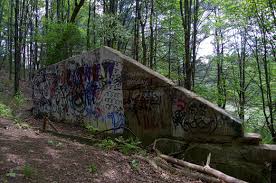
The woods contain 70 acres of diverse species, and an array of evidence of human use. One of the most prominent “unnatural” features is the large cement bunker. The presumed previous military bunker is now a crumbling mass of cement, turned into art by the graffiti sprawling across it’s surface. Although military bunker is the top contender as an answer for this mysterious piece, there have been other propositions such as an abandoned structure for agriculture, or was meant to be used for borders/surveying in Burlington.
Another use we learned about in lab was the abandoned ski area of Centennial Woods. Evident through a metal pole, and a rusty gear, we see evidence of the ski slope that once was. The placement of this evidence makes sense, since it sits beside a steep slope, now grown in with trees, with a few trails for mountain biking.
Overall, Centennial Woods is the culmination of human history and natural areas combining. Now the area is evident of human usage through the trails and bridges that adorn it. A walk through the woods and you’ll encounter runners, hikers with dogs, mountain bikers, and everyone in between, showing how Burlington is truly a place where people and nature can live together.
Sources
https://researchguides.uvm.edu/centennialwoods/history#s-lg-box-21517714
http://www.uvm.edu/~uvmsc/Centennial%20Woods/Changing_Landscapes_Centennial_Woods002.pdf
https://obscurevermont.com/tag/south-burlington-kiwanis-ski-area/