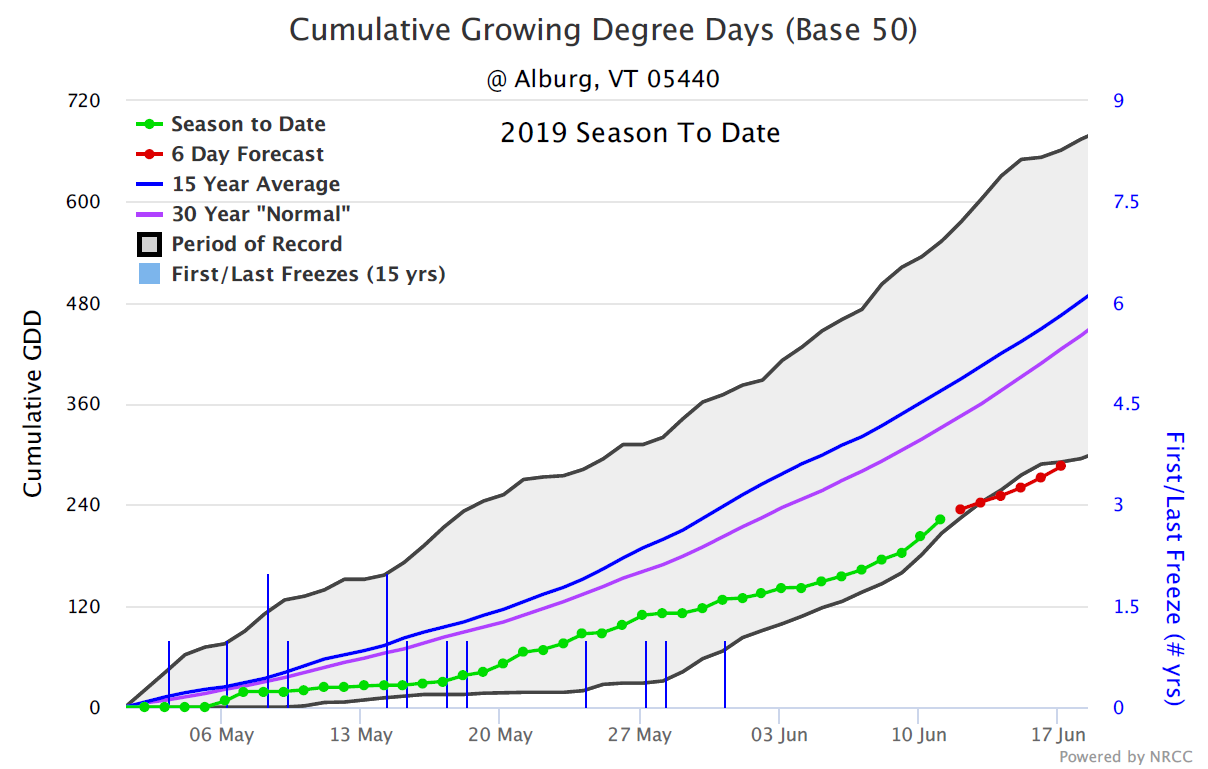
{"id":3340,"date":"2019-06-17T13:18:26","date_gmt":"2019-06-17T17:18:26","guid":{"rendered":"http:\/\/blog.uvm.edu\/outcropn\/?p=3340"},"modified":"2019-06-21T09:34:08","modified_gmt":"2019-06-21T13:34:08","slug":"late-corn-planting","status":"publish","type":"post","link":"https:\/\/blog.uvm.edu\/outcropn\/2019\/06\/17\/late-corn-planting\/","title":{"rendered":"Late Corn Planting"},"content":{"rendered":"\n<p>At this point in the season, it is important to make sure that crops planted in June and early July will have enough heat accumulation, measured in Growing Degree Days (GDDs), to reach maturity and provide adequate yields. This year we have seen fewer GDDs than average, and a wet spring has delayed corn planting. However, it may not be too late to plant corn for silage in some locations. <\/p>\n\n\n\n<p>From May 1<sup>st<\/sup> to June 11th, 224 GDDs (with a base\ntemperature of 50\u00b0F and a maximum temperature of 86\u00b0F for corn) have\naccumulated in Alburgh VT, which is 108 less than the 30-year normal of 332\nGDDs, and 152 less than the 15 year average of 376. Lower accumulations of GDDs\nhave occurred before, with the lowest on record being 207 GDDs from May 1<sup>st<\/sup>\nto June 11<sup>th<\/sup> in Alburgh, VT, and the highest being 553 GDDS.<\/p>\n\n\n\n<p>For the year to date, from January 1<sup>st<\/sup> to June 11<sup>th<\/sup>,\n240 GDDs have accumulation total, 135 less than the 30-year normal of 375. <\/p>\n\n\n\n<p>The accompanying figure at the end of this document shows this year\u2019s accumulated GDDs for corn in Alburgh, VT, starting on May 1<sup>st,<\/sup> in comparison to the 30-year normal and period of record. <\/p>\n\n\n\n<p>One option to ensure an adequate corn yield is to plant a\nsilage variety with a lower relative maturity (RM). Corn varieties will higher\nrelative maturities, like 110-115 RM, will require 2700-2900 GDDs. By planting\ncorn with a lower RM, you can harvest a crop that requires closer to 2000 GDDs.\nSilage corn with 90-95 RM will take approximately 2200-2300 GDDs to maturity,\n85-90 RM will take approximately 2000-2200 GDDs, and 80-85 RM will take\napproximately 1700-2000 GDDs. After June 10<sup>th<\/sup> it is too late to\nplant most corn varieties. <\/p>\n\n\n\n<p>Suggested planting dates in Wisconsin recommend planting\ncorn for silage with 85-90 RM around June 10<sup>th<\/sup>, 80-85 RM around June\n20th, and can be planted as late as July 1<sup>st<\/sup>. The table below shows\nprojected GDDs that will likely accumulate from June 14<sup>th<\/sup> to the end\nof October in different locations around Vermont, calculated from the average\nfrost dates and average monthly highs and lows from usclimatedata.com. <\/p>\n\n\n\n<table class=\"wp-block-table\"><tbody><tr><td>\n  <strong>Town<\/strong>\n  <\/td><td>\n  <strong>Average\n  frost date<\/strong>\n  <\/td><td>\n  <strong>Projected\n  GDDs June 14<sup>th<\/sup>-October 31<sup>st<\/sup><\/strong>\n  <\/td><\/tr><tr><td>\n  Newport\n  <\/td><td>\n  Sept 21-30\n  <\/td><td>\n  1413-1448\n  <\/td><\/tr><tr><td>\n  St. Johnsbury\n  <\/td><td>\n  Sept 21-30\n  <\/td><td>\n  1501-1582\n  <\/td><\/tr><tr><td>\n  Rutland\n  <\/td><td>\n  Sept 21-30\n  <\/td><td>\n  1467-1534\n  <\/td><\/tr><tr><td>\n  Burlington\n  <\/td><td>\n  Oct 1-10\n  <\/td><td>\n  1772-1878\n  <\/td><\/tr><tr><td>\n  Salisbury\n  <\/td><td>\n  Sept 21-30\n  <\/td><td>\n  1727-1816\n  <\/td><\/tr><tr><td>\n  Randolph\n  <\/td><td>\n  Sept 11-20\n  <\/td><td>\n  1327-1381\n  <\/td><\/tr><\/tbody><\/table>\n\n\n\n<p>In the warmer regions of Vermont such as Addison and\nChittenden counties, you may be able to successfully plant and harvest silage\ncorn with 80-85 RM varieties. In cooler regions, it is too late to plant corn\nthat will reach relative maturity. <\/p>\n\n\n\n<p>If you are outside Addison and Chittenden counties, and your\nsilage corn is still not in the ground, or if you are in Addison and Chittenden\nand will not be able to plant in the next week or so, you will want to consider\nyour other options, such as planting a cover crop. If you have crop insurance,\nconsider what the latest planting date you can plant without affecting your\ncoverage. When considering whether to plant soybean instead of corn, take into\naccount whether any nitrogen was applied to the field for a corn crop, as corn\nwill use more of the applied nitrogen than soybeans. If nitrogen amendments have\nbeen applied, corn will make the best economic use of the nutrients already\napplied. The application of corn herbicides will also limit what can be planted\nnext. Brassica cover crops for forage can be planted in July, and can be\nplanted with cereal cover crops. Brassicas will remain a good grazing forage\ninto November as they are frost tolerant. Winter cereals and legumes can be\nplanted in August. For more information on summer alternative forages, see\nNorthwest Crop and Soils\u2019 <em>Use of\n\u201cAlternative Forages\u201d on Certified Organic Dairy Farms in the Northeast <\/em>(PDF)\nfact sheet at <a href=\"https:\/\/www.uvm.edu\/sites\/default\/files\/media\/FAFOAlternativeForages.pdf\">https:\/\/www.uvm.edu\/sites\/default\/files\/media\/FAFOAlternativeForages.pdf<\/a>.\n<\/p>\n\n\n\n<p>References<\/p>\n\n\n\n<p>Climate Smart Farming Growing Degree Day Calculator, Cornell University. <\/p>\n\n\n\n<p>Grubinger, V. (2015). <em>Scheduling\nSweet Corn Plantings.<\/em> University of Vermont Extensions Vegetable and Berry\nProgram. <a href=\"https:\/\/www.uvm.edu\/vtvegandberry\/factsheets\/SchedulingSweetCorn.html\">https:\/\/www.uvm.edu\/vtvegandberry\/factsheets\/SchedulingSweetCorn.html<\/a>\n<\/p>\n\n\n\n<p>Lauer, J. (2013). <em>How\nLate Can I Plant Corn?<\/em> Field Crops 28: 421-111.<\/p>\n\n\n\n<p>usclimatedata.com <\/p>\n\n\n\n<figure class=\"wp-block-image\"><img loading=\"lazy\" decoding=\"async\" width=\"1208\" height=\"769\" data-attachment-id=\"3341\" data-permalink=\"https:\/\/blog.uvm.edu\/outcropn\/2019\/06\/17\/late-corn-planting\/cumulative-gdds\/\" data-orig-file=\"https:\/\/i0.wp.com\/blog.uvm.edu\/outcropn\/files\/2019\/06\/Cumulative-GDDs.png?fit=1208%2C769&amp;ssl=1\" data-orig-size=\"1208,769\" data-comments-opened=\"1\" data-image-meta=\"{&quot;aperture&quot;:&quot;0&quot;,&quot;credit&quot;:&quot;&quot;,&quot;camera&quot;:&quot;&quot;,&quot;caption&quot;:&quot;&quot;,&quot;created_timestamp&quot;:&quot;0&quot;,&quot;copyright&quot;:&quot;&quot;,&quot;focal_length&quot;:&quot;0&quot;,&quot;iso&quot;:&quot;0&quot;,&quot;shutter_speed&quot;:&quot;0&quot;,&quot;title&quot;:&quot;&quot;,&quot;orientation&quot;:&quot;0&quot;}\" data-image-title=\"Cumulative-GDDs\" data-image-description=\"\" data-image-caption=\"\" data-medium-file=\"https:\/\/i0.wp.com\/blog.uvm.edu\/outcropn\/files\/2019\/06\/Cumulative-GDDs.png?fit=300%2C191&amp;ssl=1\" data-large-file=\"https:\/\/i0.wp.com\/blog.uvm.edu\/outcropn\/files\/2019\/06\/Cumulative-GDDs.png?fit=640%2C408&amp;ssl=1\" src=\"https:\/\/i2.wp.com\/blog.uvm.edu\/outcropn\/files\/2019\/06\/Cumulative-GDDs.png?fit=1024%2C652&amp;ssl=1\" alt=\"\" class=\"wp-image-3341\" srcset=\"https:\/\/i0.wp.com\/blog.uvm.edu\/outcropn\/files\/2019\/06\/Cumulative-GDDs.png?w=1208&amp;ssl=1 1208w, https:\/\/i0.wp.com\/blog.uvm.edu\/outcropn\/files\/2019\/06\/Cumulative-GDDs.png?resize=300%2C191&amp;ssl=1 300w, https:\/\/i0.wp.com\/blog.uvm.edu\/outcropn\/files\/2019\/06\/Cumulative-GDDs.png?resize=768%2C489&amp;ssl=1 768w, https:\/\/i0.wp.com\/blog.uvm.edu\/outcropn\/files\/2019\/06\/Cumulative-GDDs.png?resize=1024%2C652&amp;ssl=1 1024w\" sizes=\"auto, (max-width: 640px) 100vw, 640px\" \/><\/figure>\n","protected":false},"excerpt":{"rendered":"<p>At this point in the season, it is important to make sure that crops planted in June and early July will have enough heat accumulation, measured in Growing Degree Days (GDDs), to reach maturity and provide adequate yields. This year we have seen fewer GDDs than average, and a wet spring has delayed corn planting. &hellip; <\/p>\n<p class=\"link-more\"><a href=\"https:\/\/blog.uvm.edu\/outcropn\/2019\/06\/17\/late-corn-planting\/\" class=\"more-link\">Continue reading<span class=\"screen-reader-text\"> &#8220;Late Corn Planting&#8221;<\/span><\/a><\/p>\n","protected":false},"author":909,"featured_media":0,"comment_status":"open","ping_status":"open","sticky":false,"template":"","format":"standard","meta":{"_monsterinsights_skip_tracking":false,"_monsterinsights_sitenote_active":false,"_monsterinsights_sitenote_note":"","_monsterinsights_sitenote_category":0,"jetpack_post_was_ever_published":false,"_jetpack_newsletter_access":"","_jetpack_dont_email_post_to_subs":false,"_jetpack_newsletter_tier_id":0,"_jetpack_memberships_contains_paywalled_content":false,"_jetpack_memberships_contains_paid_content":false,"footnotes":"","jetpack_publicize_message":"","jetpack_publicize_feature_enabled":true,"jetpack_social_post_already_shared":true,"jetpack_social_options":{"image_generator_settings":{"template":"highway","default_image_id":0,"font":"","enabled":false},"version":2}},"categories":[1],"tags":[],"class_list":["post-3340","post","type-post","status-publish","format-standard","hentry","category-uncategorized","entry"],"jetpack_publicize_connections":[],"featured_image_src":null,"featured_image_src_square":null,"author_info":{"display_name":"outcropn","author_link":"https:\/\/blog.uvm.edu\/outcropn\/author\/outcropn\/"},"jetpack_featured_media_url":"","jetpack_sharing_enabled":true,"jetpack_shortlink":"https:\/\/wp.me\/p67qLh-RS","jetpack-related-posts":[],"_links":{"self":[{"href":"https:\/\/blog.uvm.edu\/outcropn\/wp-json\/wp\/v2\/posts\/3340","targetHints":{"allow":["GET"]}}],"collection":[{"href":"https:\/\/blog.uvm.edu\/outcropn\/wp-json\/wp\/v2\/posts"}],"about":[{"href":"https:\/\/blog.uvm.edu\/outcropn\/wp-json\/wp\/v2\/types\/post"}],"author":[{"embeddable":true,"href":"https:\/\/blog.uvm.edu\/outcropn\/wp-json\/wp\/v2\/users\/909"}],"replies":[{"embeddable":true,"href":"https:\/\/blog.uvm.edu\/outcropn\/wp-json\/wp\/v2\/comments?post=3340"}],"version-history":[{"count":3,"href":"https:\/\/blog.uvm.edu\/outcropn\/wp-json\/wp\/v2\/posts\/3340\/revisions"}],"predecessor-version":[{"id":3350,"href":"https:\/\/blog.uvm.edu\/outcropn\/wp-json\/wp\/v2\/posts\/3340\/revisions\/3350"}],"wp:attachment":[{"href":"https:\/\/blog.uvm.edu\/outcropn\/wp-json\/wp\/v2\/media?parent=3340"}],"wp:term":[{"taxonomy":"category","embeddable":true,"href":"https:\/\/blog.uvm.edu\/outcropn\/wp-json\/wp\/v2\/categories?post=3340"},{"taxonomy":"post_tag","embeddable":true,"href":"https:\/\/blog.uvm.edu\/outcropn\/wp-json\/wp\/v2\/tags?post=3340"}],"curies":[{"name":"wp","href":"https:\/\/api.w.org\/{rel}","templated":true}]}}