May 7th, 2022 – Final Phenology Spot Visit

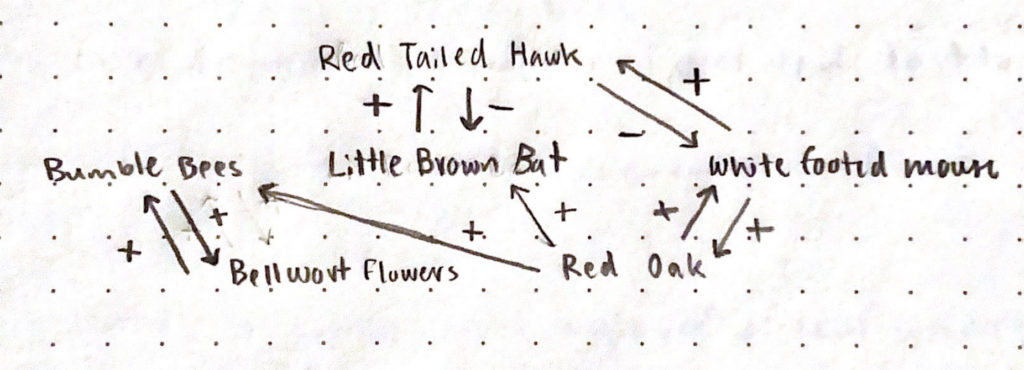
Potential Species Interaction Diagram

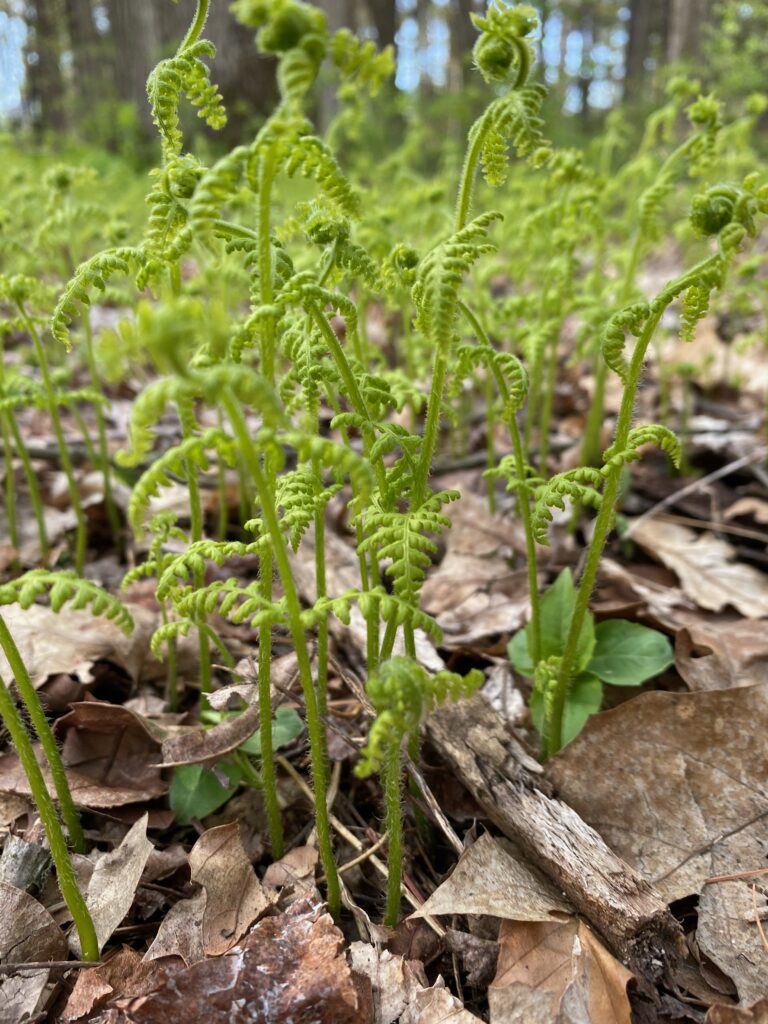
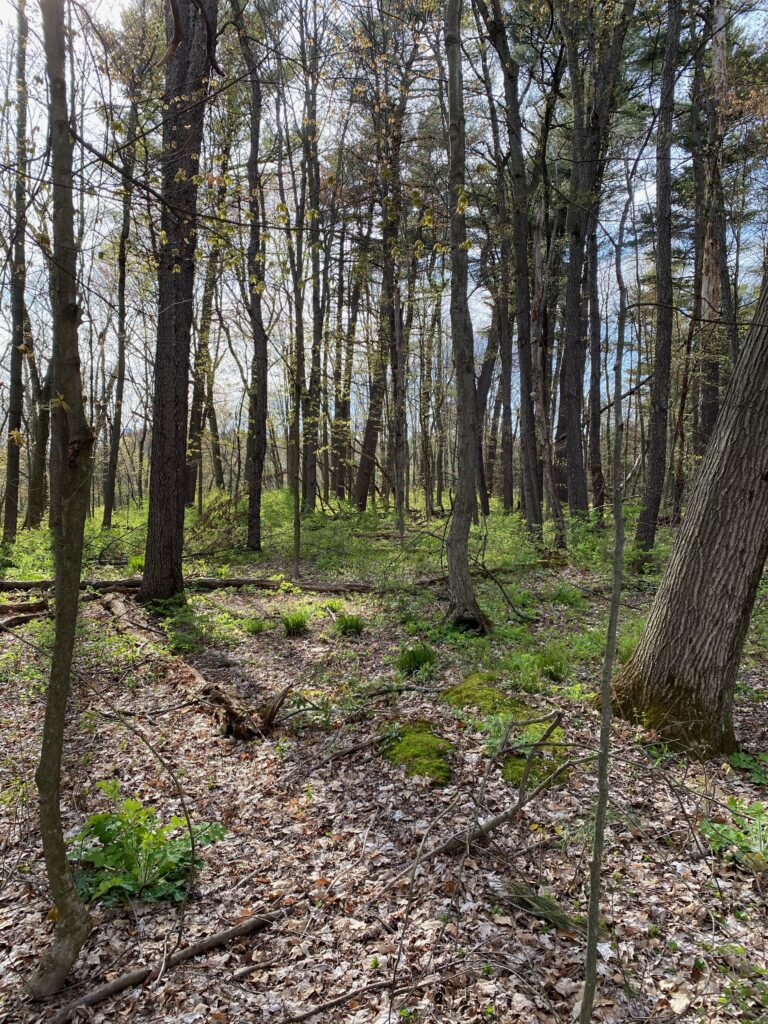
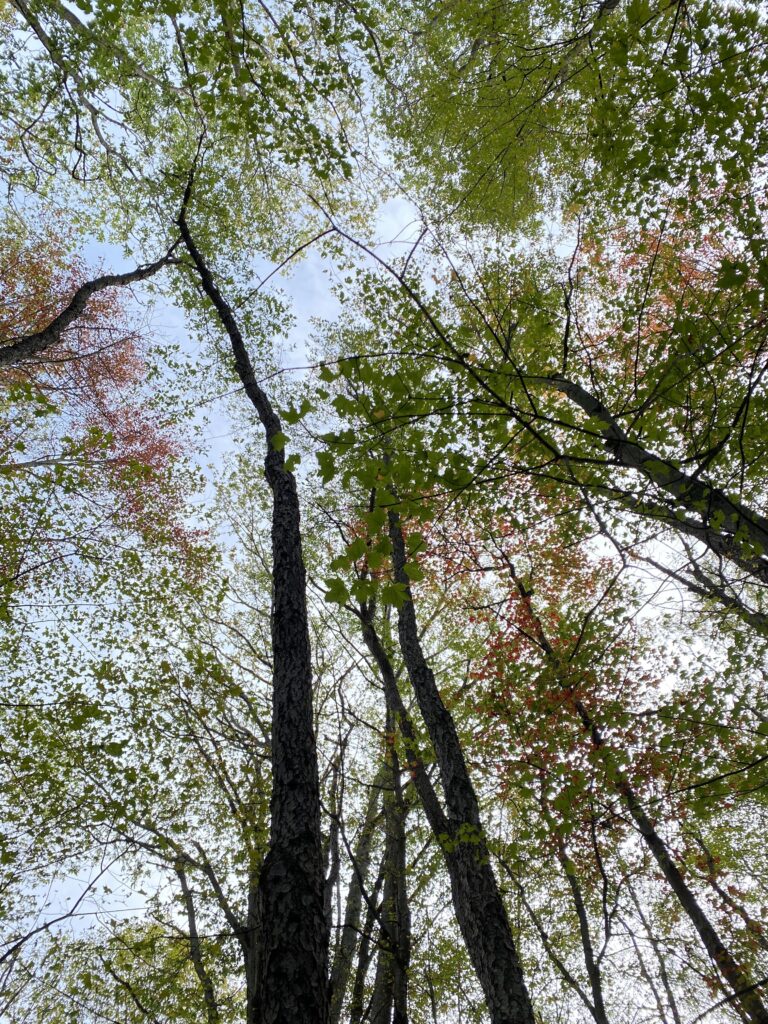
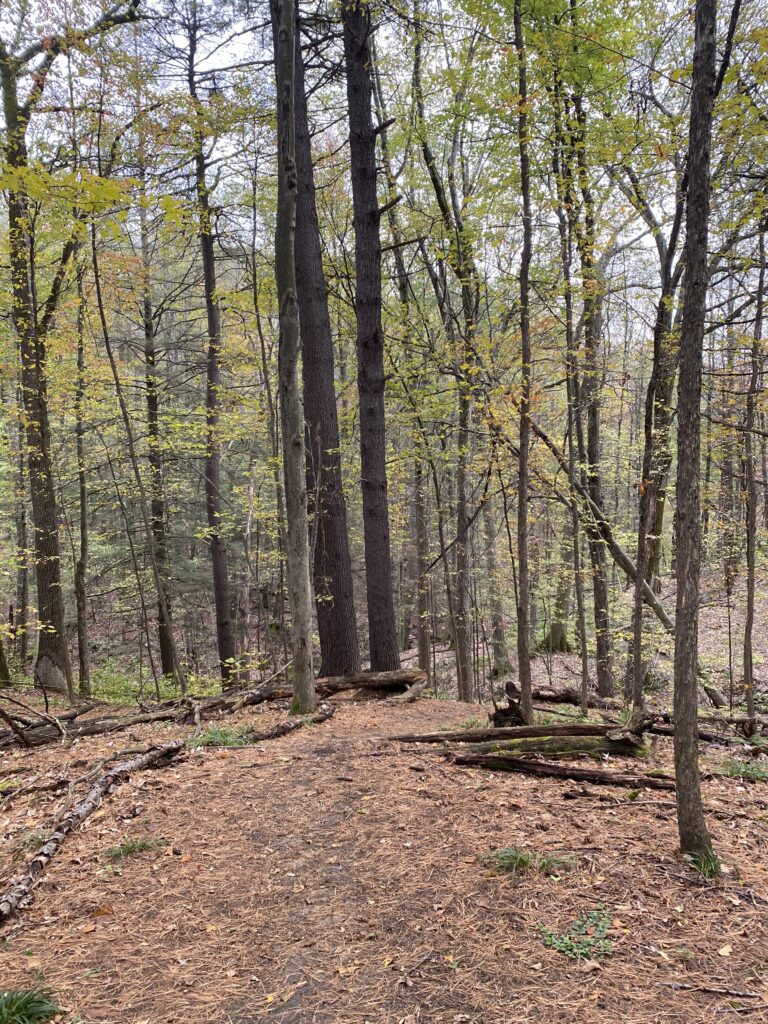
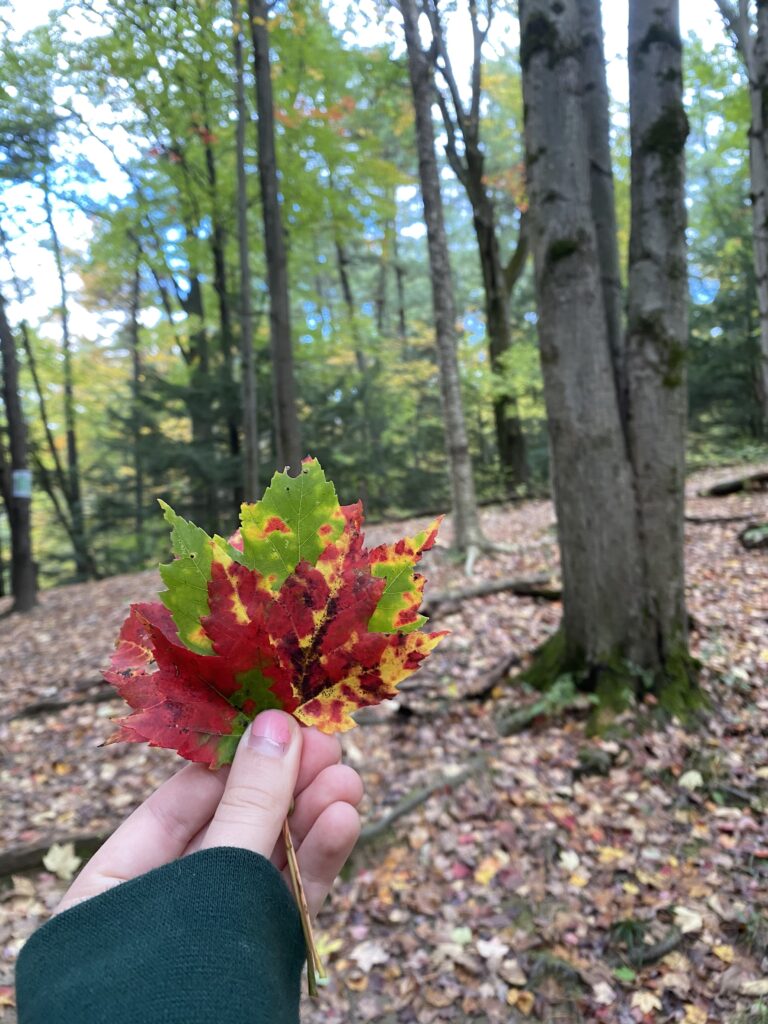
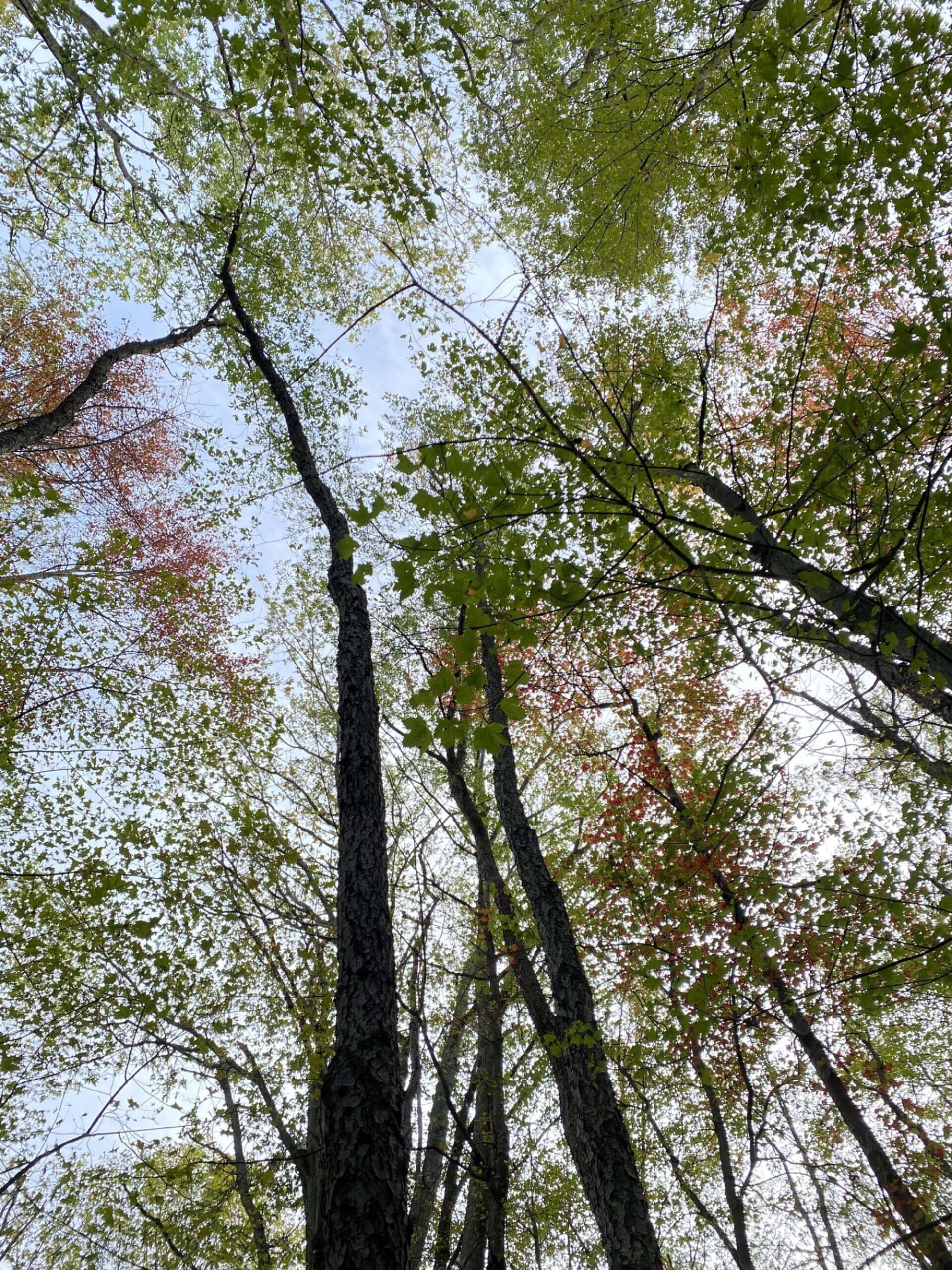
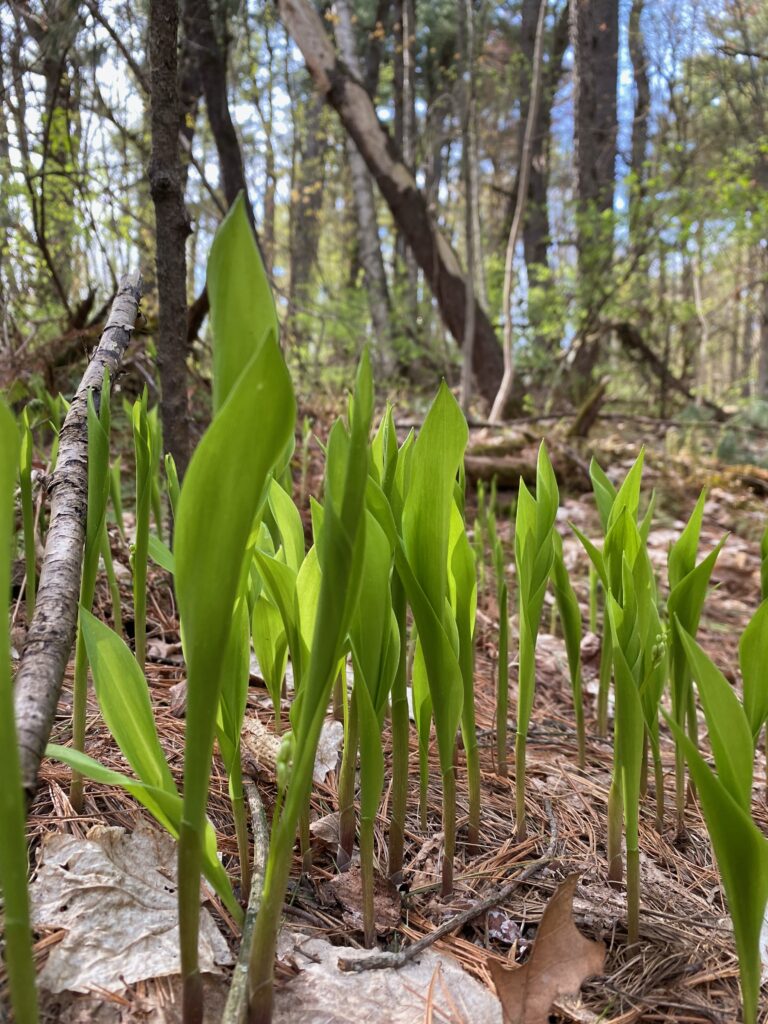
Today was a really good day for a final site visit. The wind made it almost chilly, but in Centennial (where my spot is) the trees made it just breezy. It was really nice to be able to sit and just listen to the wind for a while. I took a photo from the same place that I did on my first site visit, and it was really cool to see how its changed from the fall to winter to spring. The ferns have just come out of the ground and the trees are just starting to leaf out. All the small ground cover type plants are almost fully grown in, so it looks pretty green now, a big change from the last time I was there.
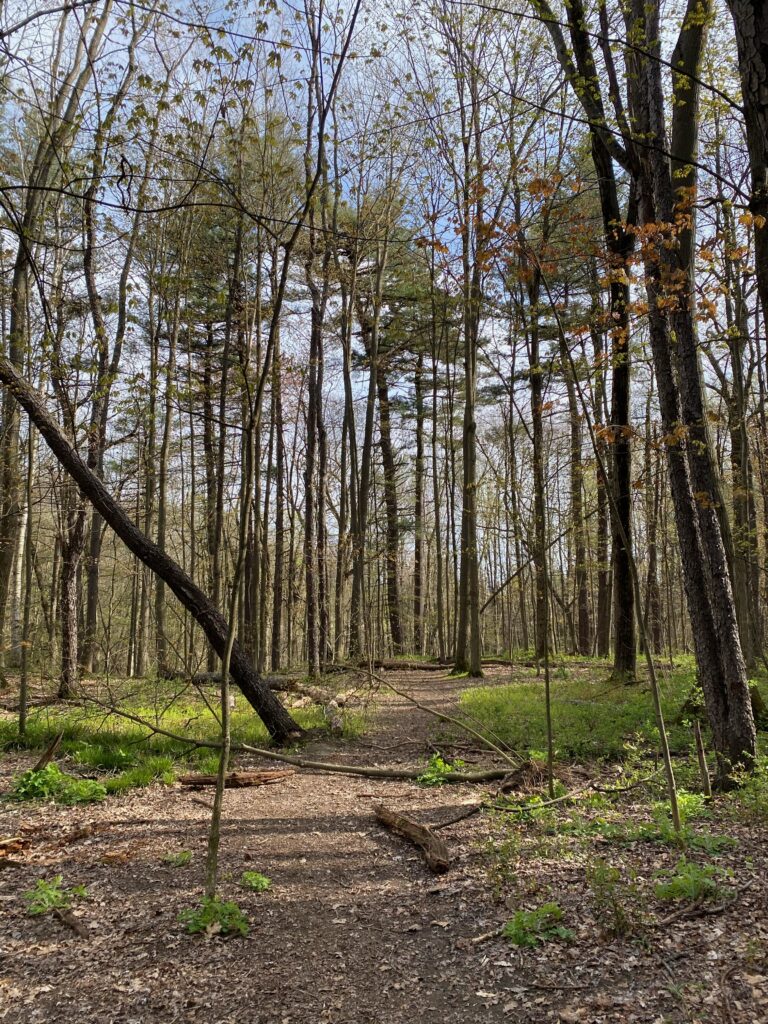
A pretty small tree fell across the trail, it wasn’t super clear what brought it down but it looks recent because it has little leaf starts on it. The roots were pretty shallow, so my first thought was maybe wind.

Given that my place is situated in an area that is managed for human use, I would say there’s a pretty significant intersection between culture and nature at this spot. I wanted to pick a spot that I could reasonably get to but also feel like I was “out in nature” a bit. The trails through Centennial, as far as trails go, are relatively low impact. They aren’t very wide and aren’t paved or gravel covered in any way, so they don’t change the landscape all that much. The way that the woods are managed for use by the community seems very intentional with the health of the forest and overall ecosystem in mind. There aren’t large areas cleared, and the trails seem to follow natural ridges and dips.

I wouldn’t say I consider myself a part of my place. Though I liked going there, I really only went to that specific spot in Centennial for assignments. When I went to Centennial for walks, I would usually just weave through the trails as a whole and not really stop in one place. I also feel like to have a really deep connection to a place to a point that you feel like part of it, you have to spend a lot of really formative time there. Given that I’ve already done a lot of my growing up on the other side of the country in very different kinds of nature, I feel a lot of connection to those places. I think as I spend more time in Vermont and it’s natural areas, I will feel more like a part of these places myself. Even though I don’t consider myself a part of this place, I think I’ll probably come back to visit it again in the fall, see what’s different and what’s the same. It was really pretty when all the leaves changed, may have to go back and see that too. So long, spot.
May 2nd, 2022 – City Nature Challenge BioBlitz

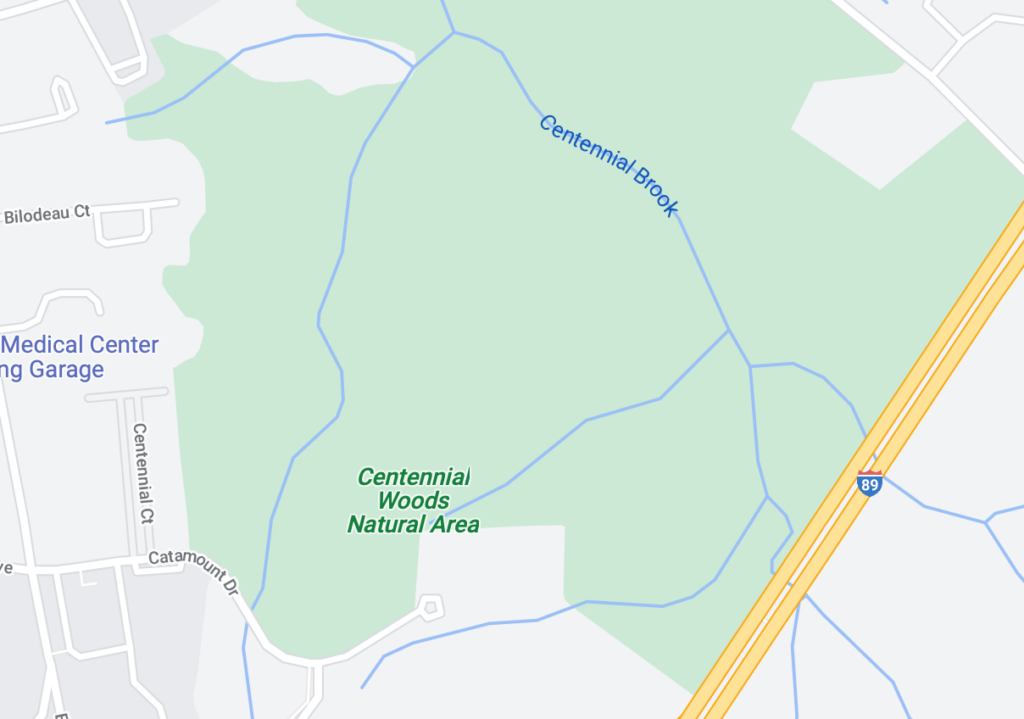
During the BioBlitz, Annie and I went for a walk around Centennial Woods. Unfortunately I was out of town for most of the weekend of the City Nature Challenge, so I got some good exploring in in East Montpelier but not as much as I would have liked in Burlington.

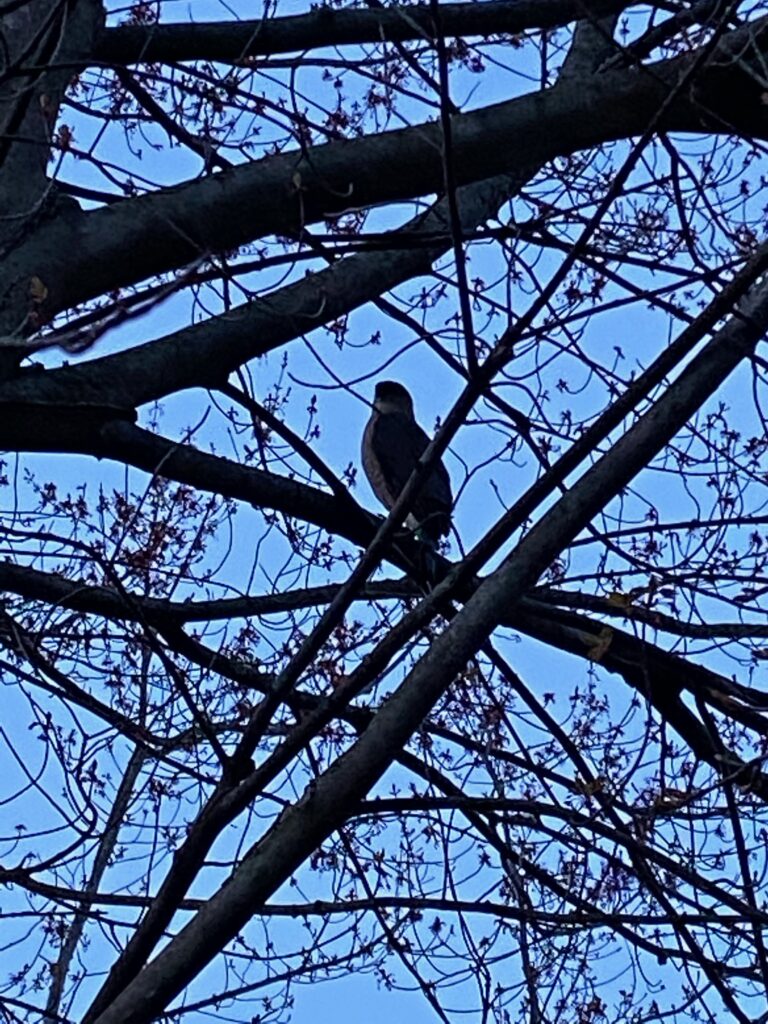
Given that we went in the evening, we didn’t see a ton of species that you may usually see, like squirrels or frogs. But we did see some cool creatures that you usually won’t see during the day. We saw a red tailed hawk swoop low over East Ave and perch on a tree in someones front yard. It was really cool to see it from so close up. Red tailed hawks tend to hunt at dusk because most of their prey are nocturnal, so I imagine that this one was starting its evening at the same time we were.

It let us get surprisingly close before it flew away again. We watched it fly south back toward campus. If I had to guess, I would guess it was going somewhere more open like a field where mice and other small animals would be easier to catch.

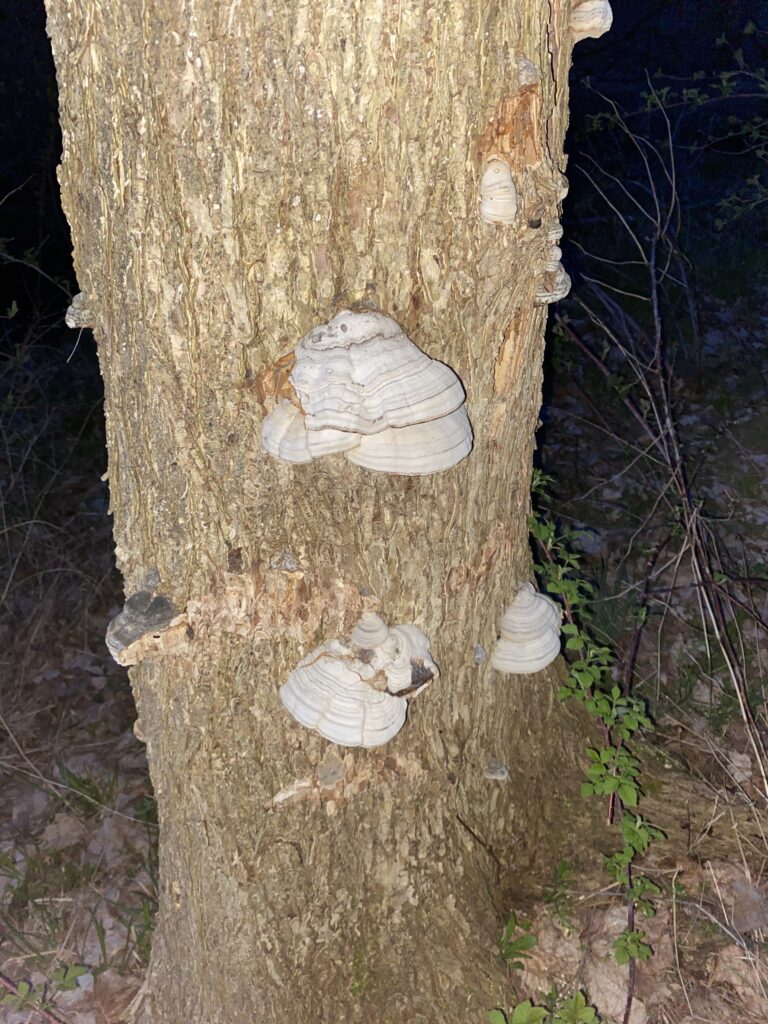
When we actually went into centennial woods, there wasn’t a lot of movement. There were a lot of moths flying around, but it is really hard to get a picture of a moth so you’ll have to just trust me on that one. We poked around near the brook looking for frogs or paw prints of any kind, but couldn’t find any. I know that there are often raccoons in Centennial, but I think we were a little too early in the evening to see them. We found some cool mushrooms, I think they were shelf fungus.

The white ones looked fresher than the grey one at the bottom left. They spiraled pretty far up the trunk of the tree.

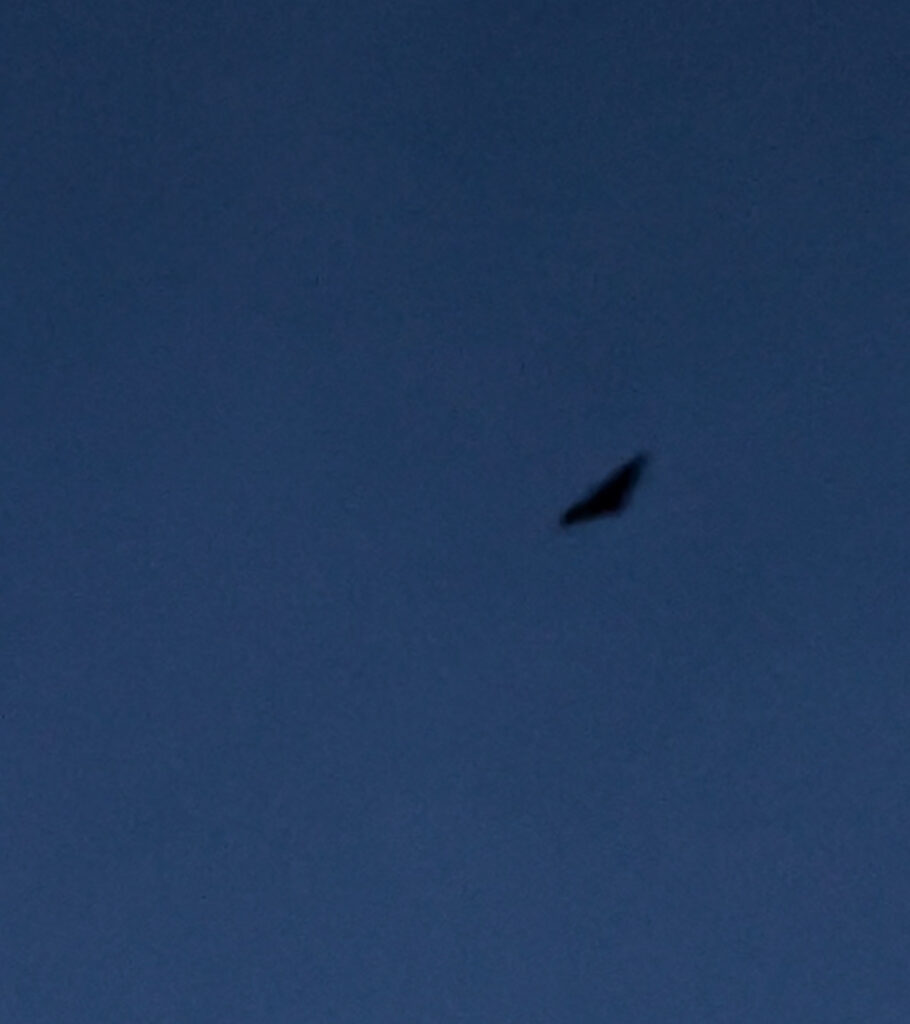
Probably the highlight of exploring that night was seeing bats! Bats always remind me of summer, so the combination of the warm weather and seeing them made it feel very summery in Centennial. We were in the clearing on the south side of the woods near the parking lot off of Carrigan Drive. At first I though they were birds that were just going in to roost very late, but after watching the way that they moved (very erratically and much after than most small birds) and seeing the outline of their wings, I identified them as bats. I couldn’t pinpoint exactly where they were coming from, but there is a large dense pine tree on the edge of this clearing that I think would be the most favorable and safe place for them.

We watched the bats for a while, but then they sort of started to swoop us and neither of us wanted to risk getting a bat to the face, we left them alone to catch bugs in peace.

It was interesting to look at the range of species that people observed all over Burlington and Vermont as a whole state. It was also interesting to look at cities on the west coast, because the observations of plant life shows just how far along in spring some of the US is, while it still feels pretty grey here. In Seattle, for example, it was reflected through various observations that most of the trees are completely leafed out and flowers have already come and gone. Compared to here, where trees still barely have visible greenery, it’s quite a difference.

Using iNatrualist, though it gives a look at nature all over the world, feels a little silly to me. I’m not in love with the idea of going out into nature for the sole purpose of documenting everything you see and putting it on the internet. It is really helpful for identifying things, but personally I’m not often out to identify, I’m just there to observe an appreciate. I like using iNatrualist more after the fact, meaning uploading pictures after I am done exploring, so I can appreciate things in the moment.

March 11th, 2022 – Spring Break Posting

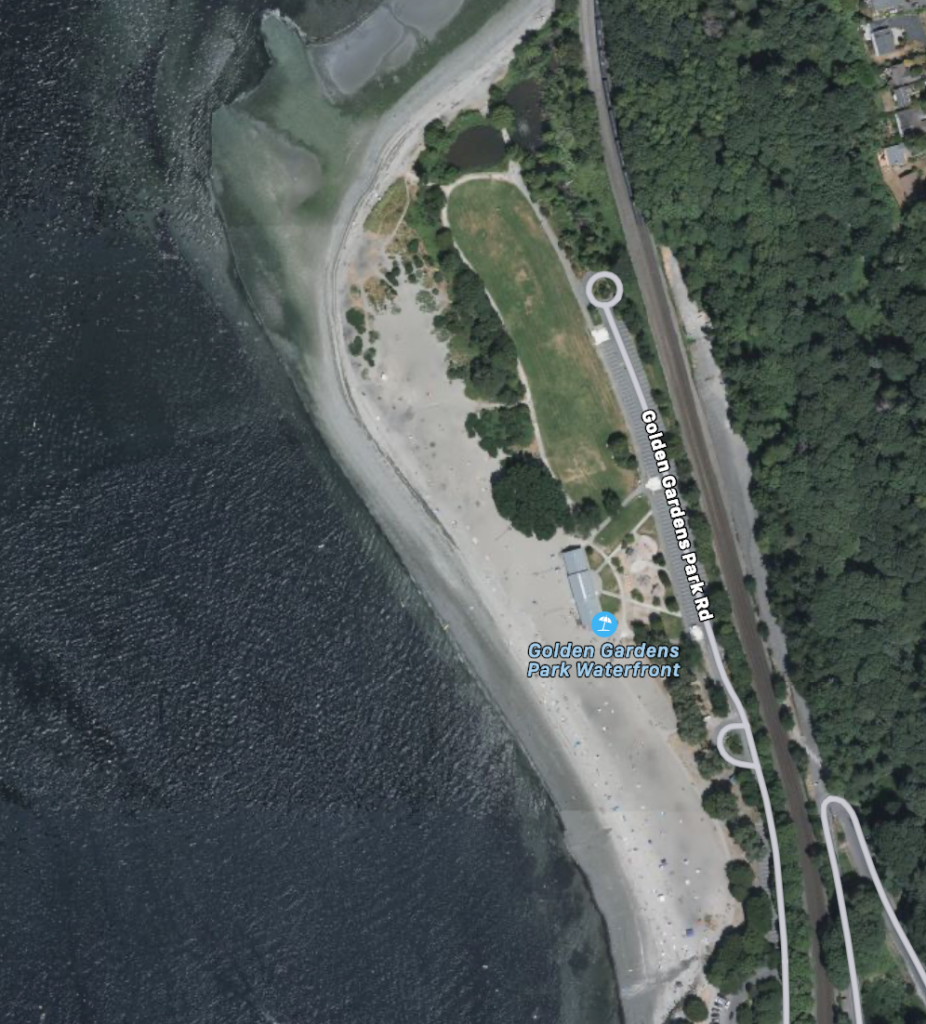
Golden Gardens Park in Seattle, Washington – developed in 1907 as an attraction paired with the new railway and the property up for sale in the area. 1907 was a year of significant population surge and development in the city, so this park was developed to appeal to newcomers and potential investors in the area.

Situated right on the beach of Puget Sound in Washington, this spot couldn’t be more different from my spot in Centennial Woods. Its really open and human impact is much clearer and noticeable in this area than in VT. Given that Seattle is much more populated and everyone has been inside for the past few rainy months, it was pretty crowded and didn’t feel as wild as Centennial Woods does. The focus here is much more on human use than wildlife or conservation. This time of year, Seattle feels like spring, unlike Vermont. It was about 50° when I was there, and plants are blooming and budding. We don’t really get the freeze-thaw cycles that Vermont gets, so once on thing blooms, it seems like everything else goes all at once.

Like I said, Golden Gardens was pretty busy that day, and usually is almost every day of the year. It’s the most accessible public beach in the city, so foot and car traffic is really high throughout the whole park. There is a small wetland on the north edge of the field near the beach that is maintained by the city. This wetland is small but supports a pretty large population of Mallard ducks, common but interesting nonetheless. Breeding season for these birds starts in early March (right now!), and so the pairs that males and females formed in the the fall are still together. When I was there, there were probably 10 or 15 different duck pairs that I saw, all sticking very close to each other. Nesting does not occur for another month or so for these birds, so for now they are just scoping out territory. There will probably be baby ducks when I am back in the summer, something to look forward to.

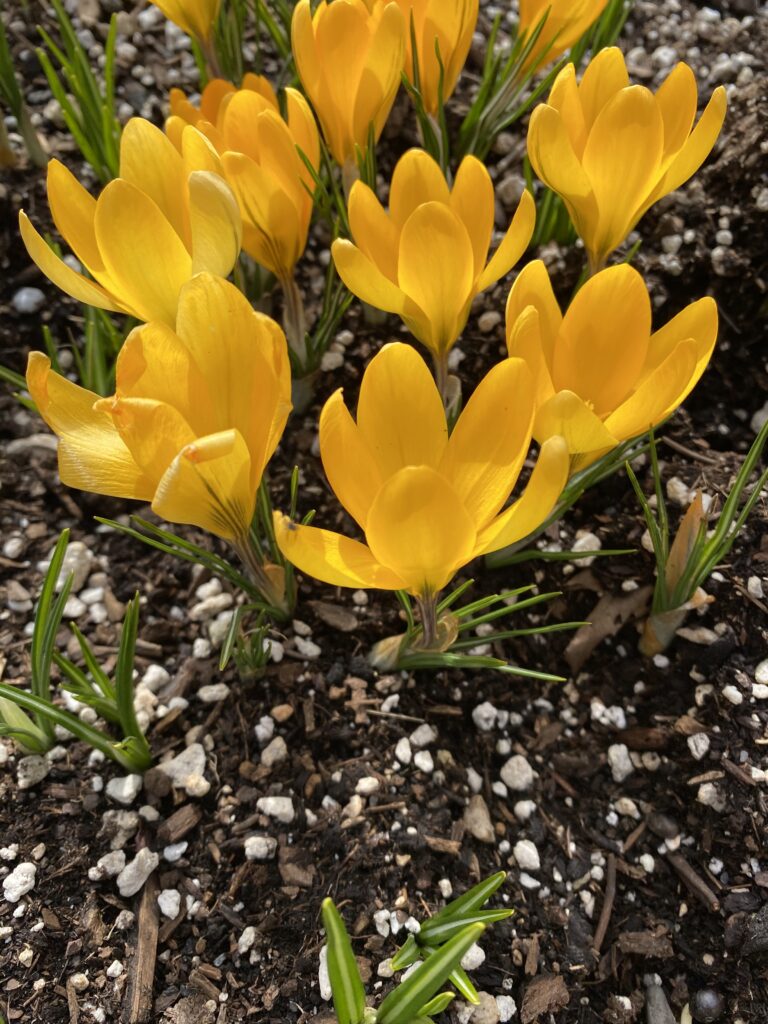
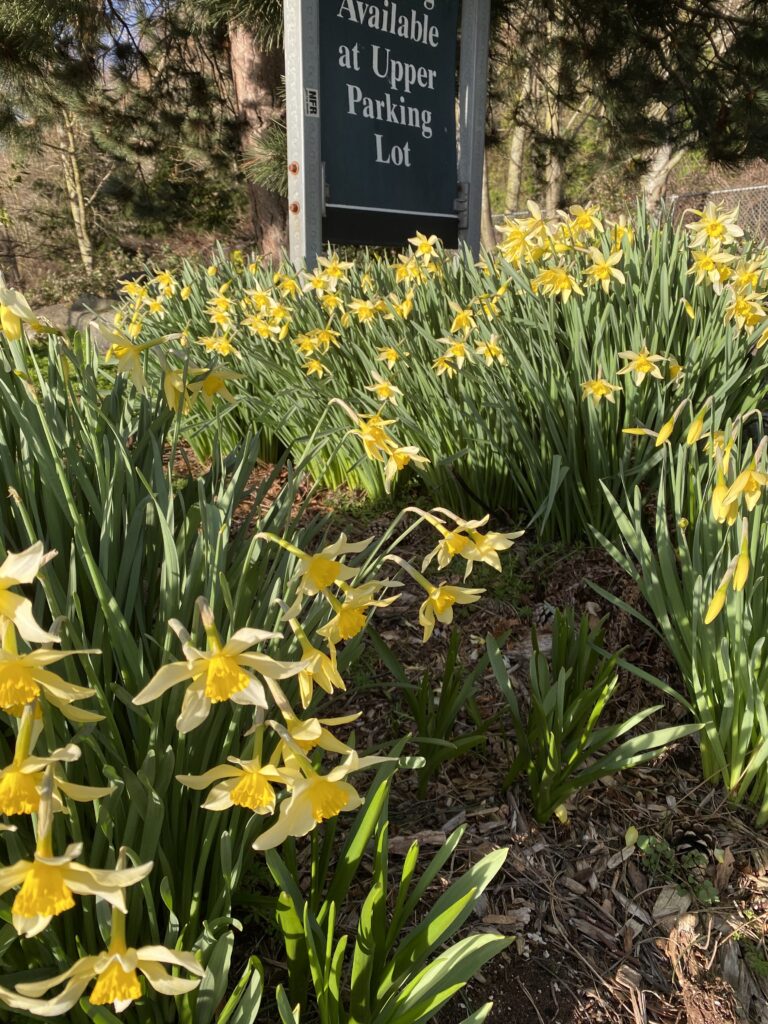
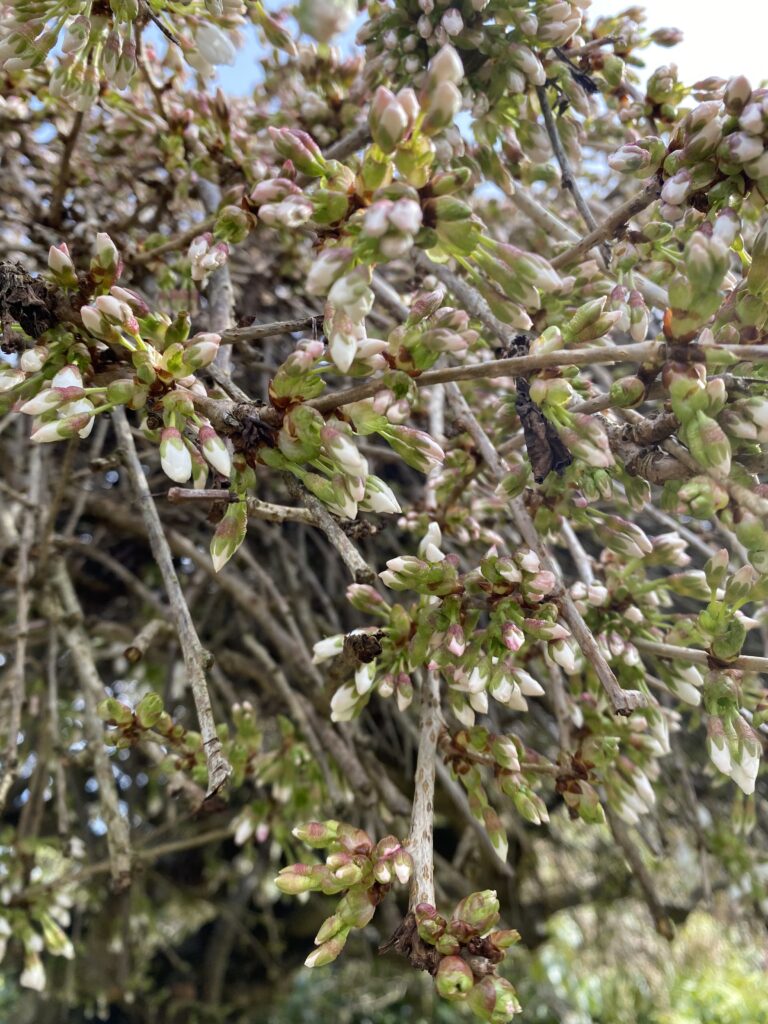
Theres other signs of spring in the area. None of the deciduous trees have leaves on the yet, but most of them have buds and some have the starts of blossoms. The neighborhood up the hill from this park has a pretty spectacular collection of flowering cherry trees, which I am unfortunately missing the peak of this year. Hopefully I’ll catch the end of them in May. Even though there aren’t blossoms on these trees yet, they appear slightly pink even from afar due to the buds on the branches that are probably only about a week and a half from popping open. A few of the smaller magnolia trees around the city have early flowers, but none of the trees have leaves yet. I have a huge poplar tree in my backyard that has catkins on it, and standing under it you can hear the casings of the catkins popping open (it sounds almost like someone crinkling plastic).

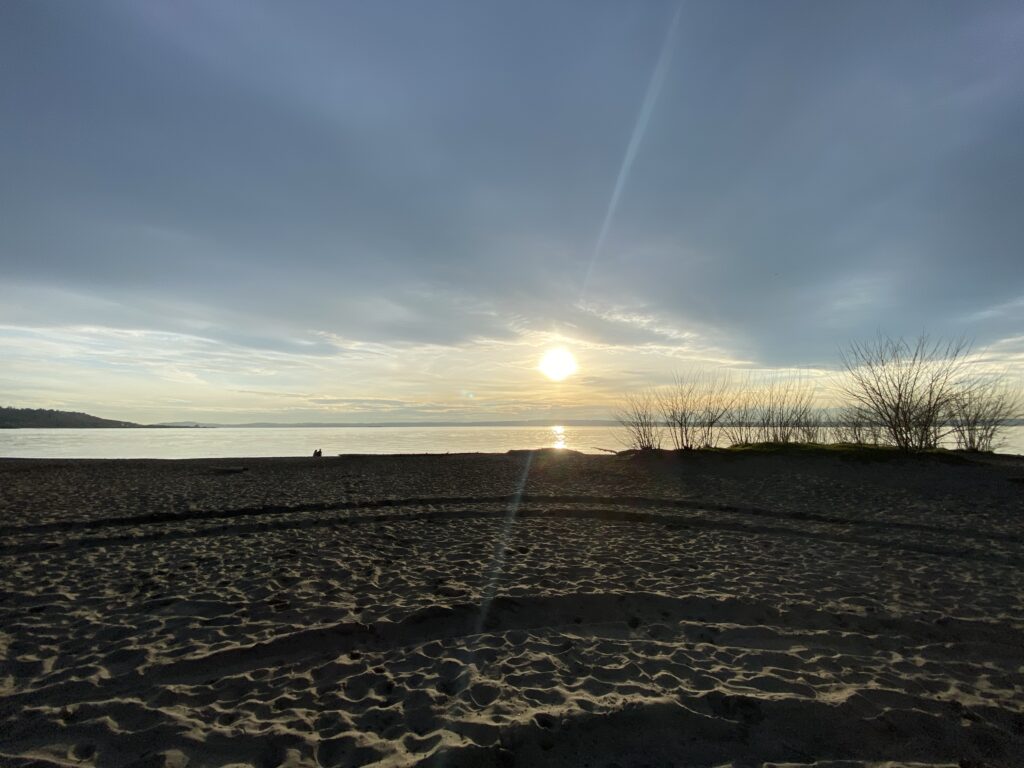
Doing the walk-around for this posting made me remember how much I love Seattle in the spring. It may rain a lot, but when the rain breaks you’re left with prefect conditions for flowers and greenery. They don’t call it the Emerald City for nothing. Seattle also has a really distinctive light in the evenings in spring and fall, when the sun dips just low enough that it comes below the cloud cover. When this happens, about an hour or so before sunset, you get this really gorgeous golden light against the dark blue sky over the Cascade Mountains to the east, and a golden outline of the Olympic range to the west. Makes for quite the sunset.

Looking west toward the Olympics, 5:16 pm.

February 21st, 2022

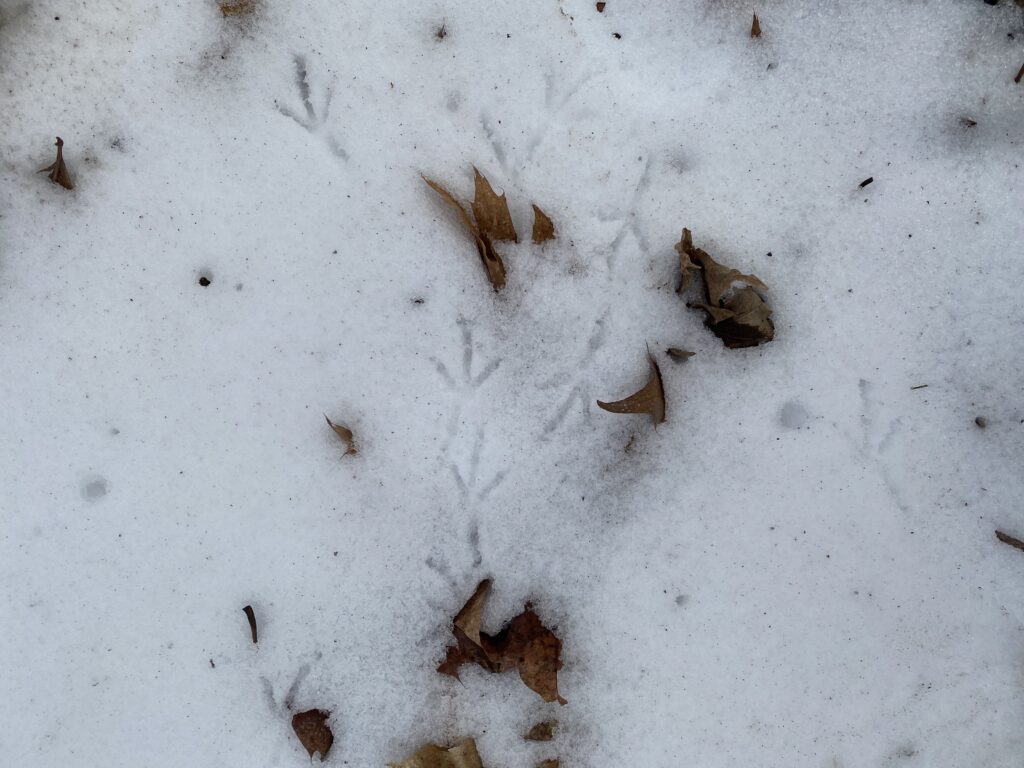
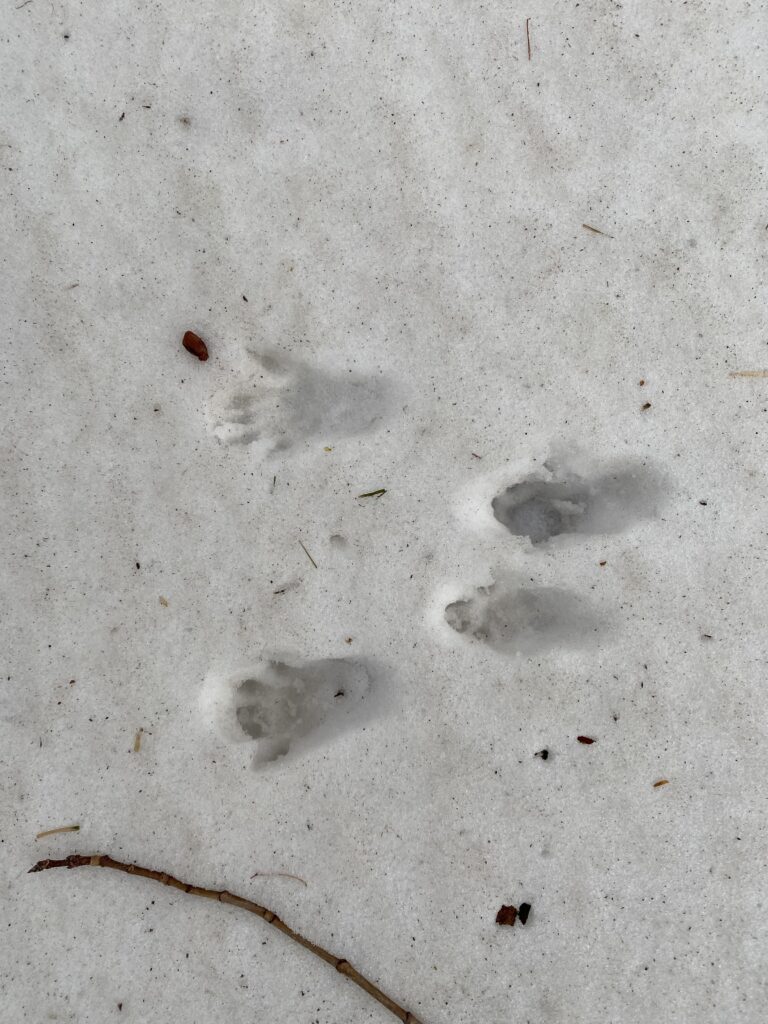
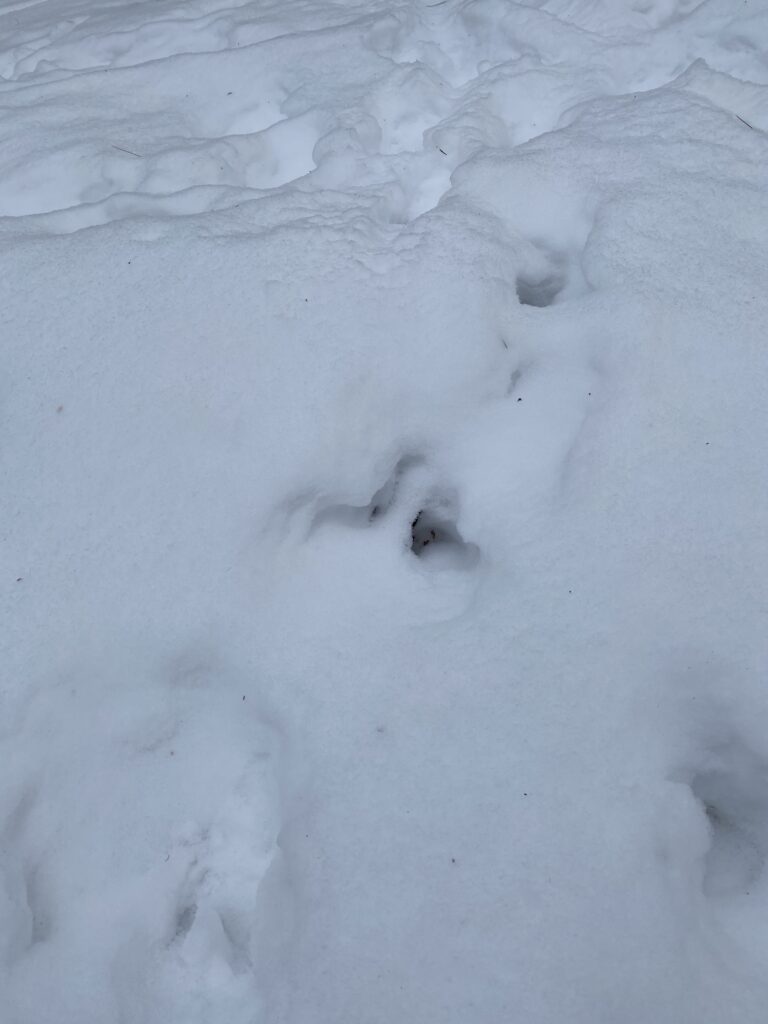
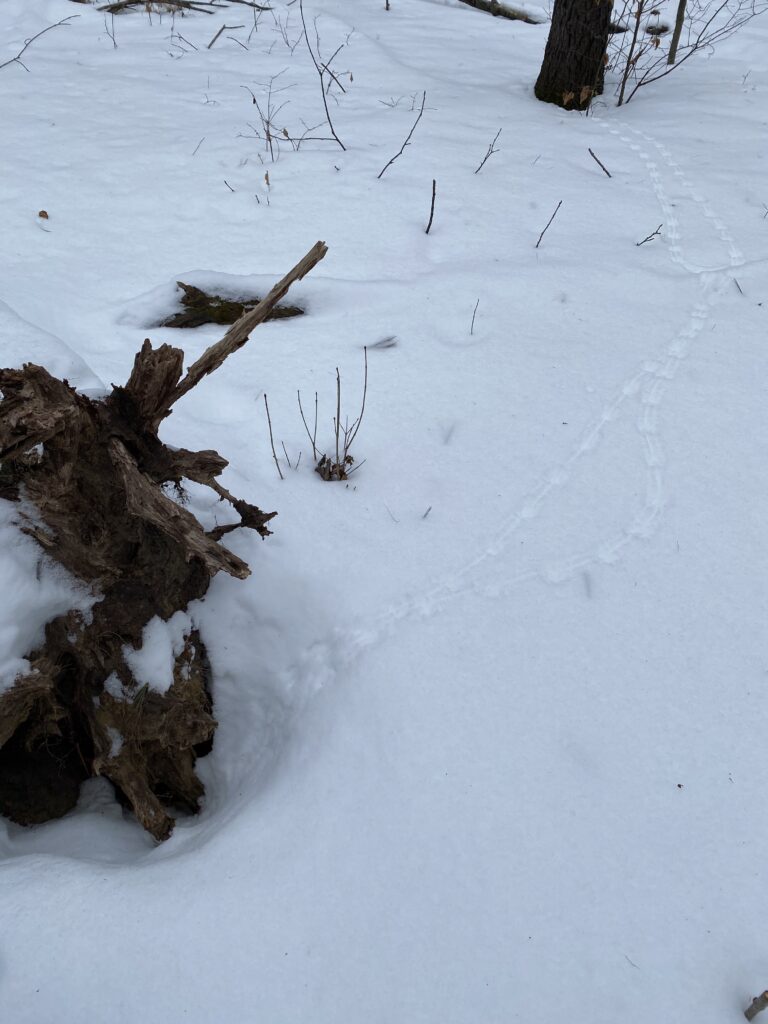
This week, rather than visiting my specific phenology spot, my friends and I went looking for animal tracks and signs around Burlington. We made the decision to stay a little closer to campus and mainly focused on the wooded area on the north end of the golf course near campus. Given that a lot of the snow cover is pretty glazed over with ice, we weren’t really expecting to find detailed tracks. But in the more tree covered area near the golf course, we sort of struck a track goldmine. The snow was not fluffy and was more of a sandy texture, the the tracks we found were almost perfect and easy to follow and identify. We found tracks primarily from Grey Squirrels, Chipmunks, and what we are guessing is either an American Robin or Chickadee.

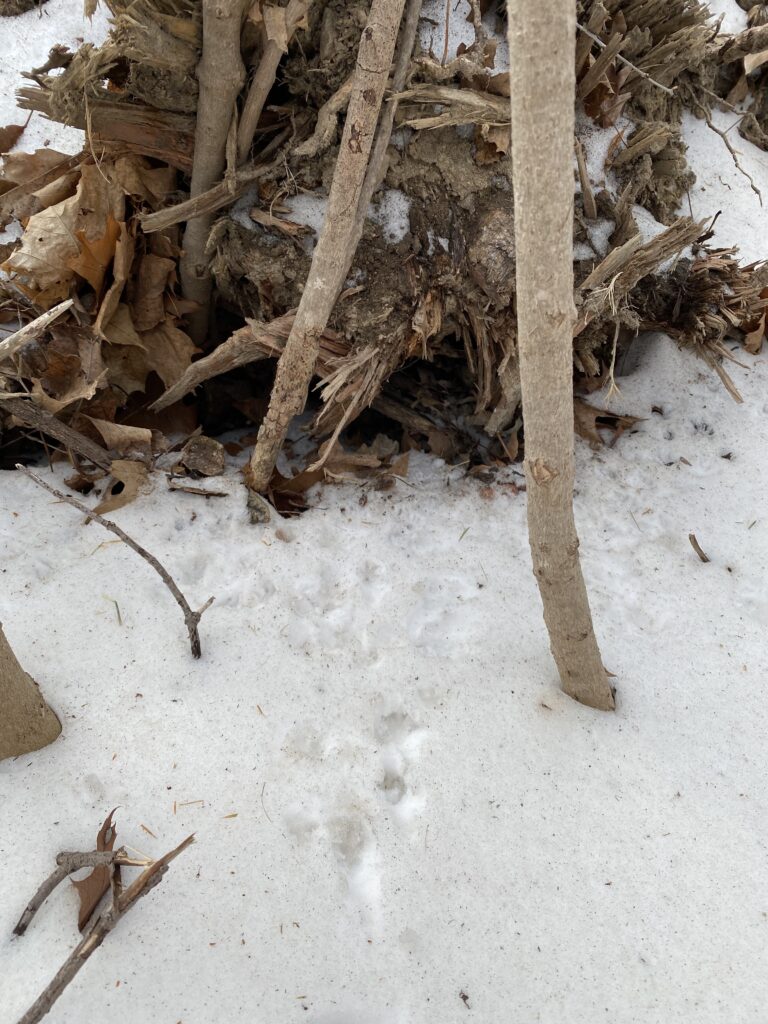
We followed a lot of the tracks pretty far through the little patch of forest. The chipmunk tracks did not cover quite the distance that the squirrel tracks did and also stayed fully in the trees, unlike the squirrel tracks, many sets of which continued on to the golf course (we weren’t able to follow these as well because the snow was a much icier texture out in the open). A lot of the chipmunk tracks came and went from a dug out area under a stump, maybe a potential den site.

in addition to the tracks leading in and out of this hole, there was a lot of chewed out wood underneath, making me think the chipmunks are using it as a den

While we were in the woods, we saw a few grey squirrels, and a pair of chickadees. The chickadees actually got pretty close, and landed on branches only a few feet from us. They didn’t seem super distressed that we were in their space or anything, because they moved on pretty quickly. Watching them move, they stayed entirely in the canopy, not landing on the ground at all. The fact that they didn’t land on the ground, and the fact that they are so little, makes me thing that the bird tracks we saw were indeed robins and not chickadees. We briefly considered that maybe they were crow tracks, but crows tend to move in a normal walking pattern, whereas robins hop or take short hurried steps, which is more what these tracks looked like (side by side or close together.)

As for using iNaturalist, I like how it can be used to catalogue all the species I’ve seen, and things that have been seen by my classmates. We spent some time looking at the other animals that people have found, and it was interesting to see the range. I wish there was a way to add a sort of description to the sightings or track posts though, because then we could get/give some context as to where the animal was going or what sort of terrain the tracks were found in.

January 29th, 2022

This is the first time I’ve been to my spot since December 11th, before I left for break. When I went last, there were quite a few plants still poking through the minimal snow, and some grasses still green and visibly alive. But now, there’s a good 4-6 inches blanketing the whole forest, with the footpaths being the only areas stamped flat. There are tons of American Robins in the forest, hopping around and sitting on branches all puffed up to stay warm. They stand out bright red against the snow. There were also a few separate murders of crows I saw circling in the wind, which wasn’t something I noticed in the fall.

In my spot, at first glance there weren’t any distinctive tracks. There was lots of evidence of people with dogs walking through, and given that my spot is right on an established part of the path this was something I expected, so I looked for tracks about 10-15 feet off the beaten path, somewhere where animals would feel a little less exposed or not be scared off by pets or people. There was a set of rabbit tracks running off the path and down the hill. These tracks were easier to identify because they are tracks I see all over campus.

The most prevalent (and interesting) tracks that I found at my spot where a set of mouse tracks that ran the length of the area and across the walking path to a dead tree. They ran in both directions, following roughly the same path each way. My guess is that the mouse has some sort of food store there that he ran a little mouse errand to earlier today. The tracks were distinctive and easy to follow, and with the wind blowing the snow everywhere this afternoon the fact that they were undisturbed makes me think they are relatively fresh. The tracks appear to start/end rather abruptly in a little indent in the snow. Small mammals are a grouping that live in the subnivean zone, so I’m guessing that the tracks we saw are evidence of the mouse leaving his burrow to gather food, then returning along the same path. In areas that it was able, the mouse traveled along the edges of logs and stuck close to tree trunks, presumably to stay less accessible to predators that may be hunting it from above, such as hawks.

My first thought was that these were chipmunk tracks, but there’s a pretty distinct tail line running along them, something that wouldn’t show up in chipmunk tracks because they run with their tails up like little flagpoles, whereas mouse tails hang down. Also, chipmunks are larger and would have a longer, more spread out stride.

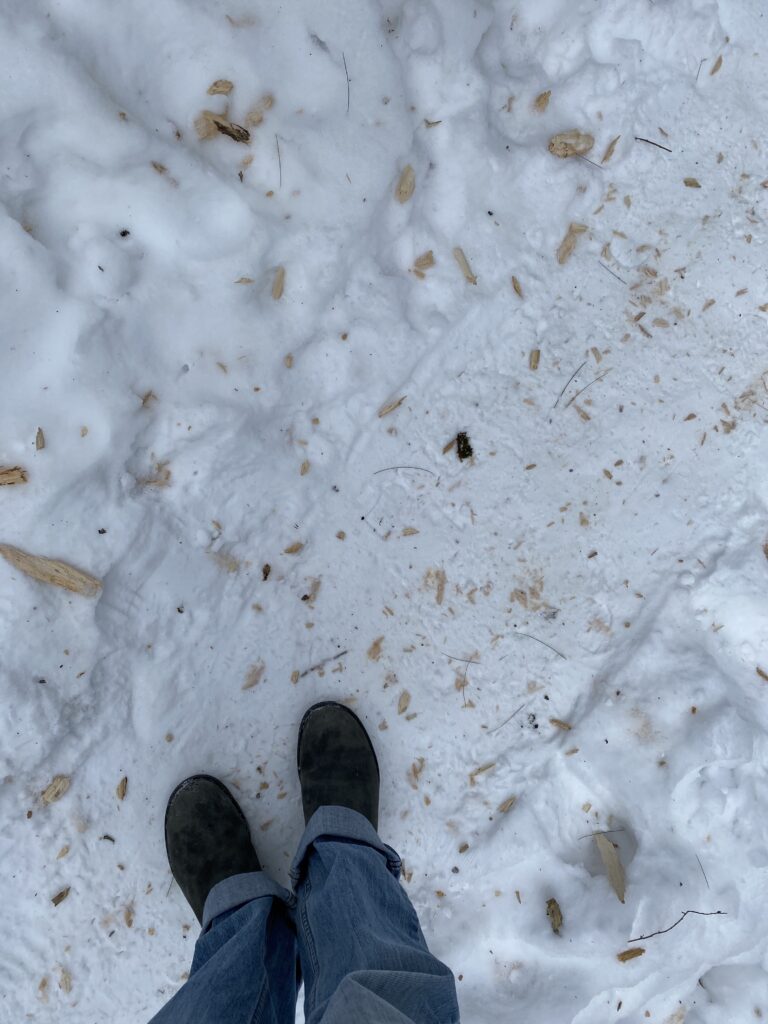
The full cover of snow in the forest adds a little bit of life to my spot, given that the trees and shrubs are far from having leaves again. With the snow, it’s clear that people are still walking in the woods, and now it’s possible to see the wildlife that passes through the forest, which wasn’t a noticeable detail in the fall. Fall felt like a kind of weird lifeless transition in Centennial Woods, given that there wasn’t snow to show animal tracks and all the shrubs and trees were in the process of losing their leaves. But now the snow adds a layer of life to the forest and makes it much brighter. It also makes it easier to notice what’s happening above in the trees! For example, while I was crossing the creek at the bridge, there was a ton of shredded wood at the base of a dead tree. This seemed like an abnormal amount of debris for a tree to drop, even in wind. Looking up, I noticed a woodpecker on a part of the tree where the bark has all been presumably pecked away by his efforts. Without the snow, I don’t think I would have noticed the excess amount of chipped wood on the group. Heres hoping the snow sticks around so I can keep track of what I usually wouldn’t see.

Of course when I turned my camera up to take a picture of the woodpecker, it switched to the other side of the tree to a spot where I couldn’t see it. But here’s the evidence of his bug gathering efforts.

December 11th, 2021

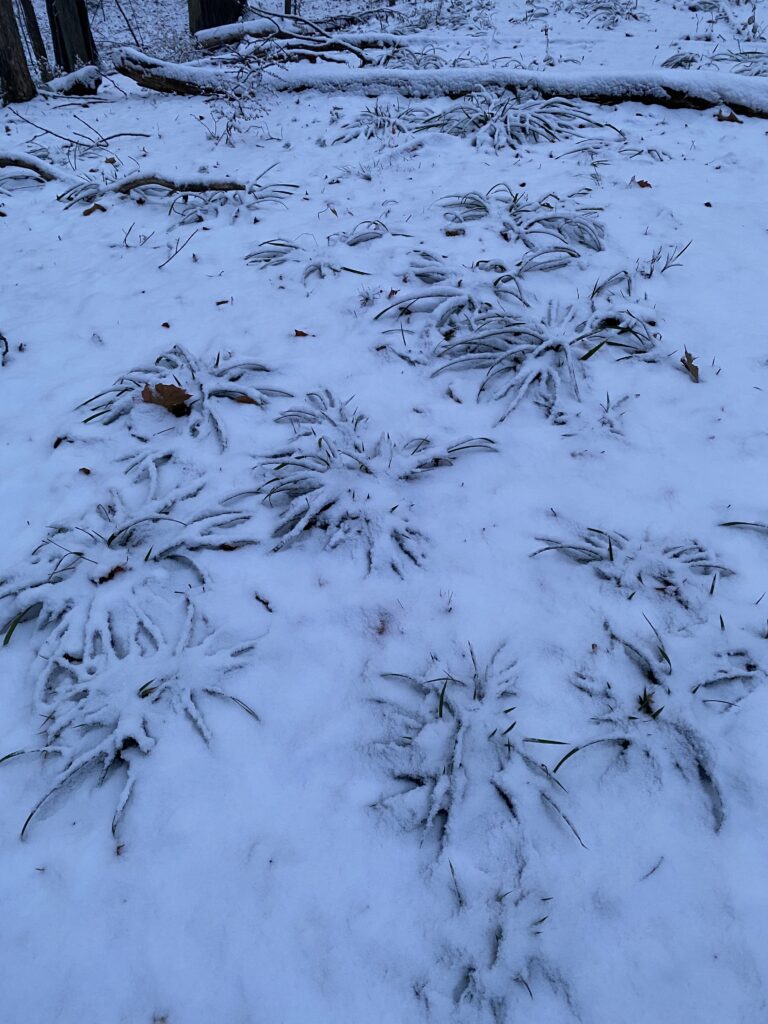
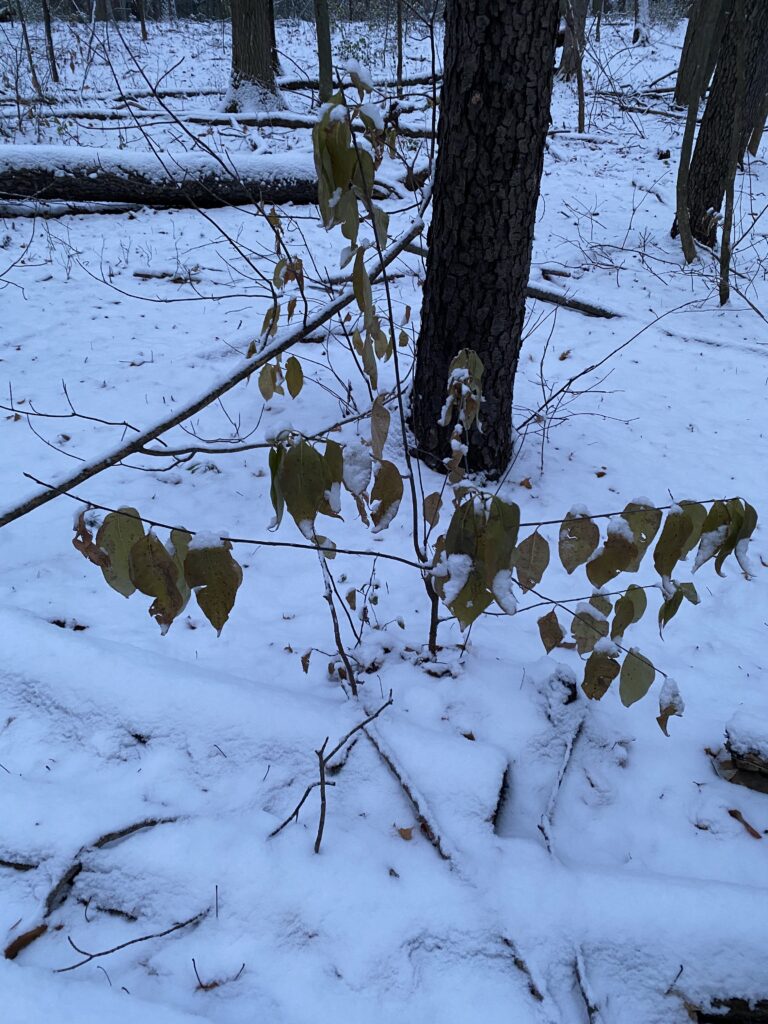
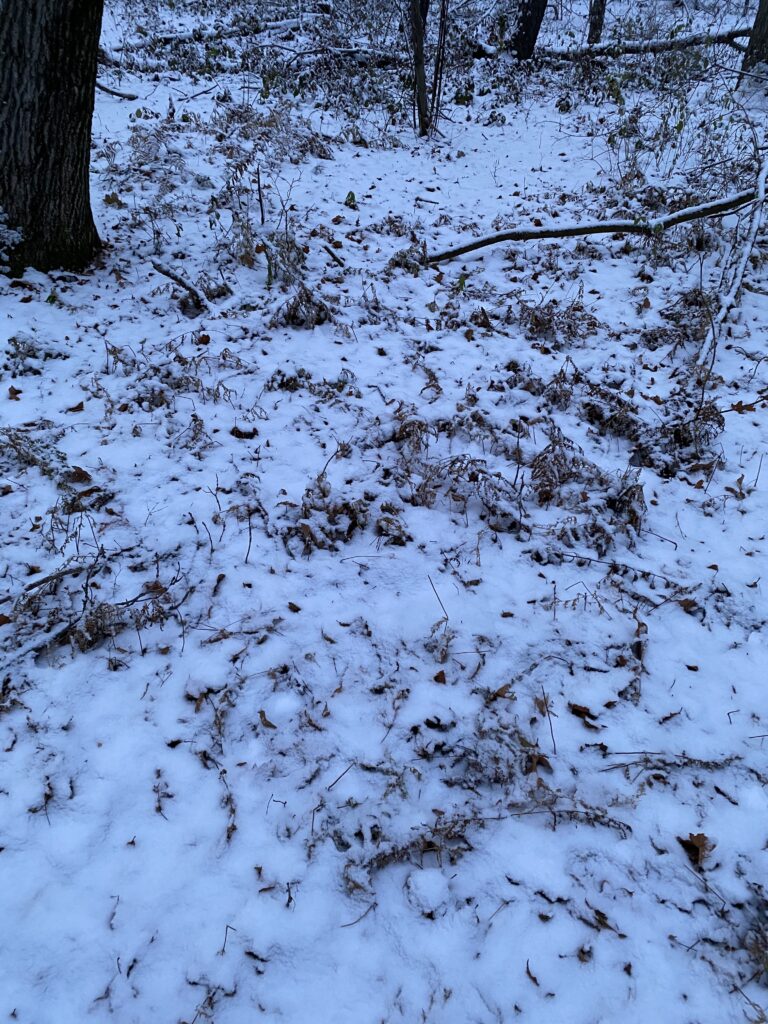
A lot has changed in my spot since the last time I was there about a month ago. The biggest change? Snow. When I visited my site this time around, it was snowing, adding to the good inch or so already there. At this point in the season, absolutely all the leaves are off the trees. Given that my spot is primarily made up of black cherry and red oak, there’s a huge gap between the forest floor and the canopy, or even the lower branches of most of the trees. The combination of the snow and the open canopy makes it feel much brighter there than before, even at dusk. There are still some shrubs holding on to their leaves, and some grasses are pushing through the snow, but the lovely little fern grove has fully died out. I’m guessing what did them is the multiple thaws and freezes they have gone through in the last few weeks.

These grasses were almost completely covered, but still living and green underneath
Though brown, these leaves were still hanging on. I’ve heard sometimes that this can be because of abnormally warm falls, but I’m not 100% sure.
Last time I went to my spot these ferns were all brilliant green. No match for snow, I guess.

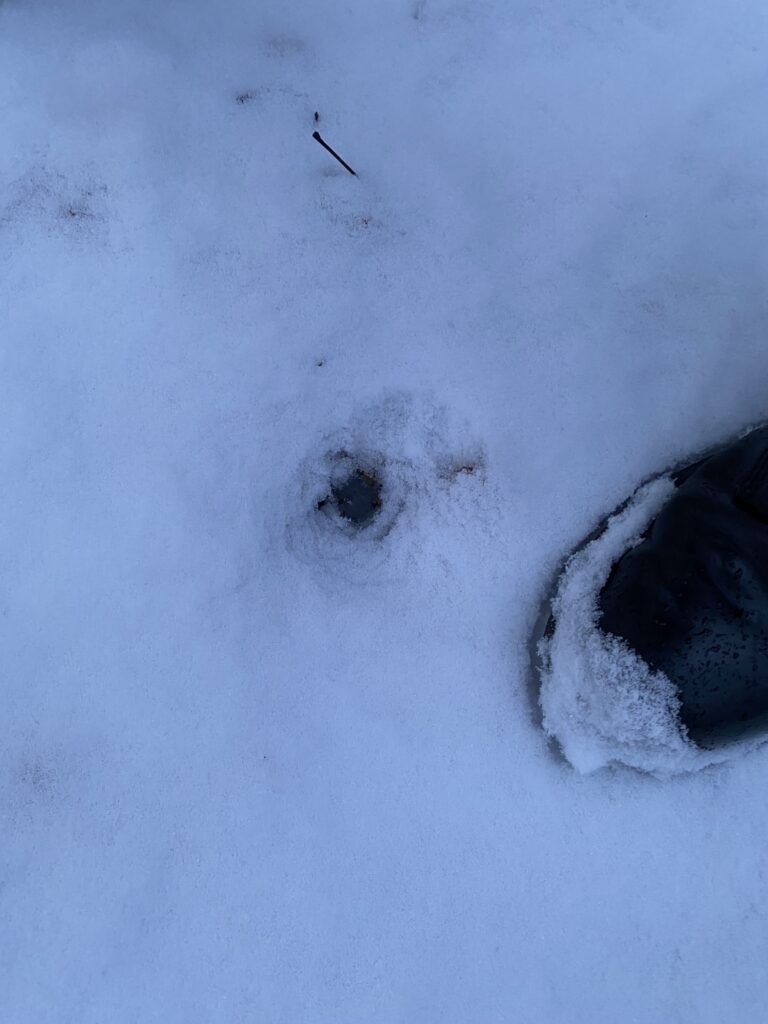
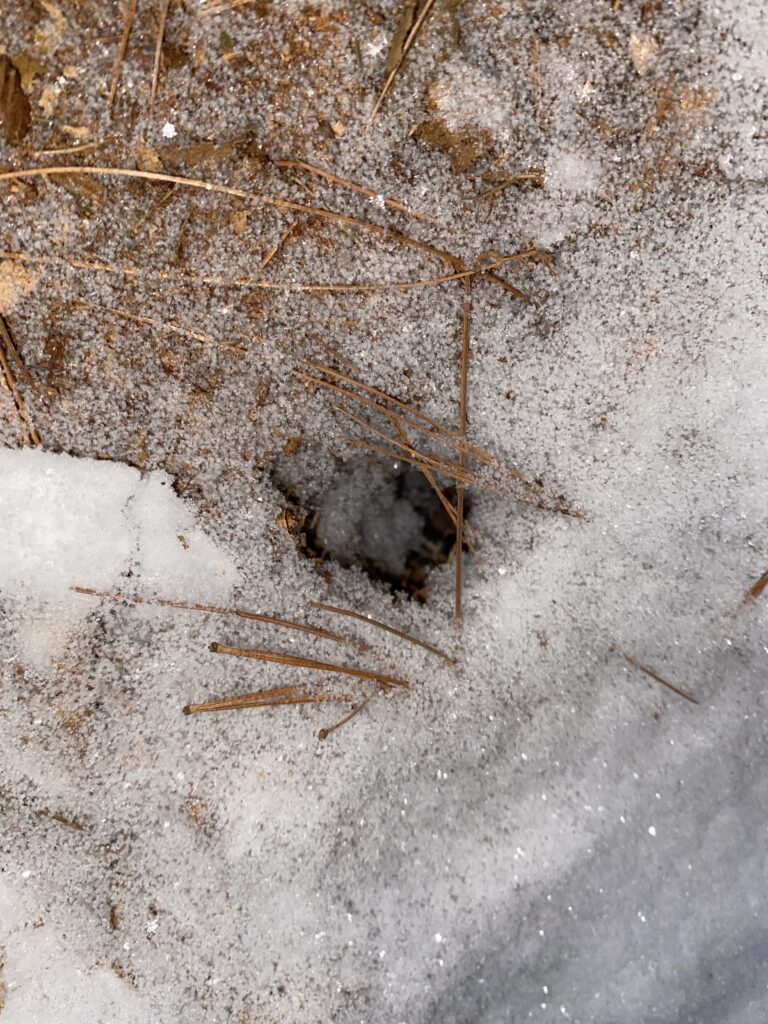
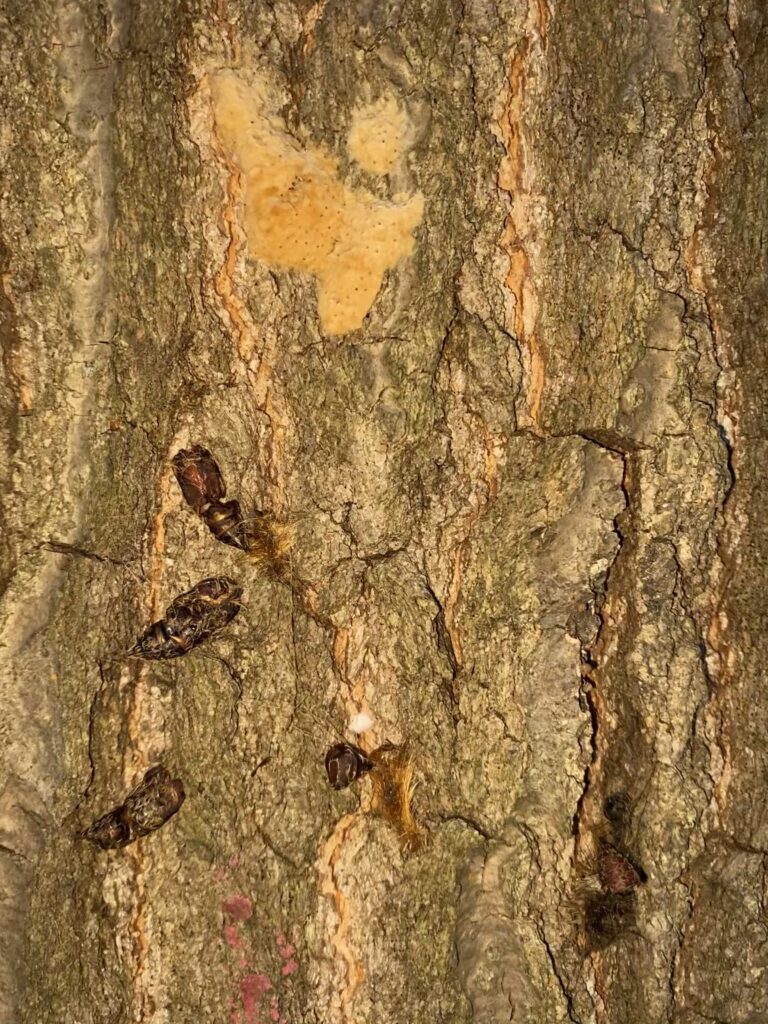
While I was there today, I kept an eye out for any signs of wildlife that may have been in the area. With all the fresh snow, tracks and scat would have been easy to see. Unfortunately, the only tracks I found were those of humans and their dogs. Given that this is the first snow that a lot of UVM students were here for this year, it makes perfect sense that people would be out walking in the woods. The heavy traffic through the area is probably part of the reason that there weren’t (signs of) any larger significant wildlife, especially dogs who were most likely off leash. Something that I noticed that I didn’t notice last time was lots of casings of woolly bear caterpillars on one of the large red oaks in the area. They looked like little brown shell casings stuck to the bark with a little bit of caterpillar fuzz on the outside. Woolly bears are a freeze intolerant insects, some of which hatch in the fall and eat lots in order to hibernate over winter. I am guessing that these casings are either old and I didn’t notice them before, or these particular caterpillars are just really late to the game. Something else I noticed that is definitely recent is a bunch of little holes through the snow and into the ground. Vermont has various types of shews, mice, and voles, so I’m guessing that it’s one of them making these. I’m looking forward to coming back in to more snow and seeing if their little burrow entrances are still open and in use.

A hole right through the snow!
This little hole was at the base of a rotted out tree, and given the pine needles around it and the fact that there is not a pine leaning over the dead tree, I’m thinking they were dragged there by whatever lives in the burrow. They were probably adding bedding for warmth in the winter.
Some cool looking caterpillar casings on red oak. I looked around for the caterpillars themselves but couldn’t find any. I also was unable to get an ID on the yellow stuff above the casings, but my guess is some sort of fungus, I’m not sure if it’s something produced by the caterpillar.

This was my last planned time at my phenology spot for this semester. Given that it has become a place that I’ve started going to when I feel overwhelmed or just need a break, I’m thinking I’ll end up there at least one more time before I head home, probably in some finals induced frenzy. I’m finding myself hoping that not much happens there over break so I don’t miss it, but I’m also excited for the possibility of huge differences (mostly in the form of lots of snow) when I return in January. Until next time, Centennial Woods. See ya soon.

November 12th, 2021

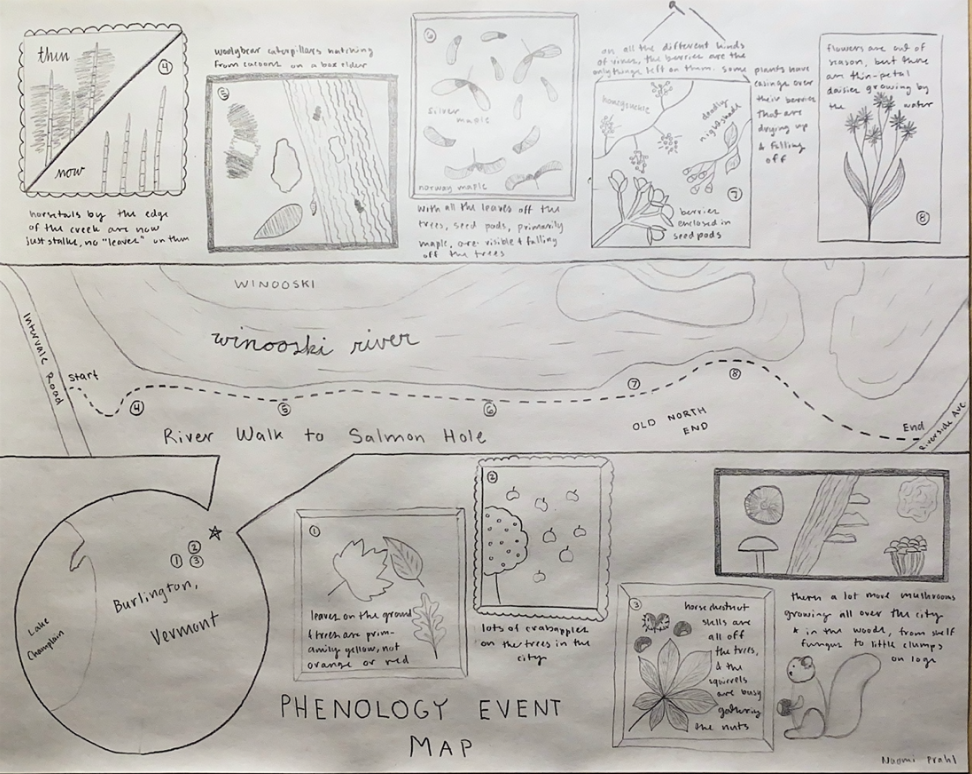
Event Map Of Burlington, Vermont – River Walk to Salmon Hole

For my event map, I tried to go somewhere that I hadn’t explored yet. I did this walk earlier in the year when I had covid, but that was at night so I didn’t run into anyone, so I didn’t make it very far because I could not see 2 feet in front of me in the dark. When Annie and I went back this week, when it was bright and sunny, I could already tell that it was very different from when I went in early September. There were far fewer leaves on the trees, and the vegetation was a lot less dense, so you could see down to the river. We walked along the established Burlington Wildways path along the south edge of the Winooski River, about a .7 mile trail. It ended up being a really nice walk, I think I’m going to keep coming back here to see how much it changes through the coming months.

November 1st, 2021

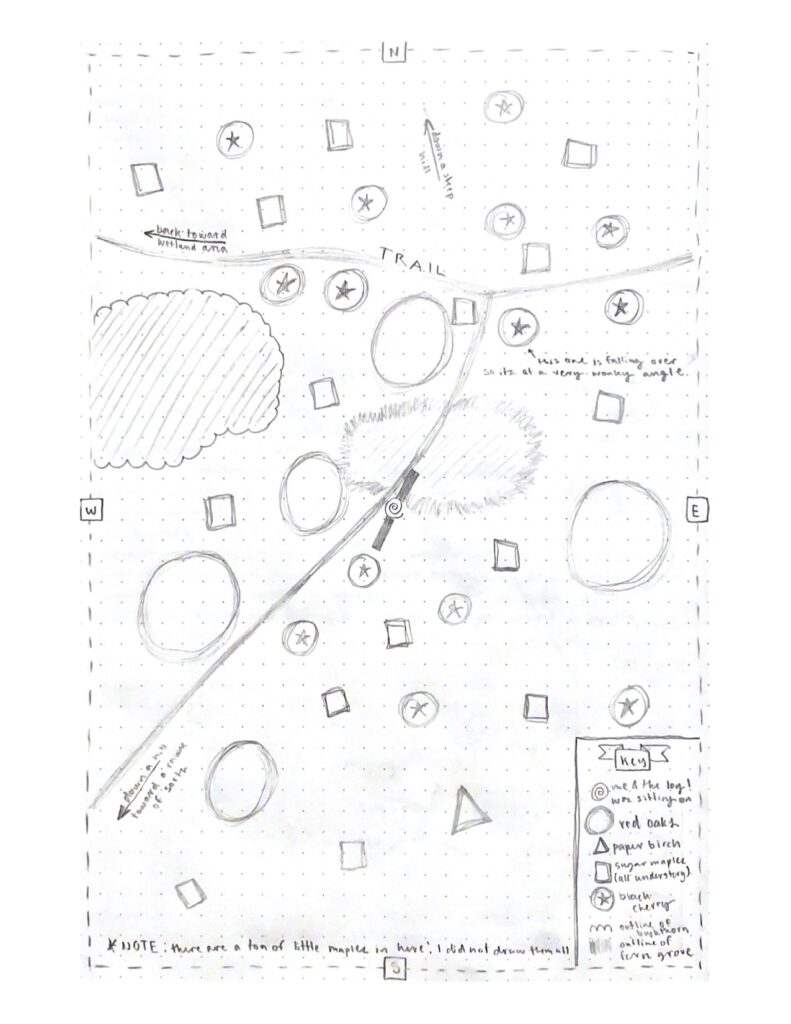
Bird’s Eye View Map

The woods felt perfect today. The colors have shifted from oranges and reds on the ground and yellow in the canopy to yellow leaves on the ground with the occasional spots of red and orange, and yellow leaves falling in the wind. Last time I came to my spot, the highway was the loudest thing I could hear. But the wind drowned it out today. All the trees that were green a few weeks ago are now light or bright yellow, and so many more leaves are on the ground. Theres a blanket of yellow on the forest floor, and the leaves still hanging on to branches make the understory glow golden with filtered sunlight. I don’t know if it’s the added color on the ground or the light, but the ferns seemed much brighter and more unfurled today. Given that ferns are a spring plant, I’m thinking they were soaking in the last bits of sun and warm(ish) air before they die off in the winter. It did make really excited to come back here in the spring and see them in their full glory though, seeing them so vibrant today. All the black cherries have dropped their leaves, but the maples and oaks are still holding on to a lot of their leaves. I also found a lot more acorns on the ground today, which is all fun and games till the wind is knocking them out of the trees at you like grenades. I kept hearing them hit the ground hard behind me. My spot felt a little less closed in today, what with the wind and the canopy much more cleared out. I’m hoping that that means when the snow finally starts falling, it’ll cover the ground completely. It felt good to be able to sit quietly and soak up the last sun of fall, don’t get me wrong, but I’m very excited for winter.

October 17th, 2021

For my spot, I chose somewhere in the Centennial Woods Natural Area. I tried to pick somewhere a little further into the woods that I hadn’t been to before that felt a little less urban, and I found a cool spot up on a sort of ridge. Unfortunately you can still hear the highway, but that’s just sort of the reality of natural areas in a city. To get there, you follow the trail from the main entrance down until you get to the bridges over the creek. Keep walking past the creek, and when you get the the bottom of the hill, turn right and walk up to the top of the hill. There’s a trail that snakes along a little ridge, and when it forks take the fork to the left, toward a dead tree sort of in the middle of the trail. When the trail forks again, take a right and stop before you start going down the hill. Ta-da! You’re there! Exciting, isn’t it? Part of why I chose this place is because it feels both open and closed in at the same time. The trees are pretty tall and spread out, but are mature enough to have mostly closed the canopy, which kept out the rain today and made the light a lovely green-yellow color. The overstory is a mix of black cherry and some type of maple. I am not 100% sure what kind of maple, because the bark was really smooth and grey which I didn’t recognize, I’ll figure it out next time I go.The understory is a few very small maple trees and a lot of ferns blanketing the forest floor. Theres also a ton of trees and large branches that have fallen and are decomposing, which could potentially make for some cool mushrooms and/or some little tree sprouts at some point. There is a trail that runs through the spot down the edge of the ridge it sits on into what I think is either a dry or seasonal stream bed, I’ll have to report back on this later in the year after I do some exploring of the woods as a whole. I’m excited to spend some time here through the semester and to see how it changes with the seasons.