
Introduction
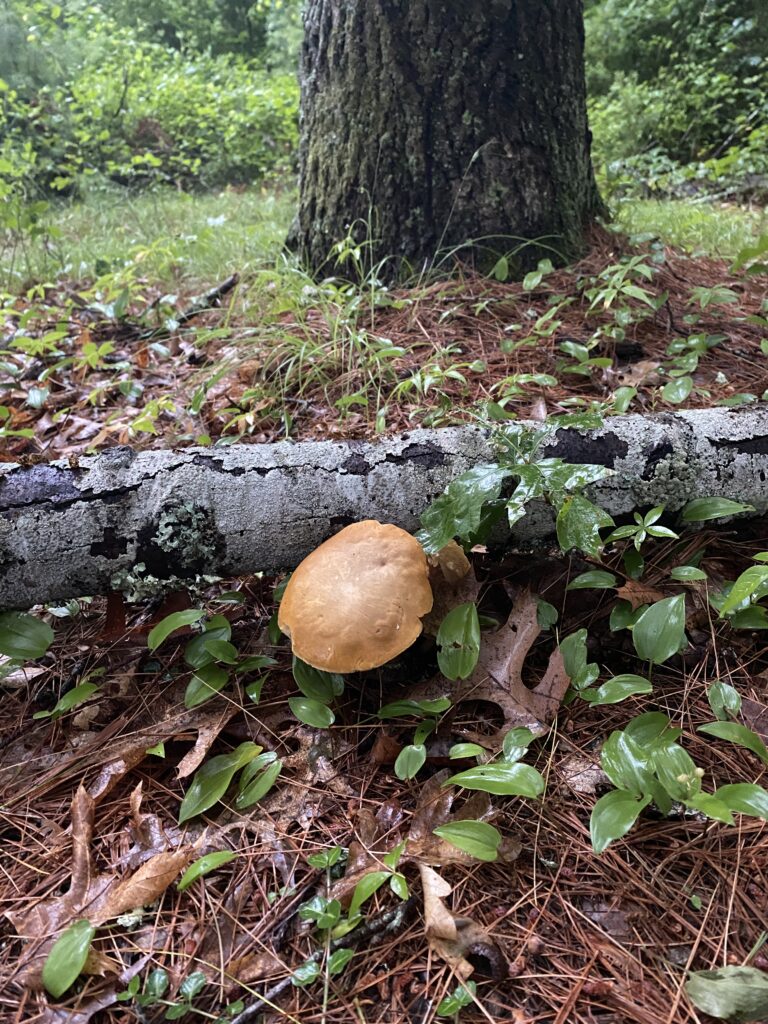
July 1st 2021, the sky is dark white with gray patchy clouds. Rain is drizzling down lightly and a haze covers the reservoir. The over growth around my feet seems to be larger than it was up on my last visit and upon entrance I saw a heron fly from the entrance to the reservoir to deep in the woods behind it. The water is now stiller then when I last visited as the only motion is from the drops of rain making ripples in the water, compared to the flow of water that travelled only threw the center of the reservoir the last time I was here. I wonder why on a rainy day the water would be calmer than a sunny day, I could be from the water level being lowered due to the three days in a row over 90 degrees and the evaporation the heat and sun would cause. The path into the woods even more congested than last time, from just one week of growth. I walked around the clearing in the woods behind the reservoir which seams to be the same as last time. As I walked around I heard more birds and was almost hit by one swooping into the path, a welcomed encounter as I didn’t see any animals last time I was here. As I walked around there were many new mushrooms that had popped out of the ground, these interested me as they are the only visually new thing I noticed. The mushrooms were a golden brown with bright white stems and a spongey like under belly on the cap, there were three one with a deformed cap, a large oval cap, and a small oval cap on top of the brick arch allowing me to look at one at eye level without touching it.
Species Identification
This week I tried to identify a mushroom growing out of the ground, there were a few of this mushroom and all appeared to be the same. I believe that I came across Bolete mushrooms, more commonly known as a Porcini mushroom. I believe that its exact name is Suillus lactifluus, I came to this conclusion after going threw a guide to identifying Bolete mushroom on mushroomexpert.com. This mushroom grows under Eastern White Pines which helps as the mushroom was found growing out of pine needles. I began my search on iNaturalist where I saw a similar mushroom labeled as just a Bolete mushroom and upon further search there are many kinds of these mushroom as Boletales are an order of mushroom. The guide to Botales asked questions about the presence of small pores instead of gills on the bottom, the color of the cap, the features of the stem, the region it was found, the properties of the cap, discolorations due to cutting or touching it, and spore pattern. I was able to come to my conclusion without observing the spore pattern or cutting up the mushroom as I didn’t have a knife with me and I didn’t want to bring a potentially poisonous mushroom home as I didn’t know truly what it was. My guess could be wrong as I didn’t examine it in the lens of a mycologist and looked at the apparent properties that anyone might observe. With further research and the help of the identification guide I was able to make my most educated guess as to this specie, the discerning factors that seamed to help eliminate other mushroom was the lack of vail and lack of noticeable features on the stem. This Mushroom is an edible variant that grows in the summer and has a symbiotic mycorrhizal relationship with pine trees by attaching to the roots in the ground and helping supply them with water and nutrients in exchange for sugars and amino acids from the tree.
Sketches

Conclusion
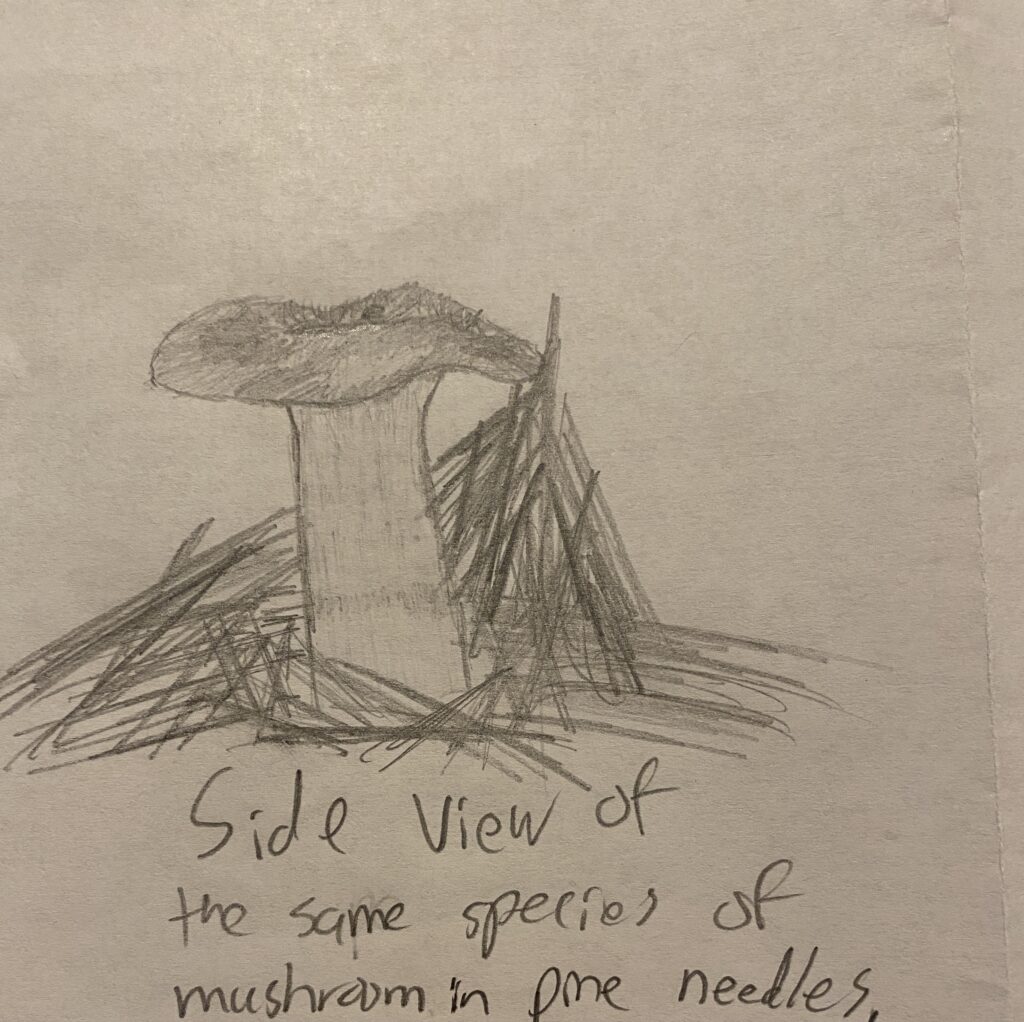
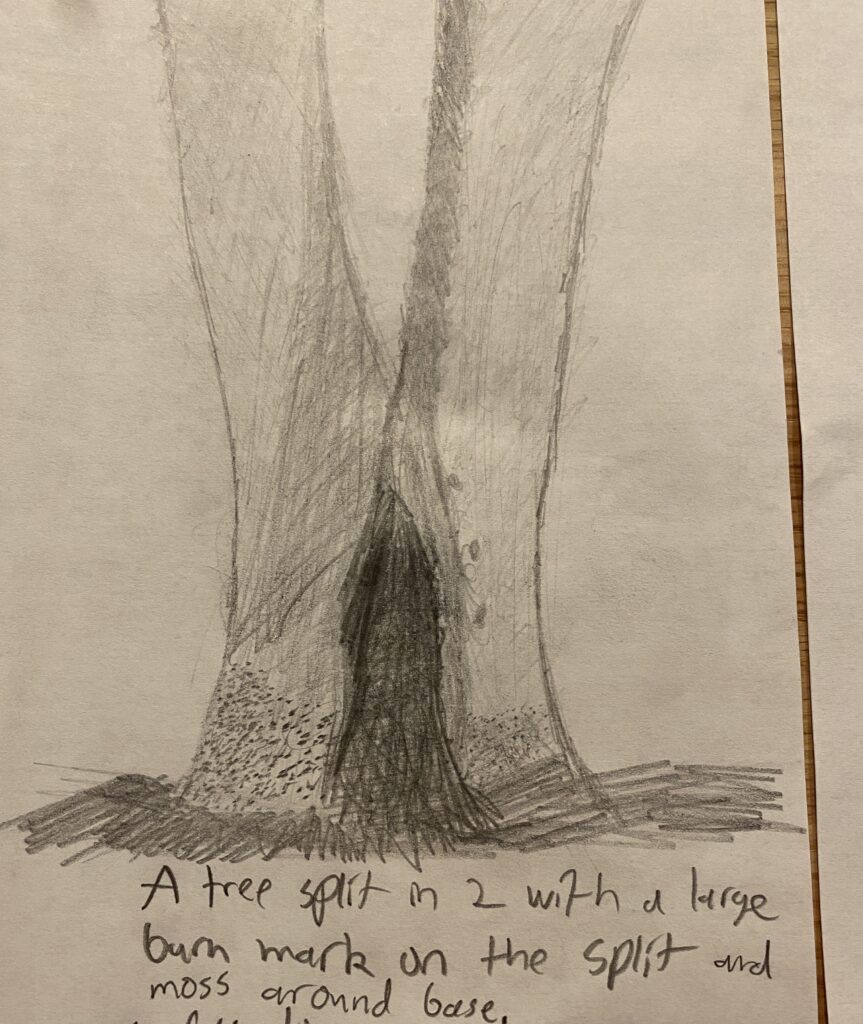
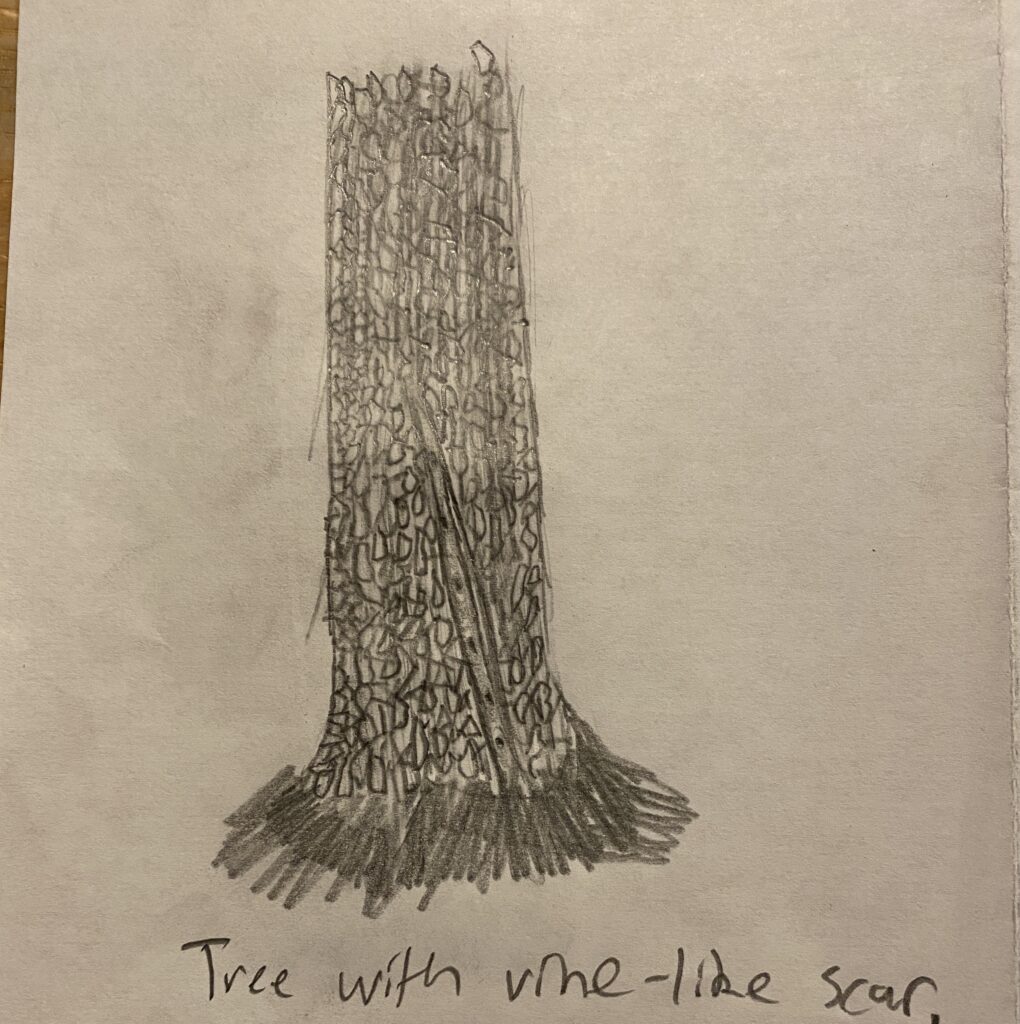
The sketching process was interesting as I had to do it below an umbrella on a clip board because it has been drizzling raining for the last few days. Having to sit on the ground and sketch was quite annoying but when I gave into being wet I was able to sit and draw. Trying to give all the wanted details became challenging when I got to the trees as the two mushrooms are the same color all around, so shades of grey can be used to show different color, but for the trees this was a challenge. The tree with the burn mark had green moss and white lichen on the sides as well as the burned black patch and brown bark making up most of the tree making differentiating the colors quite hard when sketching. The tree with the vine like scar was easier in term of color to sketch as it was mostly just brown bark but the texture of the bark was much more defined making giving it a proper bark patter on the sketch very hard as it was very intricate. I noticed I was more frustrated drawing the individual bark pattern from small odd shapes as it took much more time and attention than shading with lines for changes in color. I feel like I should try to focus on creating texture by using different line patterns and densities then actually trying to draw something close to the pattern piece by piece. Having both nature and my own attention span against me sketching in the woods I think I learned that I have to make the way I sketch more general in the patterns I use as it is both easier and faster. The ability to sketch relatively fast is useful for recording things found outside as it helps you observe the object better and get a useful picture of it for later reference.