
good morning loyal followers of my phenology blog.
This week at the salmon hole I took great care in observing the intricate crystallization patterns of the ice structures at the salmon hole, identifying several different mineral habits. While observing crystalline structures of ice is inarguably very pretty, it also gives one the opportunity to infer as to the formation circumstances of the solid. (which is soooooo cool!)
This deposition type , being a somewhat irregular assemblage of large plates, with few intersecting side planes connecting the multiple parallel layers, is indicative of a relatively warm — relative to the scale over which ice crystals can form, which ranges from approximately 0º to 70ºC — requiring temperatures of about -20ºC. Additionally, the formation of these large sheets, rather than more isolated blades, indicates a slow growth rate.
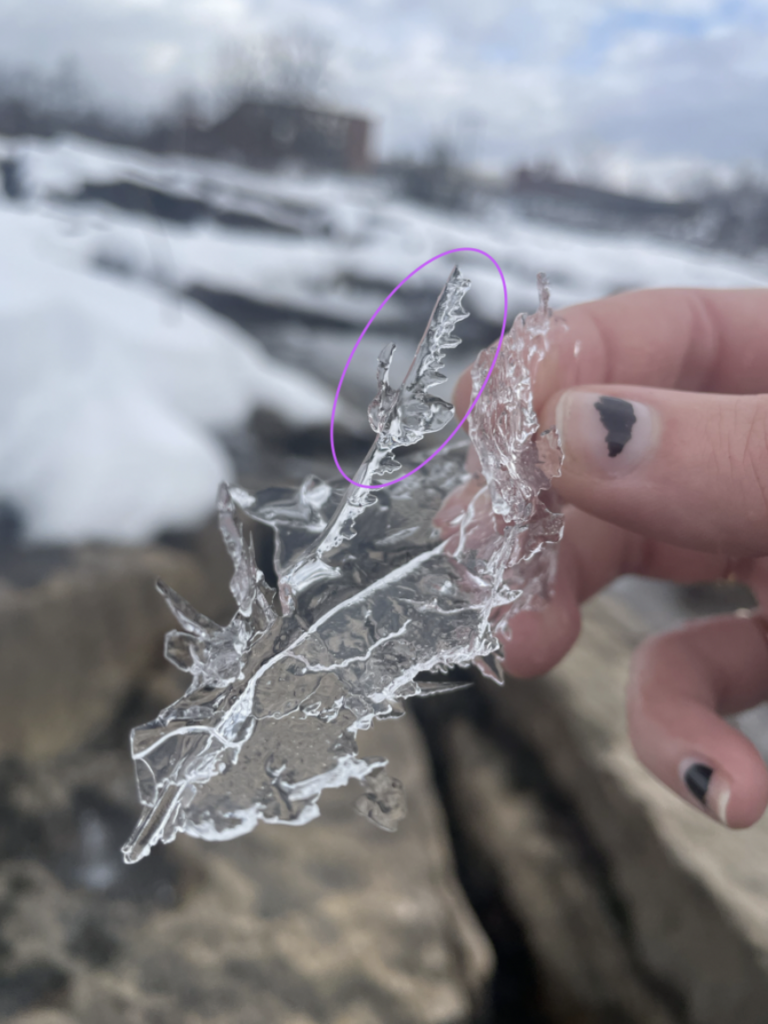
This is a crystal taken from one of the formations perpendicular to the sheets of ice shown in the video above. Rather than being a thin plate, it is blade like, with dendritic mineral formations radiating out from the central shaft. This phenomenon is best illustrated in the section circles in pink, which resembles the growth pattern seen in the arm of a snowflake. As this mass is polycrystalline, meaning is is composed of many crystalline parts which are randomly oriented with respect to one another, the temperature at formation would be colder, at around -30ºC, and the rate of formation much faster than that of the parallel sheets.
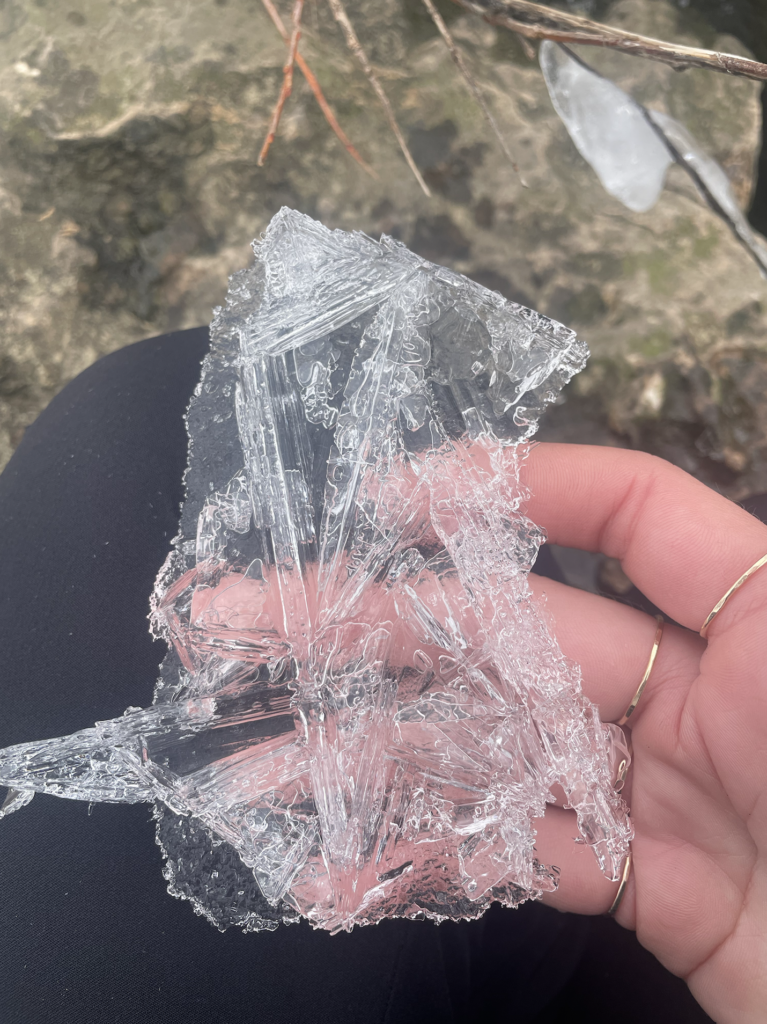
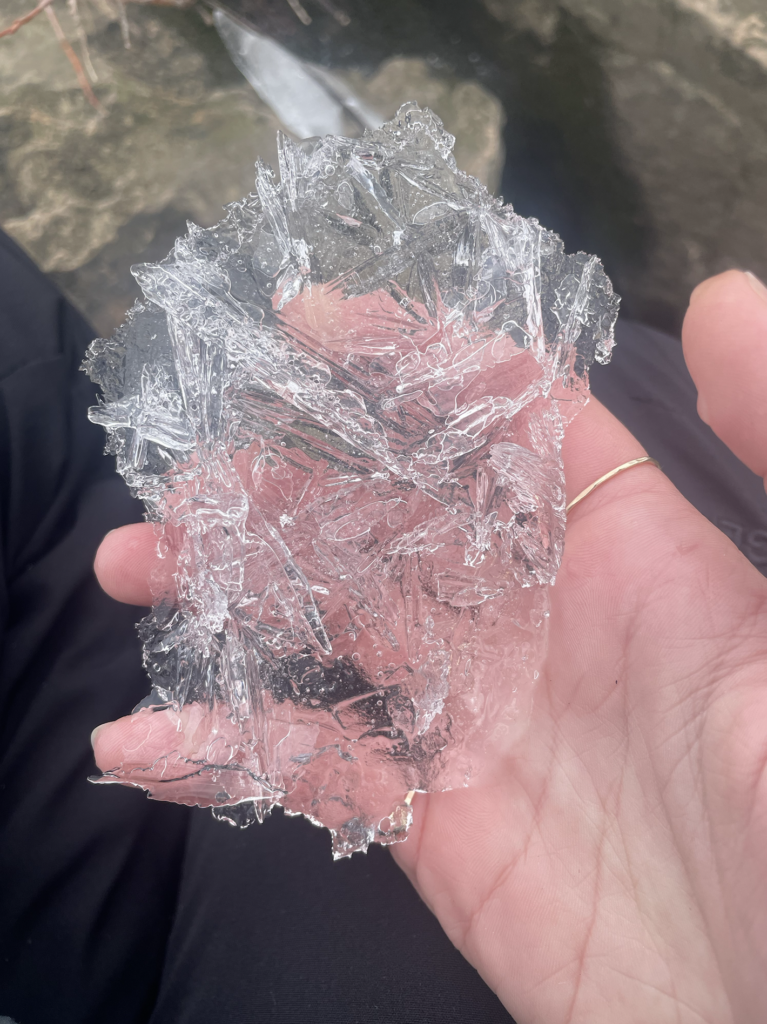
These formations are in sheets, however much thicker than the previous parallel ice sheets discussed. Rather than being made up of one plane, they are comprised of interlocking bladed formations of ice, similar to the dendrites shown above, just across one plane. As they are not polycrystalline, the temperature of formation would be at approximately -25ºC, and the growth rate approximately the same as the second selection.