
For my participation in the BioBlitz this weekend, I decided to go through Centennial Woods and the surrounding area. I was particularly looking for birds, for I was helping my friend identify them for her biology assignment, but I also observed plants and invertebrates.
The plants I observed were staghorn sumac, boxelder, Norway maple, and Eastern white pine. The staghorn sumac was found in patch next to the road by the parking lot leading into Centennial where the sumacs were the dominant plant. The boxelders and Norway maples were both found planted in rows next to this parking lot, implying they were planted there rather than naturally sprouting. Finally, the Eastern white pine was found at the border of the forest (near the aforementioned lot).
The birds I observed, which certainly predominated the number of species I observed, were:
– downy woodpecker
– pileated woodpecker
– American goldfinch
-black-capped chickadee
-white-throated sparrow
-American robin
-song sparrow
Because I observed most of these birds by the feeders, I was able to observe some interspecies dynamics that I otherwise would not have seen. For example, I saw that the white-throated sparrows spent more time at the feeders than a lot of the smaller species, and sometimes physically intimidated other birds to maintain their dominance over the food. Unfortunately, I was not able to photograph any of these birds clearly with my phone, so I was unable to submit them to iNaturalist and the BioBlitz.
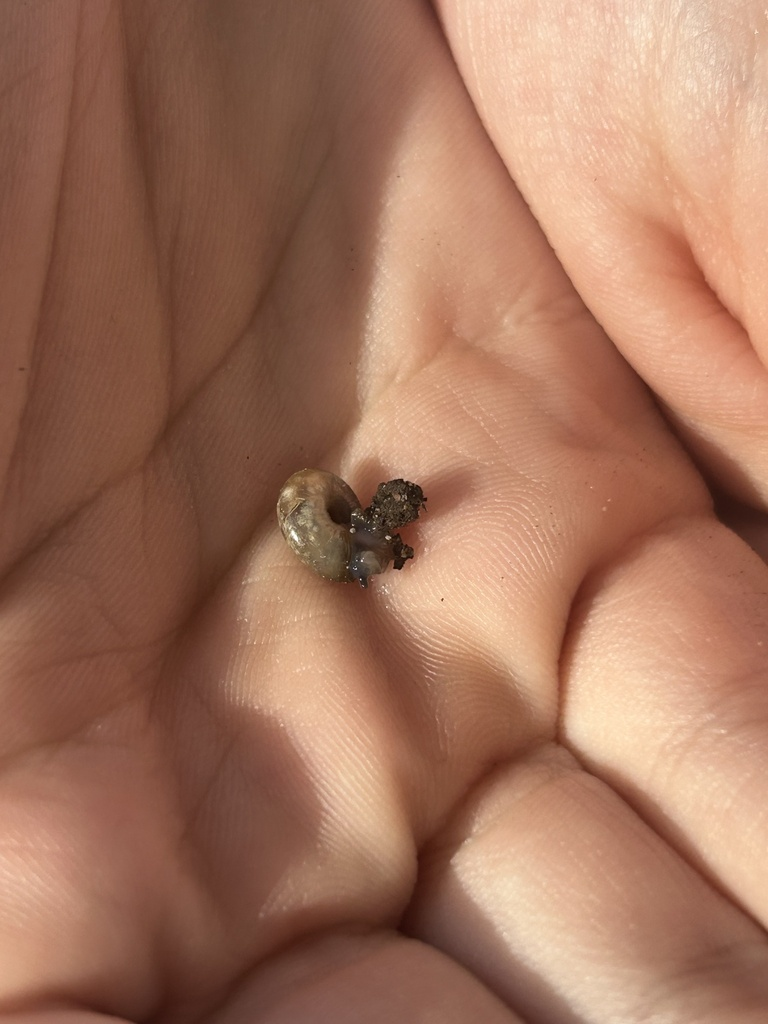
Finally, the only other fauna I observed were a snail belonging to the superfamily Gastrodontoidea, found under a rock, and a bumblebee, which I was unable to photograph. I was unable to confidently identify the snail, for I have not studied snail identification by myself or in my formal education.
Overall, I observed 12 species during my walk for the BioBlitz.
As always, I really enjoyed using iNaturalist because it helps me to identify species by suggesting taxons while allowing me to contribute to citizen science! The former was especially relevant for this weekend, as I was able to contribute to the Greater Burlington Area’s species count for the BioBlitz and improve the documentation of species in my area.
One thing I found interesting about the incoming reports from cities around the world were how the cities dominating the leaderboard were not the most populated, although they are all relatively large. I would have expected cities like New York City, Tokyo, and Los Angeles to dominate the City Nature Challenge simply because they would have more people to make observations. It is possible that urban environments, with a higher ratio of inorganic to organic mater, did not dominate the challenge because there was less wildlife to observe. I wonder, then, why cities like Dallas, San Antonio, and DC performed so well? Is it because these places are especially biodiverse, or perhaps that there is a more prevailing naturalist culture in these locations?